Infinite Memory AI Roleplay: Persistent Characters That Never Forget
2026-09-15
Jenova keeps your roleplay continuous by pairing specialized agents with unlimited chat history and persistent cross-session memory. As of September 2026, most people searching for infinite memory AI roleplay are tired of rebuilding lore, re-explaining nicknames, and watching a character forget a promise made last night. This platform treats memory as infrastructure, not a premium add-on, so stories, language practice, and long-running characters pick up where they left off.
✅ Unlimited conversation history that follows you across sessions ✅ Persistent memory of preferences, plot, and character details ✅ Specialized roleplay agents for language, story, and social simulation ✅ Full continuity on web, iOS, and Android, with synced settings
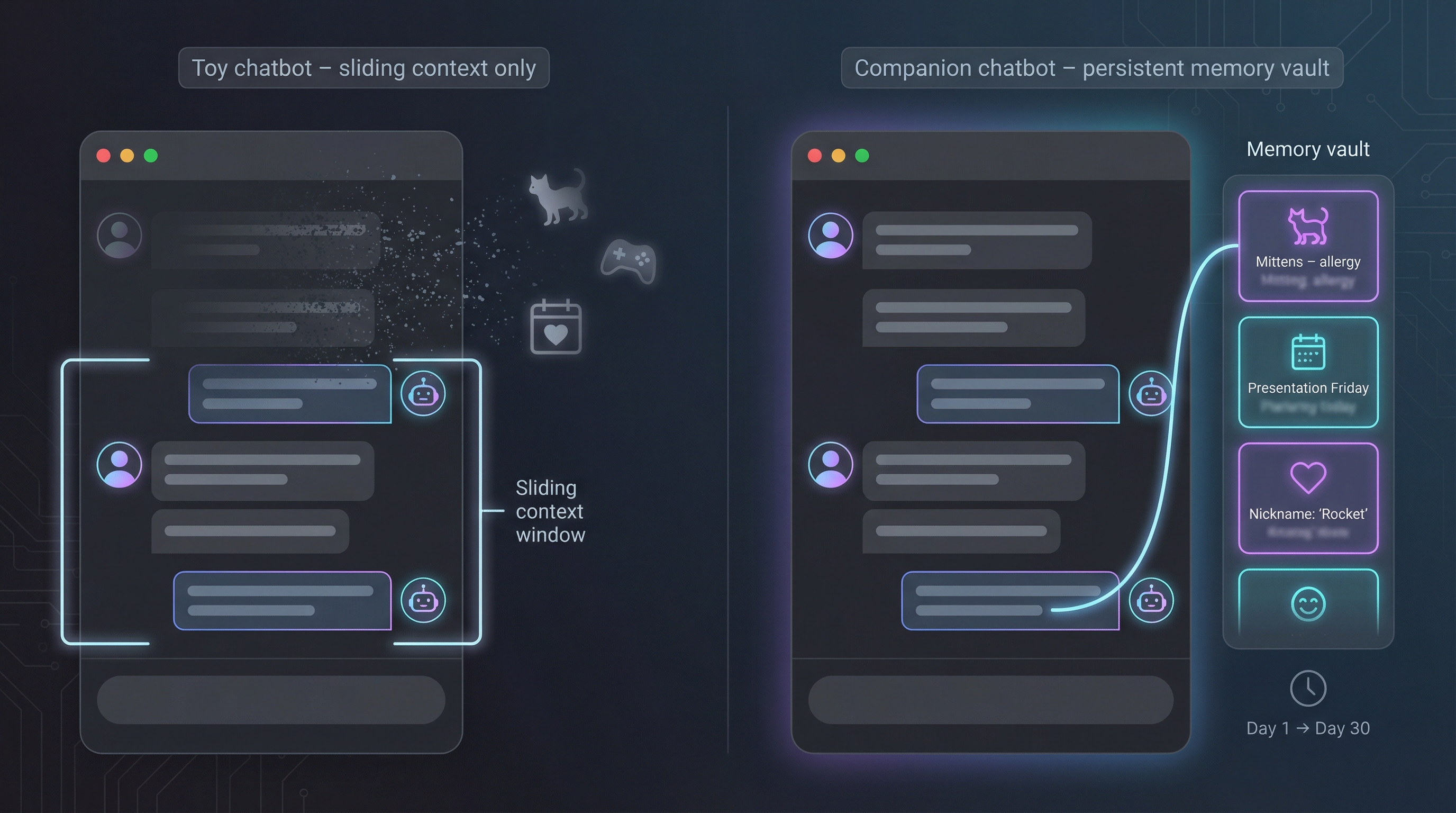
To understand why this matters, it helps to separate a toy chatbot from a companion system. One keeps a sliding window of recent turns and discards the rest. The other stores what actually makes a scene feel lived-in—who you are, what happened, and what the character would never forget.
Quick Answer: What Is Infinite Memory AI Roleplay?
Infinite memory AI roleplay is a persistent storytelling setup that remembers characters, lore, and past sessions so scenes continue without resets. It is not a larger context window. It is memory that survives the close button.
Key capabilities:
- Cross-session recall of plot, relationships, and user preferences
- Character consistency across long sagas, not just the last few messages
- Specialized agents for language immersion, fiction, and social practice
- The same memory on phone and desktop, so a scene can move with you
Why Most AI Roleplay Still Forgets Your Story
Demand for companions and roleplay is no longer a niche hobby. Industry estimates put the global AI companion market at USD 37.73 billion in 2025, with further growth projected from 2026 onward. A narrower slice—the AI roleplay chatbot market, valued around $1.20 billion in 2026—is climbing as users look for characters, not generic chat. Mixed-use platforms that blend writing, role-play, and romance already show unusually high return rates.
£1.3 billion — UK AI companion sector revenue in 2024, with a projected 32% CAGR from 2025 to 2030
16 visits per month — Average return frequency on mixed-use companion and roleplay platforms in the UK
People come back because they want continuity. But accessing that continuity is still frustratingly difficult:
- Sliding context windows drop older turns, so lore evaporates mid-saga
- “Memory” is often sold as extra storage, not treated as a default
- Characters drift in voice, facts, and emotional history after a reset
- General chatbots are not built for long-running roleplay identities
- Sessions on phone and desktop do not always share the same story state
Sliding Context Windows Erase Your Lore
Large language models do not remember you by default. Once training ends, the model carries nothing forward on its own—every new session starts cold unless a product engineers memory around it. That is why a three-hour world-building session can vanish overnight. The model still writes fluent prose. It simply no longer knows that your captain is allergic to citrus, that the city burned in chapter four, or that you asked to be called Rocket.
Research on personal AI systems describes the same gap: attention helps inside a window, but LLM memory still lacks the depth of human long-term recall needed for personalized, multi-session relationships. Roleplay makes that failure obvious. A missed fact is not a minor bug. It breaks the illusion that the character was there.
Memory Gated Behind Emotional Paywalls
When platforms do add recall, they often meter it. The Ada Lovelace Institute’s market scan found that premium tiers frequently sell extra storage so the companion can remember previous conversations. Users who have already invested emotionally are asked to pay a recurring fee to avoid being forgotten.
That design turns a technical cost into a retention lever. It also trains people to accept amnesia as normal. Infinite memory AI roleplay should not mean “the last 8K tokens, unless you upgrade.” It should mean the story is still there tomorrow.
Characters Drift When Sessions Reset
Memory without a stable persona still feels hollow. Companions need more than a transcript. They need episodic traces (what happened), semantic facts (who you are), and a consistent voice that does not reinvent itself every login. When those layers drift apart, you get the uncanny failure mode every roleplayer knows: the character recalls a wedding and forgets the name of the person they married.
Scale makes the problem louder. Character.AI reached about 20 million users in 2026, with 51.84% aged 18–24—a cohort that treats long-running chats as social space, not a demo. If the character cannot hold a week of shared history, the session stops being a relationship and becomes another audition.
One Chatbot Cannot Cover Every Roleplay Mode
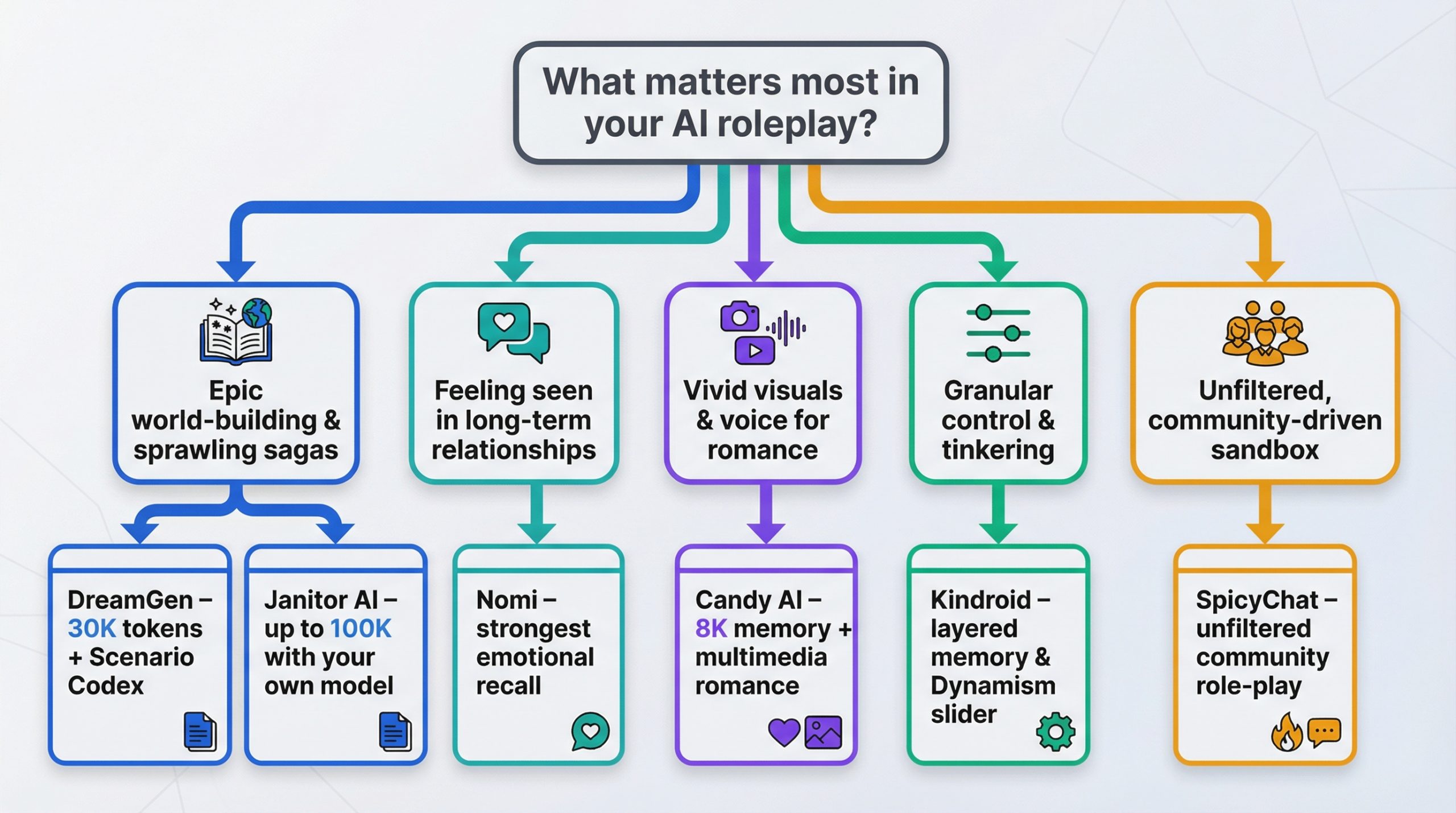
Searchers for infinite memory AI roleplay are not one audience. Some want sprawling sagas. Some want to feel recognized in a long-term dynamic. Some want language immersion that stays in character. Some want interview or stage practice that remembers last week’s weak answers.
A single general chatbot flattens those jobs into the same blank text box. Specialized agents, private knowledge bases, and persistent memory are what let a language mentor, a college-life simulator, and a screenwriter share one platform without sharing one personality.
This is exactly what Jenova was built for.
The Jenova Solution
Jenova does not stretch a generic chatbot and call it a companion. It is an agent platform: you pick (or build) a specialist, and the infrastructure keeps unlimited history, cross-session memory, and document-grounded context attached to that relationship. Multi-model access means you are not locked to one vendor’s personality. Persistent memory means you are not locked to one sitting.
| Traditional Approach | Jenova |
|---|---|
| Sliding context window; older lore drops out | Unlimited chat history plus persistent cross-session memory |
| Re-explain the character every new chat | Agents remember preferences, past scenes, and long-running projects |
| One general chatbot for every genre | Specialized roleplay, language, story, and practice agents |
| Memory sold as extra storage | Continuity treated as a core capability, including on mobile |
| Chat logs used to train public models on many companion apps | Data is not used to train public AI models |
That last row is not a minor privacy footnote. In the UK companion scan, 14 of 16 platforms claimed broad rights to use user-generated content—including private chat logs—for service improvement or model training. Roleplay memory only works if you can trust what happens to the memories.
Language Immersion That Remembers Every Arc
Language roleplay fails when the tutor forgets your level, your running gag, or the story you have been living in for two weeks. Learn English Through Roleplay keeps idioms and grammar inside scenes that actually continue. Learn Spanish Through Roleplay and Learn Korean Through Roleplay work the same way: vocabulary sticks because the moment is still part of an unfinished story, not a disposable drill.
Learn Russian Through Roleplay is built for the exact failure mode this keyword describes—unlimited scenarios, memory that does not flush, and character consistency that makes the next session feel like the next chapter.
Story Worlds That Do Not Reset
If your “roleplay” is actually a novel, a manga, or a game bible, amnesia is fatal. Film Screenwriter can hold structure, dialogue, and character arcs across drafts instead of rediscovering the protagonist every sitting. Manga Creator is built for serialized epics, where panel flow and visual continuity only work if yesterday’s choices still exist. Game Designer Assistant keeps systems, lore, and genre constraints attached to the project rather than trapped in a forgotten thread.
Attach a lore document or series bible as a knowledge base and the agent is no longer guessing. It is retrieving.
Social Simulation and Practice That Compound
Not every roleplay is fiction. College Life is an open-world social sim where friendships and fallout emerge from your choices—worthless if the campus resets every night. Interview Coach and Public Speaking Coach use roleplay as rehearsal: mock interviews, hostile Q&A, audience simulation. Those sessions get better only if the coach remembers which story you ramble through and which pause you keep missing.
Personal Therapist is a different kind of continuity—empathetic support that can reference prior check-ins rather than starting from zero. It is not a substitute for licensed care. It is a memory-aware partner for people who otherwise have to re-tell their week from scratch.
Specialized AI Agents for Infinite Memory Roleplay
Different roleplayers optimize for different things: sprawling sagas, feeling recognized over months, multimedia romance, deep tinkering, or unfiltered sandboxes. The map below is a useful way to name those priorities. On this platform, the through-line is not a single fetishized feature. It is persistent memory plus an agent that actually matches the job.
Learn Japanese Through Roleplay
Learn Japanese Through Roleplay is for people who want grammar to live inside a story they refuse to abandon. You can run any theme, keep a consistent mentor voice, and return days later without re-teaching the agent who you are.
- Immersive scenarios instead of isolated vocab lists
- Continuity across sessions so honorifics, running jokes, and plot stay intact
- Practice that scales from café small talk to long-form narrative
If you are also drafting the visual version of that story, Manga Creator can take the same continuity into panels and series structure.
College Life
College Life is the closest analog to “I want a world that reacts.” Friendships, heartbreak, and campus politics unfold from choices, which only matters if the sim remembers what you did on Monday.
- Emergent social dynamics rather than scripted one-off scenes
- Character relationships that accumulate consequences
- A sandbox you can continue on mobile between classes
Learn Russian Through Roleplay
The Russian mentor is the blunt statement of the product promise: unlimited scenarios, memory that does not flush, and characters who stay themselves. That is infinite memory AI roleplay applied to language, not bolted on as a slogan.
- Long-running character consistency
- Emotionally specific scenes that double as grammar practice
- A relationship with the mentor that compounds instead of resetting
Film Screenwriter
Film Screenwriter treats roleplay as rehearsal for dramatic writing—voices, blocking, and arc—then keeps the draft alive across revisions. You are not chatting with a blank page. You are continuing a production.
- Structure, dialogue, and character development in one persistent thread
- Outline-to-draft continuity instead of lost notes
- A partner that can stay inside a character’s voice for the whole feature
Interview Coach
Interview Coach is roleplay with a scoreboard. Behavioral, case, technical, and executive mocks only improve if the coach remembers your tells.
- Repeatable mock interviews that reference prior answers
- Honest feedback instead of empty praise
- A practice loop you can run the night before, on your phone
Try Jenova free — no credit card required.
How Infinite Memory AI Roleplay Works
Step 1: Choose the Agent That Matches the Scene Open the gallery and pick a specialist instead of a blank chatbot. Language immersion, campus simulation, screenwriting, and interview practice are different jobs. Starting with the right agent means the memory you build is attached to a persona that already knows the craft.
"I want a slow-burn mystery set in Osaka. Keep my Japanese at N3, correct me in character, and remember that my detective hates hospitals."
Step 2: Establish Canon in the First Session State names, tone, boundaries, and facts you never want forgotten. The more specific the opening, the more useful the memory vault becomes. You can also attach a lore doc, series bible, or résumé so retrieval is grounded in your material rather than improvised.
"Here is the house style: second person, no inner monologue from NPCs, and the city always smells like rain. If I contradict canon, stop me."
Step 3: Leave and Come Back Without a Recap Close the chat. Open it tomorrow. Ask what happened last time, or simply continue. Persistent cross-session memory and unlimited history are the difference between a companion and a sliding window. You should not have to paste a synopsis into the box to make the character competent.
"Continue from the rooftop argument. Do not summarize. She would not apologize first."
Step 4: Move the Same Thread to Your Phone Web, iOS, and Android share feature parity and synced settings. A scene started at a desk can continue on the train. That is not a convenience feature. For roleplay, it is how a relationship stays daily instead of becoming a weekend hobby.
"I’m on mobile. Keep replies shorter, stay in voice, and remember I’m in the library—no loud action."
Step 5: Extend the World With Another Agent When the Job Changes When language practice turns into a screenplay, or a campus sim sparks a webtoon, bring in a second specialist rather than stretching one persona past its job. The platform is built for that handoff. Custom agents are available if your original character needs its own instructions, model, and private knowledge base.
Results & Use Cases
📊 A Language Saga That Survives the Weekend
- Scenario: You are learning Japanese through a noir story. Friday’s scene ended mid-interrogation. Monday, you have twelve minutes before work.
- Traditional Approach: Re-explain the case, your level, and the character’s speech style. Half the session is lost to recap. Anki cards never see the plot.
- Learn Japanese Through Roleplay: The interrogation is still in progress. Corrections stay in character. Vocabulary is anchored to a moment you actually care about.
- Continuity without a pasted synopsis
- Tone and difficulty that match your established level
- Practice you can resume on a phone commute
🎬 A Feature Film That Does Not Lose Act Two
- Scenario: You have a 110-page crime story. The midpoint twist depends on a throwaway line in scene 12.
- Traditional Approach: Chat logs scatter across untitled threads. The model invents a new backstory for the detective because it never saw scene 12.
- Film Screenwriter: The draft, the voice, and the constraint list stay attached to the project. You ask for a rewrite of the diner scene and the twist still lands.
- Character bibles that persist across revisions
- Structure notes that survive more than one sitting
- A writing partner that can stay inside one film for months
💼 Interview Roleplay That Remembers Your Weak Answers
- Scenario: You bombed the “tell me about a conflict” question last Thursday. The real panel is Friday.
- Traditional Approach: A generic chatbot generates a new STAR story every time. You never pressure-test the same answer twice.
- Interview Coach: The coach remembers the rambling version, interrupts at the same weak beat, and makes you tighten it until it holds.
- Repeatable mocks instead of random questions
- Feedback tied to your actual prior performance
- A rehearsal loop that compounds daily
📱 Campus Sim on the Train Home
- Scenario: You made a messy choice in a dining-hall scene at lunch. You want the fallout tonight, standing on a crowded commute.
- Traditional Approach: Desktop-only threads, forgotten NPCs, and a reset that turns consequences into fan fiction.
- College Life: The same world is on your phone. People remember. The next scene is shorter, but it is still the next scene.
- Mobile-length replies without dropping canon
- Relationships that accumulate rather than loop
- A sandbox you can actually live in between stops
FAQ
What is infinite memory AI roleplay?
Infinite memory AI roleplay is a persistent character or story setup that retains lore, preferences, and past sessions instead of relying on a sliding context window. The practical test is simple: can you close the app, return days later, and continue without a recap? On Jenova, unlimited chat history and cross-session memory are built into the agents, so language sagas, campus sims, and long drafts can survive more than one sitting.
Is infinite memory AI roleplay free?
Yes. There is a free tier with all core features and limited monthly usage. Paid plans increase usage—from Plus at $20/month through higher tiers—if you run long, daily sessions. You do not need a credit card to start, and usage resets on your billing date rather than behind daily caps. Memory is not positioned as a separate “don’t forget me” upsell.
How is this different from Character.AI or a general chatbot?
General chatbots optimize for a single reply. Many companion apps optimize for engagement, then meter memory as premium storage. This platform specializes the other direction: pick an agent with a job (language, story, interview, campus life), keep history attached to that job, and optionally ground it in your own documents. You also get multi-model access and the option to build a custom agent when an original character needs its own instructions.
Does infinite memory AI roleplay work on mobile?
Yes. Web, iOS, and Android have full feature parity, including speech-to-text and synced settings. That matters more for roleplay than for one-off Q&A, because continuity is a daily habit. A scene from Learn English Through Roleplay can start at a desk and finish on a phone without cloning the character into a new thread.
Can I build my own infinite memory roleplay agent?
Yes. Custom agents take your instructions, preferred model provider, private knowledge base, and tool configuration. That is the path for original-character sagas, house style, and private lore bibles. The platform handles orchestration and memory; you define who the character is and what they are allowed to forget.
Is my roleplay private?
Roleplay memory is sensitive by nature—names, fears, drafts, and relationship details. Jenova does not use your data to train public AI models, encrypts data in transit and at rest, and does not sell it to advertisers. That stands in contrast to companion apps whose policies claim broad rights over chat logs. You should still avoid pasting information you would not want stored in any cloud product.
Infinite Memory AI Roleplay That Stays With the Story
The market is full of chat boxes. It is still short on characters who remember. Sliding windows, metered storage, and one-size-fits-all bots are why so many sagas die between Friday and Monday. Infinite memory AI roleplay is the opposite design: persistent history, a specialist that stays in voice, and the same thread on the device in your pocket.
If you want language that lives inside a plot, start with Learn English Through Roleplay or Learn Japanese Through Roleplay. If you want a world that reacts, open College Life. If the roleplay is a script, stay with Film Screenwriter. Then keep going—without the recap.
Explore the full agent library at Jenova.
For Developers: Every agent in this article is available programmatically via the Jenova API — build persistent, memory-aware roleplay into your application with a single integration. Full documentation →