Image Roleplay AI: Visual Character Chat With Perfect Memory
2026-08-26
Roleplay Game Master helps you live inside visual character stories that remember every choice, secret, and relationship you build. While typical chatbots drop plot threads and slip out of character, this image roleplay AI holds a consistent persona across unlimited sessions—so last week’s detective still knows the case file, and a crewmate still owes you a favor.
As of August 2026, illustrated character chat has moved from a niche hobby into everyday entertainment. People want stories they can see, characters who stay in role, and campaigns that do not reset when they close the tab.
- ✅ Unlimited conversation memory that never wipes a campaign mid-arc
- ✅ Character consistency across any genre, tone, or intensity
- ✅ Visual character cards and illustrated scenarios you can start in one tap
- ✅ Full experience on web, iOS, and Android, including voice input
To understand why this matters, it helps to look at why most image roleplay AI sessions fall apart after a few scenes—and what a memory-first character engine actually changes.
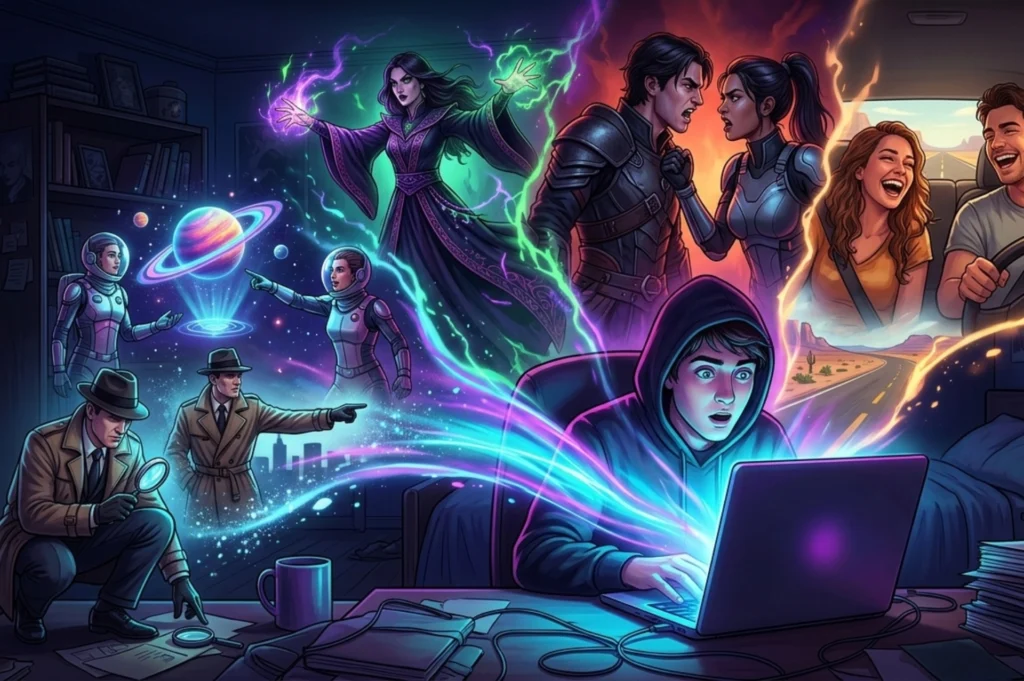
Quick Answer: What Is Image Roleplay AI?
Roleplay Game Master is an image roleplay AI that turns visual characters into living, memory-rich stories you can continue across sessions without breaking character. You pick a scene, speak in-world, and the persona holds.
Key capabilities:
- Visual character selection with illustrated scenario cards you can start instantly
- Unlimited memory so plot, relationships, and inventory survive every session
- Perfect character consistency—no sudden out-of-character coaching voice
- Complete creative freedom across fantasy, sci-fi, noir, slice-of-life, and original worlds
Why Most Image Roleplay AI Sessions Fall Apart
Demand for interactive stories is no longer theoretical. The [**interactive fiction market was valued at $6.4 billion in 2025**](https://dataintelo.com/report/interactive-fiction-market) and is projected to reach $14.8 billion by 2034. Adjacent interactive storytelling platforms reached $4.8 billion in 2025. People are paying, with time and money, for narratives they can inhabit.
Character chat is following the same curve. AI companion apps surged 700% between 2022 and mid-2025, and Character.AI alone has been reported at 20 million monthly users. Roughly two-thirds of U.S. teens (64%) now use AI chatbots, including about three in ten who do so daily. The appetite for talking to a character—not a generic assistant—is already mainstream.
But getting a satisfying image roleplay AI experience is still frustratingly difficult:
- Characters forget names, injuries, promises, and the last cliffhanger
- Visual identity and conversation tone do not match
- The model breaks character to “helpfully” summarize or moralize
- Long campaigns cannot be resumed without re-explaining the bible
$6.4 billion — Interactive fiction market value in 2025
The immersive content creation market was already $15.7 billion in 2024**](https://www.grandviewresearch.com/industry-analysis/immersive-content-creation-market-report), and the [**digital storytelling market was valued at $10 billion the same year. Readers and players want worlds with pictures, continuity, and stakes. Most general-purpose chat windows were not built for that. They were built to answer questions, not to stay a tired detective in 1947 rain while you walk in with a case that should not exist.
This is exactly what Roleplay Game Master was built for.
Why Roleplay Game Master
Roleplay Game Master is a dedicated image roleplay AI—not a general chatbot wearing a costume. You choose a visual character or describe one, set the scene, and play. The engine keeps persona, memory, and tone locked so the story can run for hours, days, or a serialized campaign.
The difference shows up immediately when you compare a typical chat session to a memory-first character engine:
| Traditional Approach | Roleplay Game Master |
|---|---|
| Plot resets when the context window fills | Unlimited memory across every session |
| Persona slips into “helpful assistant” voice | Perfect character consistency |
| Plain text with no visual identity | Visual character cards and illustrated scenarios |
| One-off scenes you cannot resume | Long-running campaigns you pick up mid-arc |
| You re-explain the world every time | The character already knows the last cliffhanger |
Visual characters you can actually talk to
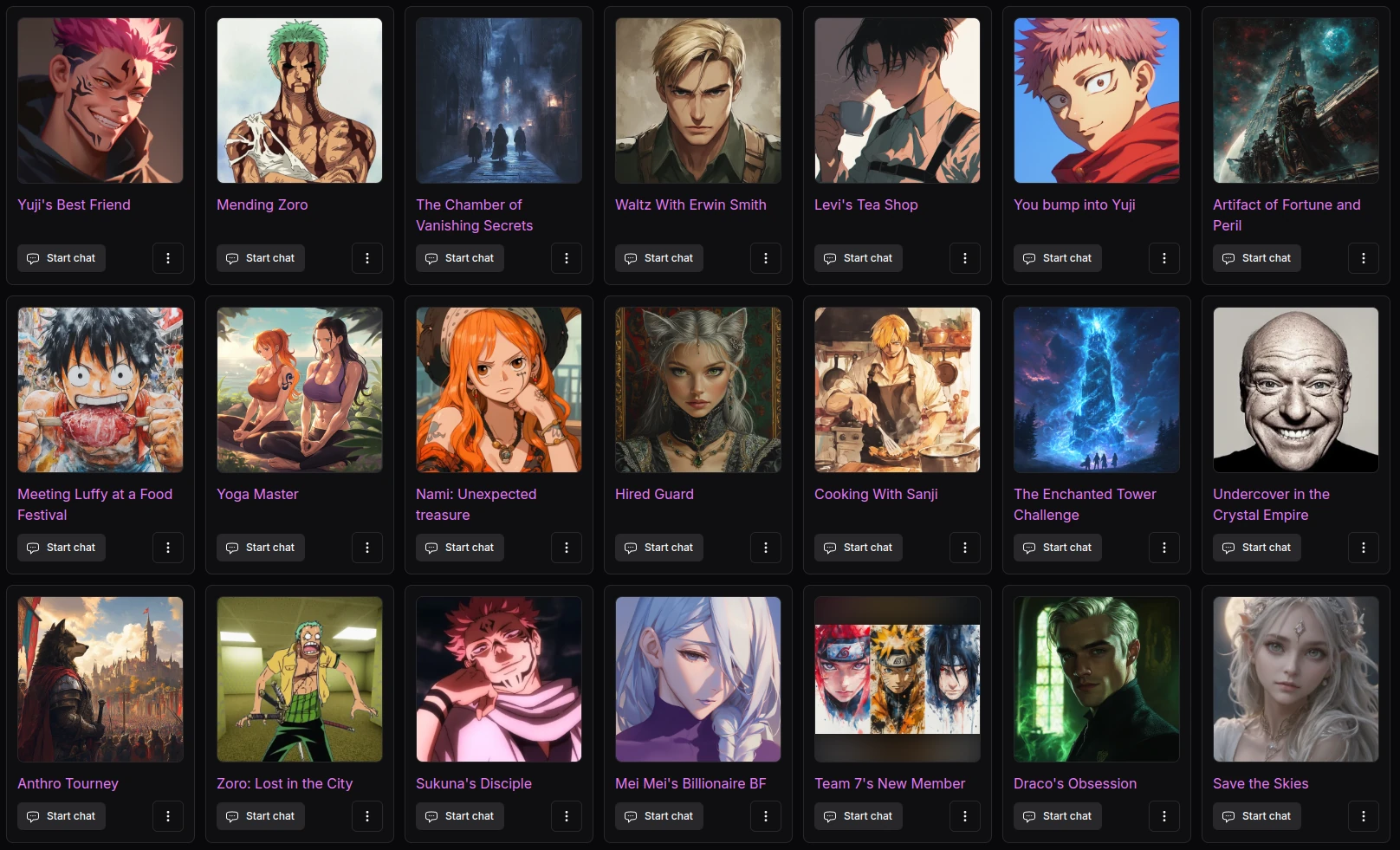
Image roleplay AI only works when the face, the setting, and the voice agree. A gallery of illustrated scenarios—anime kitchens, foggy chambers, road-trip frames, knight duels—lets you start from a picture instead of a blank prompt. You tap a card, speak in-world, and the reply arrives in that character’s diction, not a generic narrator’s.
Memory that treats your campaign like canon
Testing a long session reveals the usual failure mode: the sword the hero lost in scene two is back on their belt in scene five. Unlimited conversation memory changes that. Relationships, injuries, inventory, and private jokes persist. You can close the phone on a commute and reopen the same thread at night without recapping the bible.
Creative freedom without a tone police
Complete creative freedom means any genre and any intensity—noir, high fantasy, slow-burn slice of life, space salvage, original worlds. The job of this AI is to stay in the scene you asked for, not to flatten it into a safe summary.
Try prompts like these:
"You are a tired detective in 1947 Los Angeles. Rain on the windows. I just walked into your office with a case that should not exist. Stay in character."
"I'm a new crew member on a deep-space salvage ship. The captain is hiding something about the last wreck. Do not break immersion."
"Continue from last session: the sorceress still has my brother's pendant, and she does not know I saw her talking to the tower."
Related Agents You'll Also Find Useful
If you are already living in illustrated scenes, the next step is often to capture, translate, or publish them. These agents sit in the same workflow.
Manga Creator
If a roleplay session keeps producing panels in your head, Manga Creator turns those beats into sequential art. You bring the character bible and the cliffhangers; it handles panel flow, visual storytelling, and a consistent art style from one-shots to long serials.
- Visual storytelling and panel rhythm built for manga pacing
- Style consistency across dozens or hundreds of pages
- A direct path from chat scenes to something you can share
Comic Creator
Prefer Western sequential art? Comic Creator is the partner for dynamic layouts, issue structure, and graphic-novel scale. Use it when a noir roleplay or superhero campaign wants splash pages instead of chat logs.
- Sequential art and layout control from single issues to sagas
- Bold visual styles that match the tone of your campaign
- A clean handoff from in-character dialogue to scripted pages
Learn Japanese Through Roleplay
Many image roleplay AI galleries lean on anime-inspired worlds. Learn Japanese Through Roleplay keeps you inside those scenes while vocabulary and grammar attach to moments you will actually remember—order food, argue with a crewmate, or negotiate with a shrine spirit, in Japanese.
- Fully immersive scenarios with no theme ceiling
- Vocabulary and grammar anchored to lived scenes, not flashcards
- Character consistency so the language stays in-world
Film Screenwriter
When a campaign starts to look like a movie, Film Screenwriter helps you outline, draft, and revise. Dialogue you already improvised in roleplay becomes scene work with structure, character development, and visual storytelling craft.
- Concept through outline, draft, and revision
- Dialogue and character work grounded in scenes you already played
- Professional screenplay craft without leaving the story world
Try Roleplay Game Master free — no credit card required.
How Image Roleplay AI Works
Step 1: Choose a visual character or open a blank scene
Start from an illustrated card—a cook in a chaotic kitchen, a knight under a storm, a detective with a magnifying glass—or describe an original persona. The picture sets tone before you type a word, which is the whole point of image roleplay AI.
"Start as the hired guard at the manor gate. You have already decided you do not trust the new guest. I am that guest."
Step 2: Set stakes in one message
Give the engine a time, a place, and a problem. Specific beats outperform vague “let’s roleplay.” Name the injury, the secret, or the object that must not be lost.
"It is midnight in the Chamber of Vanishing Secrets. My lantern is dying. You are the only person who has walked out of this room twice."
Step 3: Play in character—and stay there
Reply as yourself, as a player character, or in third person. This image roleplay AI answers as the persona, not as a tutor. If you want a rules check or a recap, ask for it in a separate beat; the default is immersion.
"I put the pendant on the table and wait. Do not summarize. Just react."
Step 4: Leave and come back without a recap
Unlimited memory is the feature you feel on day three. Reopen the thread. The character still knows who betrayed whom. That is how a chat becomes a campaign instead of a disposable scene.
"Continue last night's session. I still have the map. You still think I stole the ring. Do not reset."
Step 5: Export the story into another craft
When a session produces a set piece worth keeping, hand the beats to Manga Creator or Film Screenwriter. Image roleplay AI is the rehearsal room; those tools are the production studio.
Results & Use Cases
📊 A serialized fantasy campaign that actually continues
Scenario: You and a sorceress have been circling the same tower for two weeks. She still has your brother’s pendant. She still does not know you overheard the last conversation.
Traditional Approach: Re-paste a three-page recap every session. Watch the pendant vanish from continuity. Lose the slow-burn distrust that made the story worth returning to.
Roleplay Game Master: You type “continue.” The pendant is still hers. The overheard line is still live. The campaign behaves like canon.
- No recap tax between sessions
- Relationship memory that compounds instead of resetting
- Room for secrets the character should not suddenly confess
💼 Turning anime-style hangouts into pages you can publish
Scenario: A food-festival scene with a loud captain, a lost swordsman, and a cook who takes pride as a combat skill. The chat is funny. You want pages, not a screenshot dump.
Traditional Approach: Copy logs into a doc, rewrite them as panel descriptions, and fight style drift across twenty pages.
Manga Creator and Comic Creator: The roleplay session is the animatic. You keep the jokes and blocking, then build panel flow and a consistent look for a one-shot or a serial.
- Dialogue already stress-tested in character
- Visual storytelling tools matched to manga or comic grammar
- A path from image roleplay AI chat to a finished chapter
📱 Commute-length scenes on your phone
Scenario: Twenty-five minutes on a train. You want a noir beat, not an email draft. Thumbs on a phone, maybe voice-to-text because the carriage is crowded.
Traditional Approach: Desktop-only tools, lost threads, and a character who does not remember yesterday’s alley.
Roleplay Game Master: Same campaign on iOS or Android, speech-to-text if you need it, memory intact when you surface for your stop.
- Full feature parity with the web experience
- Short sessions that still belong to a long story
- Voice input when typing on a moving train is a bad idea
🎯 Language practice inside the world you already love
Scenario: You are already talking to a shrine spirit or a Tokyo kitchen crew. You want the Japanese to live in that scene, not on a separate flashcard app.
Traditional Approach: Grammar drills in the morning, English roleplay at night, nothing connecting the two.
Learn Japanese Through Roleplay: Same immersive logic, different language. Order, argue, apologize, and bargain in-world until the phrases stick to the moment.
- Vocabulary tied to scenes you care about
- Speech levels and cultural nuance inside the fiction
- No need to drop character to “study”
Frequently Asked Questions
What is image roleplay AI?
Image roleplay AI is character chat built around visual personas and illustrated scenes, not a blank text box. You start from a picture or a described look, then speak in-world. Roleplay Game Master adds unlimited memory and strict persona consistency so the character you see is the character who answers—across a single scene or a months-long campaign.
Is Roleplay Game Master free?
Yes. A free plan includes core roleplay features with a monthly usage cap. Paid plans start at $20/month for Plus and scale through Premium, Pro, Max, Ultra, and Enterprise if you run longer campaigns or want higher limits. Usage resets on your billing date, with the full allowance available from day one rather than a daily drip.
How is this image roleplay AI different from a general chatbot?
A general assistant is trained to be helpful, concise, and willing to break character. A dedicated roleplay engine is trained to stay in the scene. Unlimited memory, visual character cards, and perfect persona consistency are the product—not optional extras you prompt around. You are not fighting the model to stop summarizing your own story.
Does image roleplay AI work on mobile?
Yes. The same campaigns run on web, iOS, and Android with feature parity, including speech-to-text. Start a scene on a laptop, continue it on a phone, and the character still knows the last cliffhanger. Settings sync, so you are not maintaining two versions of the same world.
Can I create my own visual characters?
You can start any original persona, set instructions, and play any scenario at any intensity. Illustrated scenario cards are there when you want a one-tap start; a blank scene is there when you want a world nobody else has seen. Complete creative freedom is the default, not a premium toggle.
Will the character remember previous sessions?
That is the point of unlimited conversation memory. Names, injuries, debts, and private jokes persist until you decide they should not. If you want a hard reset, start a new thread. If you want canon, reopen the same one and type “continue.”
Start the Scene You Keep Thinking About
Most image roleplay AI disappoints for a boring reason: the picture promised a person, and the chat delivered a forgetful assistant. Roleplay Game Master is built the other way around—visual characters, unlimited memory, and a persona that does not flinch out of role when the plot gets complicated.
Pick a card. Set a stake. Come back tomorrow. The detective will still have the file.
Explore more at Jenova.
For Developers: Roleplay Game Master is available programmatically via the Jenova API — integrate immersive visual character roleplay into your application with a single API call. Full documentation →