Idol Training Simulator: AI K-Pop Producer for Debut Groups
2026-08-31
K-Pop Producer helps you debut a K-pop group by running a full idol training simulator — scouting trainees, assigning vocal and dance camps, and navigating company politics across 60 intense days. While real agencies spend years developing talent behind closed doors, this AI lets you make those producer calls yourself. In August 2026, that fantasy sits at the center of global fandom: survival shows, trainee vlogs, and agency sims all try to answer the same question — who makes the lineup, and why.
- ✅ Scout, train, and debut a group with memory of every decision
- ✅ Handle rivalries, scandals, and concept strategy in character
- ✅ Practice producer judgment without a real roster or a seven-year contract
- ✅ Play on web, iOS, and Android with the same campaign
To understand why an idol training simulator hits so hard right now, it helps to look at how opaque — and how costly — the real trainee system still is. Fans can stream the debut. They rarely see the years of evaluations, lineup politics, and concept bets that got a group there. That gap is exactly what this kind of sim is built to close.
Quick Answer: What Is an Idol Training Simulator?
K-Pop Producer is an AI idol training simulator that puts you in charge of scouting trainees, running camps, and debuting a K-pop group over a 60-day campaign. You play the producer, not a menu spreadsheet.
Key capabilities:
- Scout a trainee pool and lock a lineup under time pressure
- Assign vocal, dance, and image work while tracking chemistry and burnout
- Navigate scandals, company politics, and last-minute concept changes
- Carry every choice into debut week through persistent campaign memory
The Problem With Real Idol Training
K-pop looks effortless on stage. Offstage, it is one of the most engineered talent pipelines in popular music. Korean idols are trained across dance, vocal performance, and foreign language before they ever release a title track. The result is a polished product — and a process most fans only glimpse through survival shows.
The commercial stakes keep rising. The four largest Korean music agencies saw combined revenue roughly triple between 2019 and 2023 to nearly [**$3 billion**](https://www.morganstanley.com/ideas/k-pop-investment-potential), with operating profit around $450 million. The K-pop events market was valued at USD 14.27 billion in 2025. That growth makes debut slots more valuable, not more open.
But accessing that world — even as a fan who wants to understand it — is frustratingly difficult:
- Years of unpaid (or underpaid) training before a single stage
- Monthly cuts that erase most of the trainee pool
- Concept, image, and lineup decisions made inside agencies, not in public
- Almost no safe way to practice producer judgment without real careers on the line
The trainee pipeline is long, closed, and unforgiving
Some idols debut after a few months. Others train for five to seven years before a company even names a group. CNN’s reporting on a working trainee program found days that start with two hours in the gym, then vocal and dance classes that can run until midnight, with monthly evaluations that drop anyone who is not improving fast enough.
Less than 1% — share of debuted K-pop groups that reach BTS- or BLACKPINK-level global fame
That is the tension fans feel. The industry is bigger than ever — Billboard called the past year K-pop’s most expansive yet, with tours selling over a million tickets — and the path into it is still a black box.
Tycoon games show the office. They rarely put you in the room.
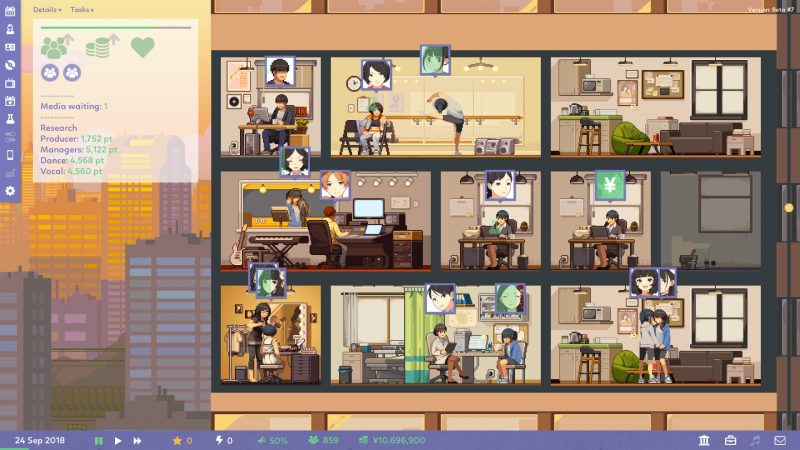
Classic agency sims do one job well: they let you stare at the building. You assign dance points, vocal points, and budget, then watch rooms fill up. Idol Manager is the clearest example — voice training, dance lessons, CD production, advertising, and office management, with scandals waiting if you push too hard.
Those systems teach resource math. They do not teach the conversation that happens when a main vocal has stage fright, a dancer refuses notes, and debut week is 12 days away. Spreadsheets cannot argue back. A producer has to.
This is exactly what K-Pop Producer was built for.
Why K-Pop Producer
K-Pop Producer treats idol training as a narrative job, not a stat grind. You are tasked with debuting the next breakout group: select trainees, navigate power dynamics, and shape careers over 60 intense days. The campaign remembers who you protected, who you cut, and which concept you bet the company on.
Where a traditional idol training simulator asks you to raise Visual, Vocal, and Dance bars, this AI asks you to live with the lineup those bars imply.
| Traditional Approach | K-Pop Producer |
|---|---|
| Menu-driven tycoon with rooms, budgets, and point allocation | 60-day producer campaign with persistent characters |
| Training as isolated stat grinding | Training as conflict: ego, chemistry, image, and time |
| Scandals as random events you click through | Image crises you have to talk your way through |
| Years of real trainee life to learn how agencies think | One sitting that still forces debut-week tradeoffs |
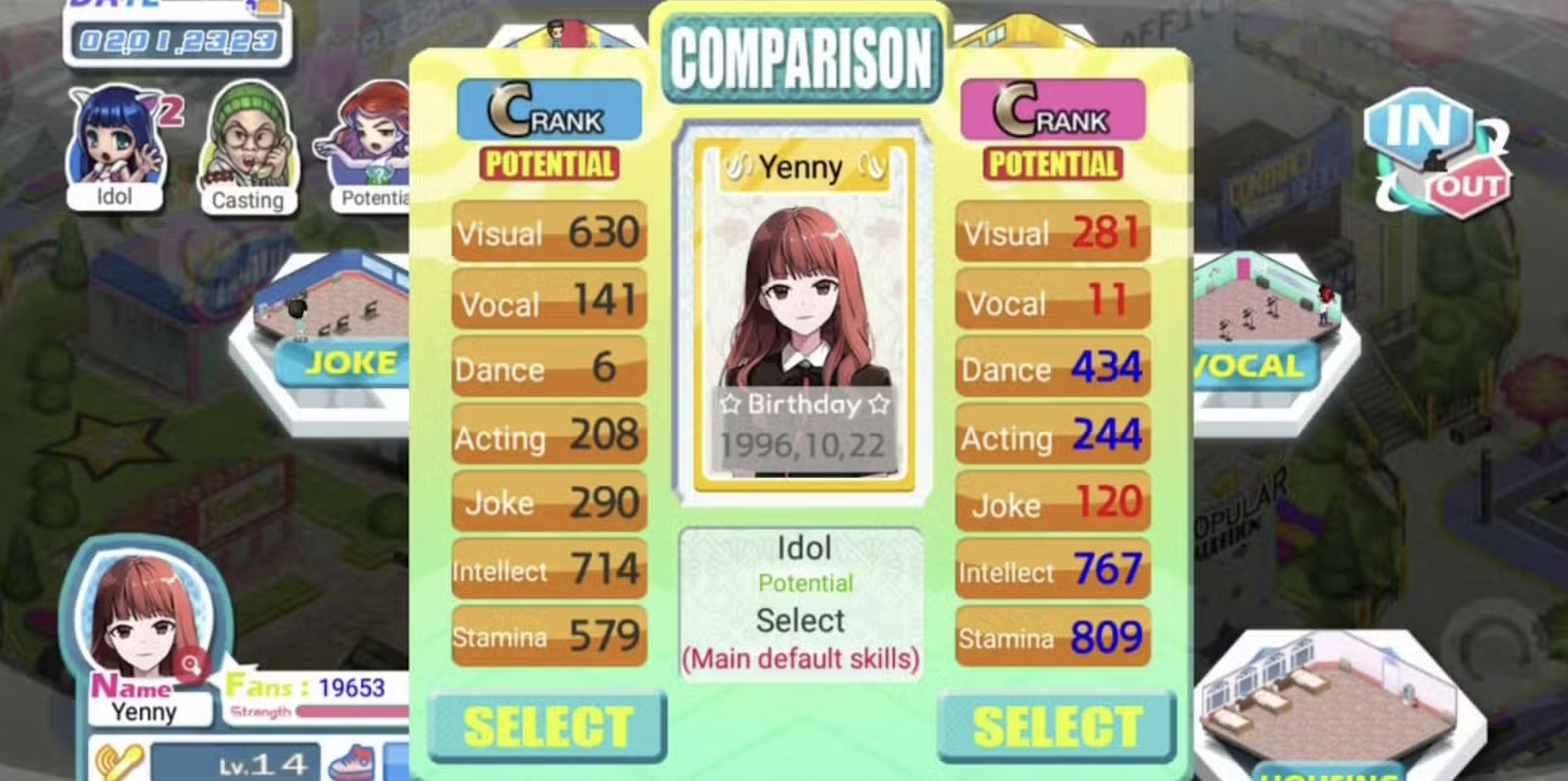
Those stat screens are honest about what agencies measure. Visual versus vocal. Dance versus stamina. A 630 visual against a 434 dancer. An idol training simulator only gets interesting when you have to choose which number you can live without.
Scout a lineup that can actually debut
You do not inherit a perfect group. You assemble one. That means reading a trainee’s strengths against the concept you want — dark, cute, performance-heavy, vocal-forward — and deciding who is center because they can carry a stage, not because they photograph well in a still.
"Scout four trainees for a dark-concept girl group. One is a main vocal with stage fright. One is a prodigy dancer who will not take notes. Build a 60-day plan that still debuts on schedule."
Train skills without ignoring the human cost
Real programs measure improvement constantly. So does this campaign — but the unit of progress is a decision, not a slider. Do you add another late dance camp, or protect a vocalist’s cords before the title-track recording? Do you leak a survival-style ranking to spark competition, or keep evaluations private to stop a spiral?
"We have 18 days to debut. The dancer is the best performer and the weakest live vocal. Assign parts, extra lessons, and a public ranking — then tell me who breaks first."
Manage politics, image, and the debut itself
A producer’s job is not only pedagogy. It is company power, fan expectation, and the press cycle. Line distribution, center positions, dating rumors, and last-minute concept flips all land on your desk before the stage does.
"The center is in a dating rumor two weeks before debut. Protect the group’s image without cutting her, and rewrite the title-track formation if you have to."
If you also want a clearer read on how real fandoms punish or reward those calls, K-Pop Analyst is the natural next tab — industry context, song breakdowns, and chart mechanics you can feed back into the sim.
Related Agents You'll Also Find Useful
If you are running an idol training simulator, you are already thinking like a company. These agents cover the adjacent desks.
K-Pop Analyst — Use it before you lock a concept. If you are simulating a 2020s-style performance group, you want current tea, song structure, and fandom norms so your debut does not feel like a generic “dark concept” mood board.
- Song and production breakdowns you can steal for title-track briefs
- Fandom culture and scandal patterns that should change your PR plan
- Artist recommendations when you need a real-world reference for a trainee archetype
Music Teacher — Vocal line distribution is where most fan-made lineups fall apart. If you are deciding who gets the bridge, this is the desk that can explain range, stamina, and why a “main vocal” who cannot mark choreography is still a scheduling problem.
- Theory, technique, and practice plans you can translate into camp assignments
- Ear-training and part-writing help when you invent a title track
- Instrument-agnostic coaching if your group also needs a live-band concept
Acting Coach — Idols do not only sing. They book dramas, variety, and endorsement spots, and they have to hold a camera in a music-video close-up. Scene work and audition craft make your “visual” trainee more than a still image.
- Scene and audition prep for variety and drama arcs inside the campaign
- Dialect and delivery notes when a member is the designated English or Japanese speaker
- Improv practice for livestreams that go off-script
Learn Korean Through Roleplay — If you are playing a Seoul-based producer, the room talks in Korean. Speech levels, honorifics, and trainee-to-sunbae dynamics are part of the job, not flavor text.
- Scenario practice for evaluations, dorm talks, and company meetings
- Vocabulary that actually shows up in idol work: formations, title tracks, fansigns
- Cultural nuance so your “strict producer” voice does not flatten into cartoon cruelty
Try K-Pop Producer free — no credit card required.
How It Works
You do not install a tycoon UI. You open a producer campaign, set the brief, and talk to the room.
Step 1: Open the producer desk and set the concept Name the company fantasy you want to run. A lean indie label with one shot at a digital single is a different game from a mid-tier agency copying a survival-show playbook. State the concept, budget mood, and debut deadline in the first message so the 60-day clock has something to enforce.
"I run a small Seoul agency with enough budget for one debut. I want a four-member performance group, dark concept, no survival-show gimmick. Start the 60-day clock."
Step 2: Scout trainees and freeze a lineup Ask for a trainee pool with conflicting strengths — not four equally pretty all-rounders. Force a tradeoff the way a real evaluation would: a vocalist who cannot dance, a dancer who will not take notes, a visual with no stage stamina. Cut people. That is the job.
"Give me six trainees. Two should be obviously debut-ready. Two should be projects. Two should be political hires from a partner company. I will cut two today."
Step 3: Assign camps and live with the friction This idol training simulator gets its texture from how you spend the days. Split vocal camp, dance camp, media training, and rest. Then ask what broke. If nobody is angry, you are not training hard enough — or you are not paying attention.
"Week three: main vocal is hoarse, dancer is isolating from the others, and the company wants a cute title track. Keep the dark concept or fold. Show me the fallout either way."
Step 4: Shape the debut and own the aftermath Lock parts, formations, the teaser schedule, and the story you will tell fans. Then play the week after debut — chart reaction, a variety booking, a rumor. The campaign’s memory is the point. A cut you made on day 8 should still hurt on day 60.
"Debut is in 72 hours. Assign the center, rewrite line distribution after the vocalist’s injury, and draft the night-of livestream script."
Results & Use Cases
🎯 Build a Dark-Concept Girl Group From Scratch
Scenario: You have a four-member slot, a performance-heavy concept, and a trainee pool that does not agree with itself.
Traditional Approach: Sketch a lineup in a notes app, argue about centers on Reddit, and never find out whether the vocalist survives the choreography.
K-Pop Producer: You run the 60-day cycle, cut a political hire, and debut a group whose weakest dancer is still on the team because she is the only one who can sell the story.
- Concept, camps, and lineup stay consistent across the campaign
- Conflicts surface before you get attached to a fantasy center
- You leave with a debut story you could actually pitch as a series bible
📊 Stress-Test a Comeback After a Scandal
Scenario: Your simulated center is in a dating rumor. Fans are splitting. The company wants a cheerful summer track.
Traditional Approach: Read a CNN-level recap of how tightly agencies manage private lives, then guess.
The AI producer: You choose silence, a handwritten-style statement, or a lineup shuffle — and the next three weeks of the campaign remember which one you picked.
- PR, training load, and title-track tone stay on one timeline
- You can compare two save-style branches by starting a second thread
- Pair it with K-Pop Analyst if you want the rumor pattern grounded in how real fandoms actually move
📱 Run a Full Training Cycle on Your Phone
Scenario: You commute 40 minutes and want a producer session, not another idle tycoon with timers.
Traditional Approach: A mobile idol game with energy bars, gacha stats, and a comparison screen you tap through between stations.
This idol training simulator: One voice-to-text brief on the platform — web, iOS, or Android, with the same memory — and you can run evaluations, rewrite formations, and close a camp day before you get off the train.
- No energy gates between story decisions
- Speech-to-text for walking-and-playing sessions
- Synced settings so a desktop recap can continue the same group
💼 Reverse-Engineer a Real Debut Strategy
Scenario: You are a songwriter, fan-cast director, or junior A&R who wants to practice why a company would give the bridge to member three.
Traditional Approach: Watch survival-show edits and hope the camera is telling the truth.
K-Pop Producer plus Music Teacher: You simulate the lineup politics, then stress-test whether the vocal parts you assigned are physically plausible before you commit them to a demo.
- Line distribution becomes a coaching problem, not just a bias
- You get language for notes you would actually give in a studio
- The campaign still forces the non-musical constraint: time, image, and who the company is afraid to demote
FAQ
What is an idol training simulator?
An idol training simulator is a game or AI campaign where you develop trainees — vocals, dance, image, and group chemistry — then debut them as a pop act. Tycoon versions focus on offices, budgets, and stat bars. K-Pop Producer is the narrative version: you play the producer across 60 days of scouting, camps, politics, and debut-week calls, with the campaign remembering every cut.
Is K-Pop Producer free?
Yes. You can run the idol training simulator on Jenova’s free tier with all core features and limited monthly usage. Paid plans raise usage if you are chaining long campaigns, branching scandal timelines, or keeping multiple groups in memory. No credit card is required to start a first 60-day cycle.
How is this different from Idol Manager?
Idol Manager is a business sim: you train idols, produce CDs, buy ads, and keep the office solvent, with a story mode that can include scandals and interpersonal fallout. K-Pop Producer is not a replacement tycoon. It is a conversation-driven producer campaign. You do not click rooms. You brief a staff, argue with trainees, and live with a debut you can explain.
Can an AI idol training simulator teach real vocal or dance skill?
It can teach producer skill — lineup logic, load management, part assignment, and image control. It cannot replace a studio. If you want actual technique, use Music Teacher for range, stamina, and practice design, or an in-person dance coach for formations. The sim is for decisions. The lessons are for bodies.
Does K-Pop Producer work on mobile?
Yes. The same campaign runs on web, iOS, and Android with full feature parity and synced settings. That matters for an idol training simulator because the useful sessions are short: one evaluation, one scandal, one formation rewrite. Speech-to-text is available when you would rather talk a camp plan than type it on a commute.
How accurate is this to the real K-pop trainee system?
It is grounded in how the industry actually works — long training, frequent cuts, concept control, and a debut rate that almost never becomes global fame — but it is still a simulation. Real programs involve contracts, dorms, and legal constraints no game should let you “win.” Treat it as a serious roleplay of producer judgment, not as a documentary or a career shortcut.
Conclusion
An idol training simulator used to mean a cutaway office and a wall of stats. Useful, if you like watching dance points tick up. The job fans actually want to try is narrower and harder: pick four people, spend 60 days on them, and debut a group you can defend.
That is the producer’s chair. K-Pop Producer puts you in it — scouting, camps, politics, and the week after the teaser drops — with a campaign that does not forget who you cut. When you need real-industry context, vocal craft, or Korean for the room, the related desks are already there.
Try K-Pop Producer now. Explore more at Jenova.
For Developers: K-Pop Producer is available programmatically via the Jenova API — integrate a 60-day idol training simulator into your app with a single API call. Full documentation →