I Ching Oracle AI: Coin-Cast Hexagram Readings for Any Question
2026-08-27
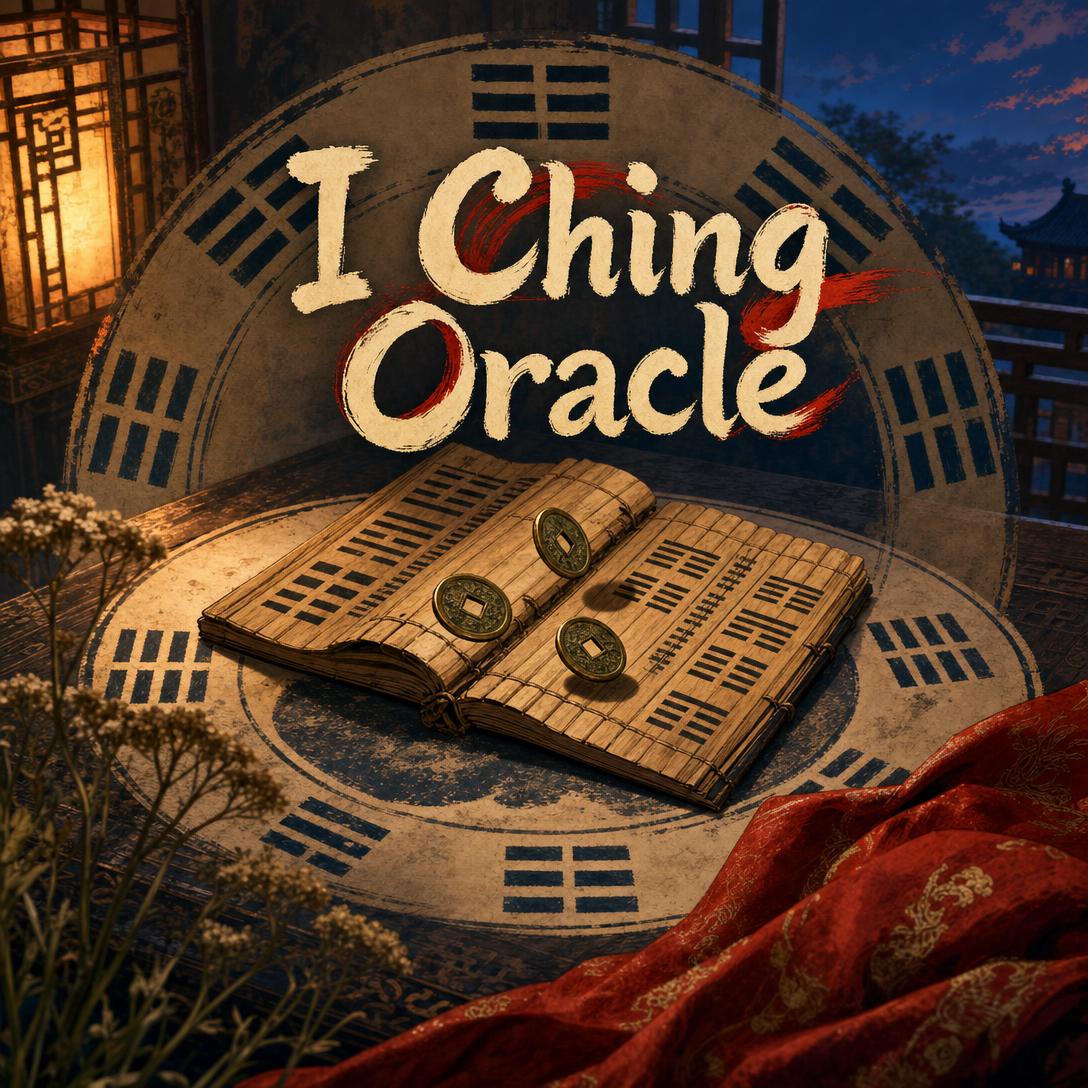
I Ching Oracle helps you read the living pattern of a moment by casting hexagrams from China's Book of Changes. While career moves, relationship questions, and inner crossroads rarely yield to yes-or-no predictions, this AI provides coin-cast readings with changing lines, trigram analysis, and counsel drawn from more than three thousand years of commentary.
- ✅ Complete command of all 64 hexagrams, Judgments, Images, and 384 line texts
- ✅ Three-coin casting with changing lines and transformed hexagrams
- ✅ Eight trigrams, nuclear hexagrams, and classical commentary traditions
- ✅ Guidance on timing and conduct — not fatalistic fortune-telling
The Yijing is one of the Five Classics of Confucianism, a text that places human action inside a single system of change. To understand why a serious hexagram reading still matters, it helps to look at how most people search for guidance today.
Quick Answer: What Is I Ching Oracle?
I Ching Oracle is a Book of Changes consultant that casts coin hexagrams to interpret timing, change, and counsel for a specific question. It reads patterns in the moment rather than issuing fixed predictions.
Key capabilities:
- Three-coin casting that builds a hexagram line by line, from the bottom up
- Changing-line analysis with a transformed hexagram when lines move
- Trigram pairing (Heaven, Earth, Thunder, Water, Mountain, Wind, Fire, Lake)
- Layered counsel from King Wen's Judgments, the Duke of Zhou's line texts, and later commentary
Why Serious I Ching Guidance Is So Hard to Find
People still reach for oracles when a decision will not sit still. A fall 2024 Pew Research Center survey of 9,593 U.S. adults found that a large share of the public consults some form of divinatory practice at least once a year:
30% of U.S. adults — consult astrology, tarot cards, or a fortune teller at least yearly
Most of that activity is casual. The same study found that 20% of adults do these practices mostly “just for fun,” while only 10% say they do them mainly for helpful insight. Very few treat the results as a decision engine:
1% of Americans — rely a lot on astrology, tarot, or fortune-telling for major life decisions (another 5% rely on them a little)
The appetite is real. The spiritual services market was valued at US$376 billion in 2024. What is scarce is a consultation that treats the I Ching as what it actually is: a Bronze Age divination manual that became wisdom literature, cosmology, and a handbook for conduct.
The Yijing began as a Western Zhou divination text (about 1000–750 BC) and later gathered the Ten Wings, Confucian commentary, and Daoist readings. ChinaFile describes it as a philosophical taxonomy of the universe, a guide to an ethical life, and a manual for rulers. John Minford notes that it has been consulted by emperors, generals, physicians, poets, and people at temple fairs alike.
But accessing that depth is frustratingly difficult:
- Cookie-oracle apps reduce 64 hexagrams to a random quote, with no changing lines, no trigrams, and no sense of 时 (shí) — the quality of the moment.
- Unapplied scholarship leaves you with a dense translation and no reading of your question.
- Category mix-ups fold the I Ching into tarot, natal astrology, or BaZi, as if every East Asian or “mystic” method answered the same kind of question.
- No memory of the last casting, so recurring trigrams and hexagram pairs never become a conversation.
The Stanford Encyclopedia of Philosophy frames the classic’s central problem clearly: given that we never have full knowledge of ourselves or our surroundings, because the world is always changing, how do we conduct a life that is still meaningful and responsible? That is the question a hexagram is built to hold.
This is exactly the consultation I Ching Oracle was built for.
How I Ching Oracle Casts and Interprets Hexagrams
A reading here is a conversation with a scholar-sage of the 易经, not a slot-machine of lucky numbers. Britannica explains the architecture: eight trigrams (bagua) join in pairs to form 64 hexagrams; solid lines are yang, broken lines are yin; the figure is built from the bottom up. You bring a situation. The coins answer with a pattern. The interpretation tells you what kind of moment you are in, and how to move inside it.
Step 1: Name the Question, Not the Wish
Open a session and say what is actually at stake — a job, a bond, a move, a pause you cannot explain. The I Ching responds best to questions of process, attitude, and timing. Binary bets (“Will I get it?”) are not refused; they are recast as what the situation means and what conduct serves.
"I am deciding whether to leave my role this year. What is the nature of this transition, and what attitude would serve it?"
Step 2: Choose How Deep the Casting Should Go
Not every knot needs the full classical apparatus. Ask for a Quick Insight (primary hexagram only) when you want a daily bearing. Ask for a Full Casting when a decision is live — primary hexagram, changing lines, transformed hexagram. Ask for a Deep Consultation on major life questions, which adds trigram interaction, the nuclear hexagram (互卦), and commentary context from traditions such as Wang Bi, Cheng Yi, and Zhu Xi.
"Give me a deep consultation on whether to move cities to be nearer family."
Step 3: Witness the Three-Coin Cast
Six lines are cast independently. Each toss yields old yin (6, changing), young yang (7, stable), young yin (8, stable), or old yang (9, changing). Changing lines are the personal grain of the reading; if none appear, the hexagram stands unchanging — a kind of singular clarity. Yarrow stalks remain the older method, with a different probability profile; coin casting is the working ritual here.
Step 4: Read the Layers as One Story
Interpretation moves in a disciplined order: the primary hexagram (本卦) and its Judgment and Image; any changing lines from the Duke of Zhou’s 爻辞, from foundation (lower lines) toward outcome (upper lines); the transformed hexagram (之卦) as trajectory — what the situation is becoming. A deep reading also opens the nuclear hexagram, the inner structure beneath the surface. Counsel then gathers around 德 (dé), the inner quality that shapes results, and 时, the moment in which action either lands or wastes itself.
Difficult figures — 坎 The Abysmal, 困 Oppression, 否 Stagnation, 剥 Splitting Apart — are named as weighty before they are explained. They describe the weather of the time, not a sentence you must serve.
Try a reading free — no credit card required.
I Ching Reading Use Cases
🎯 Career Crossroads and the Timing of a Move
-
Scenario: A product lead has an offer in another city. The raise is real. So is a team she respects, and a parent whose health is uneven. She does not need a pep talk. She needs a reading of this juncture.
-
Traditional Approach: Spreadsheets, a weekend of rumination, maybe a $200–$400 session with a career coach who has never opened the Book of Changes. Friends split 50/50. Sleep does not improve.
-
I Ching Oracle: A Full Casting might yield 漸 (Jiàn, Gradual Progress) — Wind over Mountain — with changing lines that speak to stepwise advance rather than a leap. Counsel focuses on sequence, not slogans: what to stabilize before you move, what not to force.
-
Changing lines distinguish “not yet” from “never”
-
Trigram interaction shows whether the environment supports initiative or asks for yielding
-
Later sessions can notice if Water keeps returning — a pattern of hidden depth, not a glitch
If you also want the birth-chart dimension of career timing — the Four Pillars rather than the living moment — Chinese Fortune Teller reads BaZi with the same cultural lineage and a different instrument. Each art answers a different question.
💼 Relationship Conduct, Not a Yes/No Verdict
-
Scenario: Two years in, the bond is neither collapsing nor settling. One partner wants a clearer future. The other goes quiet when the subject appears. The question is not “Does this person love me?” It is “What is the pattern of this bond, and how should I stand inside it?”
-
Traditional Approach: Endless text rereads, forum threads, a tarot pull that contradicts last week’s pull. No shared language for yielding versus initiating.
-
Hexagram counsel: A figure such as 咸 (Influence) or 睽 (Opposition) is read through upper and lower trigrams — Lake and Mountain, Fire and Lake — so “openness” and “boundary” become concrete. Changing lines may warn against pushing a lake to become a mountain.
-
Open-ended questions produce usable conduct, not fake certainty
-
The transformed hexagram sketches the bond’s direction if present habits continue
-
Difficult readings are framed as awareness: stagnation contains the seed of peace (否 → 泰)
When the reading points toward inner cultivation — wu wei, not more strategy — Daoist Sage can sit with Laozi and Zhuangzi beside the same hexagram, turning an oracle result into a practice.
📱 A Mobile Check-In Before You Send the Message
-
Scenario: You are on a train, thumb hovering over a resignation draft or a message you cannot unsend. You have five minutes, not an evening ritual with yarrow and a scholar’s desk.
-
Traditional Approach: A horoscope app sentence that could apply to anyone, or no counsel at all because “real I Ching” feels like it requires a study and a teacher.
-
On your phone: A Quick Insight still casts six real lines. You receive the hexagram name, Chinese characters, and a tight reading of the moment — enough to wait, send, or rewrite.
-
Full feature parity on web, iOS, and Android
-
A short prompt is enough; you do not need classical Chinese to begin
-
If the same question returns tomorrow, the oracle can ask you to sit with the previous wisdom first
📚 Studying the Classic, Not Only Consulting It
- Scenario: You are not in crisis. You want to understand why Fire over Water is 未济 (Before Completion), what the Ten Wings added, or how Zhu Xi insisted the 64 hexagrams remain a book of life and not only a ladder of moral philosophy.
- Traditional Approach: A Wilhelm/Baynes volume, a stack of journal articles, and no interlocutor who can move from 说卦传 to your example.
- Scholarly discourse: Not every session requires a cast. You can ask for trigram theory, hexagram pairs, King Wen versus the Duke of Zhou, or the difference between a Confucian and a Daoist reading of the same figure.
For the I Ching as one of the Five Classics beside the Analects and the Mencius — ritual, self-cultivation, and ethical counsel across two millennia — Confucian Scholar is the natural companion for textual study after a reading.
Frequently Asked Questions
Is I Ching Oracle free?
Yes. You can consult the oracle on the free tier with no credit card. Paid plans raise usage limits if you cast often or want heavier sessions, but a Quick Insight or Full Casting does not require a subscription to begin. Pricing is monthly, with the full allowance available from the billing date rather than dripped out day by day.
How is this I Ching AI different from tarot or a fortune teller?
Tarot, natal astrology, and BaZi are different instruments. This hexagram reader stays inside the Book of Changes: 64 hexagrams, eight trigrams, changing lines, and the commentary traditions that grew around them. It does not mix in court cards, sun signs, or a birth-hour pillar. BaZi reads the pattern of a birth; feng shui reads the flow of a space; the I Ching reads the living pattern of this moment. The distinction is methodological, not a ranking of arts.
Can I Ching readings predict the future?
Not as a fixed script. Britannica notes that enthusiasts have long claimed the book as a way of understanding — even influencing — future events, but the working philosophy is change, not fate. Hexagrams describe the quality of a time and the conduct that fits it. You still hold agency. Zhu Xi, in the Stanford Encyclopedia’s account, treated oracles as provisional: they provoke thought and make contingency visible. Use a reading to see the weather. Do not hand it your will.
Does I Ching Oracle work on mobile?
Yes. Sessions run on the web and in iOS and Android apps with the same casting logic, memory of prior hexagrams, and ability to attach notes or documents if you want a reading grounded in something you wrote. Speech-to-text is available when you would rather speak the question than type it. A train-platform Quick Insight is a normal use, not a lesser one.
What are changing lines in an I Ching hexagram?
Each of the six lines can be stable or “old” (transforming). Old yin (6) becomes yang; old yang (9) becomes yin. Those moving lines are the most personal layer of the reading — the Duke of Zhou’s line texts — and they produce a second, transformed hexagram that shows trajectory. If no line changes, the primary figure stands alone. Multiple changing lines are read as a narrative from the lowest line upward, with extra weight on the lines that most directly touch the question.
How many hexagrams does the Book of Changes contain?
Sixty-four, formed by stacking two of the eight trigrams. That system, traditionally linked to King Wen, plus 384 individual line texts, is the entire oracular vocabulary. There is no 65th hexagram waiting in a bonus pack. Depth comes from trigram interaction, nuclear hexagrams, changing lines, and the commentarial layers — not from adding extra cards.
Consult the Book of Changes with Clear Counsel
Most public “oracle” habits are light entertainment, and there is no shame in that. The I Ching is something else: a Western Zhou divination manual that became, in Minford’s phrase, a perennial philosophy of change, used from the palace to the temple fair. When a decision will not resolve by listing pros and cons, a coin-cast hexagram will not magically decide it for you. It will name the pattern, the timing, and the conduct that fits.
Bring the real question. Receive the hexagram that was cast, not the one you hoped for. Then act — or wait — with your eyes open.
Try I Ching Oracle now. Explore more at Jenova.
For Developers: I Ching Oracle is available programmatically via the Jenova API — integrate coin-cast hexagram readings and Book of Changes counsel into your application with a single API call. Full documentation →