How to Make AI RP Character Remember Lore Across Sessions
2026-09-18
Roleplay Game Master helps you make an AI RP character remember lore by holding unlimited campaign memory and locking NPC consistency so names, vows, factions, and room-state do not evaporate mid-scene. While typical chatbots treat canon as disposable context, this AI keeps the bible alive from the opening beat through the fiftieth session.
In September 2026, most players still patch forgetting with lorebooks, pinned recaps, and character-card bloat — then watch a rival forget the war that defined them.
✅ Unlimited conversation memory, so lore is not trimmed to fit a window ✅ Perfect character consistency for voice, inventory, secrets, and relationships ✅ Complete creative freedom across genre, rating, and ensemble size ✅ The same campaign on web, iOS, and Android, including speech-to-text
To understand why “how to make AI RP character remember lore” became a community craft, it helps to see what language models actually store — and what they quietly drop.
Quick Answer: How to Make an AI RP Character Remember Lore?
How to make an AI RP character remember lore: pin identity and relationships as always-on facts, keep world entries short and keyword-triggered, and use a partner with unlimited memory so canon does not age out. Roleplay Game Master does the retrieval job for you instead of making you babysit a wiki.
Key capabilities:
- Persistent campaign memory across sessions, not just the last few replies
- Stable NPC voice, scars, debts, and who already knows the secret
- Scene continuity: location, time, injuries, and open hooks
- Room to run romance, horror, court intrigue, or tabletop-style chronicles without rebuilding the bible every few dozen messages
The Problem With AI RP Lore
IBM’s overview of agent memory is blunt: large language models cannot, by themselves, remember. Short-term context is a rolling buffer. Long-term lore has to live in a real store, or in notes you maintain by hand.
Roleplay makes that gap obvious. You are not asking for a one-shot answer. You are asking the model to inhabit a person inside a world with history. When the window fills, eye color changes, a betrayal evaporates, and a lover is greeted like a stranger.
But making an AI RP character remember lore is frustratingly difficult:
- Always-on identity and sometimes-on world facts get dumped into the same paragraph
- Keyword lorebooks fire too often, too rarely, or all at once
- Relationship history is treated like flavor text instead of memory
- Manual recaps punish you for playing instead of bookkeeping
Context Windows Are Not a Lorebook
Character.AI’s lorebook guidance exists because a character definition can only hold so much. Details written into the always-on card consume space in every reply, relevant or not. A lorebook is supposed to keep world facts on standby until a keyword appears.
That is retrieval, not memory. If the keyword never shows up, the tavern does not exist. If the keyword is “magic” or “world,” the tavern exists in every sentence and crowds out the actual scene.
~20% of context — Typical lore load cap on one popular roleplay frontend, so world entries cannot eat the whole window
~740 tokens — Approximate free-tier lore budget on that same frontend
A campaign is larger than 740 tokens of standby facts. The rest of your canon is still hoping the last few messages mention the right noun.
Personality Anchors Get Buried Under World Dump
The reliable split is the one Character.AI documents as a rule of thumb: always-relevant identity belongs in the definition; sometimes-relevant places, factions, items, and events belong in triggered entries.
Players invert it. They paste a novel into the card, then leave relationships as a single adjective. The model over-explains the magic system and under-remembers that {{char}} already confessed.
Keywords Overtrigger — or Never Fire
SpicyChat’s lorebook docs check roughly the last four messages, keep a hit active for about two turns, and warn you to use one topic per entry with specific names — not generic words. Character.AI caps keywords at eight per entry and flags common words because they spend budget on noise.
Bad triggers are how lore “tileates”: five entries wake up, the model recites the setting, and the character stops talking like a person.
Episodic Beats Get Flattened Into Semantic Traits
Semantic memory stores durable facts; episodic memory stores what happened when. Roleplay chats smash both into one recap. A one-off tavern joke becomes a personality trait. A core wound becomes optional flavor.
Research on long-horizon agent memory calls the retrieval failure contextual isolation: vector-style lookup only surfaces what looks similar to the current line. “Why is she cold tonight?” will not pull last month’s betrayal if the embeddings do not overlap.
~16K tokens — Average dialogue length in the LoCoMo long-horizon memory benchmark
That is the scale at which recap-and-pray stops working.
This is exactly what Roleplay Game Master was built for.
Why Roleplay Game Master
Roleplay Game Master is an immersive roleplay partner with unlimited memory and perfect character consistency. You describe the world, the cast, and the tone. It runs the scene, tracks what happened, and stays in character without a lorebook you have to debug after every climax.
You can still write a clean character bible. You should not need that bible to prevent amnesia.
| Traditional Approach | Roleplay Game Master |
|---|---|
| Pin a lorebook and pray the keyword appears | Unlimited memory that persists across the campaign |
| Recap dumps that clog the context window | Continuity without turning play into clerical work |
| NPCs drift in name, tone, inventory, and canon | Perfect character consistency for the cast you defined |
| Always-on card bloat vs. entries that never fire | Identity stays locked; scenes stay specific |
| Story dies when you switch devices | Pick up the same beat on phone or desktop |
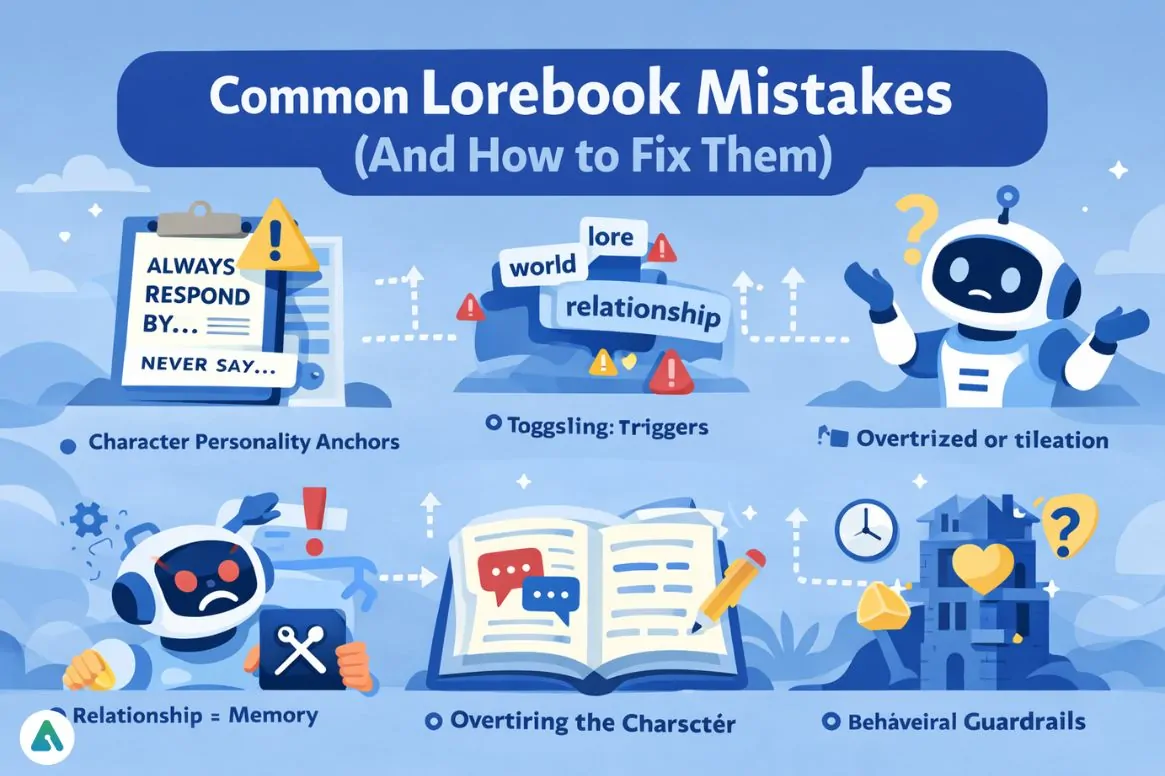
Fix the Lorebook Mistakes Even If You Still Keep Notes
If you want a written system — for a collab doc, a card export, or another frontend — structure it against the failure modes in the infographic above.
Character personality anchors (always on)
- Voice, taboos, diction, what they never say
- Invariants: scars, vows, phobias, species/role, distinctive features
- Behavioral guardrails: “does not become a new NPC,” “does not forgive in one reply,” “will not say Maren’s name”
World lore (sometimes on)
- One topic per entry: one place, one faction, one item, one event
- Specific keywords: Ivo, Velvet Tavern, torn letter — not tavern or letter
- Two to five factual sentences, not a chapter. SpicyChat’s own guidance is 2–5 sentences, one topic, max 2,000 characters
Relationship = memory, not a tag
- Status with {{user}} and key NPCs as facts: ally, rival, secret, debt, who knows
- Update after confessions, deaths, and betrayals. Stale relationship lines are how slow-burn romance “forgives” too early
Do not overthink the character in the entry
- Facts, not cinema. “Left-hand scar; still owed 40 silver” beats a paragraph of inner monologue
- Recursive lore that mentions other keywords should not chain-load a wiki into one reply
That is how to make an AI RP character remember lore on a keyword system. Playing inside an unlimited-memory game master is cleaner, because the living chat is the store.
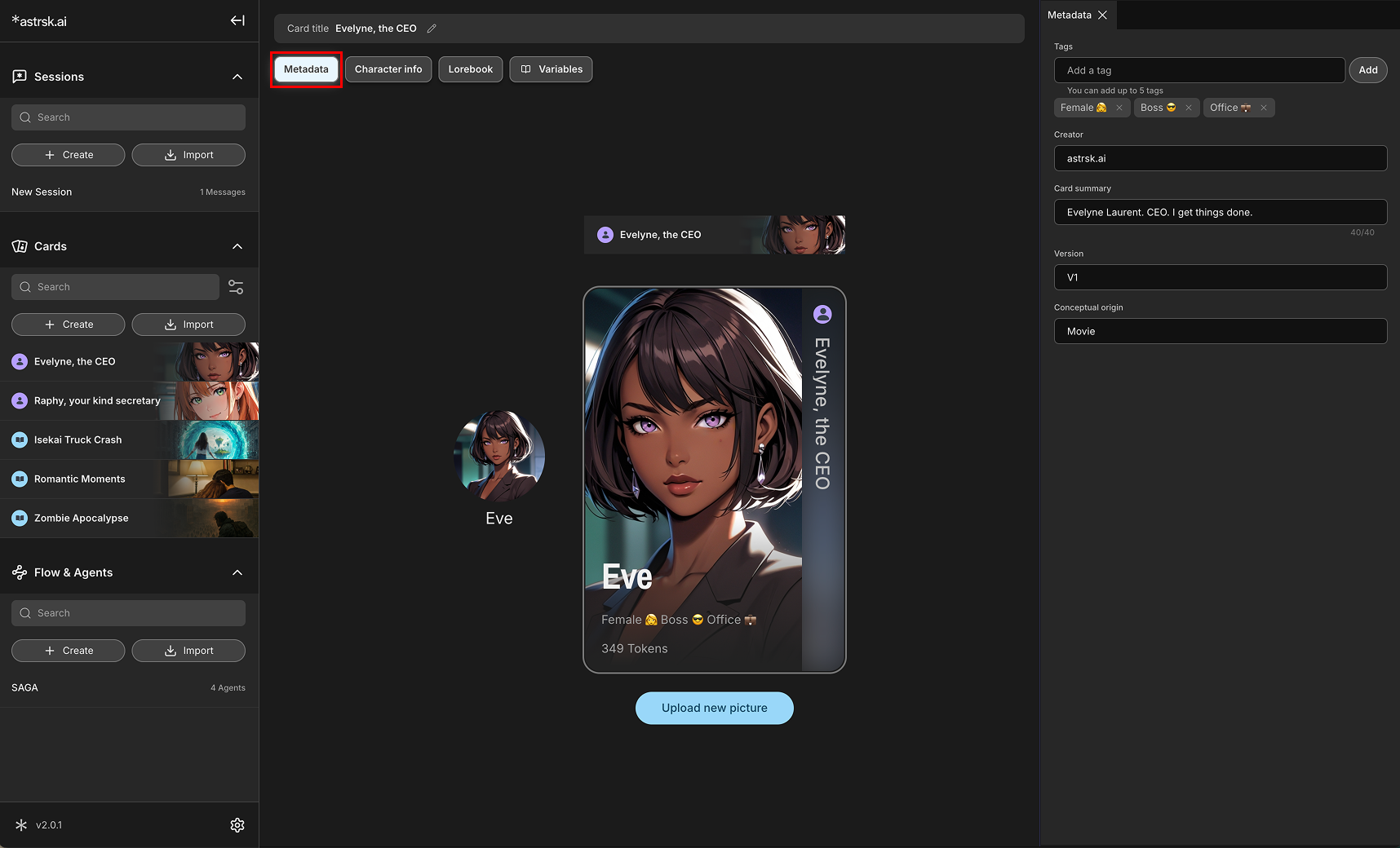
Put Always-On Lore on the Card — Not the Whole World
A metadata panel is the right size for identity: name, role, a one-line summary, a handful of tags. “Evelyne Laurent. CEO. I get things done.” belongs on the card. The floor plan of the office tower, the rival VP, and last quarter’s betrayal do not.
Creators who mix those layers force the model to carry the tower in every greeting. Keep the card thin. Keep world entries topical. Let campaign memory hold the history.
Reliable, Believable, Capable Canon
Lore failures cluster in three ways:
- Reliable: last session’s injuries, names, and locked doors still retrieve
- Believable: speech, ethics, and relationship temperature stay the same person
- Capable: heists, slow-burn arcs, and political campaigns can finish because earlier moves still exist
Static similarity search is a weak substitute for that. Testing on long dialogues found graph-style episodic-semantic memory lifting multi-hop accuracy by up to 23% while cutting token load versus stuffing the full history. Players feel the same gap as “this one remembers me.”
Prompts That Feed Lore Instead of Fighting It
Talk in invariants and outcomes, not essays.
"Continue the campaign. Last beat: Elara learned Kael sold the map. She has the torn letter. Do not reset their history. Open in the rain outside the safehouse, cold not yelling."
"Lock character lore: barkeep is Ivo, gray streak, scar on the left hand, still owed 40 silver. He does not become a new NPC. The Velvet Tavern has two exits."
"Slow-burn only. No timeskip. Keep every returning NPC consistent — names, debts, and who already knows about the letter."
Short, factual entries outperform lore novels. More text is not more memory.
Related Agents You'll Also Find Useful
If the story you want is already framed, adjacent agents keep the same pressure on continuity.
Vesper Court — A woman wakes in a hidden vampire court with no memory of why. Blood intrigue only works if each night’s bargains survive until the next dusk. Use it when you want gothic romance with consequences, not a reset at sunrise.
- Night-by-night plot that depends on retained secrets
- Character consistency under high-emotion scenes
- Political board that should not reshuffle because the window filled
College Life — Open-world campus roleplay where friendships, heartbreak, and status unfold from your choices. A rumor from week one should still hurt in week six, which is the same lore problem with social stakes instead of swords.
- Choice-driven social dynamics instead of a railroaded quest
- Relationship continuity as the main mechanic
- Ensemble cast that cannot afford name drift
The Mansion — You wake in a mansion with no memory of how you arrived. Every room hides secrets. Mystery RP is a lore test: clues, locked wings, and who already lied only matter if the house remembers.
- Environmental canon (rooms, keys, corpses) has to stay put
- Player amnesia is the hook; bot amnesia is the failure
- Short sessions should still accumulate evidence
Try the unlimited-memory game master free — no credit card required.
How It Works
Step 1: Lock Identity Before You Lock the World Open the unlimited-memory game master and lead with who must never drift. Names, voice, wounds, and the relationship with you belong in the first message. That is your character card. World geography can wait.
"You are GM. I play Ren, quiet cartographer. Companion is Captain Sera: dry humor, never shouts, missing the last two fingers on her right hand. We are wanted in Virel. Do not soften that."
Step 2: Split Always-On Lore From Tonight’s Scene Give semantic rules once (how magic costs, who can lie to whom). Then give the episodic opener (where you are, what just happened). Mixing them into one purple paragraph is how cards and lorebooks both fail.
"World rule: glamours fail in church bells. Scene: midnight, warehouse loft, Sera is bandaging my arm and has not mentioned the wanted posters."
Step 3: Write World Facts Like Lore Entries, Even in Chat When you introduce a place or NPC, use one topic, specific names, and two to five facts. You are training retrieval even if no keyword engine is watching.
"Lore, not a speech: Ivo runs the Velvet Tavern. Gray streak, left-hand scar, owed 40 silver from the card game. Two exits. He has already heard rumors about us."
Step 4: Update Only What Changed Stay in scene. When something story-critical happens — a death, a confession, an item lost — state it once as an episodic log. Do not novelize.
"Memory update, not a new scene: Sera now knows I forged the charts. The original map is ash. She kept the compass. Relationship: trust high, honesty not."
Step 5: Resume Without a Recap Novel Because memory is unlimited, you do not need a 500-word OOC summary every login. A short continue-from line is enough. The same thread should work on a phone when you have ten minutes on a train.
"Continue from the loft. Same night. Sera has the compass. I am still bleeding. No timeskip. Ivo is not in this scene."
Results & Use Cases
🎲 Heist Chronicle Without a Wiki Editor
Scenario: You and two friends are running a 30-session crew job. The fence, the crooked priest, the named cat, and three unpaid debts all have to exist in session 19.
Traditional Approach: After each session someone pastes a recap, trims it when the lore budget overflows, and still watches the priest change names because “priest” was a lazy keyword.
Roleplay Game Master: You play. Aliases, debts, and the cat stay put, so a check written in session 3 can cash.
- Ensemble NPCs remain distinct
- Heist logistics survive timeskips
- Less OOC bookkeeping, more table time
💼 Slow-Burn That Remembers the Wound
Scenario: Rivals-to-lovers. A betrayal in act one must still shape every polite conversation in act three.
Traditional Approach: The model “forgives” because the betrayal aged out of the window. You paste the wound into memory again. It still comes out as generic angst.
This AI roleplay partner: The betrayal is treated as relationship fact plus event. Later tenderness has to work around it. If you want a prebuilt gothic frame with the same pressure, Vesper Court is the darker cousin.
- Emotional continuity without railroading
- Voice stays sharp under intimacy
- Secrets remain secrets until they are spent
📱 Mobile Scene on a Commute
Scenario: You drafted a tavern standoff at your desk. The next morning you have twelve minutes on the subway and want Ivo, not a new extra.
Traditional Approach: Thin mobile history rewrites the room. You spend the commute re-explaining the scar and the 40 silver.
Unlimited-memory roleplay: You send one line of dialogue. Ivo still has the scar and the debt. The scene moves.
- True device switching, not a new bot
- Short sessions that still accumulate lore
- No laptop required to keep character
🏫 Social Canon on a Campus Map
Scenario: You want rumor mills, friend groups, and a midterm disaster to compound — not a dungeon crawl.
Traditional Approach: Each club is a lore entry with the keyword “class,” so every hallway scene dumps the whole student handbook.
College Life as the frame, same memory discipline: Play the social map. Let one rumor stay attached to the person who started it.
- Relationship state is the plot
- Named NPCs do not reshuffle weekly
- Your choices remain expensive
FAQ
How do you make an AI RP character remember lore?
Pin always-true identity and relationship status in the opening instructions. Store world details as short, one-topic facts with specific names. Update only after story-critical changes. Keyword lorebooks can approximate this if you keep entries tight and triggers rare. An agent with unlimited campaign memory removes the need to win a keyword lottery every reply.
Why do AI roleplay characters forget previous lore?
They are reading a limited slice of recent text, not a durable world bible. IBM notes that memory must be added on top of the model. When that slice fills, older names and promises fall out. Keyword systems only inject an entry if the last few messages mention the right term, which is why a faction can vanish until someone says its name out loud.
Is Roleplay Game Master free?
Yes. Core features run on a free plan with limited usage and no credit card required. Paid tiers raise usage if you play long daily campaigns. The test that matters is whether NPCs still match their first appearance after a week — not whether a lore token counter is green.
Do I still need a lorebook to keep world canon straight?
Not if campaign memory is actually unlimited. Lorebooks are a clever retrieval hack for frontends that cannot remember. They still help as a writing tool: one topic, specific keywords, two to five facts. You can paste that discipline into an opening message. You should not need to maintain it as a second job. For a prebuilt mystery house that depends on retained clues, The Mansion is the stress test.
Does AI RP lore memory work on mobile?
It should, or it is not campaign memory. This agent keeps the same continuity on web, iOS, and Android, including speech-to-text if you would rather dictate a reply than type on a train. A lorebook that only lives in a desktop editor will not save a subway scene.
How is this different from keyword lorebooks on other apps?
Keyword lorebooks inject standby text when a word appears. They are useful, and their own docs tell you to keep entries short, specific, and non-recursive. They do not store this campaign’s events unless you write those events back in. The game master is built so immersive play and character consistency are the product. You can still keep a written bible for worldbuilding; you should not need it to prevent amnesia.
Conclusion
How to make an AI RP character remember lore is not a prompt trick. It is a storage problem. Split durable identity from timestamped events, keep world facts short and named, and stop asking a sliding window to be a campaign bible.
Roleplay Game Master keeps unlimited memory and character consistency so lore, relationships, and plot can actually accumulate. Build the party, set the scene, and stay in character — on the couch or on your phone.
Try it now, then explore more at Jenova.
For Developers: Roleplay Game Master is available programmatically via the Jenova API — integrate unlimited-memory AI roleplay and lore-consistent characters into your application with a single API call. Full documentation →