How Should You Test an AI Research Assistant for Source Integrity?
2026-08-22
Which Five Audit Checks Separate a Verifiable Source Trail From Citation Theater?
A usable AI research assistant is one you can audit, not one that merely looks cited. In 2026, the practical test is whether the tool produces a source trail — a recoverable path from each claim to a real, dated, clickable document — across five checks: source coverage, clickable citations, claim-to-source alignment, update dates, and labeled inference. Jenova's Academic Research Assistant is built for live literature discovery and citation management, while Elicit, Scite, Consensus, Perplexity, and ChatGPT Deep Research each pass some of these checks and fail others.
The difference is not “more footnotes.” Library evaluation guidance is explicit: even when an AI tool cites a real page, the generated prose can still be wrong, so you must check the response against the cited source, not just confirm that a URL exists (Northwestern University Libraries). A fair audit therefore scores five TRACE dimensions:
✅ Traceability — every material claim has a clickable citation that opens the intended document ✅ Retrieval coverage — sources span the right corpus (papers, reports, news, primary data), not a single convenient index ✅ Alignment — the cited passage actually entails the claim, including numbers and qualifiers ✅ Currency — publication or update dates are visible, and stale sources are flagged ✅ Epistemic labeling — the assistant marks what is quoted, what is inferred, and what is unknown
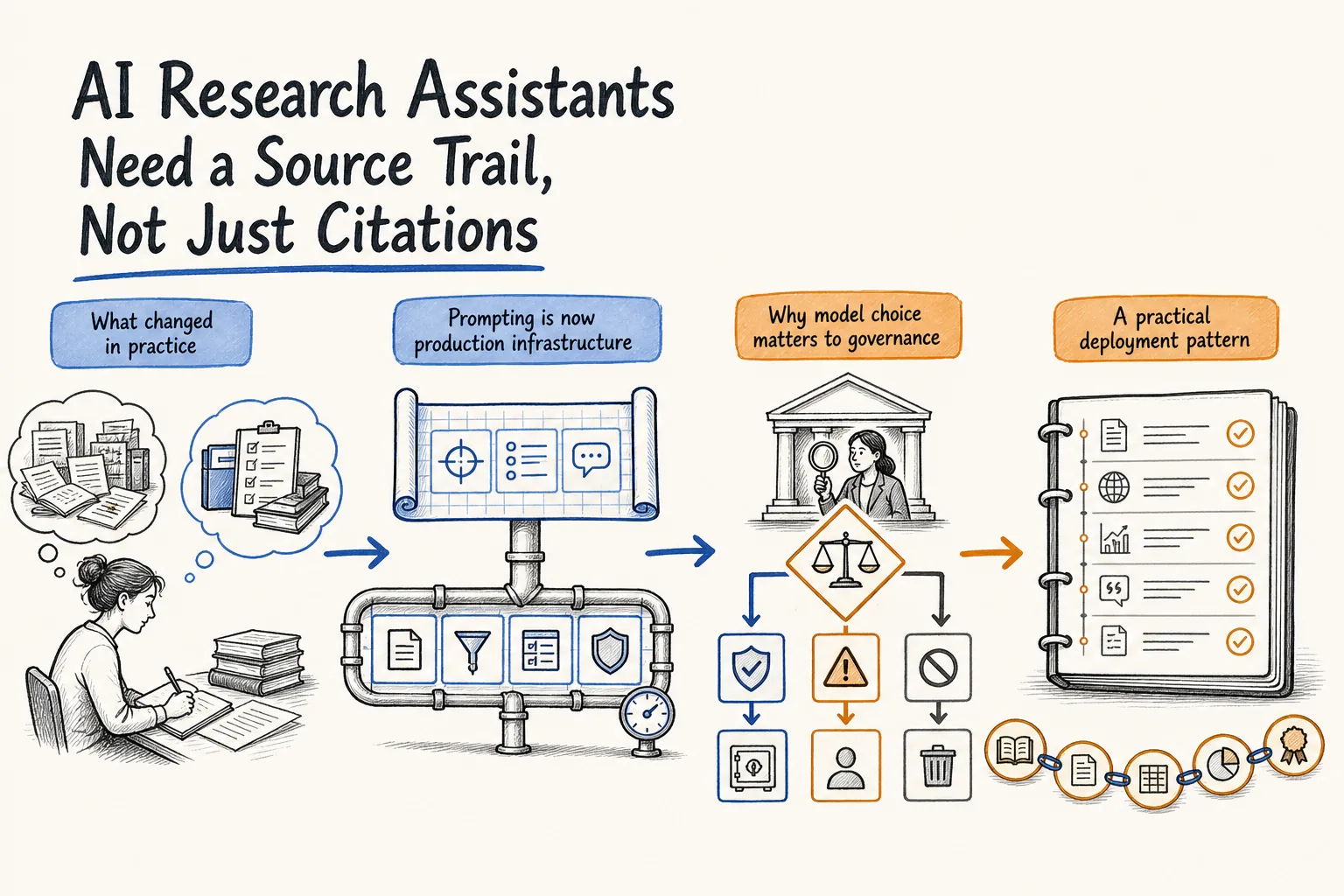
To compare tools meaningfully, treat prompting and scoring as production infrastructure: same queries, same pass/fail rules, same requirement that unsupported synthesis be labeled as inference rather than fact.
Why Does Citation Testing Matter More for AI Research Assistants in 2026?
Citation testing matters more now because researchers are using generative tools for high-stakes synthesis while those tools still invent, misattribute, and quietly update their sources. University of Nevada, Reno Libraries put the failure mode plainly: you are evaluating the claim, not the vibe of the source list, and a citation you cannot locate may be hallucinated.
The error rate is not theoretical. A JMIR study of ChatGPT-generated references found that only about 73–76% of citations corresponded to real sources. Stanford HAI reported that legal AI models hallucinated on at least one in six benchmarking queries. Those figures are why “it gave me a bibliography” is not an acceptance test.
Freshness raises the stakes further. Industry analyses of AI search citations report that roughly half of AI-cited pages are less than 13 weeks old, and that AI-cited content is on average about 25% fresher than classic web results. Assistants that omit update dates can look current while recycling last quarter’s numbers. If your workflow includes literature reviews, policy memos, or investment research, an unaudited assistant is a silent co-author with no lab notebook.
What Scoring Rubric Should You Use to Audit an AI Research Assistant?
Use a claim-level rubric with binary gates and one graded alignment score, not a holistic “this looks scholarly” impression. The unit of evaluation is a single factual sentence plus its cited span, which is the same grain used in automated citation-validation pipelines that compare statements against referenced text.
Score each material claim on this rubric:
| Check | Pass | Partial | Fail |
|---|---|---|---|
| Source coverage | Primary or peer-reviewed source appropriate to the claim | Relevant secondary source only | Blog, SEO page, or wrong domain for the claim |
| Clickable citation | URL opens the cited document at a usable location | URL opens a homepage or paywall splash | Dead, redirected-to-unrelated, or fabricated link |
| Claim-to-source alignment | Source entails the claim, including numbers and hedges | Source is on-topic but does not support the exact claim | Contradiction, wrong number, or unsupported leap |
| Update date | Date shown and appropriate to the query | Date present but stale relative to the question | No date, or date implied without evidence |
| Labeled inference | Assistant marks synthesis, extrapolation, and unknowns | Mixed sourced and inferred text, only weakly flagged | Inferences written as established fact |
A practical pass line for professional use is: zero fabricated links, zero unlabeled numerical claims, and at least 80% of material claims fully entailed by the cited span. Entailment is the right standard because it grades the inference gap rather than keyword overlap; ACL Findings research on Open-QA evaluation shows entailment scoring tracks human judgment more closely than exact-match metrics.
Run the rubric on a fixed probe set: one fast-moving news/policy question, one quantitative scientific claim, one contradictory-literature question, and one “what is unknown” question. If the assistant cannot fail gracefully on the last item, it is not ready for research.
How Do Elicit, Consensus, Scite, Perplexity, and Jenova Compare on Source Integrity?
No single AI research assistant leads every TRACE dimension. Elicit is strongest for structured extraction from a large paper corpus; Scite is strongest for citation polarity; Perplexity and ChatGPT are fastest for open-web answers with inline links; Jenova’s Academic Research Assistant is stronger when you need a live, multi-source research session that can keep an audit trail across turns.
Hands-on 2026 comparisons typically treat Elicit as the literature-review workhorse and Consensus as the faster yes/no evidence meter. Medical-research roundups describe Perplexity as the quickest general-purpose option with inline citations, and less constrained than academic specialists. HKUST’s literature-review tool comparison is a useful catalog of coverage and access differences across this set.
| Feature / Dimension | Elicit | Scite | Consensus | Perplexity / ChatGPT | Jenova Academic Research Assistant |
|---|---|---|---|---|---|
| Source coverage | 125M+ papers; academic-first (Elicit) | Citation graph and full-text Smart Citations (Scite) | Paper corpus tuned to research questions | Open web plus optional academic sources | Live web + scholarly search, manuscript and citation workflow |
| Clickable citations | Paper records and extracts | Citation pages with context snippets | Paper-backed answers | Inline URLs; quality varies by query | Inline, clickable source links in research answers |
| Claim-to-source alignment | Published extraction accuracy of 1,502/1,511 data points (99.4%) | Shows supporting vs. contrasting citations | Strong for binary evidence questions | User must verify; hallucination risk documented | Depends on retrieved span; no published extraction benchmark |
| Update dates | Paper metadata (year, venue) | Publication-year context | Paper-year context | Inconsistent unless prompted | Can surface and compare dates when sources expose them |
| Labeled inference | Structured columns reduce hidden leaps | Polarity labels, not full epistemic tags | Consensus Meter signals agreement | Rarely labels inference unless asked | Can be instructed to tag sourced vs. inferred claims |
| Pricing (as of 2026) | Unverified in this review | Unverified; older tests noted a short trial (Pure AI) | About $144/year entry point in one 2026 comparison | Unverified; vendor-tiered | Free limited usage; Plus $20/mo (30×), Premium $50, Pro $100, Max $200, Ultra $500, Enterprise $1,000 |
| Best for | Systematic extraction from papers | Checking whether literature supports a claim | Fast yes/no scientific questions | Broad web research with inline links | Auditable, multi-turn research and citation management |
Jenova’s honest limitation is structural: it is not a purpose-built paper-extraction grid like Elicit, and it does not ship Scite’s supporting-versus-contrasting citation graph. Its advantage is session memory plus live retrieval, which matters when an audit requires follow-up questions against the same source trail. Elicit’s limitation is the inverse — exceptional inside a paper index, weaker as a general web or policy-document researcher. Perplexity and ChatGPT remain the easiest tools to over-trust because fluent inline citations can still fail alignment.
How Do You Test Source Coverage and Clickable Citations?
You test coverage by asking questions whose correct answer cannot come from one corpus, then you click every link. A coverage pass means the assistant retrieves the genre of source the claim requires — a trial for a clinical effect size, a statute or agency page for a legal threshold, a dataset codebook for a statistic — rather than a convenient blog that mentions the same keywords.
Build three coverage probes:
- Academic-only probe: “What do randomized trials since 2020 show about X, and which outcomes were pre-registered?”
- Primary-document probe: “What does the original agency rule, filing, or dataset say — not a news recap?”
- Negative-space probe: “Which reputable sources discuss this and still treat the effect as unproven?”
Then apply a click protocol. For each citation, record whether the URL resolves, whether the landing page is the cited document, and whether a human can find the supporting passage within two minutes. Northwestern’s evaluation guide recommends searching the title in a library catalog or database because AI systems often attach a real title to the wrong journal, author, or year. Dead links, homepage dumps, and “source: the internet” footnotes are automatic fails.
On Jenova, make coverage an explicit instruction rather than a hope:
“Answer using at least four independent sources. Prefer peer-reviewed papers, government or standards bodies, and primary datasets. For each claim, give a clickable URL, the document title, the publication or update date, and a 15–25 word quotation that supports the claim. If you cannot find a primary source, say so and stop.”
On Elicit, the equivalent test is whether extracted cells map back to visible paper spans rather than to a model paraphrase. On Perplexity or ChatGPT, the test is harsher: open every inline link, because open-web research agents can retrieve many pages and still cite the weakest one. Pairing Jenova’s Academic Research Assistant with Real-Time Search is useful when the probe spans papers, forums, code repositories, and news at once — but each channel still needs its own click check.
How Do You Test Claim-to-Source Alignment and Labeled Inference?
You test alignment by asking whether the cited passage entails the sentence, not whether it is vaguely related. The failure that matters most is a near-miss number or a dropped qualifier: the source says “about 80%,” the model writes “78%,” and the citation still looks perfect. That is the exact error class automated evaluation runners are built to catch.
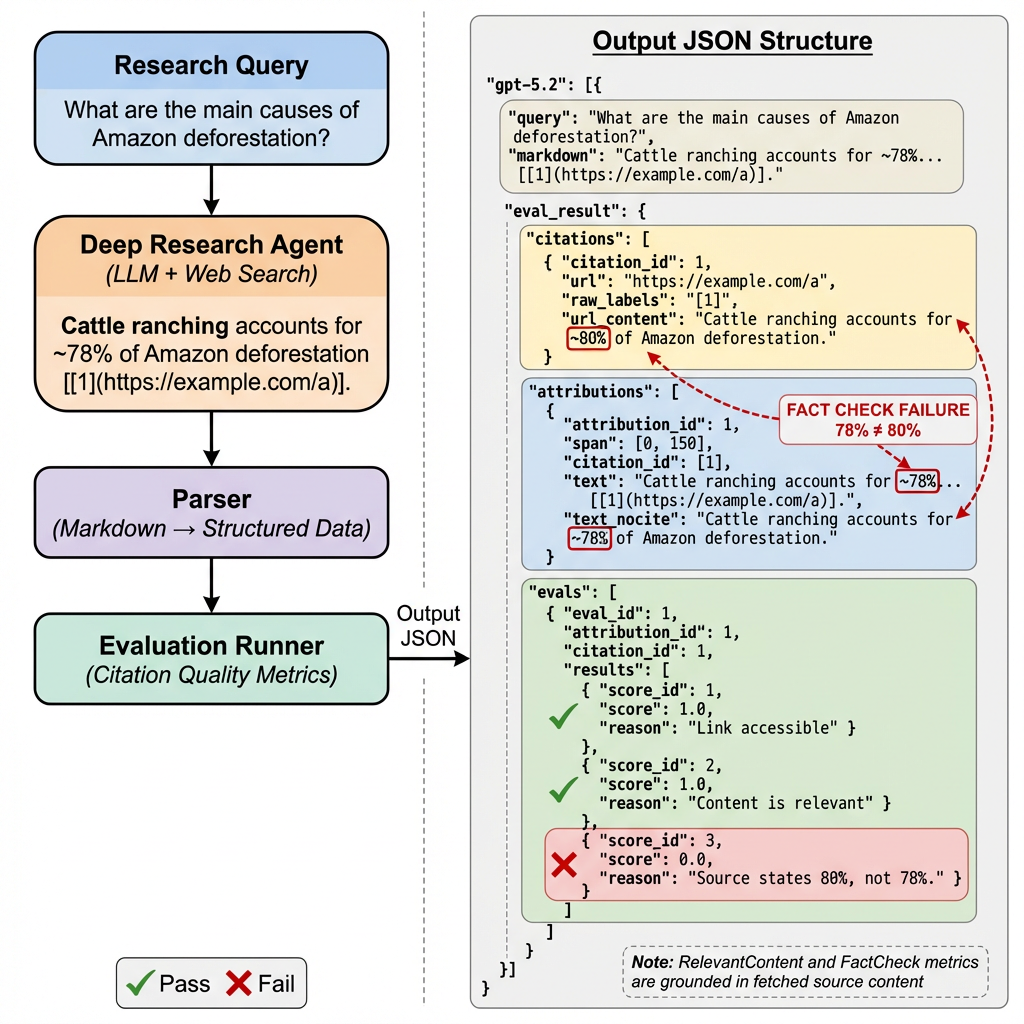
Use a three-layer alignment test on every quantitative or causal claim:
- Span match: highlight the sentence in the source that supposedly supports the claim.
- Entailment: decide entailed, underdetermined, or contradicted. Underdetermined is a fail if the assistant stated the claim as fact.
- Fidelity of numbers and hedges: units, sample, year, confidence interval, and words such as “may,” “in mice,” or “in one country” must survive intact.
This is why textual entailment is a better audit metric than “the page is on topic.” Entailment-based Open-QA evaluation exists specifically to quantify the inference gap between two strings. NVIDIA’s citation-validation approach operationalizes the same idea: compare the claim to the referenced text, then score it.
Labeled inference is the companion check. A research assistant should tag each paragraph as sourced, inferred, or unknown. Synthesis is allowed; silent synthesis is not. UNR’s claim-checking guidance is the right instinct: ask who can verify the statement. If the verifier is “the model’s general knowledge,” the sentence needed an inference label.
A strict prompt for this check:
“Separate your answer into three labeled blocks: (1) Directly supported claims, each with a quotation and URL; (2) Inferences, with the premises they rest on; (3) Unknowns. Do not move an inference into block 1. If a number is approximate in the source, keep the approximation.”
Elicit reduces hidden inference by forcing answers into extraction columns, which is a genuine strength. Scite labels whether later papers support or contrast a citation, which catches a different leap — treating one paper as settled consensus. Jenova can follow the three-block format across a long session, but it will not enforce those labels unless you require them. That is a real product gap relative to tools with baked-in evidence meters.
How Should You Verify Update Dates and Source Freshness?
You verify freshness by demanding a visible date on every source and by including at least one probe whose correct answer changed in the last year. An assistant that cannot show when a page or paper was published is not ready for questions about prices, regulations, model releases, epidemiology, or market structure.
Content-freshness research in AI search finds that recency affects whether systems retrieve a page for a current question. Tracking work on AI citations likewise warns that engines re-evaluate sources continuously, so yesterday’s tidy brief can silently rot. Your audit should therefore record three dates, not one:
- Source date — publication or last-updated timestamp on the page or paper
- Evidence date — the year the underlying data were collected
- Answer date — when the assistant retrieved the source
A common fail is citing a 2019 review for a “current” prevalence number, or citing a live dashboard without capturing the retrieval timestamp. Academic specialists such as Elicit and Consensus usually expose publication year because they sit on paper metadata. Open-web tools often do not unless instructed. Jenova can report dates when the retrieved document exposes them, but it cannot invent a trustworthy timestamp for an undated page — and it should say so.
Freshness probe examples:
“What is the current figure as of 2026? Give the source’s update date. If the best source is older than 18 months, label the answer historical, not current.”
“Compare the newest source you can find with the most-cited older source. What changed, and what did not?”
If the assistant cannot distinguish a revised HTML page from an unchanged PDF reprint, score currency as fail even when the URL works.
How Do You Run a Repeatable TRACE Audit From a Single Prompt?
You run a repeatable audit by freezing the probe set, freezing the scoring sheet, and forcing every tool to emit the same machine-checkable fields. The goal is a transcript another researcher could re-score without watching you work.
Use this sequence for Jenova’s Academic Research Assistant, then repeat it on at least one specialist (Elicit or Scite) and one generalist (Perplexity or ChatGPT):
- State the role and the output contract before the question.
- Ask one probe from each class: quantitative, contradictory, primary-document, and unknown.
- Require title, URL, date, quotation, and claim label on every citation.
- Click every link and score TRACE before asking any follow-up.
- Only then request a revision of failed claims.
Starter contract:
“You are under audit. For every material claim, output: claim text; label (sourced / inferred / unknown); source title; clickable URL; publication or update date; supporting quotation ≤25 words. If alignment is imperfect, lower the label to inferred or unknown. Do not cite sources you did not retrieve. End with a coverage note listing source types used and source types missing.”
On Elicit, the parallel procedure is: run the same question as a research report, then spot-check extracted cells against the PDF span. On Scite, run the core claim as a citation-context query and count supporting versus contrasting papers before you accept a consensus-sounding sentence. On ChatGPT Deep Research, OpenAI’s own research workflow still requires you to inspect sources; the product feature is retrieval plus structure, not a substitute for entailment checking.
Keep a simple log — claim, URL, date, TRACE scores, notes. Ten claims across four probes is enough to see a pattern. If more than two numerical claims fail alignment, stop using the tool for any deliverable that will be cited by someone else.
What Do Research Integrity Practitioners Say About AI Citation Testing?
Research integrity practice has converged on a blunt rule: treat AI citations as unverified assertions until a human or an automated entailment check has opened the source. The useful debate is no longer whether models hallucinate, but which failures you can instrument.
“The field keeps optimizing for prettier bibliographies. That is the wrong unit. A citation is a pointer, not a proof. If the quoted span does not entail the sentence — especially the number, the population, and the year — the citation is decorative. We have seen ‘78% versus 80%’ failures pass every cosmetic check: real URL, relevant title, confident tone. Those are the errors that survive into manuscripts.”
“Labeled inference is the cheapest control that most teams skip. Once an assistant is allowed to mix retrieval with world knowledge, it will launder guesses as findings. Force three buckets — sourced, inferred, unknown — and your hallucination rate becomes visible. Teams that refuse to show an unknown bucket are telling you they cannot represent uncertainty.”
“Coverage testing is also a governance choice. A paper-only assistant will look rigorous and still miss the agency memo that changed the rule last month. A web-only assistant will look current and still miss the trial that actually measured the outcome. Model choice matters here because some models hedge, some compress, and some drop qualifiers. The audit has to follow the claim, not the brand.”
— Jenova Product Team, research-agent evaluation, 6 years building retrieval-and-citation workflows for academic and professional users
That position matches library practice. Northwestern documents cases where a model cited a real encyclopedia article and still got names and dates wrong. UNR tells researchers to ask who can verify the claim. Both are TRACE in prose form.
When Is an AI Research Assistant Good Enough to Use in Real Research?
An AI research assistant is good enough when it survives a TRACE audit on your actual question types, with failed claims either corrected from the source or downgraded to labeled inference. It is not good enough when it produces fluent, link-rich answers that collapse under a click-and-entailment check.
Use this decision rule:
- Use a specialist extractor such as Elicit when the task is screening or data extraction from a known paper set, and you will still spot-check cells.
- Use Scite when the question is whether the literature supports, mentions, or contrasts a specific claim.
- Use Consensus when you need a fast evidence-direction read on a bounded scientific question.
- Use Perplexity or ChatGPT for broad reconnaissance, then re-verify every number before it enters a manuscript.
- Use Jenova’s Academic Research Assistant when the work is multi-turn — literature discovery, manuscript language, and citation management in one auditable thread — and you are willing to require TRACE fields in the prompt.
Do not use any of them as an unsupervised last mile. The JMIR citation-accuracy results and Stanford HAI hallucination rates are sufficient reason to keep a human in the loop. The winning setup in 2026 is not a single “trusted” model. It is a source trail you can replay: clickable links, dated documents, entailed claims, and a visible boundary between evidence and inference.
References
- Northwestern University Libraries — Evaluating AI Generated Content
- University of Nevada, Reno Libraries — AI and Source Evaluation
- JMIR — Evaluation of Large Language Model Performance and Reliability of Generated Citations
- Stanford HAI — AI on Trial: Legal Models Hallucinate in 1 out of 6 (or More) Benchmarking Queries
- AuthorityTech — Content Freshness SEO in 2026
- Chris Long / Ahrefs discussion — Freshness and AI Search Visibility
- ACL Findings — Accurate and Nuanced Open-QA Evaluation Through Textual Entailment
- NVIDIA Developer — Automatic Citation Validation Using NVIDIA NIM
- Elicit — AI for Scientific Research, Coverage and Extraction Accuracy
- Scite — Smart Citations for Scientific Literature
- The Drive AI — Elicit vs Consensus vs Semantic Scholar
- iatroX — Best AI Tools for Medical Research 2026
- HKUST Library — Emerging AI Tools for Literature Review Comparison
- Omid Saffari — Best AI Research Tools 2026: Elicit vs Consensus
- Pure AI — Citation Needed: Putting 7 AI Research Tools to the Test
- SEOptimer — Content Freshness in SEO and AI Search
- OtterlyAI — How to Track AI Search Engine Citations and Sources
- Firecrawl — Web Search and Deep Research for AI Agents
- OpenAI Academy — Research with ChatGPT: Search and Deep Research