How Should International Students Use AI for Admissions Planning?
2026-08-25
What Is the Three-Bucket Test for AI Admissions Advice?
International students get safer results from AI when they sort every prompt into school information, visa process mapping, or official confirmation — and they treat only the first bucket as something a model can draft without a university or government source open beside it. In 2026, specialized agents such as Jenova's Immigration & Visa Consultant, general chatbots, and admissions apps can speed research, but none of them issue a Form I-20, approve an F-1 visa, or replace a Designated School Official (DSO).
Key factors that separate useful AI planning from risky mixing:
✅ School facts — deadlines, course sequences, essay prompts, test-optional policies — can be compared with AI if every claim is checked on the university site ✅ Visa questions can be mapped as a sequence, but the steps must match Study in the States and the U.S. Department of State student visa page ✅ Official confirmation items — eligibility, document validity, fee payment, visa outcome — require a school, the Student and Exchange Visitor Program (SEVP), or a consulate ✅ Passport numbers, SEVIS IDs, and bank letters should not be pasted into unvetted tools ✅ Application essays remain the student's own work under Common App authenticity rules
To compare tools meaningfully, it helps to ask whether they isolate these three buckets or collapse them into one fluent answer.
Why Is Separating These Questions More Urgent for International Applicants in 2026?
International applicants face a stacked process that domestic applicants never see: academic admission, SEVP certification, Form I-20 issuance, the I-901 SEVIS fee, a consular interview, and status maintenance after arrival. AI is fluent across all of those topics, which is exactly why mixed chats become dangerous — a confident paragraph can sound like a decision when it is only a summary.
The U.S. Department of Education's 2025 AI guidance treats college and career pathway exploration as a legitimate use of AI, with human oversight and privacy limits. That supports school research. It does not authorize a chatbot to certify immigration status.
Visa rules also move. On July 17, 2026, the Department of Homeland Security published a final rule creating a fixed period of admission and an extension-of-stay procedure for F students. A model that still describes “duration of status” as if it were unchanged can mislead a senior who is choosing Early Decision.
School-side complexity is high as well. New York University evaluates first-year international applicants who will complete pre-university education equivalent to U.S. 12th grade, and need-aware review for international students makes binding Early Decision a financial decision, not only an admissions tactic. AI can explain that distinction. It cannot tell you whether your aid package will make ED affordable.
What Should You Look for in an AI Tool for International Admissions Planning?
You should look for tools that isolate domains, cite official sources, refuse to “confirm” status, and keep personal identifiers out of the chat. Those four tests matter more than essay polish or a long feature list.
A practical evaluation framework — call it the Three-Bucket Verification Framework — scores tools on six dimensions:
- Domain isolation — Does the product keep school research, visa mapping, and confirmation requests in separate threads or agents?
- Source grounding — Does it point to .gov and .edu pages, or only to generic training knowledge?
- Confirmation gating — Does it clearly say “verify with your DSO / embassy / admissions portal”?
- Privacy handling — Can you work without uploading passport bio pages or tax documents?
- Application integrity — Does it support brainstorming and grammar without drafting the essay as if it were yours?
- Cost and access — Is there a usable free tier, and are paid limits monthly rather than unpredictable?
New York City Public Schools' AI guidance states the same principle in simpler form: AI supports decisions, it does not replace them, and personal information should not go into unapproved tools. TeachAI's sample guidance adds a second rule students can use daily: review and critically assess every output before acting on it.
The World Economic Forum's responsible-use principles start with purpose and compliance. For international admissions, purpose means “compare NYU Stern math sequencing with my transcript.” Compliance means “do not ask the model whether my I-20 is valid.”
How Do Specialized AI Agents Compare With General Chatbots and Admissions Apps?
Specialized agents are stronger when the job is keeping school research apart from visa mapping, while general chatbots are stronger for quick, low-stakes summaries and essay-focused apps are stronger for drafting practice — each with clear limits. No option in 2026 is an official confirmation channel.
| Feature / Dimension | General chatbots (e.g., ChatGPT) | Jenova Immigration & Visa Consultant | Kollegio | Kolly |
|---|---|---|---|---|
| Domain isolation (school vs. visa vs. confirmation) | Single mixed chat unless the user enforces it | Separate domain agents; visa work is not blended with essay drafting | Built for college matching and essay feedback | Built for admissions essays |
| Source grounding | Variable; often no .gov citation unless prompted | Evidence-based consultation with real-time research | Product site emphasizes recommendations and feedback | Trained on accepted essays, not SEVP rules |
| Confirmation gating | Will often answer eligibility questions unless refused | Stronger at process mapping; still not a DSO or consulate | Not designed as an immigration source | Not designed as an immigration source |
| Essay / application integrity | Easy to overuse for drafting; Common App treats unattributed AI content as a fraud risk | Admissions writing sits in other agents; this agent is visa-focused | Essay feedback is a core feature | Essay generation is the core feature |
| Pricing (as of 2026) | Consumer free and paid plans; verify current rates | Free tier with limited usage; Plus starts at $20/month for 30× usage | Unverified | Unverified |
| Best for | Fast overviews and prompt experiments | Separating visa process questions from school research | College list building and counselor-style matching | Students practicing essay structure |
General chatbots
General chatbots are widely available and useful for translating a university webpage, turning a deadline list into a calendar, or generating questions to ask a counselor. Their limitation is structural: one thread will happily answer “Is NYU test-optional?”, “Can I work off campus?”, and “Is my visa going to be approved?” as if those were the same kind of fact.
Kollegio and other matching tools
Kollegio describes itself as an AI college counselor for personalized recommendations and essay feedback. That is a genuine strength for school-information work. It is a poor fit for SEVIS, I-901 fees, or OPT rules, and treating matching output as an admissions decision is still a bucket error.
Kolly and essay-trained models
Kolly markets itself as an admissions model trained on accepted essays from highly selective universities. That can help a student see structure. It does not solve visa sequencing, and it sits in tension with schools that prohibit AI-generated application content. Lumiere Education's roundup of admissions AI tools is similarly essay- and test-prep heavy — useful for bucket one, silent on bucket three.
Jenova's specialized agents
Jenova's Immigration & Visa Consultant is built for destination-country pathways and evidence-based research rather than a single mixed chatbot. Related agents such as the TOEFL/IELTS Tutor, SAT/ACT Tutor, and MBA Admissions Consultant keep English testing and school applications in other rooms. Persistent memory helps a multi-year plan stay consistent.
The honest limitation is the same one every responsible tool should advertise: Jenova does not issue immigration documents, cannot see your SEVIS record, and is not a substitute for a DSO, licensed attorney, or consular officer. Domain separation reduces mix-ups. It does not create official status.
How Can You Use AI for School Information Without Treating It as Official?
You can use AI to compare published requirements, build a four-year academic map, and prepare questions for counselors — as long as every date, test policy, and financial-aid rule is verified on the university's own admissions pages. School information is the only bucket where AI drafting is routinely appropriate.
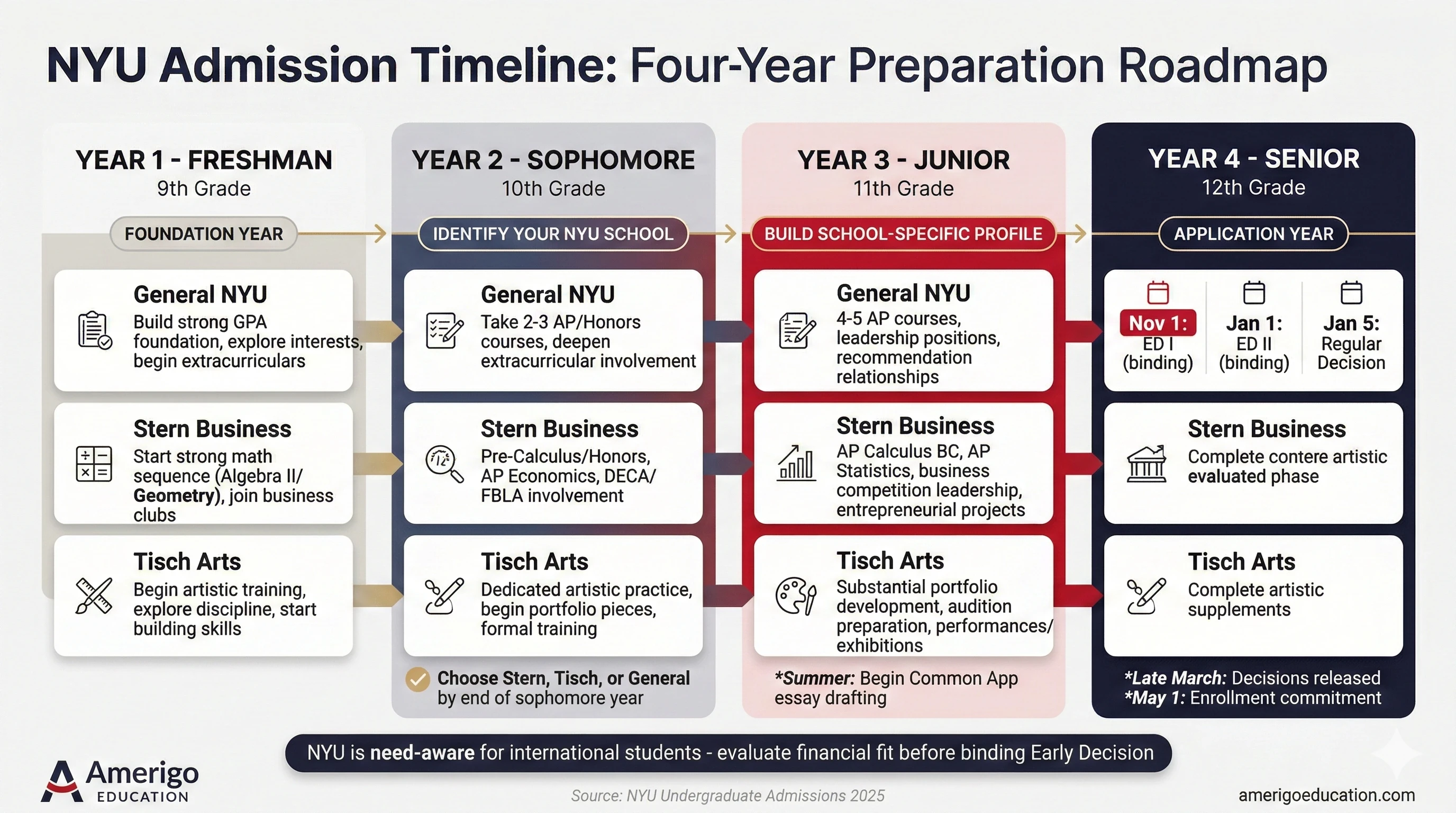
A planning infographic like the NYU four-year roadmap above is a good example of bucket-one material. It organizes GPA building in ninth grade, AP and honors load in tenth and eleventh, and senior-year deadlines such as Early Decision I, Early Decision II, and Regular Decision. Amerigo Education's 2026 NYU pathway analysis similarly notes test-optional practice and a heavier AP/IB load for competitive Stern and Tisch profiles.
Use AI to turn that map into a personal checklist. Do not use AI to invent NYU's current deadline if you have not opened NYU's site.
A clean school-information prompt looks like this:
"I am an international student comparing undergraduate business programs. Summarize NYU Stern's publicly described academic preparation, and list what I must verify on NYU's international applicant page. Do not advise on F-1 eligibility, I-20 issuance, or whether I should apply Early Decision for visa reasons."
Then verify against NYU's international applicant resources. Repeat the same pattern for University of California international applicants and Princeton's international student page. Different institutions publish different testing options, credential rules, and aid policies. AI is a comparison layer, not the record.
School-information tasks that are usually AI-appropriate:
- Translating a requirements page into a table of courses, tests, and documents
- Explaining what “need-aware” means before a binding ED round
- Building a week-by-week senior fall calendar from published dates
- Generating counselor questions about curriculum rigor in your home system
School-information tasks that quietly become confirmation requests:
- “Will NYU accept my diploma board results?”
- “Is my transcript official enough?”
- “Can I skip this English test?”
Those belong in bucket three until the admissions office answers.
Which Visa and SEVIS Questions Can AI Map but Never Confirm?
AI can outline the F-1 and M-1 sequence — SEVP-certified school, Form I-20, I-901 SEVIS fee, visa interview, entry timing, status maintenance, and departure — but it cannot confirm that your record, payment, or interview result is valid. Process mapping is bucket two. Approval is bucket three.
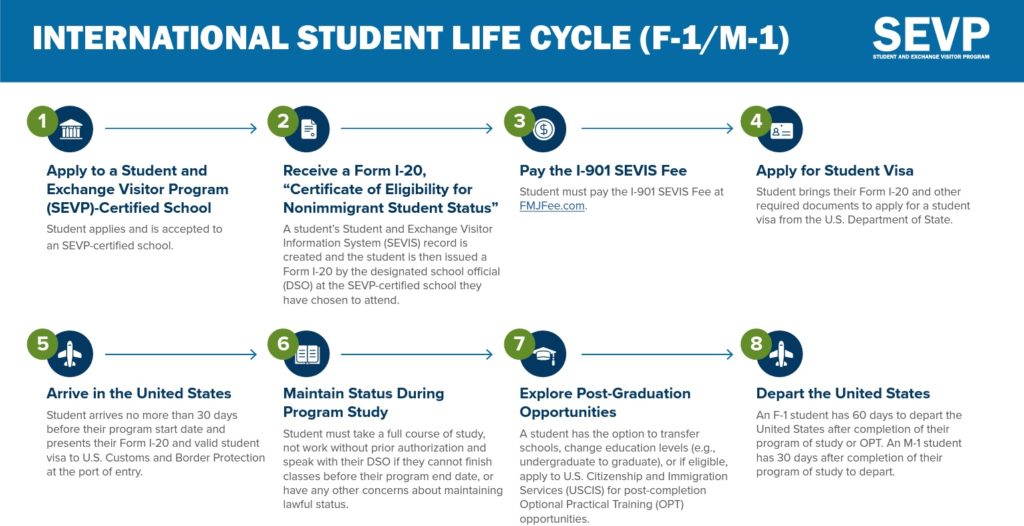
The Study in the States student resources are the primary public map for this cycle. After a school accepts you, a DSO creates a SEVIS record and issues Form I-20. The Department of State then requires that I-20 at the visa interview. Arrival is generally no more than 30 days before the program start date. F-1 students usually have 60 days after the program to depart; M-1 students have 30 days. Those numbers are rules to verify, not AI opinions.
A responsible visa-mapping prompt:
"Map the public F-1 steps from SEVP-certified admission to visa interview using Study in the States and travel.state.gov. Flag every step that only a DSO, SEVP portal, or embassy can complete. Do not tell me whether I will be approved."
NAFSA's summary of USCIS policy manual guidance on F and M students is another human-readable pointer back to primary law. Use AI to find that page. Do not use AI as a replacement for it.
Visa questions AI may map:
- What documents people typically bring to a student visa interview
- What “full course of study” means in public SEVP materials
- How OPT is described as a post-completion option, not a guarantee
- Why transferring schools or changing education levels requires a DSO
Visa questions AI must not close:
- “Is my I-20 correct?”
- “Was my I-901 payment accepted?”
- “Will the consular officer approve me?”
- “Can I work this campus job without authorization?”
If the answer would change your legal status, it is not a chatbot answer.
What Items Require Official Confirmation From a School or Government Office?
Anything that creates, changes, or proves status — admission, I-20, SEVIS fee, visa stamp, entry, work authorization, or graduation — requires an official actor, not an AI summary. This is the bucket students skip when a model sounds certain.
Treat the following as confirmation-only. AI may remind you to request them. AI may not “green-light” them.
School / admissions office
- Application complete / incomplete status in the portal
- Official transcript and credential-evaluation acceptance
- English-test waiver decisions
- Admission, deferral, or waitlist outcome
- Financial-aid or scholarship award letters
- Whether binding Early Decision is financially viable for a need-aware international review
DSO / SEVP-certified school
- Form I-20 issuance and program dates
- SEVIS transfers, level changes, and reduced-course-load authorizations
- On-campus work rules as applied to your campus
- CPT or OPT recommendation and timing
Government systems
- I-901 SEVIS fee payment at the official fee site
- Visa appointment, issuance, or refusal at a U.S. embassy or consulate
- Admission at the port of entry
- SEVP Portal access for eligible F-1 and M-1 students
- Any change created by the July 2026 fixed period of admission rule
A useful self-test: if a wrong answer could cancel a visa, delay an I-20, or cause a status violation, the item is bucket three. Put it on a tracker with an owner (admissions portal, DSO, or embassy) and a date. Leave the AI chat out of the “yes/no” cell.
How Do You Run a Three-Bucket Workflow From Research to Application?
Start three labeled threads or agents — School, Visa Map, Official Tracker — and never paste a confirmation question into the first two. That workflow works on Jenova and on a general chatbot; the difference is how much isolation the product gives you by default.
Step 1: Label the buckets before you type.
Write the heading in the chat: BUCKET 1 — SCHOOL, BUCKET 2 — VISA MAP, or BUCKET 3 — OFFICIAL TRACKER. If you cannot label it, do not ask yet.
Step 2: Do school research in a school-only space. On Jenova, keep testing and essay-adjacent work with the SAT/ACT Tutor, TOEFL/IELTS Tutor, or MBA Admissions Consultant rather than inside the visa agent. On a general chatbot, use a custom instruction:
"You are a research assistant for published university requirements. Cite official pages. If I ask about visa approval, I-20 validity, or whether I am eligible, refuse and tell me which official office confirms it."
Step 3: Map the visa sequence with sources, not outcomes.
Open the Immigration & Visa Consultant (or a fresh chatbot thread) and request a step list tied to Study in the States and the Department of State. Ask it to output a two-column table: What I can prepare vs. Who must confirm.
Step 4: Keep an official tracker outside the model. A spreadsheet is enough: item, office, date requested, date confirmed, document stored. AI can format the sheet. The checkmarks come from portals and emails, not from the model.
Step 5: Protect identity data. Follow the no-personal-information rule used in school AI guidance. Describe “a valid passport” rather than pasting the number. Describe “sufficient funds per the I-20” rather than uploading bank PDFs to an unknown tool. Jenova states that user data is not used to train public models and is encrypted in transit and at rest, which is relevant here — it still does not make the product a SEVIS system of record.
Step 6: Keep essays in human voice. College Essay Guy documents Common App language that the work you submit must be your own, and Brown, Caltech, and the University of California have published limits on AI-generated application content. Ethical uses they and Caltech describe include grammar review, brainstorming questions, and researching the process. Unethical uses include pasting a generated essay. International students under time pressure are the group most likely to blur that line.
Step 7: End every AI session with a verification list. Require the model to finish with: “Verify these n items on official pages.” If it cannot name the page, discard the claim.
What Do Admissions Experts Say About Using AI Around Immigration Rules?
Experts who work at the intersection of counseling and compliance treat AI as a sorting and research layer, not as an authority that can close an immigration or admissions question. The failure mode they flag is not “students used a chatbot.” It is “students let one fluent answer stand in for a DSO, a consulate, or an admissions portal.”
"The three-bucket split is a quality-control device, not a branding idea. School research is a synthesis task. Visa mapping is a navigation task. Confirmation is a records task. When those sit in one chat, models optimize for completeness and tone. Completeness is the wrong objective if the missing sentence is 'only your DSO can issue this I-20.'"
"We also see date drift. Students still quote older 'duration of status' language after a 2026 rule change, because the paragraph they saved last year still reads well. Any visa-adjacent answer that cannot name the current Study in the States or SEVP page should be treated as expired, even if it is eloquent."
"On essays, the integrity bar is already public. If a student would not be comfortable telling an admissions officer how AI was used, the use was too deep. Grammar passes. Ghostwritten supplements do not. That line does not move because the applicant lives outside the United States."
— Jenova Product Team, international admissions and agent-design group (experience building domain-separated research agents used by students planning cross-border applications)
The same caution appears outside vendor settings. At least 33 U.S. states have issued K-12 AI guidance, and higher-education application policies are catching up document by document. International students should assume the strictest published rule on the list — usually “your words, your facts, official offices for status” — rather than the most permissive chatbot default.
References
- Study in the States — Homeland Security overview of the nonimmigrant student process
- Study in the States — Students: F and M status, July 2026 admission-period rule, and maintenance resources
- ICE — Student and Exchange Visitor Program (SEVP) and SEVIS
- U.S. Department of State — Student Visa (F and M) and Form I-20 requirements
- U.S. Department of Education — Guidance on artificial intelligence use in education, including college and career pathway exploration
- College Essay Guy — Navigating college applications with AI, Common App authenticity rules, and institutional policies
- New York University — Resources for International Applicants
- Amerigo Education — NYU admissions pathway for international students, including need-aware review
- Kollegio AI — AI college counseling, recommendations, and essay feedback
- Kolly — Admissions-focused AI model trained on accepted essays
- Lumiere Education — Roundup of AI tools used in college admissions
- New York City Public Schools — Guidance on Artificial Intelligence, human oversight, and personal information
- World Economic Forum — Principles for responsible AI use in education
- TeachAI — Sample guidance on reviewing and assessing AI outputs
- NAFSA — USCIS Policy Manual guidance on F and M students
- University of California Admissions — International applicants
- Princeton Admission — International students
- AI for Education — Compilation of state AI guidance for schools