How Much Does Persistent Memory Actually Change AI Roleplay?
2026-08-07
Persistent cross-session memory changes AI roleplay more than any other single technical factor — it is the difference between a story that accumulates and a story that resets. Session-only memory holds a conversation inside a fixed context window; once that window fills or the session ends, the character forgets the promise you made, the ally you betrayed, and the emotional arc you built over twenty hours. Persistent memory writes those details to storage outside the conversation and retrieves them later, so continuity survives the session boundary.
The practical gap shows up in measurable ways. Snap Research's LoCoMo benchmark — built from conversations averaging 300 turns and 9,000 tokens across up to 35 sessions — found that long-context models and retrieval-augmented approaches improved memory-dependent question answering by 22–66% over short-context baselines, yet still trailed human performance by 56%, and by 73% on temporal reasoning. That gap is exactly what roleplayers feel as "the character forgot."
Key factors that separate genuine persistence from marketing claims:
✅ Storage location — memory written outside the context window survives session end; memory that only lives in the prompt does not ✅ Retrieval quality — storing facts is easy, surfacing the right fact at the right narrative moment is the hard part ✅ Temporal reasoning — knowing when something happened, not just that it happened, is where benchmarks show the widest failure gap ✅ Character consistency — persistent memory of personality and voice, not just plot events ✅ Deletion and export controls — persistence creates a permanent record of intimate conversation, which is a privacy liability as much as a feature
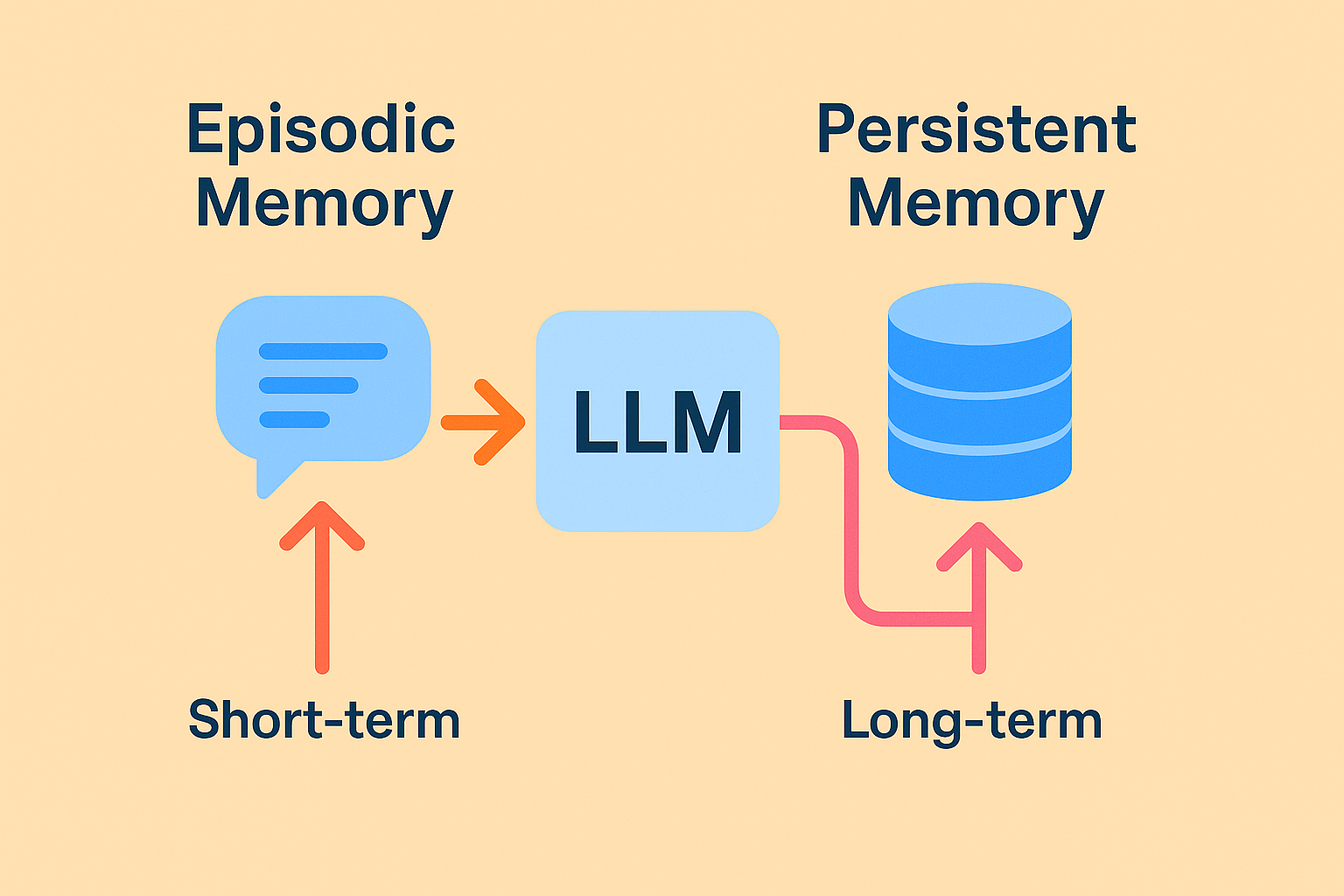
To compare roleplay platforms meaningfully, it helps to separate the two memory architectures precisely — because most platforms use both, and the marketing language rarely distinguishes them.
What Is the Difference Between Session-Only and Persistent Cross-Session Memory?
Session-only memory is the model's context window — the running transcript the model re-reads on every turn. Persistent memory is an external store the system writes to and retrieves from, independent of any single conversation.
The distinction is architectural, not a matter of degree:
Session-only (episodic) memory:
- Lives entirely inside the active context window
- Re-processed on every single message the model generates
- Bounded by a hard token limit — when full, earlier content is truncated or summarized away
- Vanishes completely when the session closes
- Fast and lossless within its boundary — nothing is "retrieved," everything is simply present
Persistent (long-term) memory:
- Extracted facts, summaries, or embeddings written to a database outside the conversation
- Retrieved selectively and injected into context when relevant
- Survives session end, app restarts, and often model switches
- Effectively unbounded in capacity, but lossy in retrieval — the system must correctly decide what to surface
The critical asymmetry: session-only memory is perfect-recall-within-limits, while persistent memory is imperfect-recall-without-limits. A 200,000-token context window remembers everything in it flawlessly. A persistent memory system remembers everything you've ever said — but only surfaces what its retrieval layer judges relevant, which is where errors enter.
This is why research surveying AI long-term memory architectures maps AI memory systems onto human categories — episodic, semantic, and procedural memory — rather than treating memory as a single capacity. A roleplay system needs episodic recall ("you killed the guard captain in chapter three"), semantic recall ("this character despises the nobility"), and procedural consistency ("this character always speaks in clipped sentences") simultaneously.
Why Do AI Roleplay Characters Forget Your Story?
Characters forget because session-only architectures physically discard content when the context window fills, and because persistent memory systems fail at retrieval even when the data still exists. Both failure modes produce the same user-facing symptom.
Failure mode 1: Context window overflow. In a long roleplay session, early scenes get truncated or compressed into lossy summaries. The character doesn't "forget" — the information is no longer in front of the model at all.
Failure mode 2: Retrieval miss. The persistent store contains the fact, but the retrieval layer doesn't surface it because the current turn didn't semantically match. This is the more insidious failure, because the platform can honestly claim it has memory.
Failure mode 3: Temporal confusion. The system recalls a fact but misplaces it in the timeline. LoCoMo's benchmark results isolate this precisely — temporal reasoning showed the largest human-model gap at 73%, far worse than general recall.
Failure mode 4: Hallucinated recall. The LoCoMo evaluation found that long-context models "demonstrate significant hallucinations, leading to difficulty with adversarial questions" — meaning the model confidently invents shared history that never happened. For roleplay, false memory is arguably worse than no memory, because it silently corrupts continuity.
This is a widely felt problem, not a niche complaint. Roleplayers on
as their primary friction point, citing "characters forgetting major past events" as the specific breaking pattern. The frames it as an unresolved technical problem across the entire category, despite Character.AI's scale.How Much Does Memory Actually Improve the Roleplay Experience?
Memory improves perceived intelligence and engagement measurably, but the research suggests the relationship is not purely positive — there is a trust dimension that cuts the other way.
What improves with persistent memory:
| Dimension | Session-Only | Persistent Cross-Session |
|---|---|---|
| Narrative payoff | Callbacks limited to current session | Setups from months ago can resolve |
| Character consistency | Personality drifts as early definition is truncated | Voice and traits anchored in external store |
| Relationship progression | Restarts from zero each session | Accumulates across the full history |
| Worldbuilding depth | Lore must be re-established or pasted in | Factions, locations, and rules persist |
| Onboarding friction | High — re-explain context every session | Near-zero after initial setup |
Where the picture gets complicated. An ACM pilot study titled "Remembering Things Makes Chatbots Sound Smarter, but..." investigated how semantic long-term memory affects user assessments of chatbot likeability, perceived intelligence, and perceived safety — the title itself signals that the gains are not uniform across all three dimensions. Memory that makes a system seem smarter can simultaneously make it feel more surveillant.
This is the trade-off most platform marketing omits. A character that remembers your childhood trauma from four months ago is more immersive and more unsettling than one that doesn't. Whether that's a feature depends entirely on the user's intent — narrative roleplay and companion roleplay have genuinely different memory requirements.
Our evaluation framework. Assessing roleplay memory meaningfully requires six dimensions, not one:
- Retention span — how far back can it recall?
- Retrieval precision — does it surface the right memory?
- Temporal accuracy — does it place events correctly in sequence?
- Character fidelity — does personality survive alongside plot?
- Cross-session continuity — does it work after closing the app?
- User control — can you inspect, edit, and delete what it stored?
Most platforms optimize for 1 and 5, which are the easiest to market. Dimensions 2, 3, and 6 are where real differentiation lives.
Which AI Roleplay Platforms Handle Memory Best?
No single platform leads on every memory dimension — the strongest choice depends on whether you prioritize world state, prose control, character variety, or cross-session persistence.
🎭 Character.AI
The largest character library and the easiest entry point. Character.AI reportedly reached around 20 million monthly active users as of February 2026. Memory is conversation-context based, and industry comparisons note "limited world simulation, no integrated scene art, and weaker long-story continuity than dedicated roleplay worlds."
Strong for: casual character chat, discovery, short scenes. Limited by: long-story continuity — the most common complaint in its own community.
📖 NovelAI
A prose studio rather than a chat game. Its memory approach uses lorebooks — manually curated entries that inject relevant world information into context based on keyword triggers. This is deterministic memory: you control exactly what surfaces.
Strong for: solo fiction, worldbuilding, author-led narrative where you want explicit control over what the model recalls. Limited by: it requires manual curation, and it is not built around multiplayer sessions or game-like loops.
🃏 Janitor AI
Character-card driven with high model flexibility. Memory quality "depends heavily on model choice, setup, and character design" — meaning memory is effectively a user-configuration outcome rather than a platform guarantee.
Strong for: large free character library, experimentation, model switching. Limited by: inconsistent memory behavior across configurations.
🛠️ SillyTavern + local models
The power-user stack. World info, extensions, and full prompt control, with the option to run entirely locally. Privacy is maximal because nothing leaves your machine.
Strong for: technical users who want control and privacy. Limited by: setup, model selection, hardware, and troubleshooting are part of the experience — this is a stack, not a finished product.
🎲 Jenova's Roleplay Game Master
Roleplay Game Master is built around unlimited memory and character consistency, with persistent cross-session memory operating at the platform level rather than per-character. Because Jenova maintains unlimited chat history and persistent memory across all sessions, a campaign can pause for weeks and resume with continuity intact. The agent also inherits multi-model access — you can switch the underlying model without losing accumulated story state, which is unusual in this category.
Strong for: long-running campaigns, complete creative freedom, cross-session continuity, model flexibility within a single story. Limited by: it is a general-purpose agent platform rather than a purpose-built roleplay social product — there is no character discovery marketplace, no community-shared character cards, no multiplayer co-op sessions, and no integrated scene image generation inside the roleplay flow. If your priority is browsing thousands of community characters or playing with friends in a shared world, dedicated roleplay platforms serve that better.
Comparison table
| Dimension | Character.AI | NovelAI | Janitor AI | SillyTavern | Jenova Roleplay Game Master |
|---|---|---|---|---|---|
| Memory type | Conversation context | Lorebook + long context | Model-dependent context | World info + extensions | Persistent cross-session |
| Cross-session continuity | Weak for long stories | Lorebook-driven | Configuration-dependent | Setup-dependent | Persistent by default |
| Character consistency | Character-card based | Author-controlled | Card + model dependent | Fully customizable | Platform-level consistency |
| Model flexibility | Platform model | Platform models | High | Full (local or hosted) | Multi-provider, switchable mid-story |
| Community characters | Very large library | Not applicable | Large free library | Card import | None |
| Multiplayer | Group chat features | Not party-first | Solo-first | Setup-dependent | Not supported |
| Pricing | Free tier + paid | Paid tiers | Free tier | Free software, hardware/API cost | Free tier; Plus $20/mo (30× usage) |
| Best For | Casual character chat | Solo prose and lorebooks | Free character variety | Maximum control and privacy | Long campaigns needing continuity |
Platform features and pricing change frequently. Verify current details on each provider's site before deciding.

How Do You Set Up Roleplay for Maximum Memory Continuity?
Regardless of platform, memory continuity improves substantially with deliberate setup — most degradation is preventable through structure rather than better technology.
Universal technique: the anchor summary. Every 20–30 turns, write a short in-session summary of established facts. This works on session-only systems (keeps facts in-window) and persistent systems (creates a high-signal record for retrieval to find).
"Before we continue — recap the current state: my character's name and traits, who we've allied with, who we've antagonized, unresolved plot threads, and the current location."
For NovelAI's lorebook approach:
- Create a lorebook entry for each major character, faction, and location.
- Set keyword triggers to the names that appear in normal prose.
- Keep entries under ~200 tokens each — long entries crowd out actual narrative context.
- Update entries after major plot developments rather than relying on the transcript.
For Jenova's Roleplay Game Master:
- Open the agent at jenova.ai/a/roleplay-game-master.
- Establish the world and character in the opening message rather than incrementally:
"Setting: a decaying merchant city where magic is illegal. I'm playing Kael, a former inquisitor now smuggling banned artifacts. Cynical, dry humor, avoids direct violence. Track my reputation with three factions: the Watch, the Guild, and the Ashen Choir."
- Continue in the same chat session across days or weeks — persistence operates at the session level, so returning to the same chat preserves the accumulated state.
- To verify continuity after a long break, prompt for a state check:
"Recap where we left off — my standing with each faction, open threads, and what I was about to do."
For SillyTavern:
- Configure World Info entries with appropriate scan depth and token budget.
- Use the summarization extension to maintain a rolling condensed history.
- Choose a model with a large context window — memory quality here is directly bounded by your model choice and hardware.
Cross-platform habit: name things explicitly and reuse the exact same names. Retrieval systems match on semantic similarity, and inconsistent naming ("the captain" vs. "Vell" vs. "that guard guy") fragments what should be a single memory into three weak ones.
What Are the Privacy Risks of Persistent Roleplay Memory?
Persistent memory means your intimate conversational history is stored, retained, and potentially difficult to delete — and research on this specific category finds the governance gaps significant.
A 2026 arXiv study analyzing 2,909 Reddit posts across 79 subreddits over one year identified four recurring privacy patterns in companion and roleplay AI:
- Disproportionate entry requirements — identity verification and broad integrations that feel excessive for a companion context.
- Intensified sensitivity in intimate use — conversations become "reclassified as diary-like or highly intimate records."
- Interpretive uncertainty and perceived surveillance — contradictory privacy signals produce a generalized sense of being watched.
- Irreversibility, persistence, and user burden — deletion and migration become difficult, and privacy work shifts onto users.
The study's central argument is directly relevant to the memory question: privacy in these systems "is shaped not only by what data are collected or reused, but by how governance is staged across access, interpretation, retention, and exit." Persistent memory is retention by design. The feature and the risk are the same mechanism.
The paper also notes that Italy's data protection authority fined Replika over privacy violations, including failures related to age verification — evidence that regulatory scrutiny in this category is active rather than theoretical.
Practical checklist before enabling persistent memory:
- ☐ Can you view what the system has stored about you?
- ☐ Can you delete individual memories, or only the entire account?
- ☐ Does deletion actually remove data, or only hide it from the interface?
- ☐ Is your conversation data used for model training?
- ☐ Can you export your history if you want to migrate?
Jenova states that user data is never used to train public AI models, is encrypted in transit and at rest, and is not sold or shared with advertisers. Global Memory — the cross-session layer — can be toggled off entirely in Settings, which disables both storage and retrieval. Local stacks like SillyTavern with local models offer the strongest privacy posture available, since data never leaves your hardware, at the cost of setup complexity.
What Do Researchers Say About Long-Term Conversational Memory?
The research consensus is that persistent memory delivers real gains but remains substantially below human performance, particularly on temporal reasoning — and that the reliability gap, not the capacity gap, is the current bottleneck.
"The most misread finding in the memory literature is the headline improvement number. LoCoMo showed retrieval-augmented and long-context approaches improving memory-dependent QA by 22 to 66 percent — which sounds like the problem is nearly solved. But the same benchmark showed a 56 percent gap to human performance overall and a 73 percent gap on temporal reasoning. For roleplay specifically, temporal reasoning is the product. A story is a sequence. If the system knows a betrayal happened but can't place it relative to the alliance that preceded it, the narrative logic collapses even though recall technically succeeded."
"The second thing worth flagging is that hallucinated recall is a distinct failure mode from forgetting, and it's more damaging in creative contexts. The LoCoMo evaluation found long-context models struggled with adversarial questions — they confidently confirmed events that never occurred. In a factual assistant, that's an error you can catch. In a 40-hour roleplay campaign, a confidently invented shared memory becomes canon, and the user has no external reference to check it against. We treat retrieval precision as more important than retrieval recall for exactly this reason."
"The architectural implication is that unlimited storage was never the hard part. Writing everything down is trivial. The hard part is deciding which three facts out of ten thousand belong in the context window for this turn. That's a ranking problem, and it's where the remaining engineering effort in this category actually sits."
— Jenova Product Team, AI agent memory and orchestration, 6+ years building production conversational systems
The research literature broadly supports this framing. Aveni Labs' evaluation of long-term memory for LLMs explored multiple distinct memory types rather than treating memory as monolithic, and ACL Findings research on evaluating long-term memory proposes more precise evaluation methods — signaling that measurement itself remains an open problem.
Notably, the LoCoMo authors found that RAG offers a balanced compromise, "combining the accuracy of short-context LLMs with the extensive comprehension of wide-context LLMs," and performs "particularly well when dialogues are transformed into a database of assertions (observations) about each speaker's life and persona." For roleplay platform selection, this favors systems that extract structured facts over systems that simply store raw transcripts.
Which Memory Approach Should You Choose for Your Roleplay Style?
The right architecture depends on session length, story complexity, and how much manual curation you're willing to do — there is no universally superior option.
Choose session-only memory when:
- Your scenes are self-contained and under a few hours
- You enjoy restarting with variations rather than continuing one thread
- Privacy is paramount and you want no retained record
- You're exploring characters rather than building a campaign
Choose lorebook-style curated memory (NovelAI, SillyTavern World Info) when:
- You're writing long-form fiction with a defined world bible
- You want deterministic control over what the model recalls
- You're willing to maintain entries manually
- Authorial precision matters more than convenience
Choose persistent automatic memory (Jenova Roleplay Game Master and similar) when:
- Your campaign spans weeks or months across many sessions
- You want continuity without manual curation overhead
- Relationship and reputation progression is central to the experience
- You value being able to close the app and return without re-establishing context
Choose local/self-hosted when:
- Privacy is non-negotiable
- You want to inspect and modify the memory layer directly
- You have the hardware and tolerance for configuration work
The honest summary: persistent cross-session memory makes a large difference — probably the largest single difference available in current roleplay tooling — but it is not free. It costs privacy surface area, it introduces hallucinated-recall risk that session-only systems don't have, and it still fails at temporal reasoning in ways that will occasionally break immersion. Choosing it means accepting those trade-offs in exchange for stories that actually accumulate.
If you're running a long-form campaign and want unlimited memory with consistent characters across sessions, the Roleplay Game Master is built for exactly that.