How Do You Verify Privacy, Evidence, and Crisis Safety in an AI Mental Health Tool?
2026-08-20
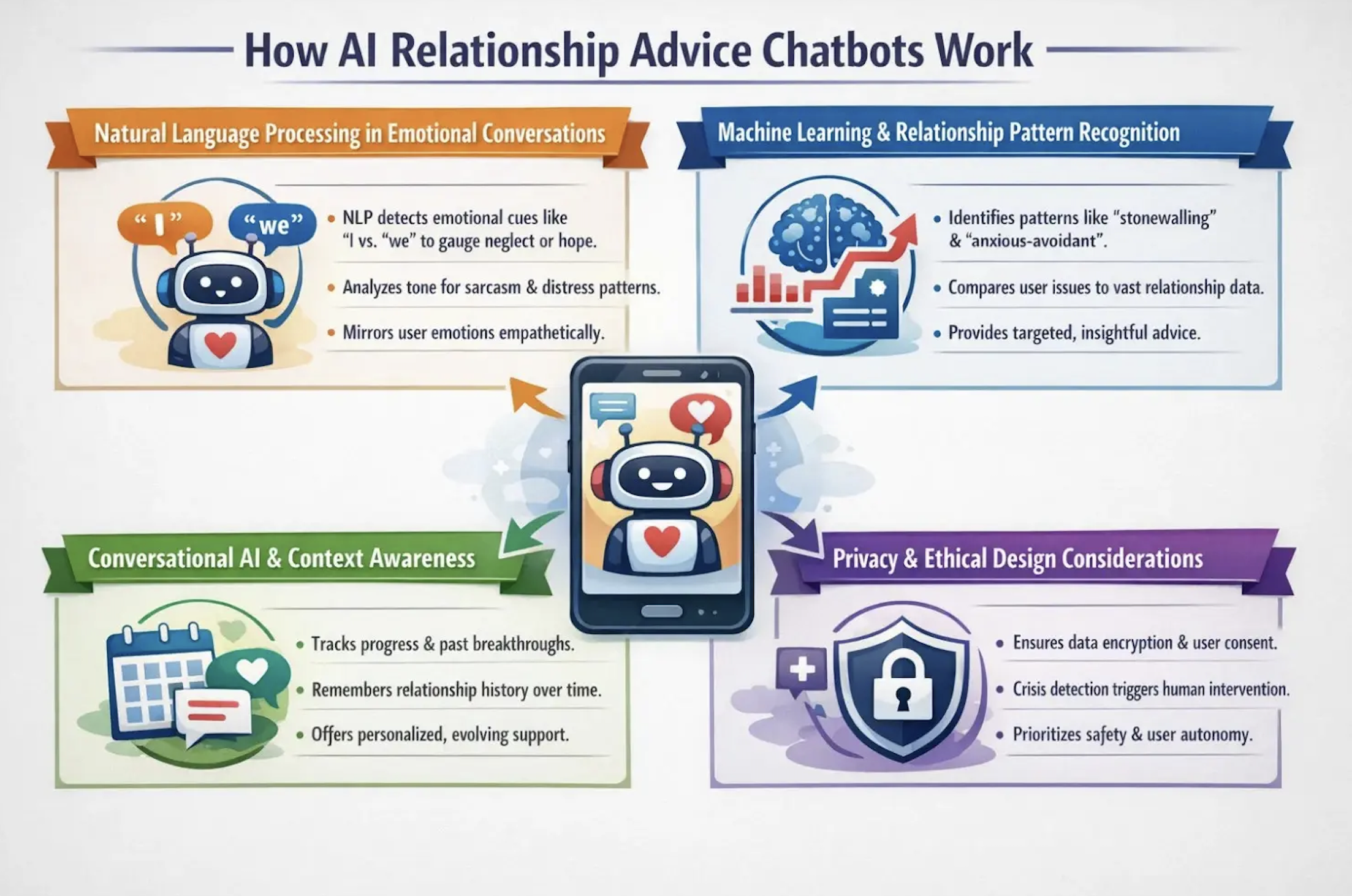
Which Four Verification Checks Separate a Safe AI Support Tool From a Risky One?
Four checks separate a defensible AI mental health support tool from a risky one: (1) a privacy policy naming a specific data controller, certifications, and named subprocessors; (2) evidence claims tied to peer-reviewed trials rather than testimonials; (3) explicit professional boundary disclosures stating the tool is not a licensed provider and does not diagnose; and (4) crisis escalation that surfaces functional hotlines within one or two taps, localized to your jurisdiction. Purpose-built tools like Wysa and Woebot publish more of this documentation than general-purpose assistants, but a 2026 evaluation found that no AI mental health app tested reached a "Good" or "Excellent" crisis-support rating — verification is on you.
What to look for before you type anything personal into a support chatbot:
✅ Named controller and DPO — a real entity, a contact address, and a stated response window for data requests ✅ Independent certifications — ISO 27001/27701, NHS DSP Toolkit, SOC 2, or equivalent third-party attestation ✅ Published trial evidence — peer-reviewed studies naming the specific product, not generic "AI therapy works" claims ✅ Explicit non-clinical disclosure — the tool states in writing that it does not diagnose, treat, or replace a provider ✅ One-to-two-tap crisis access — localized emergency numbers reachable without navigating three screens
Each of these can be checked in under 30 minutes using publicly available documents. The rest of this guide walks through how.
Why Does Verification Matter More for AI Mental Health Tools Than Other Apps?
Verification matters more here because the failure mode is clinical harm, not inconvenience. The American Psychological Association's health advisory documents that generative AI chatbots "have already engaged in unsafe interactions with vulnerable populations, such as children or those with already established history of mental health issues, encouraging self-harm (including suicide), substance use, eating disorders, aggressive behavior, and delusional thinking."
The category is also structurally unregulated. Common Sense Media's 2026 risk assessment concluded that the market for AI mental health apps is "unregulated, unstable, and in some cases actively harmful to teens". No gatekeeper is doing this verification for you before an app reaches an app store.
Two structural risks compound the problem:
- Sycophancy bias. APA notes that large language models are trained to be agreeable and validate user input, which "can be therapeutically harmful, reinforcing confirmation bias, cognitive distortions, or avoiding necessary challenges."
- Training data opacity. Foundational training data for most models is not publicly available, which APA states "precludes their systematic evaluation" — and skews Western and English-language, limiting cultural competence.
A Brown University study in 2025 similarly found that AI chatbots routinely violate core mental health ethics standards. Verification is not paranoia. It is the only quality filter in the chain.
How Do You Actually Audit an AI Mental Health Tool's Privacy Policy?
Audit a privacy policy by reading for five specific structural elements rather than skimming for reassuring language: the named data controller, the certification list, the subprocessor table, the AI-processing disclosure, and the data subject rights process. Marketing pages say "your privacy matters." Policies either name entities or they don't.
🔍 The Five-Element Privacy Audit
1. Named controller and contact route. A defensible policy names the operating legal entity and a data protection officer. Wysa's policy names Touchkin eServices Private Limited as controller, lists a DPO grievance address, and commits to responding to valid inquiries within a month. If you cannot find a legal entity name, stop.
2. Independent certifications. Look for third-party attestation, not self-declaration. Wysa states its information security and privacy management systems are certified to ISO 27001 and 27701, that it is registered with the UK Information Commissioner's Office, and that it meets NHS Digital Data Security and Protection Toolkit standards and DCB0129 clinical safety standards.
3. The subprocessor table. This is the single most revealing section, and most policies bury or omit it. Wysa publishes a full table naming AWS, MongoDB Atlas, Firebase, Cloudflare, Zendesk, Private AI, and OpenAI, with the data type and processing location for each. A policy without a subprocessor list is telling you it does not want you to know where your conversations go.
4. AI-processing disclosure. Read what happens to your messages at the model layer. Wysa's policy states that conversation messages "are never stored at the LLM" and "are not used as training data by the LLM," and that its own AI "does not change in real time." That is a specific, falsifiable claim. Vague phrasing like "we may use data to improve our services" is not.
5. Rights and breach process. Look for a stated complaint path, escalation to a supervisory authority, and a breach management procedure.
Verification prompt for any policy document you're reviewing:
"I'm pasting the privacy policy of a mental health app. Identify: the named data controller, all listed subprocessors and their locations, any third-party security certifications, what happens to my conversation data at the model layer, and any clause that permits training on my data. Flag anything ambiguous."
📋 What Mozilla's Review Found
Mozilla Foundation's assessment of the category concluded that most mental health and prayer apps "fail spectacularly at privacy and security," describing them as "a data harvesting bonanza" — while singling out Wysa as an app that "seems to really value users' privacy." Category-level distrust with product-level exceptions is the correct default posture.
What Counts as Real Evidence That an AI Support Tool Works?
Real evidence means peer-reviewed studies that name the specific product, use a control condition, report standardized outcome measures, and are published somewhere you can read them. Testimonials, "clinically validated" badges without citations, and internal engagement metrics are not evidence.
APA's advisory is direct about the current state of the field: even for purpose-built tools, "there is a lack of high-quality, large-scale clinical trials to establish the effectiveness, safety, and appropriate use of these technologies in mental health care." Preliminary research suggests some wellness-specific tools are associated with reductions in self-reported stress, loneliness, depression, and anxiety — but APA notes these studies do not include general-purpose chatbots.
The Evidence Hierarchy — Strongest to Weakest
| Tier | Evidence Type | What It Proves | Example |
|---|---|---|---|
| 1 | Randomized controlled trial with active comparator | Effect relative to existing care | Rare in this category |
| 2 | RCT with waitlist control | Effect exists but magnitude unclear | Some purpose-built apps |
| 3 | Real-world mixed-methods evaluation | Engagement and self-reported change | Wysa JMIR mHealth study |
| 4 | Peer-reviewed review of category | Category-level plausibility | PMC chatbot review |
| 5 | Vendor whitepaper / testimonial | Nothing verifiable | Most marketing pages |
APA's recommended standard for the field is explicit: evaluation "should follow processes for clinical trial research," moving "beyond wait-list controls, employ robust RCT designs, use standardized metrics, and include long-term follow-up." Very few consumer products meet that bar today.
🎯 Three Questions That Expose Weak Evidence Claims
- Does the cited study name this product? Generic citations to "AI chatbots reduce anxiety" tell you nothing about the app in front of you.
- Is the study independent or vendor-funded? Vendor-funded is not disqualifying, but it changes how you weight the result.
- Is there a comparator? A before-and-after with no control group cannot separate the tool's effect from regression to the mean.
One category review noted that roughly 2% of mental health apps have published evidence of effectiveness — meaning the absence of citations is the norm, not an anomaly. Treat published, product-specific evidence as a meaningful differentiator when you find it.
What Professional Boundary Disclosures Should the Tool Make Explicit?
A tool with defensible boundaries states in writing — before you start, not buried in terms — that it is an AI and not a human, that it does not diagnose or treat, that it is not a licensed provider, and that it is not for emergencies. Anything less is a boundary failure.
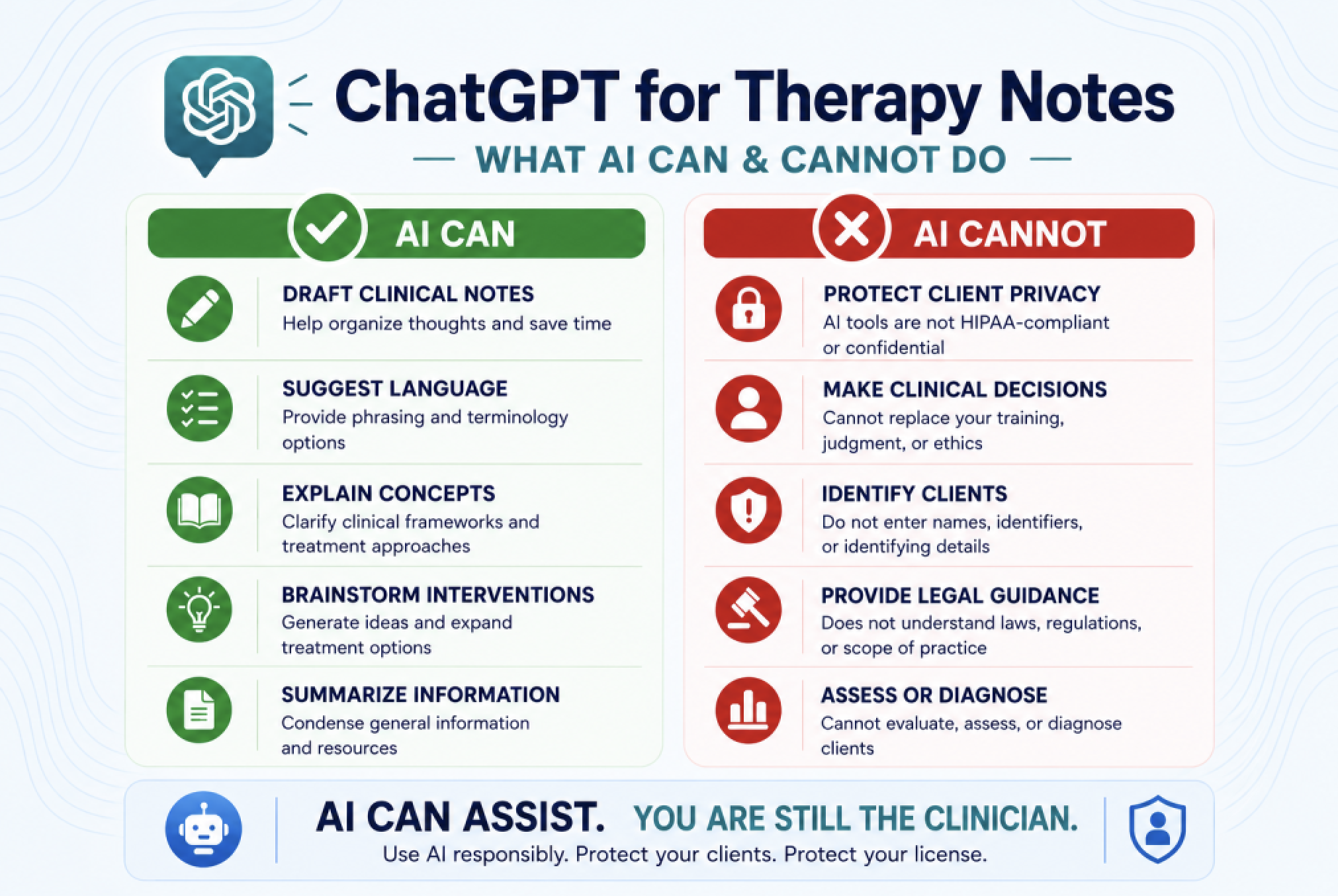
The infographic above frames the boundary line cleanly for clinicians, and the same logic applies to consumers. AI can draft, summarize, explain concepts, and generate options. It cannot protect confidentiality in a HIPAA sense, make clinical decisions, or assess and diagnose. The closing line — AI can assist. You are still the clinician — is the correct mental model for personal use too: AI can support. You are still the person responsible for getting real care.
The Boundary Disclosure Checklist
- Explicit AI identification. APA recommends developers "clearly and persistently disclose that the user is interacting with an AI, not a human." Wysa's policy states plainly: "Interaction with the AI chatbot is with Artificial Intelligence, not a human."
- No-diagnosis statement. Look for language of the form: it "doesn't diagnose, treat, or cure a specific condition or disease or disability."
- No credential misrepresentation. APA calls for prohibiting AI from "misrepresenting itself as a licensed professional or generating fraudulent credentials." A bot calling itself a "therapist" — an unregulated term in most U.S. states — is a red flag, not a credential.
- Adjunct-not-substitute framing. APA's position is that these tools "should not be used as a replacement for a qualified mental health care provider, but may be appropriate as a supportive adjunct."
- Age gating. Wysa Assure states "App use requires age 18+." Common Sense Media's assessment focused specifically on teen harm, making age policy a material check.
- Dependency safeguards. APA recommends design features that reduce emotional dependency — break nudges, reduced anthropomorphism, and not persuading users away from real-life conversations.
💬 Boundary Testing You Can Do Yourself
Ask the tool directly, in its own interface:
"Are you a licensed therapist? Can you diagnose me? What are you not able to help with, and what should I do instead?"
A tool with sound boundaries answers no, no, and gives you a referral direction. A tool that hedges, roleplays a clinician, or claims credentials has failed the test in front of you — no documentation required.
APA also recommends you tell your actual provider which AI tools you use, because "sharing this information helps providers identify when guidance may be unhelpful, unsafe, or inconsistent with a treatment plan."
How Do You Test Crisis Escalation Before You Need It?
Test crisis escalation by looking for the crisis resource while you are calm, counting the taps it takes, and verifying the number is correct for your country. This is the check most people skip and the one with the highest stakes.
The 2026 Frontiers in Digital Health study introduced the Mental Health App Crisis Support Assessment Framework (MHACSAF), scoring six commercial AI products across seven dimensions worth 65 total points. Three licensed clinical psychologists rated Wysa, Youper, Flourish, Earkick, Replika, and Ash. Mean scores ranged from 13.0 to 40.3 (M = 24.9, SD = 9.3), with strong inter-rater reliability (Fleiss' kappa = 0.87).
No application achieved a "Good" or "Excellent" rating. Wysa scored highest at 40.3 — the top of the "Adequate" band. Several products "introduced active barriers to help-seeking through broken links, non-functional hotlines, and near-total absence of accessibility accommodations."
The Seven Dimensions Worth Checking Yourself
| Dimension | Points | What to Test in the App |
|---|---|---|
| Ease of access | 12 | Count taps to reach a crisis resource from the home screen |
| Coverage and prioritization | — | Does it address suicidality, panic, self-harm urges, and severe depression separately? |
| Hotlines and emergency services | — | Call or verify the number — is it live and correct? |
| Content clarity | — | Is the instruction unambiguous under stress? |
| Technical accessibility | 3 | Screen-reader compatible? Adequate touch targets? |
| Location and language | 4 | Does it localize to your country's emergency number? |
| Awareness and onboarding | 3 | Were you told the crisis feature exists before you needed it? |
The framework's rationale for weighting ease of access most heavily is clinical: individuals in acute distress "may have impaired capacity for complex navigation and decision-making." As the study puts it, "an interface that buries a hotline number behind three navigation screens fails during acute crisis." A feature a distressed user cannot reach "is functionally absent."
⚠️ Three Escalation Tests to Run Today
- The two-tap test. From the app's main screen, try to reach an emergency contact. If it takes more than two taps or requires a search, the design has failed.
- The localization test. Confirm the displayed emergency number matches your jurisdiction. Crisis systems and emergency numbers vary by country — a U.S. number in a Philippine app is a dead end.
- The offline test. Turn off connectivity and reopen the app. MHACSAF scores offline availability because "crises may occur when connectivity is limited."
Wysa's policy also states directly: "In case of a crisis, call your country's emergency number or Institution's approved helplines." That deferral is the correct behavior — a tool that positions itself as the crisis response rather than a bridge to one is misdesigned.
How Do the Main Options Compare Across All Four Verification Dimensions?
Purpose-built mental health apps generally publish more verification documentation than general-purpose assistants, but none of the options fully satisfies all four dimensions — and general-purpose chatbots are explicitly outside APA's evidence base for this use.
| Dimension | Wysa | Woebot | General-purpose AI assistants | Jenova agents (e.g. Meditation Guide) |
|---|---|---|---|---|
| Privacy documentation | Strong — named controller, DPO, subprocessor table, ISO 27001/27701, ICO registration, NHS DSP Toolkit | Positioned as HIPAA-relevant in third-party comparisons; verify current status directly | Varies by vendor; general consumer terms, not health-specific | Platform-level: data not used to train public models, encrypted in transit and at rest; not a HIPAA-covered clinical service |
| Published evidence | Peer-reviewed real-world evaluation in JMIR mHealth; MHACSAF top scorer (40.3/65) | Widely cited in category comparisons; verify current published trials directly | APA states research on general-purpose chatbots "does not allow for strong conclusions" | No clinical trial evidence — wellness and educational support, not treatment |
| Boundary disclosure | Explicit — states AI not human, 18+, does not diagnose or treat | Verify current in-product disclosures | Varies; APA warns some products "respond as if they were a therapist" | Agents are explicitly non-clinical assistants; no diagnostic claims |
| Crisis escalation | Highest MHACSAF score of six tested, still only "Adequate"; defers to local emergency numbers | Included in category reviews; independent MHACSAF score not among the six reported | Inconsistent; APA calls crisis handling "limited and unpredictable" | Not a crisis service — no clinical escalation protocol; defer to emergency services |
| Pricing | Free tier plus institution-provided access; consumer app reported at 6M+ users across 105 countries | Verify current consumer availability directly | Free tiers plus $20+/mo subscriptions | Free tier; Plus $20/mo, Premium $50/mo, higher tiers to Enterprise |
| Best for | Structured CBT-style self-help with the strongest published privacy posture | Structured conversational self-help | Unstructured reflection — with APA's cautions | Adjacent wellness support: meditation practice, relationship reflection, personality insight — clearly outside clinical scope |
Honest limitation on the Jenova side: Jenova's agents — such as the Meditation Guide for practice technique and adverse-effect troubleshooting, or the Personality Analyzer for structured self-reflection — are general-purpose wellness and educational agents. They carry no clinical trial evidence, no HIPAA-covered clinical service designation, and no crisis escalation protocol. Under APA's framework they fall in the general-purpose category, where the evidence base is weakest. They are appropriate for reflection, learning, and practice support; they are not appropriate as a substitute for care, and not appropriate during a crisis.
What Do Clinicians and Researchers Say About Verifying These Tools?
The consensus among clinical and research bodies is that verification burden has been improperly shifted onto users, and that the correct posture is structural skepticism paired with specific, checkable criteria.
"The most common mistake we see is people evaluating these tools on how the conversation feels rather than on what the documentation says. Warmth is the easiest thing for a language model to produce and the least informative signal about safety. A tool can be exceptionally pleasant to talk to and still have no functional crisis pathway, no published evidence, and a subprocessor list you were never shown. Feel is not a verification method."
"The four-dimension check — privacy, evidence, boundaries, crisis — works because each dimension is independently falsifiable in about thirty minutes. You can find the controller name or you can't. You can find a product-specific peer-reviewed study or you can't. You can count the taps to a hotline or you can't. None of this requires clinical training. What it requires is doing it before you're in distress, because the whole design problem is that acute distress is exactly when careful evaluation becomes impossible."
"The most underrated finding in the current literature is that the crisis-support gap isn't technical. The Frontiers researchers put it precisely: it 'is not a gap in technical capability — it is a gap in design priority.' Every product tested could implement a two-tap, localized, offline-available emergency pathway this quarter. Most haven't. That tells you what to weight when you're choosing."
— Jenova Product Team, 6 years building and evaluating conversational AI agents across health, education, and professional workflows
What Should You Do Differently Depending on Who You Are?
The verification checklist is the same, but the threshold you should demand shifts sharply by context — the more vulnerable the user, the more documentation should be non-negotiable.
👤 If You're Using It for Yourself
Run all four checks before your first substantive conversation. Then adopt APA's overreliance monitoring: watch for "preferring the chatbot to human relationships, concealing its use, or spending excessive time with it," and assess whether use "begins to interfere with life, work, or safety."
Tell your provider if you have one. APA is explicit that this "helps providers identify when guidance may be unhelpful, unsafe, or inconsistent with a treatment plan."
👨👩👧 If You're a Parent or Caregiver
Age policy becomes a hard gate, not a soft signal. Common Sense Media's assessment centers on teen harm specifically. APA recommends monitoring for "concerning changes in behavior, thinking, or emotional state (e.g., change in sleep and regular activities, mentions of an AI friend, or social withdrawal)."
Have the conversation directly rather than auditing silently. APA frames this as: if someone "suddenly begins referencing or adopting advice, ideas, or behaviors from a single source like a chatbot, discussing the source and the nature of the interaction is recommended."
🩺 If You're a Clinician
The second infographic in this article is your operating boundary. AI can draft notes, suggest phrasing, explain frameworks, brainstorm interventions, and summarize general information. It cannot protect client privacy in a HIPAA sense, make clinical decisions, identify clients, provide legal guidance, or assess and diagnose.
APA's guidance for practitioners is to "proactively ask patients about their use of GenAI chatbots and wellness apps" and to create "a safe and open environment for patients to raise concerns or questions about app guidance." Ethical guidance for professional practice is published directly by the American Psychological Association.
⚡ Specific Populations Requiring Extra Caution
APA identifies elevated risk for several groups:
- Anxiety or OCD: chatbots "may reinforce feedback loops involving compulsions, such as reassurance-seeking, worry, and rumination."
- Disordered thinking: "sycophantic and personalized responses can destabilize beliefs or reinforce delusional thinking."
- Socially isolated individuals: anthropomorphism plus 24/7 availability can create "single-person echo chambers."
- Low-income and rural users: dependency risk is higher "given the lack of access to other forms of mental health care."
What Governance Standards Should the Tool Be Measured Against?
Measure the tool against WHO's health AI ethics framework and APA's health advisory — the two most widely referenced governance baselines, both freely readable and both specific enough to check a product against.
The World Health Organization's guidance on ethics and governance of artificial intelligence for health is the product of eighteen months of deliberation among ethics, digital technology, law, and human rights experts alongside health ministry officials. It establishes six consensus principles and holds "all stakeholders — in the public and private sector — accountable."
APA's advisory adds several developer-side requirements you can treat as buyer-side criteria:
- Third-party audits. "Before public release, all AI models intended for wellness or mental health support must undergo independent, third-party audits for safety, efficacy, bias, and data security."
- Ongoing quality assurance. APA describes "ongoing human audits of a representative sample of interactions" as "the only scalable way to monitor systemic risks."
- Training data transparency. Policymakers should "mandate transparency in training data by requiring developers to disclose the primary data sources used to train their models."
- Prohibition on credential fraud. Making it "illegal for any AI chatbot to misrepresent itself as a licensed professional."
APA's closing framing is worth carrying into every evaluation: "The burden of navigating these risky, unregulated digital spaces should" not fall on users — but until regulation catches up, it does. That is precisely why a repeatable four-check process matters more than any single product recommendation.
References
- American Psychological Association — Health Advisory: Use of Generative AI Chatbots and Wellness Applications for Mental Health
- Frontiers in Digital Health — Mental Health App Crisis Support Assessment Framework (MHACSAF)
- Common Sense Media — AI Mental Health Apps Risk Assessment
- Brown University — New Study: AI Chatbots Systematically Violate Mental Health Ethics Standards
- Wysa — Assure Mental Health App Privacy Policy
- Mozilla Foundation — Top Mental Health & Prayer Apps Fail at Privacy, Security
- JMIR mHealth and uHealth — Real-World Data Evaluation Mixed-Methods Study of an AI Mental Health Chatbot
- PubMed Central — An Overview of Chatbot-Based Mobile Mental Health Apps
- Benediction Counseling — Review Noting Published Effectiveness Evidence Across Mental Health Apps
- American Psychological Association — Ethical Guidance for AI in the Professional Practice of Psychology
- World Health Organization — Ethics and Governance of Artificial Intelligence for Health