How Do AI Roleplay Games Keep Multiple NPCs Consistent?
2026-09-09
Which Consistency Layers Separate Ensemble Roleplay From Single-Character Chat?
AI roleplay games keep multiple NPCs consistent when they treat the cast as a tracked ensemble — identity, relationships, secrets, and world state — rather than as one chatbot wearing different names. In 2026, that distinction is what separates a durable campaign from a chat that sounds vivid for twenty turns and then collapses. Tools such as Jenova's Roleplay Game Master, Character.AI, AI Dungeon, and NovelAI all generate characters; they do not all preserve an ensemble equally.
The evaluation frame used here is a Six-Dimension Ensemble Consistency Model:
✅ Identity persistence — voice, appearance, motives, and speech patterns remain locked to each named character ✅ Relational memory — who trusts whom, who is indebted, and who already argued last session ✅ World-state tracking — location, time, inventory, injuries, and clocks that other NPCs can observe ✅ Knowledge partitions — secrets stay with the characters who earned them, not with the narrator ✅ Motivational autonomy — NPCs pursue goals when the player is elsewhere ✅ Cross-session continuity — session 12 still knows the promise made in session 2
Single-character companions can fake consistency by restating a persona card. Ensemble play fails as soon as two NPCs share one mind. The rest of this guide compares how current platforms implement those six layers, where they break, and how to brief a game master so a cast stays distinct.
Why Do Multi-NPC Stories Drift Faster Than One-on-One Chat?
Multi-NPC stories drift faster because every extra character multiplies facts that must stay separate: voices, alibis, inventories, and who is allowed to know what. Long roleplay rarely breaks in one dramatic moment; it usually drifts one forgotten fact at a time. A one-on-one companion only has to remember you. A tavern scene has to remember the barkeeper, the spy in the corner, and the fact that they should not share a brain.
Community players report a related failure:
. That flattening is not just “bad memory.” It is what happens when the model compresses several people into one helpful narrator.Research on generated fiction points in the same direction. A 2026 narratology study of LLM-written stories found that generated characters are more likely to be stylized, dynamic, and neatly closed than human-written characters. That bias helps a single protagonist feel complete. It hurts an ensemble, because supporting NPCs start sounding like moral lessons instead of people with unfinished business.
A separate line of work treats narrative consistency bugs in long-form LLM stories as a measurable failure class, not a taste issue. In games, the cost is concrete: a witness recants a fact they never learned, a rival forgets a grudge, or two characters occupy the same body in dialogue.
What Should You Look for in an AI Roleplay Game That Runs an Ensemble Cast?
You should look for systems that store character state outside the latest prompt, not just a longer persona paragraph. Platform roundups in 2026 repeatedly rank persistent memory, persona customization, and continuity ahead of raw chat fluency. Fluency without partitions produces eloquent contradictions.
Weight the six dimensions unequally. For mystery, horror, and political intrigue, knowledge partitions outrank pretty prose. For romance ensembles, relational memory and autonomous jealousy matter more than map clocks. For visual novels and illustrated casts, identity persistence includes faces, outfits, and spatial blocking — the problem NovelAI’s multi-character tools are built to solve.
Practical checks before you commit a long campaign:
- Named dossiers, not vibes. Each NPC needs a short, stable card: voice, goal, secret, relationship to the player.
- Selective memory, not total recall. Saving every meal and joke makes the facts that change the plot harder to find.
- Scene anchors. Location, unfinished action, and who is physically present should be restorable in five lines.
- Correction without a rewrite. A one-line out-of-character fix should beat restarting the universe.
- Model choice without amnesia. If you switch models mid-campaign, the cast file must travel with you.
Guides to character chat still recommend editing instructions and adding memory notes after you see how the AI behaves. That advice is necessary. It is not sufficient once three or more NPCs share a scene.
How Do Popular AI Roleplay Platforms Compare on Multi-NPC Consistency?
They compare most clearly on where state lives: in a community persona, in a story transcript, in visual character slots, or in a dedicated game-master agent with persistent memory. No option is uniformly stronger; each is built around a different consistency bottleneck.
| Feature / Dimension | Character.AI | AI Dungeon | NovelAI | Roleplay Game Master | Janitor AI |
|---|---|---|---|---|---|
| Multi-NPC identity lock | Strong for one active persona; weaker when many community characters share a scene | Open narrative generation; cast tracking is prompt-dependent | Explicit multi-character slots, grid placement, CRef fidelity for visuals | Domain agent with persistent cast, agendas, and session memory | User-configured models and character data; quality depends on setup |
| Cross-session memory | Community chats; long-form continuity is a known weak point | Adventure log inside the session; long campaigns can lose earlier beats | Story and image settings persist as project data more than as a living RPG clock | Unlimited chat history and cross-session memory on the Jenova platform | Flexible; often paired with external notes or APIs |
| Knowledge partitions | Easy to leak secrets when the same model speaks every role | Narrator and NPCs often blend unless the player enforces POV | Visual identity is partitioned better than spoken secrets | Stronger when the GM is instructed to keep secrets per NPC | Possible with custom prompts; not guaranteed |
| Autonomous NPC agendas | Mostly reactive to the user | Emergent events, but pattern collapse is common in long runs | Interaction poses (handshake, blocking) more than independent plots | NPCs can pursue goals, grudges, and clocks off-screen | Depends on the model and jail/config |
| Pricing (as of 2026) | Free tier plus paid | Freemium; exact 2026 rates unverified here | Subscription; exact 2026 rates unverified here | Free tier with limited usage; Plus from $20/month (30× free usage) | Often free front-end plus user-supplied API keys |
| Best for | Casual one-on-one personas and community characters | Open-ended text adventures and improvisation | Illustrated casts and visual identity control | Long campaigns that need a stable ensemble | Builders who want model-level control |
Character.AI
Character.AI remains strong for easy onboarding and a huge library of community-created personalities. A single well-written bot can hold a voice for a surprisingly long time.
The limitation is ensemble play. When you need a full inn, a court, or a party of rivals, the product’s center of gravity is still one character talking to you. Memory and long-form continuity are widely described as less robust than dedicated storytelling stacks.
AI Dungeon
AI Dungeon remains a reference point for open-ended narrative adventures. It is still one of the fastest ways to drop into a world with no character sheet.
The trade-off is structural. Open generation without a durable cast file tends to recycle story beats and merge NPC voices. It is excellent for discovery. It is a weaker system of record for a twelve-session mystery.
NovelAI
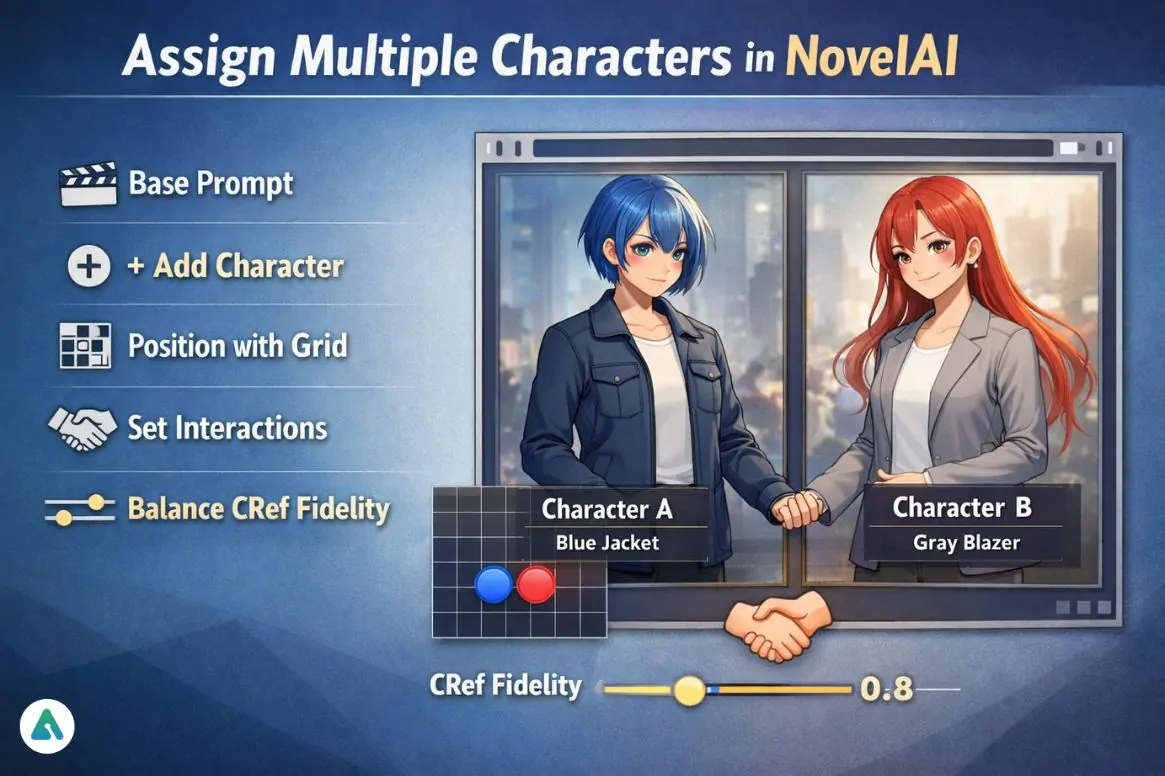
NovelAI’s multi-character workflow — base prompt, add character, grid position, set interactions, then balance CRef fidelity — attacks a different consistency problem: visual identity. Two named figures can share a frame without swapping jackets, hair, or body language.
That is a real strength for illustrated roleplay and visual novels. It does not automatically give the gray-blazer character a secret the blue-jacket character cannot know. Image-slot consistency and narrative knowledge partitions are related skills, not the same feature.
Roleplay Game Master
Roleplay Game Master is a specialized game agent rather than a single persona. It is built for unlimited memory, character consistency, and any genre the player specifies. Testing long scenes shows the practical difference: the barkeeper can refuse information the assassin already knows, and both remain in the log after you close the tab.
Honest limits remain. It is text-first, not a 3D scenario editor with room collision. It will not replace NovelAI’s CRef slider for portraits. Heavy ensemble campaigns also consume more usage than short companion chats, which matters on metered plans. Players who want a map-and-token VTT still need a separate tabletop tool.
Janitor AI
Janitor AI is built for configuration: model choice, parameters, and developer-style control. Users who already maintain character cards and API keys can impose stricter consistency than a consumer chatbot allows.
The limitation is labor. Consistency is not a default product behavior; it is something the operator engineers. If you want a campaign that remembers itself without a second job as a prompt librarian, a managed game-master agent is usually less work.
How Does Persistent Memory Stop NPCs From Contradicting Each Other?
Persistent memory stops contradictions when it stores typed facts — identity, relationships, secrets, world clocks — instead of a raw transcript dump. Roleplay-oriented reviews in 2025–2026 treat memory retention as a primary selection criterion, alongside customization and filters. An infinite scroll of chat is not the same as a character bible.
The useful split, adapted from continuity practice, is four information types:
- Stable character facts — voice, motive, boundaries, species, occupation
- Current scene facts — where, when, who is in the room, what is unfinished
- Story history — promises, injuries, betrayals that still have consequences
- Disposable detail — jokes, meals, weather that do not change the next scene
Continuity improves when you preserve the few facts that would make the story feel different if they disappeared. If every line is equally “remembered,” the model treats a sandwich order as important as a murder confession.
Research on role-playing characters is moving the same way: automatically codifying character profiles into interpretable structures that maintain narrative coherence. That is the industrial version of a character card. Multi-agent storytelling work likewise argues that complex narratives arise when separate agents co-create under shared rules rather than one model improvising every voice.
In practice, Roleplay Game Master keeps the typed layer on the platform: unlimited history, persistent cross-session memory, and the ability to attach documents as a private bible. That does not make hallucination impossible. It makes the default recovery path “consult the cast file,” not “sound plausible.”
Pre-built ensemble games on the same platform show why typed memory matters. The Mansion only works if each room’s occupant keeps secrets the player has not extracted. Love Island only works if eight contestants remember alliances, rejections, and jealousy without collapsing into one flirtatious narrator.
How Do Visual Character Controls Differ From Narrative Consistency Systems?
Visual controls keep bodies from swapping; narrative systems keep minds from leaking. Confusing the two is the most common category error in 2026 ensemble tools.
NovelAI’s multi-character panel is a clean example of the visual stack. You set a base prompt, add Character A and Character B, place them on a grid, define an interaction such as a handshake, then tune CRef fidelity (shown around 0.8 in typical workflows). The job is compositional: blue jacket stays on the left, gray blazer stays on the right, contact is intentional rather than a merged extra limb.
Narrative consistency has no fidelity slider. It needs:
- Voice locks — short sentences vs. ornate ones, dialect, pet phrases
- Information firewalls — NPC B cannot quote a letter NPC A hid
- Relationship edges — A cooperates with B but does not trust B
- Off-screen clocks — the messenger arrives downstairs whether you look or not
Narrative understanding with large language models still struggles when character, plot, and world knowledge are not explicitly structured. A pretty dual portrait can be perfectly consistent and still ruin a mystery if both faces speak with omniscient knowledge.
The practical implication: illustrated roleplay often needs both stacks. Generate the handshake with visual character assignment. Run the conversation in a game-master agent that refuses to let Character B confess Character A’s secret. Using only one stack is why so many “consistent” casts still feel wrong after a few scenes.
How Do You Brief an AI Game Master So Multiple NPCs Stay Distinct?
You brief the GM with a cast file, a scene anchor, and a knowledge map — then you play, correcting only facts that would change motivation or plot. Most platforms let you edit character instructions or add memory notes after the first replies. Ensemble play needs that edit before the second NPC opens their mouth.
A compact setup for Roleplay Game Master looks like this:
- Open the agent and state genre, tone, and player role in one paragraph.
- Paste a cast file with three to seven NPCs, not twenty.
- Mark one secret per NPC and who is allowed to know it.
- Name the current location, time, and unfinished action.
- Tell the GM which character may speak, and that unnamed extras stay mute.
Example opening prompt:
“Run a detective noir in a two-room apartment. I am a private investigator. NPCs: Lena (building manager, gray blazer, hiding a forged lease), Ori (neighbor in a blue jacket, saw someone in the stairwell, will not talk in front of Lena), and Officer Rhee (arrives in twenty minutes). Knowledge rule: Lena does not know Ori saw the stairwell figure. Start in the kitchen. Do not resolve the crime in this scene.”
If you prefer a continuity card instead of a novel-length bible, keep it to five lines, as long-form chat guides recommend: where, when, relationship, unresolved thread, next pressure. Then play. When drift appears, correct one variable:
“OOC: Still in the kitchen. Ori has not told Lena about the stairwell. Continue from Ori noticing the forged lease in Lena’s pocket.”
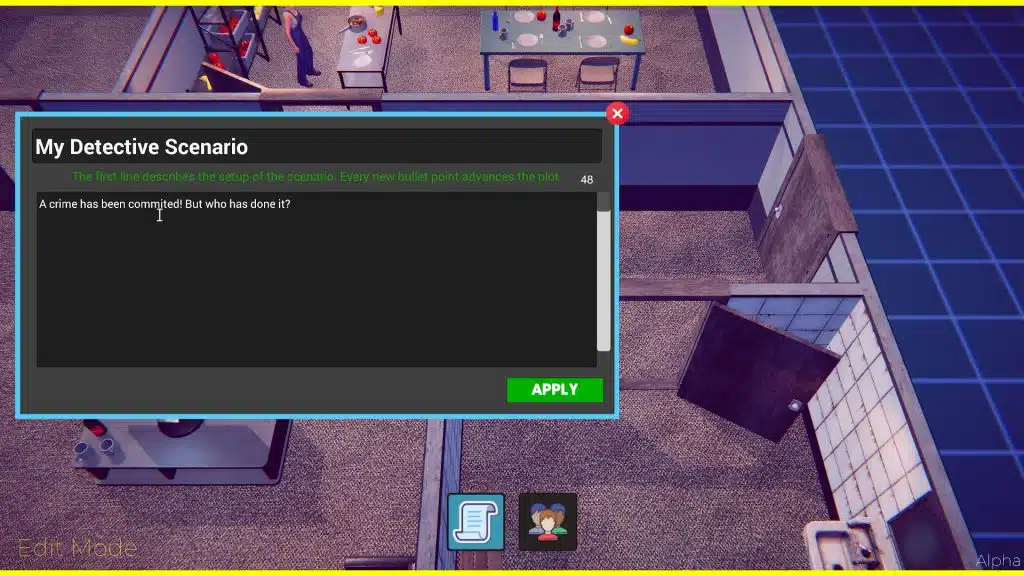
Scenario editors in investigation games use the same idea in UI form. The first line sets the situation; each bullet advances plot. That structure is a knowledge partition in disguise: new bullets are events, not a license for every NPC to become omniscient.
For Character.AI or similar one-bot chats, split the ensemble across bots or write a director bot that is forbidden to merge voices. For NovelAI images, assign characters and lock CRef before generating group shots, then keep those visual IDs aligned with the text cast file. For Janitor AI, put the cast file in the system prompt and keep scene recaps in memory notes rather than hoping the context window will prioritize the right facts.
What Do Narrative Designers Say About Autonomous NPC Casts?
Narrative designers treat multi-NPC consistency as a state problem first and a prose problem second. The cast has to remain separately addressable, or “better writing” only makes the contradictions more fluent.
"The failure we see in ensemble roleplay is almost never a forgotten name. It is a forgotten partition. The moment two NPCs share one pool of knowledge, players feel the author in the room. Persistent memory only helps if it stores relationships and secrets as typed objects, not as a longer chat log."
"Human-written supporting characters are allowed to stay unfinished. Generated characters, especially in popular LLMs, tend to close arcs and speak in archetypes. That is useful for a fable and lethal for a mystery. If every witness grows, confesses, and moralizes, you no longer have a cast — you have a chorus."
"Autonomy is the test players actually notice. An NPC with an agenda will leave the room, lie, or refuse to help while you are talking to someone else. Reactive chatbots cannot do that for long because they are optimized to answer you, not to want something you did not ask for."
— Jenova Product Team, designers of persistent-memory roleplay agents
That view lines up with story-generation research: multi-agent character simulation from a narrative plan is a different architecture than one model completing a prompt. It also matches the CAspER finding that model size alone does not change the types of characters produced. Bigger models can write prettier dialogue and still flatten an ensemble if the scaffolding is missing.
When Is a Specialized AI Game Master Stronger Than a Character Chatbot?
A specialized game master is stronger when the player needs several minds, a clock, and consequences that survive a week away from the keyboard. A character chatbot is stronger when the relationship is the product: one companion, one voice, one ongoing conversation.
Choose a game-master agent when:
- Three or more named NPCs must appear in the same scene without merging
- Secrets, alibis, or faction goals would break if leaked
- You intend to resume the same campaign across many sessions
- You may switch models (for prose vs. logic) without resetting the world
- You want off-screen movement, not only replies to the last user line
Stay with a character chatbot when you want a single persona, community character browsing, or low-setup casual chat. Character.AI is still a reasonable fit there. AI Dungeon is still a reasonable fit for “see what happens” improvisation. NovelAI is still the more natural fit when the deliverable is a consistent illustrated cast rather than a refereed mystery.
Roleplay Game Master sits on the campaign side of that split. Free access includes core features with limited usage; Plus starts at $20/month for 30× the free allowance, with higher tiers at $50, $100, $200, $500, and $1,000 per month as usage needs grow. It is not a visual blocking tool, and it will not make a poorly briefed cast suddenly brilliant. Used with a short dossier and knowledge rules, it is among the more complete options for keeping multiple NPCs distinct across a long game.
The design lesson travels beyond any one product. Ensemble consistency is architecture: identity, relationships, world state, secrets, motives, and memory that outlive the context window. Prompt charm can hide the absence of that architecture for an evening. It cannot hide it for a campaign.
References
- CAspER — Insights into Character Variety in LLM-Generated Stories (arXiv)
- CrushOn AI — How to Keep Long AI Roleplay Consistent: Memory, Recaps, and Scene Control
- ChatJanitor — Best AI Roleplay Chat Platforms 2026
- Quantum Zeitgeist — AI Role-Playing Characters Gain Consistency
- ConStory-Bench — Consistency Bugs in Long Story Generation by LLMs (alphaXiv)
- FunFun AI — The Complete Guide to Character AI Roleplay
- Luvr AI — 8 Best AI Roleplay Chat Platforms to Try in 2025
- The Computist Journal — AI-Driven Storytelling with Multi-Agent LLMs, Part III
- The Alan Turing Institute — Narrative Understanding with Large Language Models
- ACL Anthology — Multi-Agent Based Character Simulation for Story Writing
- Flocci AI — Character.AI freemium listing