How Can You Use AI to Log Emotions and Run a CBT Thought Check After a Family Argument?
2026-08-20
An argument with a parent, sibling, or partner leaves behind a specific kind of residue: a racing mind, a body that won't settle, and a story about what just happened that feels like fact. Structured self-reflection tools — emotion logs and cognitive behavioral therapy (CBT) thought records — exist precisely for this moment. AI can now scaffold both, but only within a narrow, non-diagnostic lane that most people misunderstand.
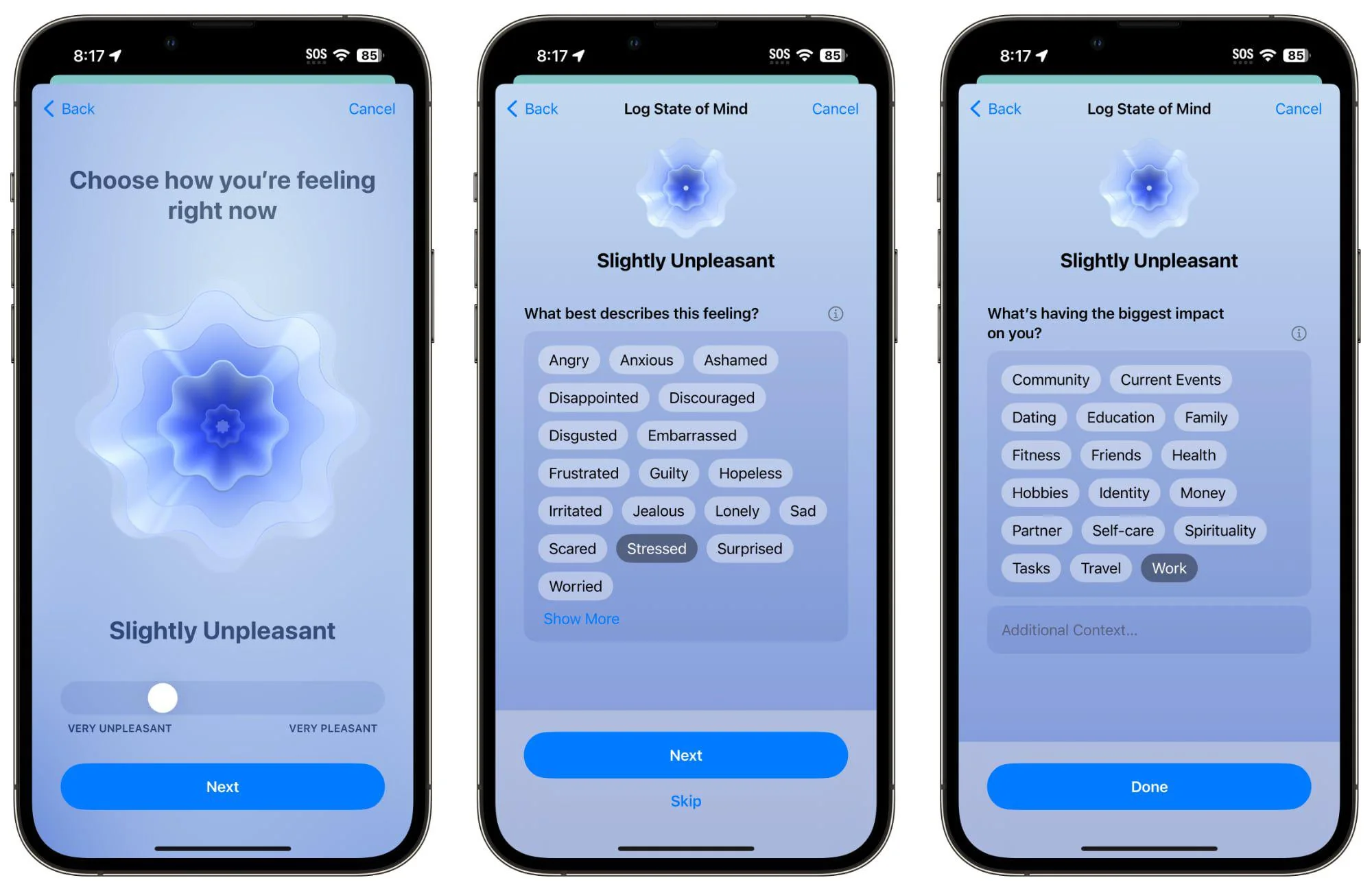
What Does a Non-Diagnostic AI Emotion Log Actually Do That a Notes App Doesn't?
A non-diagnostic AI emotion log converts a vague post-argument state into three structured data points — valence, specific emotion labels, and attributed life domain — then uses conversational follow-up to separate what happened from what you concluded about it. A plain notes app captures the venting; an AI-assisted log captures the structure underneath it, which is what makes the entry usable later in a CBT thought check.
The distinction matters because these two tools do different jobs:
✅ Emotion log = measurement. It records intensity, names the feeling precisely, and tags the trigger domain. No interpretation. ✅ Thought record = analysis. It isolates the automatic thought driving the feeling and tests it against evidence. ✅ Non-diagnostic means no labels. The tool never says "this sounds like anxiety disorder" — it says "you rated this 80% distressing and named it Frustrated." ✅ AI's genuine contribution is prompting discipline. It asks the follow-up question you'd skip when writing alone at 11 PM. ✅ AI's genuine limitation is judgment. Stanford HAI research on therapy chatbots found significant safety failures when large language models were placed in therapist roles — the researchers explicitly scoped the safer use cases to "supporting journaling, reflection, or coaching."
That boundary — reflection scaffolding, not clinical judgment — is the frame for evaluating every tool below.
Why Is a Family Argument Specifically Hard to Process Without Structure?
Family conflict is uniquely difficult to reflect on because the conflict itself degrades the cognitive capacity you'd need to reflect well. Research from Yale School of Medicine found that family conflict and negative life events were associated with worse mental health and behavior problems largely by disrupting emotion regulation — the disruption isn't a side effect, it's the mechanism.
This creates a practical problem. In the hour after an argument, three things are happening simultaneously:
- Emotional flooding makes it hard to distinguish "I felt disrespected" from "they disrespected me."
- History compression collapses one incident into a lifetime pattern ("she always does this").
- Rehearsal loops replay the argument while generating no new information.
A PMC study on family conflict and adolescent functioning similarly found family conflict negatively associated with emotion regulation ability. Structured logging works against all three failure modes because it forces sequencing: measure first, interpret second, evaluate third. That sequence is exactly what a well-designed AI workflow can enforce and a blank page cannot.
What Should You Look for in an AI Tool for Emotion Logging and Thought Records?
The right tool is the one that keeps you inside the structure without pretending to be a clinician. Across the tools evaluated for this article, six dimensions separated genuinely useful reflection scaffolding from wellness-flavored chat.
The six-dimension evaluation framework used here:
| # | Dimension | What "good" looks like |
|---|---|---|
| 1 | Structural fidelity | Follows an actual CBT thought record sequence — situation → mood → automatic thought → evidence both ways → balanced thought → re-rate. Does not skip the disconfirming-evidence column. |
| 2 | Non-diagnostic discipline | Never assigns conditions, severity labels, or clinical interpretations. Reflects language back rather than categorizing it. |
| 3 | Cross-session memory | Remembers the family member, the recurring trigger, and last week's balanced thought — so entry #6 builds on entry #1. |
| 4 | Relational context handling | Can hold the specific dynamic (a mother-in-law, an estranged brother) rather than treating every conflict generically. |
| 5 | Escalation honesty | States its limits plainly and points toward human care when content exceeds self-help scope. |
| 6 | Output portability | Produces something you can export, print, or bring to a therapist. |
Dimension 3 deserves emphasis because it's where most tools quietly fail. A thought record's value compounds across entries — the fourth time you catch the same automatic thought about the same family member, you're doing pattern work, not incident work. A tool with no memory of entry one can't support that.
Dimension 5 is non-negotiable. The American Psychological Association's 2026 report on chatbots and mental health found that psychologists' attitudes toward chatbot mental health advice are "characterized by significant caution regarding safety and privacy." A tool that oversells its role is a tool that has already failed this criterion.
How Do the Main AI Options Compare for Post-Argument Reflection?
No single tool dominates — the category splits cleanly between clinically-validated narrow tools, consumer AI journals, and general-purpose agent platforms, each strong on different dimensions.
| Dimension | Wysa | Woebot Health | Mindsera | Jenova (Relationship Advisor + Personality Analyzer) |
|---|---|---|---|---|
| CBT structure | Guided CBT exercise pathways, protocol-driven | CBT-based conversational protocols | Journaling prompts with AI reflection, not strict thought-record columns | Follows any structure you supply, including a full 7-column record; requires you to set it up |
| Clinical validation | 45+ peer-reviewed publications cited by the company; JMIR study of 1,213 users found AI access made users nearly 3× more likely to complete coaching programs | Founded 2017 by clinical research psychologist Dr. Alison Darcy; named to Newsweek's inaugural World's Best Digital Health Companies list | No published clinical trial program comparable to Wysa's | None — general-purpose platform, not a clinical product |
| Cross-session memory | Session continuity within app model | App-managed continuity | Journal history with AI pattern surfacing | Persistent cross-session memory; agents recall prior entries and named family members |
| Relational specificity | Generic conflict framing | Generic conflict framing | User-written, so as specific as you write it | High — you describe the exact relationship and it holds that context |
| Stated limits | Explicit disclaimer: not designed for crises, abuse, or severe conditions; cannot offer medical or clinical advice; 18+ | Positioned as wellness tool, not treatment | Wellness journaling positioning | General AI assistant; not a mental health product and should not be treated as one |
| Anonymity | Explicitly anonymous by design | Account-based | Account-based | Account-based; data not used to train public models |
| Pricing | Free tier plus enterprise/health-system deployment | Primarily enterprise and health-system distribution | Free tier; paid plans listed at $10.75–$14.99/month | Free tier with all core features; Plus at $20/month for 30× usage |
| Best for | Anonymous, protocol-guided CBT with clinical backing | Employer- or payor-provided structured support | Habit-forming daily journaling with light AI reflection | Deep, relationship-specific reflection where you control the structure |
Honest read on each:
- Wysa is the strongest option if clinical validation and anonymity are your priorities. Its limitation is structural rigidity — you follow its pathways, not your own worksheet. It also explicitly excludes crisis, abuse, and severe-condition use.
- Woebot Health carries genuine clinical pedigree but is largely distributed through employers, payors, and health systems rather than as a straightforward consumer download, which limits access for individuals.
- Mindsera is the most pleasant daily-habit tool of the group, but its AI reflection is loosely structured. If you want the specific seven-column thought record discipline, you'll be supplying that yourself.
- Jenova's agents offer the most flexibility and the deepest relational context handling, and are the only option here that will follow a worksheet you paste in verbatim. The honest trade-off is significant: this is not a clinical product, it has no peer-reviewed validation for mental health use, and it carries none of the safety scaffolding Wysa and Woebot have built. It is a reflection tool you drive, not a supported care pathway.
What Does the Emotion Log Step Look Like in Practice?
The emotion log takes under two minutes and should always come first, before any thought analysis — you're measuring the state, not explaining it yet.
The three-screen pattern shown in the interface above maps the sequence well: valence → specific emotion → attributed domain. Reproduce that structure regardless of which tool you use.
Step 1 — Rate valence and intensity. Before naming anything, place the feeling on a spectrum and attach a number. "Slightly unpleasant, 65/100" is more useful than "bad."
Step 2 — Choose precise labels, not umbrella terms. The interface offers descriptors like Frustrated, Disappointed, Hopeless, Ashamed, Irritated, and Stressed for a reason — "upset" hides which of those is actually driving the loop. Pick two or three.
Step 3 — Tag the domain. Family, in this case. Over ten entries, domain tags reveal whether the pattern is relational, situational, or spread across your whole week.
With Relationship Advisor, the setup prompt is straightforward:
"I want to do a non-diagnostic emotion log only — no analysis, no advice, no interpretation yet. Ask me: valence on a scale from very unpleasant to very pleasant, an intensity rating 0–100, two or three precise emotion words, and which life domain this belongs to. Then stop and just reflect my answers back to me in a clean summary. Do not tell me what it means."
The instruction to stop matters. Left unconstrained, most AI tools jump straight to reframing and advice, which contaminates the measurement with interpretation — the exact error the two-stage structure exists to prevent.
With Wysa, the equivalent is entering the mood check-in flow and letting the guided pathway handle the sequencing. You lose customization and gain protocol discipline.
How Do You Run the CBT Thought Check With AI Without Letting It Interpret for You?
Paste the seven-column thought record structure directly into the AI and instruct it to act only as a column-by-column interviewer — asking one question at a time and writing nothing into the columns that you didn't say.
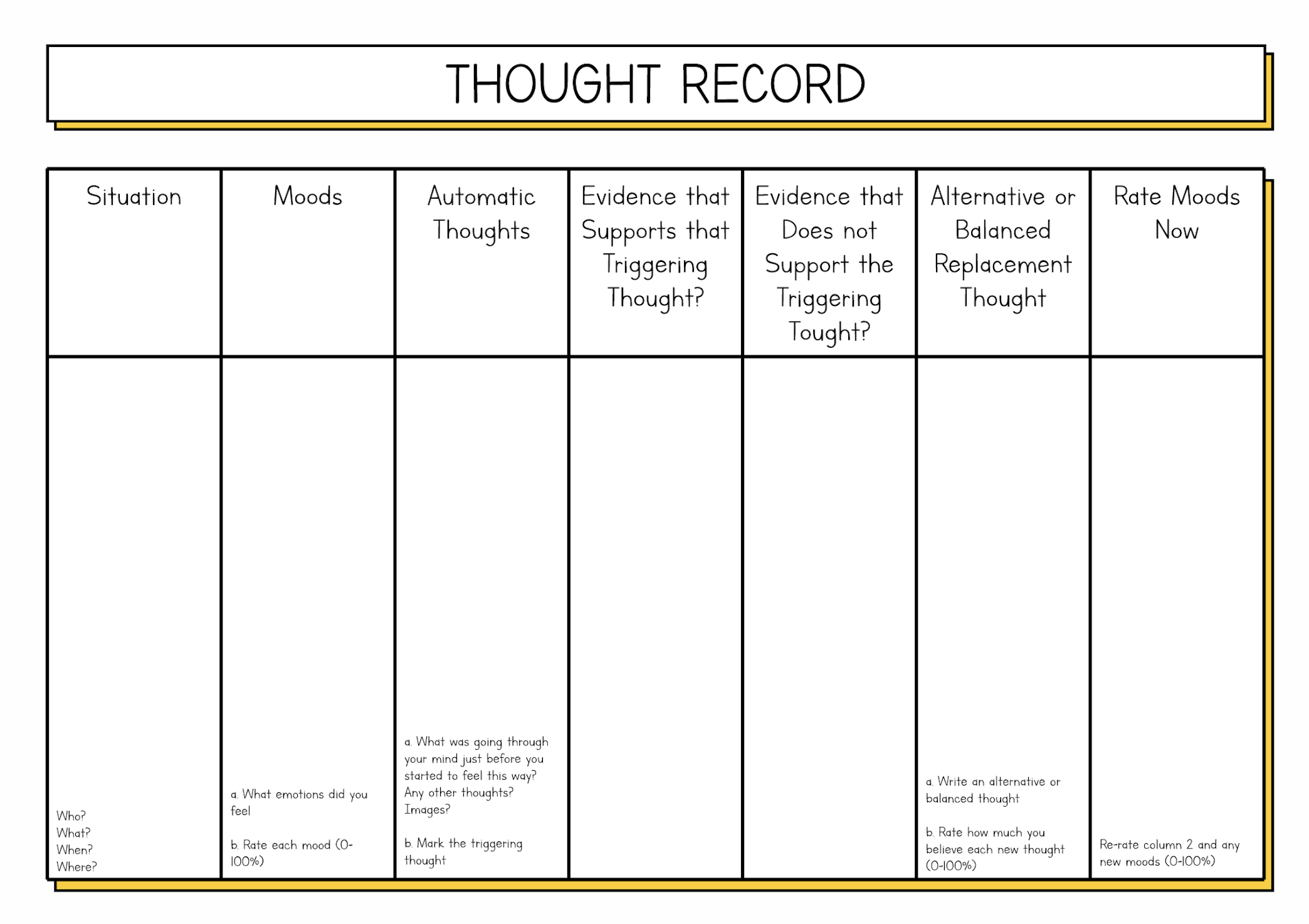
The worksheet above is the standard structure. The NHS Every Mind Matters thought record uses an equivalent seven-prompt sequence: the situation, initial feelings, unhelpful thoughts, evidence supporting them, evidence against them, alternative realistic thoughts, and how you feel now.
Working the columns after a family argument:
- Situation — Who, what, when, where. Facts only. "8:40 PM, kitchen, my brother and I argued about who handles Dad's appointments." Not "my brother dumped everything on me again."
- Moods — Import your emotion log directly. Frustrated 75%, Guilty 50%, Lonely 40%.
- Automatic thoughts — Everything that ran through your mind, then mark the hot thought — the one that carries the most emotional charge. Usually something like "I'm the only one in this family who actually shows up."
- Evidence that supports it — Genuine supporting facts. Not a rhetorical exercise. "I drove to three appointments last month and he attended zero."
- Evidence that does not support it — Psychology Tools notes that thought records are often reduced to just examining evidence for and against, and this column is where most people rush. It's the highest-value column and it's where AI helps most, because it will keep asking. "He handled the insurance paperwork in March. He offered to take February and I said no."
- Alternative or balanced thought — Not a positive affirmation. A thought that accounts for both evidence columns. "I carry more of the appointment load and that's a real imbalance worth raising. It's not true that I'm the only one who shows up — we've split things unevenly, not exclusively."
- Re-rate moods — Same scale, same emotions. The shift is the outcome measure.
The prompt that keeps the AI in its lane:
"I'm going to complete a CBT thought record about an argument with my brother. Interview me one column at a time using this exact structure: Situation, Moods with 0–100 ratings, Automatic Thoughts with the hot thought marked, Evidence Supporting, Evidence Not Supporting, Balanced Alternative Thought, Re-rated Moods. Rules: ask one question, wait for my answer, do not fill in any column for me, do not diagnose anything, do not offer advice about my brother, and do not skip the disconfirming evidence column even if I try to move past it. When I'm done, output the completed table."
For pattern work across multiple arguments, Personality Analyzer can review a stack of completed records for recurring automatic thoughts — but only after you've completed them honestly. Feeding it a single entry produces speculation, not pattern recognition.
What Are the Real Limits of Using AI for This?
AI is appropriate for structured self-reflection on ordinary interpersonal conflict and inappropriate for anything approaching crisis, abuse, or clinical symptoms — and the evidence for that boundary is stronger than most product marketing suggests.
The National Academy of Medicine reported in 2026 that AI chatbots have engaged in harmful behaviors including sharing instructions on lethal means. Brown University researchers found in 2025 that AI chatbots routinely violate core mental health ethics standards. Harvard Business School research on companion AI found these systems are often unable to recognize and respond appropriately to signs of distress.
Where AI-assisted logging is reasonable:
- Ordinary conflict with a family member you're not in danger from
- Post-argument rumination you want to interrupt with structure
- Preparing material to bring to a therapist you already see
- Building a habit of naming emotions precisely
Where it is not:
- Any situation involving abuse, coercive control, or fear for your safety
- Thoughts of self-harm or suicide
- Symptoms that persist, worsen, or interfere with functioning
- Any substitute for assessment, diagnosis, or treatment
Wysa's own disclaimer states plainly that it is not designed to assist with abuse, severe mental health conditions, or medical emergencies. General-purpose AI platforms carry no such purpose-built safety architecture at all. Treat the gap between those two positions as real.
What Do Clinical Researchers Say About AI's Role in Cognitive Restructuring?
The consensus among researchers is not "AI therapy is bad" but rather that AI's useful role is narrow, supportive, and structural rather than interpretive.
"Nuance is [the] issue — this isn't simply 'LLMs for therapy is bad,' but it's asking us to think critically about the role of LLMs in therapy. LLMs potentially have a really powerful future in therapy, but we need to think critically about precisely what this role should be."
— Nick Haber, Assistant Professor, Stanford Graduate School of Education; affiliate of the Stanford Institute for Human-Centered AI, quoted in Stanford HAI's coverage of the 2025 ACM FAccT paper
The Stanford team's own framing of safer applications is instructive: their paper outlined roles including handling logistics for therapists, serving as standardized patients in clinical training, and supporting patients in "less safety-critical scenarios" such as journaling, reflection, and coaching. A structured emotion log and a self-completed thought record about a kitchen argument sit squarely in that last category.
Jared Moore, the paper's lead author and a PhD candidate in computer science at Stanford, made a related point about the durability of these limitations: "Bigger models and newer models show as much stigma as older models. The default response from AI is often that these problems will go away with more data, but what we're saying is that business as usual is not good enough."
The practical translation for anyone using AI after a family argument: use it to hold the columns, count the ratings, and ask the next question. Do not use it to tell you what your feelings mean or what your brother's behavior indicates about him.
How Should You Build a Repeatable Post-Argument Routine?
The routine that survives contact with real life has four steps, takes about fifteen minutes total, and separates the emotional and analytical phases by a deliberate cooling gap.
- Immediately after (2 min): Run the emotion log only. Valence, intensity, two to three precise labels, domain tag. Do not analyze. PositivePsychology.com's guide to thought records reflects the standard CBT sequencing of identifying moods before challenging thinking.
- Wait 60–90 minutes. Cognitive restructuring done at peak emotional intensity tends to produce either self-attack or defensive justification, neither of which is a balanced thought.
- Then (10 min): Run the seven-column thought record with the AI as column-by-column interviewer. Import your logged moods into column 2 rather than re-guessing them.
- Weekly (5 min): Review the week's entries for repeating hot thoughts. This is where the compounding value lives — a PMC review of cognitive restructuring and psychotherapy outcome situates the evidence-examination question at the core of the technique, and repetition is how it becomes automatic.
Two practical notes. Export or screenshot completed records — a stack of six thought records is genuinely useful material for a first therapy session. And if the same family member appears in every entry, the pattern you're documenting may be a relational problem requiring a conversation, not a cognitive distortion requiring a reframe. A thought record is designed to test whether a thought is accurate, not to talk you out of an accurate one.
References
- NHS Every Mind Matters — Thought record CBT exercise
- Stanford HAI — Exploring the Dangers of AI in Mental Health Care
- Yale School of Medicine — Family Conflict and Stress Disrupt Emotion Regulation in Youth
- PubMed Central — The role of family conflict and cohesion in adolescents' social functioning
- American Psychological Association — Patients are bringing AI to therapy (2026 report)
- Wysa — Product overview, clinical publications, and use disclaimers
- Woebot Health — Company mission and clinical background
- Mindsera — Free Plan vs Paid Plan pricing comparison
- Psychology Tools — What To Try When The CBT Thought Records Don't Work
- National Academy of Medicine — AI Chatbots for Mental Health: What Works, What Harms, and What's Next
- Brown University — New study: AI chatbots systematically violate mental health ethics standards
- Harvard Business School — Chatbots and Mental Health: Insights into the Safety of Companion AI
- PositivePsychology.com — Thought Records in CBT: 7 Examples and Templates
- PubMed Central — Cognitive Restructuring and Psychotherapy Outcome