How Can You Use a Three-Card AI Tarot Reading to Reflect on a Career Choice Without Predicting the Outcome?
2026-08-12
What Distinguishes a Reflective Three-Card Spread From a Predictive One?
A reflective three-card spread and a predictive one use identical cards but ask fundamentally different questions of them — and that difference lives entirely in how you name the card positions. Predictive spreads assign positions like past / present / future or outcome, which frame the cards as reporting on events that will occur. Reflective spreads assign positions like opportunity / concern / next step, which frame the cards as prompts for examining what you already know but have not articulated.
Key distinctions that separate a reflection tool from a fortune-telling one:
✅ Position naming does the work — replacing an "outcome" slot with a "next step" slot converts the spread from prophecy to planning, because a next step is something you choose rather than receive ✅ Tarot's psychological function is projective, not predictive — scholarly analysis describes tarot's contemporary evolution "from divinatory tool to psychological instrument for self-reflection", operating through projection, archetypal symbolism, and narrative therapy ✅ Career reflection has measured effects — research published in Reflective Practice notes that making career decisions "involves constant self-reflection, awareness of the environment, and expectations concerning future potential states" ✅ The AI's job is question generation, not answer delivery — a well-configured AI reader returns questions you must answer, not verdicts you must accept ✅ Tool boundaries matter — one AI tarot platform explicitly declines questions tied to life safety, medical diagnoses, legal disputes, or specific financial decisions, which is a signal of responsible design
To use this well, it helps to understand why the three-card structure specifically suits career deliberation.
Why Does the Three-Card Structure Work So Well for Career Deliberation?
The three-card structure works for career decisions because most career paralysis is a three-part problem — you can see an upside, you can feel a risk, and you cannot identify a concrete first move — and the spread forces you to address each part separately instead of letting them blur into generalized anxiety.
The blur is the actual obstacle. When you think about a job offer in your head, opportunity and concern occupy the same mental space and cancel each other out. A three-card layout physically separates them onto a table or a screen, which is a small structural intervention with disproportionate effect.
UCSF's Office of Career and Professional Development frames reflection as a necessary counterweight to outward-facing career activity, noting that without it "you may lose sight of your values, spend energy pursuing a path that isn't right for you, or feel unsettled about your decisions." A three-card spread is a compact version of that reflective pause — five minutes rather than a weekend retreat.
Why three and not more:
- 🎯 Cognitive load stays manageable — a ten-card Celtic Cross produces more symbolic material than most people can hold against a single decision
- 📊 Each position gets real attention — with three cards you can spend five minutes per card; with ten you skim
- 🪞 The gaps become visible — if you can write a full paragraph on the opportunity card and only one sentence on the concern card, that asymmetry is itself the finding
- ⏱️ Repeatability — a three-card spread is short enough to repeat monthly, which is what makes longitudinal comparison possible
An honest caveat: the structure works because you do the interpretive labor. If you read the AI's output and feel resolved without writing anything down, the spread functioned as reassurance rather than reflection — a distinct and less useful outcome.
How Should You Frame the Question Before You Draw?
Frame the question as a decision you are actively making, not as an event you are waiting to learn about — this single reframing does more to prevent predictive drift than any other setup step.
The difference is concrete:
| Predictive framing (avoid) | Reflective framing (use) |
|---|---|
| "Will I get the promotion?" | "What am I not seeing about how I'm positioning myself for this promotion?" |
| "Should I take job A or job B?" | "What does each of these offers ask me to prioritize, and which priority am I avoiding?" |
| "Is now the right time to leave?" | "What would need to be true for leaving to feel like a decision rather than an escape?" |
| "Will this career change work out?" | "What am I treating as a certainty in this plan that is actually an assumption?" |
Tarotap's guidance on question quality aligns with this: it advises skipping broad questions like "what am I doing with my life" in favor of concrete ones, noting that "the more concrete the question, the more concrete the cards can be back." Its examples include weighing two specific job offers against a stated direction.
A useful pre-draw checklist:
- Write the question down before you draw. If you draw first and formulate the question after seeing the cards, you will unconsciously shape the question to fit the imagery.
- Check for a hidden verb. "Will," "is going to," and "what happens" signal prediction. "What," "how," and "what am I" signal reflection.
- Name the decision you actually control. If the question is about someone else's choice — whether they will hire you, whether your manager will approve — restate it as what you will do in either case.
- State your current leaning explicitly. Writing "I think I'm going to take it, but something is stopping me" gives the reflection a real starting point.
What Should Each of the Three Positions Actually Ask?
Each position should be defined as a question you must answer, not a label the card answers for you — this is the mechanical core of a non-predictive spread.
Position 1 — Opportunity: "What is genuinely available here that I might be underweighting?"
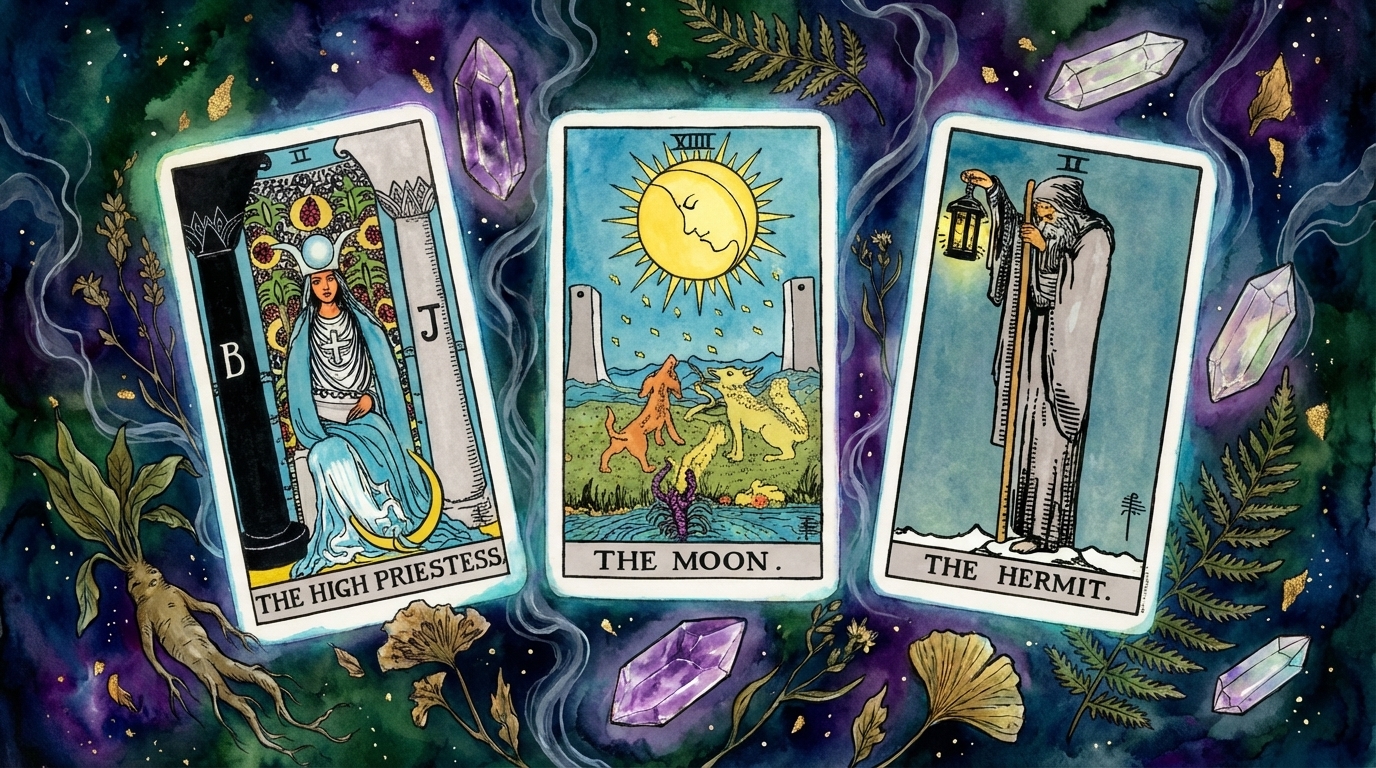
This card is not a promise. It is a prompt to articulate value you have not fully named. If you drew The High Priestess in this position, the reflective question is not "will hidden knowledge come to me" but rather: what do I already know about this role that I have not said out loud, to anyone, including myself?
Prompt yourself with: What would I lose access to if I said no? Career opportunity is often clearer as an absence than a presence.
Position 2 — Concern: "What am I avoiding examining?"
This is the most misused position, because it invites catastrophizing. The discipline here is to distinguish a concern (something to plan around) from a fear (something to sit with). A card like The Moon in this position reads well as ambiguity and unverified assumption — the reflective question becomes: which parts of this decision am I filling in with imagination rather than information?
Prompt yourself with: What would I need to find out to make this concern smaller? If the answer is "nothing, it's just uncertainty," that is a different category of problem than a research gap.
Position 3 — Next Step: "What is the smallest concrete action I can take this week?"
The critical constraint: this position must produce an action you could put in a calendar, not a disposition. "Be more confident" fails. "Email the two people who did this role before me and ask what they wish they'd known" passes. The Hermit in this position, for instance, points toward deliberate solitary assessment — which translates into a schedulable block of time, not a vague inward turn.
Prompt yourself with: What is the version of this step that takes under two hours?

How Do You Run the Reading With an AI Tarot Tool Step by Step?
Running a reflective three-card reading with an AI tool takes about fifteen minutes and depends almost entirely on how you instruct the tool at the outset — most AI tarot readers default to predictive framing unless you explicitly redirect them.
With a general-purpose AI assistant (ChatGPT, Claude, Gemini):
You must supply the draw yourself, since the model has no card-selection mechanism. Draw physically from a deck, or use a separate randomizer, then prompt:
"I drew three cards for a career decision. Positions are: (1) Opportunity I might be underweighting, (2) Concern I'm avoiding examining, (3) Smallest concrete next step. Cards: The High Priestess, The Moon, The Hermit. My question: I have an offer to move from IC to management and I think I'll say yes but something is stopping me. Do not tell me what will happen. For each card, give me three questions I should answer myself, and name one assumption I appear to be making."
The instruction "do not tell me what will happen" and the request for questions rather than interpretations are what convert a general chatbot into a reflection tool.
With a specialized tarot agent:
The Mystic Tarot Reader on Jenova handles the draw as part of the reading ritual and renders the spread visually. To keep it reflective:
"I'd like a three-card career reflection spread — not a prediction. Please use these positions: Opportunity, Concern, Next Step. After the reading, ask me follow-up questions rather than giving conclusions. My situation: I've been offered a management track role after six years as an individual contributor."
Because Jenova agents retain memory across sessions, a follow-up a month later can reference the prior spread directly:
"Pull a new three-card career spread on the same management decision. Then compare it to the spread we did last month — what shifted in how I'm describing the concern?"
With a dedicated tarot app:
Tools like CHATAROT.AI build spread position, upright/reversed orientation, and card relationships into the product flow, and support same-reading follow-up chat so you can clarify a card without restating the whole draw. Tarotap offers a "Two Options Spread" and "Three Options Spread" built specifically for choosing between paths, plus multiple reader personas with different interpretive styles.
The step most people skip: write your own answer to each card before reading the AI's interpretation. Otherwise the AI's framing becomes your framing, and you have outsourced the reflection you came to do.
Which AI Tarot Tools Handle Reflective Career Spreads Best?
No tool is definitively best for reflective career work — the meaningful differences are in draw handling, spread customization, follow-up continuity, and whether the tool retains context between sessions.
We evaluated across six dimensions relevant specifically to non-predictive career reflection: custom position naming, draw handling, follow-up continuity, cross-session memory, predictive-framing resistance, and privacy posture.
| Dimension | General AI assistant (ChatGPT / Claude) | CHATAROT.AI | Tarotap | Jenova Mystic Tarot Reader | Physical deck + journal |
|---|---|---|---|---|---|
| Custom position naming | Full — you define positions in the prompt | Four fixed spreads (Mirror of Soul, Time Flow, Choice, Celtic Cross) | Spread auto-selected from your question; includes Two Options and Three Options spreads | Full — definable in your instructions | Full — you define everything |
| Draw handling | None — you must supply the cards yourself | Built-in 3D interactive draw with upright/reversed orientation | Built-in draw | Built-in as part of the reading ritual | Physical shuffle and cut |
| Follow-up continuity | Yes, within a session | Same-reading follow-up chat tied to the same card set | Follow-ups tracked across the session | Yes, within and across sessions | None automated |
| Cross-session memory | Varies by provider and settings | Not documented in reviewed materials | Not documented in reviewed materials | Persistent memory across sessions with unlimited chat history | Only if you keep the journal |
| Predictive-framing resistance | Depends entirely on your prompt | States it should not be described as a guaranteed predictor | Explicitly declines safety, medical, legal, and specific financial questions | Depends on your instructions | Depends on your discipline |
| Pricing | Free tiers available; paid tiers commonly around $20/mo | Verify current terms directly | Free readings available; verify premium terms | Free tier available; Plus $20/mo, Premium $50/mo, Pro $100/mo | One-time deck purchase, typically under $40 |
| Best for | People who want total control over position naming and already own a deck | People who want structured spread mechanics with orientation handling in one flow | People who want a spread matched automatically to a two- or three-option decision | People who want the same reader to track a decision across months | People for whom the physical ritual is the point |
Two honest caveats. First, pricing and features for third-party tools change frequently — verify current terms before committing. Second, no AI tarot tool is more "accurate" than another, because accuracy is not a coherent measure in a reflective context. What varies is interpretive coherence and workflow fit, which is the framing CHATAROT.AI itself adopts when it argues that for AI tarot, "accurate" should not mean guaranteed prediction.
Where each falls short. General assistants require you to supply the draw, which breaks the randomization that makes the exercise useful. Dedicated tarot apps constrain you to their spread library, which limits custom position naming — the exact lever that makes a spread reflective. Jenova's agent lives in a chat interface and cannot replicate the embodied ritual of shuffling a physical deck, and its memory means your career deliberations are stored on a server rather than in a notebook. A physical deck offers total privacy and the best ritual, and zero pattern detection.
What Do You Do With the Reading After the Cards Are Down?
The reading only becomes useful in the twenty minutes after it ends, when you convert symbolic material into written commitments — and this is the step that separates reflection from entertainment.
A four-part post-reading protocol:
- Write one paragraph per position, in your own words. Not the AI's interpretation — yours. Date it.
- Extract exactly one action from the Next Step card and schedule it. One. If you extract four, you will do zero.
- Name the assumption you identified in the Concern position and write what would falsify it. Example: "I'm assuming I'd hate managing. Falsification test: talk to two people who made the same switch and ask what they didn't expect."
- Write a one-sentence prediction — and then explicitly label it as yours, not the cards'. This preserves the boundary. "I think I'll take it and struggle for six months" is your judgment, generated with the cards' help.
This mirrors standard career-reflection practice. UCSF's guidance recommends keeping a dated record of reflection answers, noting it is "useful to look back and see what you were thinking about at different stages of your career exploration" — because thoughts and feelings evolve in ways that are hard to notice without a record.
The re-draw discipline. Tarotap's guidance is worth adopting regardless of which tool you use: avoid repeating a reading on an unchanged question, because asking again when you dislike the first answer "won't make it more 'right'; it'll just muddy things." Wait until something in your situation has actually shifted.
How Do You Keep the Practice From Sliding Back Into Fortune-Telling?
You keep the practice reflective through explicit structural guardrails, because predictive drift is the default failure mode — it is easier and more emotionally satisfying to receive an answer than to generate one.
Five guardrails that work:
- Banned words in your own notes. If you catch yourself writing "the cards say I should" or "this means it will," stop and rewrite as "reading this card, I notice that I..."
- No outcome position, ever. The moment a spread contains a slot labeled outcome, result, or what happens next, the entire reading reorganizes around it.
- The falsifiability test. After the reading, ask: would I have accepted the opposite interpretation just as readily? If yes, the reading confirmed a pre-existing lean rather than revealing anything.
- Separate the decision date from the reading date. Never draw cards on the day a decision is due. The time pressure converts reflection into permission-seeking.
- Escalate to human input for anything consequential. Tarot as a reflection layer is legitimate; tarot as the deciding input for a financial, legal, or health-adjacent career decision is not. Tarotap draws this line explicitly, stating that safety, medical, legal, and specific financial questions "need real professionals, not a card spread."
A related risk worth naming: the same specificity that makes a spread useful can make it feel authoritative. A well-written AI interpretation is fluent, confident, and tailored — three properties that create an impression of insight independent of whether insight occurred. Fluency is not evidence.
If reflection is not the actual bottleneck, a different tool applies. Someone who has already reflected extensively and needs market data, compensation benchmarks, or positioning strategy is better served by a Career Advisor than by any symbolic framework. Tarot is a tool for surfacing what you think; it is not a tool for finding out what is true about the labor market.
What Do Practitioners and Researchers Say About Tarot as a Reflection Tool?
The scholarly and practitioner consensus is that tarot's psychological utility is real and mechanistically explainable — through projection and narrative construction — and entirely separate from any claim of predictive validity.
"The single highest-leverage change we see is position renaming. People arrive wanting a career spread and default to past-present-future because that's the layout they've seen. When we swap the third position from 'outcome' to 'next step,' the character of the entire session changes — users start writing longer responses, they push back on interpretations, and they leave with something they can actually do on Monday. The cards are identical. The frame is doing all the work."
"There's a specific failure pattern with AI tarot that doesn't exist with physical decks: fluency inflation. A language model produces a beautifully written, situationally specific paragraph, and that fluency reads as insight even when the content is generic. Our recommendation is that users write their own reading for each position before looking at the AI's output. If your reading and the AI's reading diverge, that divergence is the most interesting thing in the session — and you only get access to it if you wrote yours first."
"We're explicit internally that we don't make predictive claims and that no responsible implementation should. What a structured symbolic framework does well is hand you a vocabulary you didn't invent for a situation you're too close to see clearly. That's a genuine cognitive function, and it's well-supported by the projection literature. The moment a tool starts telling users what will happen rather than offering a frame for what is happening, it has stopped being a reflection tool and become something else."
— Jenova Product Team, spiritual and lifestyle agent development, 8 years in conversational AI systems
This aligns with the academic treatment. The Global Review of Humanities, Arts, and Society analysis argues that tarot's symbolic language "facilitates psychological benefits such as improved self-awareness, emotional clarity, and meaning making", drawing on projection, archetypal symbolism, and narrative therapy — while noting that skepticism among academics remains and that the therapeutic applications warrant further research.
Bowdoin College's science journal notes that a 2009 study specifically investigated how regular tarot users employed the cards as a tool for self-reflection rather than for divination — indicating that the reflective use case is not a recent AI-era reframing but a documented existing practice.
When Should You Reach for Something Other Than a Tarot Spread?
Reach for a different tool when the bottleneck is information rather than articulation — tarot cannot supply facts you do not have, and using it as though it can is the practice's most common misapplication.
Use a three-card reflective spread when:
- You have the information but cannot articulate your own position
- You suspect you are avoiding something and cannot name it
- You keep circling the same decision without new thinking
- You want a repeatable monthly check-in on a long-running deliberation
Use something else when:
- You need market data — compensation ranges, industry trajectory, role requirements. This is research, not reflection.
- The decision is time-critical. Reflection under deadline pressure reliably degrades into justification.
- The stakes are financial, legal, or health-related. Get qualified human input.
- You are in genuine distress rather than deliberation. Career anxiety that is affecting sleep, health, or functioning is a clinical concern, not a spread. Human support is the right resource.
- You have already drawn three times this week on the same question. That is not reflection; it is a loop.
Research published in Reflective Practice on career decision-making frames the process as requiring both self-reflection and "awareness of the environment" — two distinct inputs. A tarot spread addresses the first and contributes nothing to the second. Treating it as a substitute for environmental awareness is the error; treating it as a complement is the practice.
References
- Global Review of Humanities, Arts, and Society — The Mirror, Not the Crystal Ball: A Psychological Analysis of Tarot as a Self-Reflection Tool
- Taylor & Francis / Reflective Practice — Reflective Practice and Career Decision-Making
- Tarotap — Free AI Tarot Reading Online: How It Works and FAQ
- UCSF Office of Career and Professional Development — Reflection as Part of Career Exploration and Preparation
- CHATAROT.AI — Best AI Tarot Reading Tools: Evaluation Criteria for 2026
- Bowdoin Science Journal — It's in the Cards: A Dive into Tarot Card Psychology, Interpretation and Therapeutic Applications
- ResearchGate — The Mirror, Not the Crystal Ball (full text record)
- National Institutes of Health — Linking Career Exploration, Self-Reflection, Career Calling, Career Adaptability and Subjective Well-Being
- ProQuest — Therapeutic Practice of Artistically Manifesting a Tarot Pull
- The Poetry Lab — How to Use Tarot as a Tool for Self-Reflection