How Can You Spot Misleading AI Investment Tools?
2026-08-24
Which Four Marketing Patterns Separate Research Tools From Promotional AI Products?
Misleading AI investment tools usually fail a simple integrity screen: they promise returns, treat backtests as forecasts, hide who gets paid, or deliver personalized advice they are not qualified to give. In 2026, the more useful split is not “AI versus human.” It is research software that explains uncertainty versus promotional products that sell certainty.
Four patterns separate those categories:
✅ Return promises — any claim of guaranteed, “can’t lose,” or risk-free AI performance is a classic fraud marker, including when the seller is a registered firm (FINRA’s joint investor alert with the SEC and NASAA). ✅ Backtest-as-prediction — historical simulations estimate a strategy’s past risk-return trade-off; they do not forecast live results (CFA Institute). ✅ Hidden promotion — undisclosed affiliate, solicitation, or product-shelf incentives distort rankings the same way they distort human advice (Federal Register). ✅ Unsuitable personalization — a chatbot that tells you what to buy without knowing goals, horizon, income, constraints, and legal status is not advice. It is a liability dressed as intimacy (Investor.gov).
Legitimate options look different. Jenova’s Fundamental Stock Analyst is built for filings, valuation, and earnings analysis rather than guaranteed picks. Koyfin concentrates on market data and portfolio reporting. TradingView is strongest as a charting and community platform. TipRanks organizes analyst consensus and insider activity. None of those roles requires a promised return. The rest of this article turns those four patterns into a repeatable screening method.
Why Are Misleading AI Investment Claims Spreading Faster in 2026?
AI investment claims are spreading because “AI” is now a fundraising and conversion word, and regulators have already documented both outright scams and quieter “AI washing.” The technology is real. The marketing often is not.
In March 2024, the U.S. Securities and Exchange Commission charged two investment advisers, Delphia (USA) Inc. and Global Predictions Inc., for false and misleading AI statements. Combined civil penalties totaled $400,000. Delphia claimed its artificial intelligence used client data to “predict which companies and trends are about to make it big.” The SEC found it did not have those capabilities. Global Predictions called itself the “first regulated AI financial advisor” and advertised “expert AI-driven forecasts.” Those claims were also false.
That is the legal name for a now-common pattern: AI washing — saying a model is doing work it does not do. Chair Gary Gensler put the point bluntly: advisers should not tell the public they are using an AI model when they are not (SEC).
Scams sit one layer below that. Unregistered platforms advertise proprietary systems that “can’t lose” or pick “guaranteed stock winners,” according to FINRA, the SEC, and NASAA. The same alert warns that deepfake audio and video can impersonate executives, relatives, or even government staff. Complexity is the camouflage. If a buyer cannot inspect the model, the seller can sell the word “AI” instead of a process.
What Can AI Trading Tools Actually Do — and What Remains Impossible?
AI can improve how a decision is produced. It cannot make markets honor that decision. Continuous monitoring, faster data processing, consistent rule execution, and reduced emotional trading are real operational benefits. They do not become price certainty, profit guarantees, or immunity from broker failure.
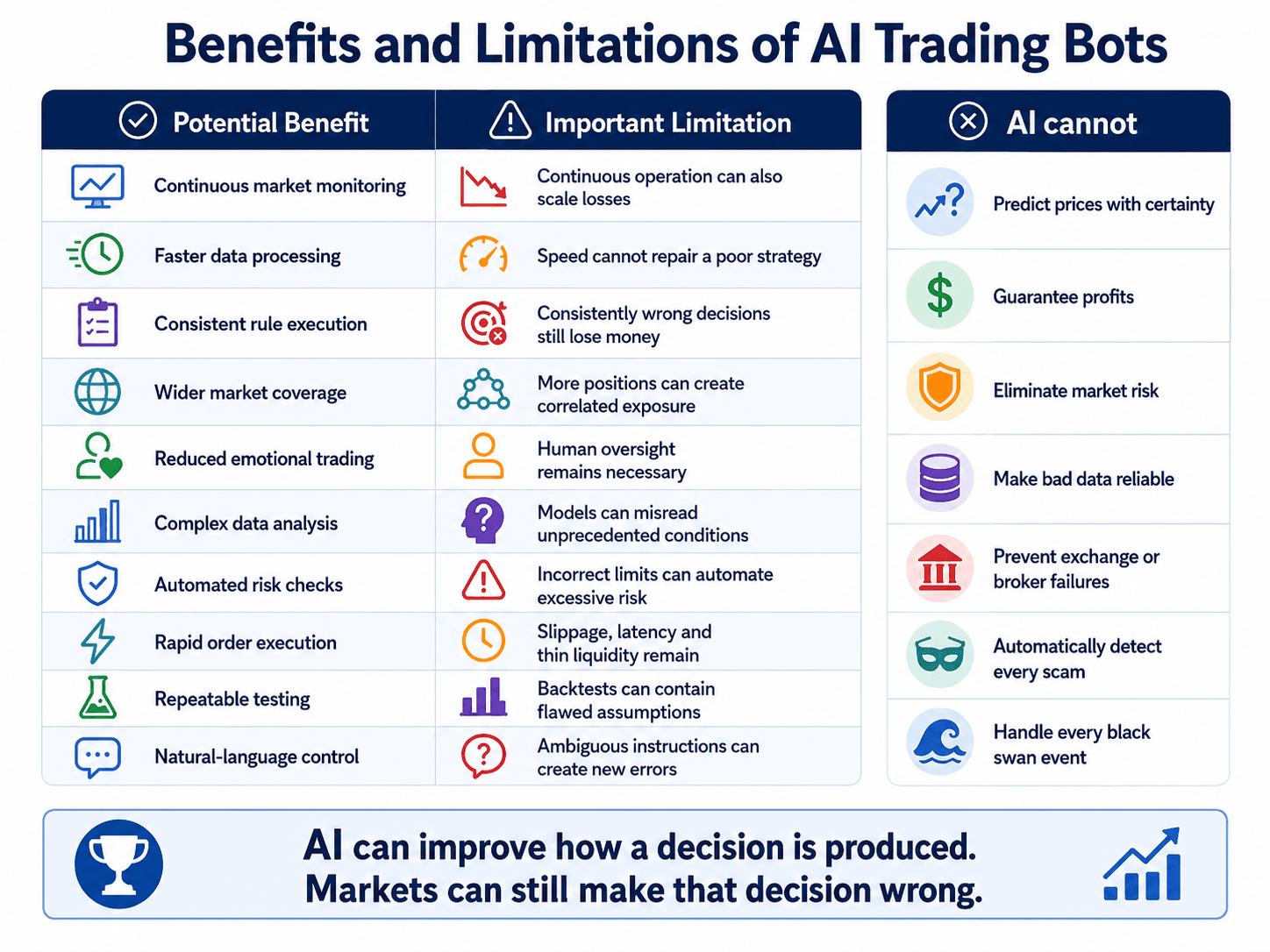
The useful distinction is between process advantages and outcome claims.
Process advantages are narrow and testable:
- A model can scan more filings, prices, and news items than a person can in the same hour.
- A rules engine can place the same order type every time a signal fires.
- A risk script can refuse a trade that breaches a pre-set loss limit.
Outcome claims are different. No system can predict prices with certainty, eliminate market risk, make bad data reliable, or handle every black-swan event. Speed also scales losses: a flawed strategy that trades faster simply fails faster. FINRA’s investor alert is explicit on a related point — do not rely solely on AI-generated information to predict market direction or a security’s price, because the underlying data may be inaccurate, incomplete, outdated, or planted to move a stock.
If a product’s homepage talks more about “winning” than about data lineage, risk limits, and failure modes, it is selling an outcome it cannot underwrite.
What Should You Check Before Trusting an AI Investment Tool?
You should check registration status, claim language, data lineage, commercial incentives, and the tool’s actual advice perimeter before you trust any AI investment product. A polished interface is not a control.
Use this Four-Claim Integrity Screen. Score each item pass or fail. One fail is enough to keep capital out.
1. Return-promise test
Fail the product if it uses “guaranteed,” “can’t lose,” “risk-free,” or a specific future percentage return. FINRA treats high promised returns with little or no risk as a classic fraud marker, including when the speaker is registered.
2. Backtest-framing test
Fail the product if a historical simulation is presented as expected live performance without look-ahead controls, transaction costs, survivorship treatment, and an out-of-sample window. The CFA Institute defines backtesting as an approximation of a past process, not a forecast.
3. Promotion-disclosure test
Fail the product if rankings, “top picks,” or model portfolios could steer you into a paying issuer, affiliate broker, or sponsored slot and that relationship is not obvious. The SEC’s 2023 predictive-data-analytics proposal exists because algorithms can scale conflicts as efficiently as they scale signals.
4. Suitability-scope test
Fail the product if it tells a specific person what to buy, sell, or allocate without collecting goals, horizon, income, other assets, and risk capacity — the intake Investor.gov describes for robo-advisers — or if it is not authorized to give that advice.
Add two operational checks. Confirm the firm or professional is registered with the free search tool on Investor.gov. Then ask whether the vendor can show the filing, price, or estimate behind any number. A tool that cannot point to a source is generating confidence, not research.
How Do Transparent AI Research Tools Compare on Integrity Signals?
Transparent research tools differ on data depth and workflow, but they share a trait promotional bots lack: they sell analysis, charts, or consensus — not a promised return. Comparing them on integrity signals is more useful than comparing them on who sounds smarter.
Jenova’s Fundamental Stock Analyst is strongest when the job is to read a business: earnings quality, relative valuation, and the story inside SEC filings, estimates, and sentiment. It is not a registered investment adviser, does not manage accounts, and should not be used as a fiduciary substitute. That limitation is also a honesty signal. The agent can be asked to refuse buy/sell language.
Koyfin is built as a data and reporting workstation for investors and advisers, with screening, portfolio views, and client-ready charts (Koyfin). As of 2026, public plan summaries commonly list a free tier plus paid Plus and Pro levels near $39 and $79 a month (Koyfin’s own plan summary). It is weaker as a discretionary trading coach.
TradingView is the technical-analysis and charting default for many active traders, with a usable free tier and paid Essential, Plus, and Premium plans listed around $12.95, $29.95, and $59.95 a month in independent 2026 comparisons (Invest Focus Guide). It does not replace a fundamental terminal.
TipRanks concentrates on analyst consensus, insider activity, and beginner-friendly scores, with a limited free tier and a Premium plan commonly listed near $30 a month (Invest Focus Guide). Consensus is a useful input. It is still not a personal recommendation, and crowds of analysts can be late or wrong together.
| Feature / dimension | Jenova Fundamental Stock Analyst | Koyfin | TradingView | TipRanks |
|---|---|---|---|---|
| Return promises | Research framing; no guaranteed-return product claim | Market-data and reporting product | Charting and alerts product | Consensus and scoring product |
| Backtest framing | Can critique assumptions; not a strategy-sales engine | Research/visualization first | Strategy tester exists; user must interpret limits | Not a backtest vendor in the usual sense |
| Commercial-relationship visibility | Platform subscription; no issuer-pay “winner” list | Subscription data terminal | Ads on free tier; broker integrations exist | Ratings business; users should read methodology |
| Personalized-advice perimeter | Analysis on request; not a registered RIA | Tools for advisers and self-directed users | Execution via brokers, not fiduciary advice | Idea generation, not suitability review |
| Core strength | Filings, valuation, narrative synthesis | Fundamentals dashboards and reporting | Charts, alerts, community | Analyst and insider aggregation |
| Pricing (as of 2026) | Free tier; paid plans from $20/month | Free; Plus ~$39/mo; Pro ~$79/mo | Free; paid from ~$12.95/mo | Limited free; Premium ~$30/mo |
| Best for | Document-grounded equity research | Screening and portfolio reporting | Technical timing and chart work | Tracking Street consensus |
Related Jenova agents fill adjacent jobs without changing the integrity rule. The Portfolio Management Strategist is built for allocation drift, risk, and stress tests. The Macro Strategist is built for cross-asset and policy context. The Technical Stock Analyst is built for price structure and defined-risk setups. If any of them started promising a yearly return, they would fail the same screen as an anonymous Telegram bot.
Why Should Backtests Never Be Treated as Return Predictions?
A backtest answers “how would this process have behaved on past data?” It does not answer “what will this earn next year?” Treating the first number as the second is the most common sophisticated lie in quantitative marketing.
The CFA Institute states the objective directly: backtesting approximates the real-life investment process so an investor can study a risk-return trade-off. In a CFA Institute survey of nearly 250 analysts, portfolio managers, and private-wealth managers, 50% had backtested a strategy in the prior 12 months. The technique is mainstream. The misreading of it is also mainstream.
Known failure modes are not obscure:
- Survivorship bias quietly drops the funds, stocks, or coins that died.
- Look-ahead bias lets the model use information that was not available on the trade date.
- Costless trading ignores commissions, bid-ask spreads, slippage, and market impact.
- Regime breaks mean the historical distribution may not represent the next crisis. The CFA curriculum flags structural breaks and the fat tails and negative skew that standard windows understate (CFA Institute).
- Overfit beauty appears when a developer hunts across hundreds of parameter sets and publishes only the winner.
CFA Standard V(A) on Diligence and Reasonable Basis applies this duty to quantitatively oriented models, including backtested strategies. A vendor who will not discuss those defects is not being concise. They are hiding the only facts that make the chart interpretable.
A practical filter is linguistic. “This long-short book returned 18% annualized from 2012–2024 in a frictionless backtest, with a 32% max drawdown” is a historical statement. “Our AI delivers 18% a year” is a prediction — and, if it is presented as expected personal performance, a red flag.
How Do Hidden Promotional Relationships Show Up in AI Tools?
Hidden promotional relationships show up as rankings, default portfolios, “smart” product shelves, and finfluencer scripts that look like research while routing money toward whoever pays. The conflict is old. The delivery mechanism is new.
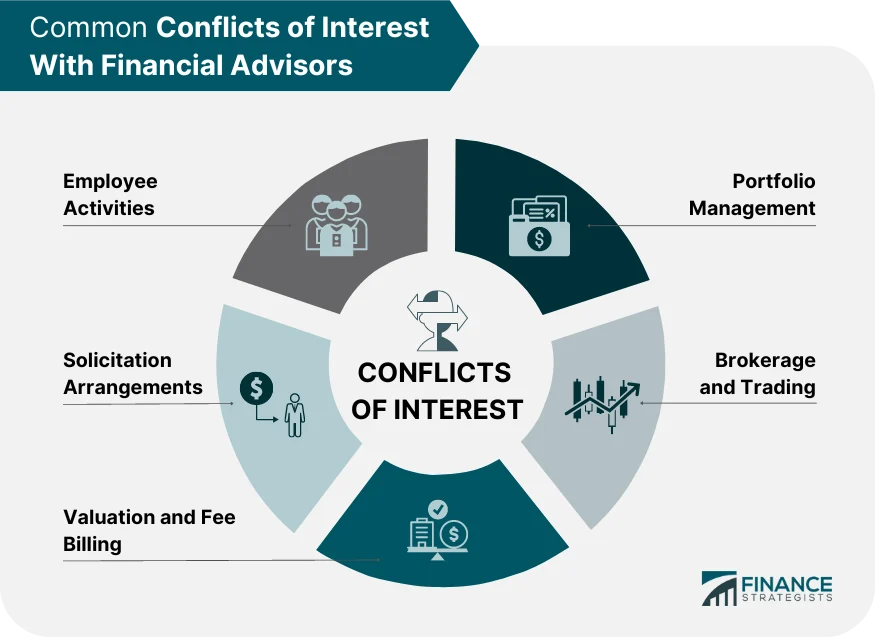
Human advisory conflicts cluster in familiar places: portfolio management, brokerage and trading, valuation and fee billing, solicitation arrangements, and employee activities. An algorithm can encode every one of those incentives and then scale them. That is why the SEC’s 2023 predictive-data-analytics release focused on conflicts associated with these tools at broker-dealers and investment advisers.
Watch for these specific tells:
- A “best AI pick” list that happens to feature the house fund, a paying issuer, or an affiliate crypto token.
- A chatbot that will discuss only one broker’s product menu.
- A model portfolio with a large cash or proprietary-product sleeve that is not explained in plain language. Robo-adviser cases have already turned on undisclosed cash allocations and related conflicts (Stradley Ronon discussion of SEC settled charges).
- Social proof from celebrities or “finfluencers” with no disclosure of payment. FINRA warns that a famous face is not evidence an investment is legitimate or suitable.
- Affiliate links dressed as independent rankings. Some comparison sites, including ones that publish useful fee tables, disclose that they may receive affiliate compensation (Invest Focus Guide). That disclosure is the minimum, not a nuisance footnote.
A clean product can still have a business model. Subscription terminals such as Koyfin and charting platforms such as TradingView are easier to inspect because the customer can see what is being bought: data, charts, or alerts. Opacity starts when the “AI” is free, the recommendation is specific, and the only invisible party is the one who profits if you click.
When Does Personalized AI Investment Advice Become Unsuitable?
Personalized AI advice becomes unsuitable when the system speaks to your situation without knowing your situation, or when it is not legally allowed to give that advice in the first place. Personal tone is not personalization.
Investor.gov’s robo-adviser bulletin describes the ordinary intake: goals, horizon, income and other assets, and risk. Registered robo-advisers that skip material facts about their model, conflicts, or allocation rules have already drawn SEC actions. Unregistered chat products that skip the intake entirely and still say “you should put 40% in this coin” are doing something more aggressive. They are simulating a fiduciary.
Unsuitability has several common shapes:
- Risk mismatch — leveraged options language aimed at a user who asked about retirement income.
- Horizon mismatch — a day-trading bot answering a 20-year allocation question.
- Constraint blindness — ignoring taxes, concentrated employer stock, liquidity needs, or legal restrictions.
- Jurisdiction blindness — a model that cannot know whether it is speaking to a retail client, a professional, or someone in a country where the product is not offered.
- Emotional capture — FINRA notes that chatbot-style AI output can push people toward impulsive decisions even when the underlying facts are weak.
Jenova’s investment agents are strongest when they stay inside analysis. A user can instruct the Fundamental Stock Analyst to evaluate a 10-K, compare valuation bands, and refuse a buy or sell recommendation. That is a feature. A tool that insists on telling you what you should do, after three chat turns and no financial statement, is performing intimacy. It is not performing suitability.
Registered advice and research software are different products. Mixing them without disclosure is how unsuitable personalization hides.
How Do You Vet an AI Investment Tool Before Acting on Its Output?
You vet the vendor first, the claim second, and the number third — then you keep the model in a research role until those checks pass. Acting on the first confident paragraph is how promotional systems convert.
A compact sequence:
- Identify the legal person. Find the company name, not the bot name. Search registration and disciplinary history on Investor.gov. Unregistered platforms pitching AI trading systems are a primary warning in the FINRA/SEC/NASAA alert.
- Run the Four-Claim Integrity Screen. Promise of return, backtest-as-forecast, hidden promotion, unsuitable personalization. One fail stops the process.
- Demand the exhibit. Every material figure should map to a filing, exchange print, or named estimate vendor. If the model cannot show the exhibit, treat the figure as unverified.
- Separate research from instruction. Ask for drivers, risks, and what would falsify the thesis. Do not ask a chatbot what you personally should buy until a registered professional has your full profile.
- Compare across independent tools. A filing summary from Jenova, a fundamentals snapshot in Koyfin, a chart structure in TradingView, and a consensus view from TipRanks should be reconcilable. If only one source is euphoric, the euphoria is the signal.
A research-only prompt keeps the model inside a defensible perimeter:
"Using the latest 10-K, 10-Q, and earnings release, summarize revenue concentration, free-cash-flow trend, net debt, and valuation versus named peers. Cite the exhibit for every figure. List what you cannot verify. Do not give me a buy, sell, or allocation recommendation."
A backtest interrogation prompt is equally specific:
"Here is a strategy description and its reported backtest. Identify look-ahead risk, survivorship risk, missing costs, and regime dependence. Tell me what additional disclosure would be required before this result could be described as historical — not predictive."
For a Koyfin or TradingView workflow, the analog is mechanical: export the dates, fees, and universe rules, then try to break the result. A strategy that only works in one vendor’s default settings is not a strategy. It is a setting.
If you suspect fraud rather than sloppy marketing, FINRA points investors to the SEC tip form at sec.gov/tcr, FINRA’s complaint form, and state or provincial regulators.
What Do Market Integrity Specialists Say About AI Investment Claims?
Market-integrity specialists treat “AI” as a claim that must be evidenced like any other performance or process statement, not as a reason to relax diligence. The enforcement record already shows that both invented models and guaranteed-return pitches are being used on real investors.
"The cleanest integrity test is still linguistic. If a product converts a historical simulation into a personal expected return, it has crossed from research into prophecy. In product reviews, we treat any guaranteed percentage, any ‘can’t lose’ system, and any unnamed proprietary model that cannot show training data, costs, and an out-of-sample window as a failed control — even when the interface is excellent."
"AI washing is the quieter cousin of the scam bot. The 2024 SEC cases did not require a fake exchange. They required a false sentence about what the model did. That is why we design research agents to cite exhibits, refuse unverifiable numbers, and stay out of fiduciary allocation language unless a human adviser owns that duty."
"Backtests remain useful. About half of practitioners already run them. They become dangerous when the vendor omits survivorship, look-ahead, and fat-tail risk, then pastes the CAGR onto a landing page. A serious tool will spend more words on the drawdown and the excluded names than on the headline return."
— Jenova Product Team, financial-research product evaluation, multi-year review of AI investment workflows
The practical implication is unsentimental. Use models that make their limits legible. Use terminals that show the data. Use a registered adviser when the question is what you should do with capital you cannot replace. The combination is slower than a guaranteed-return bot. It is also the only combination that survives contact with a real market.
References
- FINRA — Artificial Intelligence (AI) and Investment Fraud (joint SEC/NASAA investor alert)
- U.S. Securities and Exchange Commission — SEC Charges Two Investment Advisers with Making False and Misleading Statements About Their Use of Artificial Intelligence (March 18, 2024)
- CFA Institute — Backtesting and Simulation
- Investor.gov — Investor Bulletin: Robo-Advisers
- Federal Register — Conflicts of Interest Associated With the Use of Predictive Data Analytics by Broker-Dealers and Investment Advisers (2023)
- Koyfin — Platform overview
- Koyfin — Best Platforms for Earnings Estimates, Price Targets, and Analyst Ratings (plan summary)
- Invest Focus Guide — TradingView vs TipRanks comparison and pricing (checked 2026)
- CFA Institute — Standard V(A) Diligence and Reasonable Basis
- Stradley Ronon — SEC Settles Charges with Robo-Adviser for Disclosure-Based Breach of Fiduciary Duty