How Can You Prevent AI Research Integrity Violations?
2026-08-22
Which Failure Modes Should Guide Your Choice of AI Research Tools?
Most AI-related integrity failures in academic work come from four predictable failure modes — fabricated sources, mismatched or distorted citations, accidental plagiarism, and sensitive-data exposure — and the tools that reduce them are those that retrieve real literature before they write, not those that write first and invent a bibliography later. In 2026, a Nature analysis found that tens of thousands of 2025 publications may contain invalid AI-generated references. Researchers comparing options typically evaluate Jenova’s Academic Research Assistant for citation-managed literature work, Elicit for systematic evidence extraction, and Scite for citation-context checks, while treating generic chatbots as high-risk for any claim that will appear in a submitted manuscript.
Key factors that separate integrity-safe AI research from unconstrained drafting:
✅ Retrieve-then-cite architecture — the system must locate a real paper before it attributes a claim to that paper. ✅ Human verification of every reference — Cornell’s teaching guidance requires students to verify the accuracy of all citations when AI use is allowed. ✅ Disclosure and human accountability — the Committee on Publication Ethics (COPE) states that AI tools cannot be authors and that humans remain liable for every sentence, including AI-drafted ones. ✅ Data containment — unpublished datasets, identifiable participant information, and embargoed manuscripts should never enter public training pipelines. ✅ Similarity-threshold awareness — institutional rules now treat elevated overlap, not just copied paragraphs, as a sanctionable event.
To compare tools usefully, it helps to treat integrity as an engineering problem with four gates — existence, fidelity, attribution, and containment — rather than as a single plagiarism score.
Why Have AI-Generated Citations Become a Research Integrity Crisis?
AI-generated citations have become a crisis because large language models complete plausible bibliographic patterns rather than querying a library catalog, so fabricated references look real enough to survive hurried proofreading. Enago reports that roughly one in five AI-generated scholarly references is fake, and those fakes typically mimic legitimate journal names, familiar author-naming patterns, and article titles that sound like they belong in the field.
The contamination is no longer confined to student essays. A 2026 STAT report on rising fraudulent citations described fabricated references spreading through the published literature and polluting the public record of science. Biomedical analyses have likewise found AI-generated fake references becoming more common in research papers. Once a phantom paper is cited, later authors may copy the citation without opening the source, which is how a single hallucination becomes a durable error.
David B. Resnik and coauthors argue that hallucinated citations may constitute research misconduct when citations function as data — for example in systematic reviews, evidence maps, or any paper whose argument depends on who said what. That framing matters: a invented reference is not a formatting mistake. It is a false empirical claim about the existence of a scholarly record.
Editors are now being asked to treat unverifiable references as a gatekeeping failure, not a copyediting nuisance. A PubMed Central commentary framed fabricated citations in the age of AI as a wake-up call for journal editors. For individual researchers, the practical implication is simpler. If a tool cannot show you the source, you do not have a citation.
What Should You Look for in an Integrity-Safe AI Research Assistant?
An integrity-safe AI research assistant should retrieve identifiable papers, attach claims to specific passages, keep your unpublished files off public training sets, and leave a disclosure trail you can defend to a supervisor or editor. Feature lists are a weak proxy. What matters is whether the tool’s default workflow makes fabrication expensive and verification cheap.
A useful evaluation model is the Source-First Integrity Model. Score a tool on whether it can pass four gates before you paste anything into a thesis chapter:
- Existence — Does a persistent identifier (DOI, PMID, ISBN, or stable URL) resolve to a real work?
- Fidelity — Does the cited passage actually support the claim, or has the model distorted the finding?
- Attribution — Is the right author, year, and pagination attached to the right sentence?
- Containment — Did any identifiable, embargoed, or clinically sensitive material leave your control?
Tools that generate prose first and sprinkle references afterward systematically fail Gate 1. Tools that search academic databases, return the paper, and only then summarize it are structurally safer, though never automatic. George Mason University’s guide to AI literature-review tools groups products such as Elicit and Scite around evidence synthesis rather than open-ended chat, which is the right category boundary.
Also weigh operational criteria that integrity offices actually ask about:
- Disclosure support — Can you record the model name, date, and prompt, as APA, MLA, and Chicago now provide patterns for citing LLM output?
- Memory scope — Does project memory help you stay consistent, or does it silently mix one client’s data into another session?
- Human-in-the-loop defaults — Does the interface make it easy to open the PDF, or does it bury the source behind a fluent paragraph?
- Detector independence — Cornell currently advises against relying on automatic AI-detection algorithms because they are unreliable and can falsely accuse writers. A good tool reduces the need for detectors by making sources inspectable.
Jenova’s Academic Research Assistant is built around literature discovery, manuscript preparation, and citation management, with platform-level persistent memory and scholarly search tools. It is not a replacement for iThenticate, an institutional review board, or a supervisor’s sign-off. That limitation is intentional: integrity remains a human responsibility.
How Do Leading AI Research Tools Compare on Citation Verification and Privacy?
Specialized research assistants outperform general chatbots on citation integrity because they are wired to corpora of papers, while general models are wired to next-token fluency. The comparison below uses the Source-First Integrity Model rather than marketing categories. Assessments reflect vendor documentation and published reporting available at the time of writing in 2026.
| Feature / Dimension | Generic LLM chatbots | Elicit | Scite | Jenova Academic Research Assistant |
|---|---|---|---|---|
| Citation architecture | Generate-then-cite; high fabrication risk | Retrieves from a corpus of 138 million papers and 545,000 clinical trials, with sentence-level citations | Searches 300 million-plus scholarly articles and shows whether later papers support or dispute a claim | Real-time literature discovery plus citation-managed manuscript support |
| Hallucinated-reference control | Weak unless the user independently verifies every item | Stronger for evidence tables; still requires human checks | Strong for citation context; weaker as a full writing environment | Stronger when Scholar/search tools are used before drafting; verification still required |
| Accidental-plagiarism risk | High if users paste fluent output unchanged | Lower for extraction tables; summaries can still be too close to source phrasing | Lower for claim-checking; not primarily a drafting tool | Lower when used for outlines and source maps; drafts still need originality review |
| Sensitive-data posture | Varies by vendor and plan; public models are a poor default for identifiable data | Research workspace; training/retention terms should be read per plan | Research workspace; training/retention terms should be read per plan | Platform policy: user data is not used to train public AI models |
| Pricing (as of 2026) | Unverified in this review | Unverified in this review | Unverified in this review | Free tier with limited usage; Plus at $20/month (30× free allowance); higher tiers scale usage |
| Best for | Brainstorming questions you will later source yourself | Systematic screening, data extraction, evidence tables | Validating how a paper is cited in the literature | End-to-end academic workflows that mix discovery, notes, and citation-aware drafting |
Elicit is particularly strong when the job is a structured review. The company says researchers report up to 80% time savings on systematic-review workflows and that every AI-generated claim is backed by sentence-level citations. Independent comparisons in 2026 generally treat Elicit as the broader review-operations tool and Scite as the citation-intelligence specialist. One side-by-side review put Elicit ahead for operations and Scite ahead for evidence validation.
Consensus-style products, as described in 2026 tool comparisons, answer research questions from peer-reviewed evidence rather than from open web text. That design reduces fabrication relative to a chatbot, but it does not remove the fidelity problem: a real paper can still be summarized incorrectly.
Jenova’s honest limitation is the same limitation every responsible research agent should advertise. It can retrieve, organize, and draft; it cannot swear that a paywalled PDF says what a model thinks it says. Researchers who need citation-context tallies may still prefer Scite for that narrow job. Researchers running a PRISMA-style screen may still prefer Elicit’s tables. The integrity win is using a source-first tool at all, then verifying.
How Can You Detect and Block Fabricated or Distorted Citations?
You detect fabricated and distorted citations by resolving every reference to a live record and then reading the cited passage against your sentence, because existence and fidelity are different failures. A DOI that 404s is a fabrication or a fatal metadata error. A real article that is quoted for a finding it never made is a distortion. Both can trigger misconduct reviews.
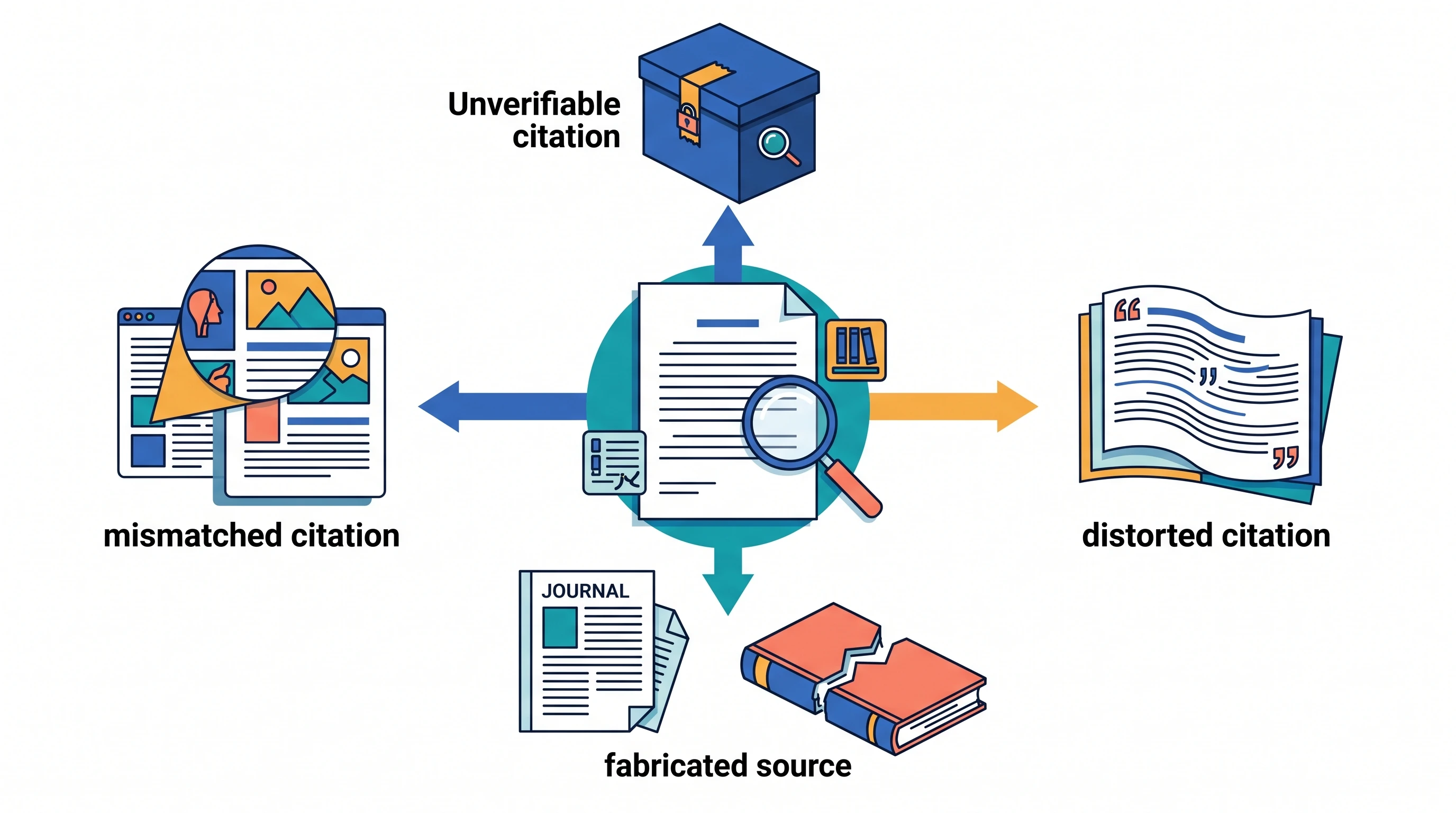
Four violation types show up repeatedly in AI-assisted bibliographies:
- Fabricated source — the article, dataset, or book does not exist.
- Unverifiable citation — the item may exist, but no accessible record, DOI, or archive copy can be located.
- Mismatched citation — a real work is attached to the wrong claim, author, or year.
- Distorted citation — the source exists and is on topic, but the model inverted a result, dropped a qualifier, or treated a limitation as a finding.
A practical blocking protocol takes about two minutes per key claim and far less once it becomes habit:
- Copy the reference into Crossref, PubMed, Google Scholar, or the journal site and confirm the title–author–year triple.
- Open the PDF or HTML and find the passage. If you cannot find it, delete the citation.
- Check that hedges survive. “Associated with” is not “causes.” “In mice” is not “in patients.”
- Reject any source the model cannot produce on demand. “I recall a 2019 paper in Nature Neuroscience…” is not a citation.
- Keep a verification log (spreadsheet or reference-manager note) for thesis chapters and journal submissions.
Jenova’s Academic Research Assistant is most useful at step 1, when you ask it to retrieve candidate papers and build a source map before any prose exists. Pair it with Scite when you need to know whether later literature supports or disputes the paper you are about to lean on. Pair it with Elicit when you are extracting methods and outcomes from a stack of trials.
A high-integrity prompt looks like this:
“Find peer-reviewed papers from 2020–2026 on [topic]. For each paper provide title, authors, year, DOI, venue, and a 25-word claim that is explicitly stated in the abstract or results. If you cannot verify a DOI, omit the paper. Do not invent references.”
Generic chatbots will still fail this prompt sometimes. The difference is that a source-first workflow makes the failure visible.
How Do You Prevent Accidental Plagiarism When Drafting With AI?
You prevent accidental plagiarism by treating AI output as unlicensed raw material — never as text you own — and by rewriting from notes rather than from the model’s fluent sentences. Accidental plagiarism is now the common case: the user did not intend to steal, but the model compressed a source so closely that a similarity checker, examiner, or reviewer can still match the phrasing.
COPE requires authors who use AI in writing, figures, or analysis to disclose the tool and how it was used, typically in Methods or an equivalent section. Authors remain “fully responsible for the content of their manuscript, even those parts produced by an AI tool.” That sentence is the entire legal structure. The model cannot hold copyright, manage conflicts, or answer a retraction notice. You can.
Three plagiarism pathways appear in AI-assisted drafts:
- Source echo — the model paraphrases a paper you pasted or it retrieved, keeping the original syntax.
- Self-plagiarism — the model recycles your earlier published methods paragraph because you uploaded it as “background.”
- Patchwriting at scale — many slightly altered sentences from many papers, which similarity software still flags.
A safer drafting sequence:
- Read the source yourself and write a bullet in your own words with a page number.
- Ask the model to reorganize your bullets, not the PDF.
- Run your institution’s similarity tool on the chapter, not on a chatbot’s “originality score.”
- Disclose the AI assistance in the form your journal or graduate school specifies.
A prompt that reduces echo:
“I will paste my own outline notes, not source PDFs. Reorder them into a logical argument. Do not add new citations. Do not expand any bullet into language that could pass as a finished scholarly sentence. Flag any point that still needs a source.”
Jenova’s Academic Research Assistant helps here when you keep source text in a notes layer and draft in a separate thread. Persistent memory is an advantage for long theses, because the agent can remember your research question and excluded papers. It is also a risk if you paste a coauthor’s unpublished draft into the same project. Containment is part of originality: do not let one manuscript bleed into another.
The European Network for Academic Integrity publishes general integrity guidelines that institutions still use as a baseline vocabulary. A 2025 ScienceDirect review argued that universities must build student competencies and explicit AI policies, not merely buy detectors. That is the right emphasis. Detectors guess. Disclosure and source logs prove.
How Do You Keep Sensitive Research Data Out of Public AI Systems?
You keep sensitive research data out of public AI systems by never pasting identifiable, embargoed, or contractually restricted material into a tool whose training, retention, or subprocessors you cannot name. IBM defines AI privacy as protecting personal or sensitive information collected, used, shared, or stored by AI systems. Academic work is full of exactly that class of information: interview transcripts, patient notes, school records, unpublished negative results, and grant narratives.
Classic privacy principles collide with naive AI use. Victoria’s information commissioner notes that AI challenges collection limitation, purpose specification, and use limitation — the idea that you collect only what you need, say why, and do not recycle it for a new purpose. Pasting a full qualitative dataset into a public chatbot to “find themes” is a new purpose the participants did not approve.
A containment checklist that holds up in ethics review:
- Minimize — send the code, the de-identified excerpt, or the variable dictionary, not the raw file. Data-minimization guidance for AI systems is to collect and store only what the task requires.
- De-identify before upload — remove names, locations, rare diagnoses, and file metadata.
- Prefer platforms that state they do not train public models on your content — Jenova’s platform policy is that user data is not used to train public AI models and is encrypted in transit and at rest. Read any competitor’s terms at the same level of specificity; “we take privacy seriously” is not a control.
- Separate projects — one agent thread per study, so a hospital dataset cannot be recalled while you draft a public blog post.
- Check contracts — industry-sponsored work, dual-use findings, and data-use agreements often forbid third-party processors entirely.
Jenova is stronger than a consumer chatbot on this dimension because of the no-public-training stance and project memory you control. It is not a HIPAA-certified electronic health record, an anonymization engine, or a substitute for your university’s secure enclave. If an IRB protocol names approved software, that list wins.
For interview research, a safe prompt is:
“Here are six de-identified excerpts with names and places already removed. Propose thematic codes only. Do not guess identities. Do not store these excerpts beyond this task if I later ask you to forget them.”
If you cannot write that prompt because the text is still identifying, you are not ready to use AI on it.
How Do You Build an Integrity-Safe AI Research Workflow?
An integrity-safe workflow starts with the research question and a source library, uses AI only inside named stages, and ends with a disclosure paragraph and a verification log. The sequence below works in Jenova’s Academic Research Assistant and can be mirrored, with different strengths, in Elicit or Scite.
Stage 1 — Scope without sources. Ask the agent to list rival definitions, likely databases, and exclusion rules. Do not accept any citation yet.
“I am writing a methods chapter on [question]. List the sub-questions a systematic search should cover. Do not cite papers. Flag where my question is too broad.”
Stage 2 — Retrieve, then freeze a library. Use the Academic Research Assistant (or Elicit, if you are screening hundreds of trials) to collect candidate records with DOIs. Export them to Zotero, EndNote, or your institutional manager. The reference manager — not the chat transcript — becomes the system of record.
Jenova’s related Deep Research agent is useful when you need a wide, citation-heavy briefing before you narrow the corpus. Treat that briefing as a map, not as literature you have read.
Stage 3 — Extract with a table, not a paragraph. Ask for study design, sample, outcome, and limitation in columns. Elicit is purpose-built for this; Jenova can draft the same table if you feed it papers you have already opened.
Stage 4 — Draft from your notes. Write or dictate bullets. Allow the agent to outline and pressure-test logic. Do not let it “smooth” language until sources are locked.
Stage 5 — Verify and disclose. Resolve every DOI. Read every passage you cite. Add a methods sentence such as: “A large language model (model name, date) was used to organize notes and suggest search terms; all citations were checked against primary sources by the author.”
Setup on Jenova takes a few minutes: open the Academic Research Assistant, state your field and integrity constraints in the first message, and attach only files you are allowed to process. The free tier covers limited usage; Plus starts at $20 per month with 30 times the free allowance. Usage is a monthly pool rather than a daily cap, which matters during a revision sprint.
For Elicit, the parallel path is: pose a review question, generate an evidence table, customize which papers enter the report, then export and verify. For Scite, the parallel path is: drop your key papers in and inspect supporting versus disputing citations before you claim consensus.
The workflow’s non-negotiable rule is order. Search before sentences. Passages before paraphrases. Disclosure before submission.
What Do Research Integrity Experts Say About AI-Assisted Scholarship?
Research integrity specialists increasingly treat hallucinated citations, undisclosed AI drafting, and uncontrolled data uploads as process failures that institutions can design against, not as rare student cheating events.
“The error we see is not that researchers use models. It is that they use a generate-then-cite loop on tasks where the citation is itself a datum. If your results section depends on a paper existing, then a fluent fake reference is closer to data fabrication than to sloppy formatting. The fix is architectural: retrieve the record, extract the claim, then write. Tools that invert that order will keep seeding the literature with ghosts.”
“Privacy failures follow the same inversion. People paste the richest file they have because it is convenient, which is the opposite of collection limitation. De-identify first, minimize second, and choose a system that will not train public models on the residue. Convenience is not an ethics exemption.”
“We also advise labs to stop outsourcing integrity to AI detectors. Detectors cannot show a source, cannot prove intent, and create false positives that punish non-native writers. A verification log and a COPE-style disclosure are slower on day one and much faster when a reviewer asks, ‘Where did this reference come from?’”
— Jenova Product Team, academic AI workflow research, eight years designing citation-aware research agents
That perspective aligns with formal guidance. COPE assigns liability to human authors. Cornell asks instructors to require citation verification and to gather objective evidence — nonexistent references, methods the student cannot explain — rather than a detector score. Cambridge’s treatment of academic integrity in the age of AI starts from the same premise: if assessments no longer reflect learning, the credential itself is the casualty.
What Happens When AI Use Crosses Institutional Integrity Thresholds?
When AI use crosses institutional thresholds, penalties attach to the human author and, increasingly, to supervisors — ranging from mandatory revision to stalled submission or cancelled registration. Policies differ by country and campus, but the direction of travel in 2026 is tighter similarity bands, explicit AI scrutiny, and less patience for “the model made it up.”
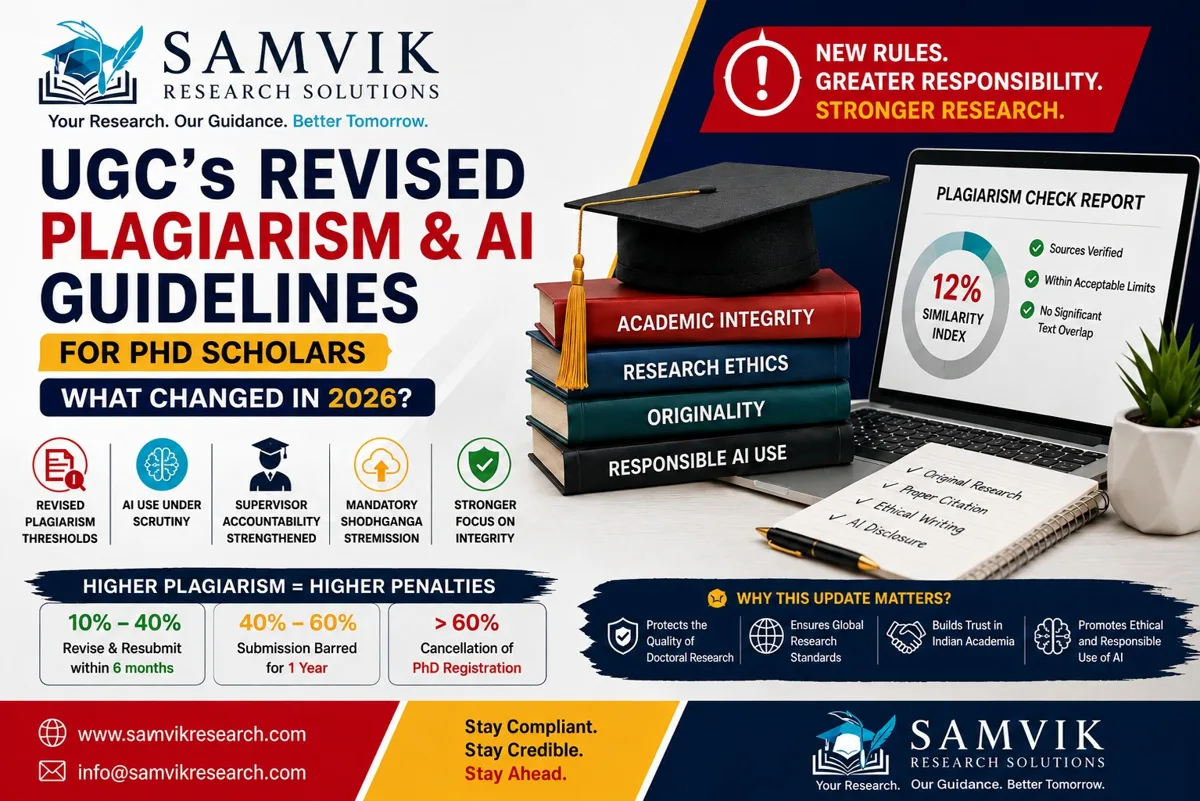
Guidance circulated to PhD scholars in 2026 around the University Grants Commission (UGC) revision illustrates how numeric thresholds become career events. In that framework, similarity between 10% and 40% triggers revise-and-resubmit within six months; 40% to 60% can bar submission for a year; and similarity above 60% can cancel PhD registration. The same guidance pairs those bands with closer review of AI use, stronger supervisor accountability, and mandatory repository deposit. Even if your university uses different cutoffs, the logic is portable: overlap is treated as a measurable integrity signal, and “AI helped” is not a defense if the text is not yours or the references are not real.
Journals add a second layer. COPE’s authorship position means you cannot list ChatGPT, Elicit, Scite, or Jenova as a coauthor. You can, and often must, name the tool in Methods. Failure to disclose is increasingly treated as a transparency breach even when the science is sound. Fabricated references, by contrast, can justify rejection or retraction because they falsify the scholarly record.
Practical implications for anyone submitting in 2026:
- Know your local similarity band before you draft, not after the checker runs.
- Keep prompts and model versions so you can reconstruct what the tool contributed.
- Do not treat a low AI-detector score as clearance. Treat a complete, resolvable bibliography as clearance.
- If you supervise students, review their source logs. Accountability is moving up the chain.
Used inside those constraints, AI remains a legitimate accelerator for search, extraction, and organization. Used as an invisible coauthor with an invented reference list, it is now one of the faster ways to stall a degree or a paper.
References
- Nature — Hallucinated citations are polluting the scientific literature
- Enago — AI-generated references: 1 in 5 are fake
- STAT — Fraudulent citations, blamed on AI hallucinations, are spreading in academic papers
- Today’s Clinical Lab — AI-generated fake references increasing across biomedical literature
- Accountability in Research (Taylor & Francis) — Hallucinated citations produced by generative artificial intelligence
- PubMed Central — Fabricated citations in the age of AI: a wake-up call for editors
- Cornell University Center for Teaching Innovation — AI and academic integrity
- COPE — Authorship and AI tools
- Elicit — AI for scientific research (corpus size, sentence-level citations, systematic-review workflow)
- Scite — Citation-backed answers across 300 million-plus scholarly articles
- Paperguide — Elicit vs Scite comparison for researchers (2026)
- The Drive AI — Elicit vs Consensus vs Semantic Scholar
- George Mason University Libraries — AI tools for literature reviews
- IBM — Exploring privacy issues in the age of AI
- Office of the Victorian Information Commissioner — Artificial intelligence and privacy: issues and challenges
- Fortra — AI data privacy: challenges and solutions
- European Network for Academic Integrity — General guidelines for academic integrity
- ScienceDirect — Reassessing academic integrity in the age of AI
- Cambridge University Press — Academic Integrity in the Age of AI