How Can You Keep the Same AI Companion Relationship and Memories Across Mobile and Desktop?
2026-08-17
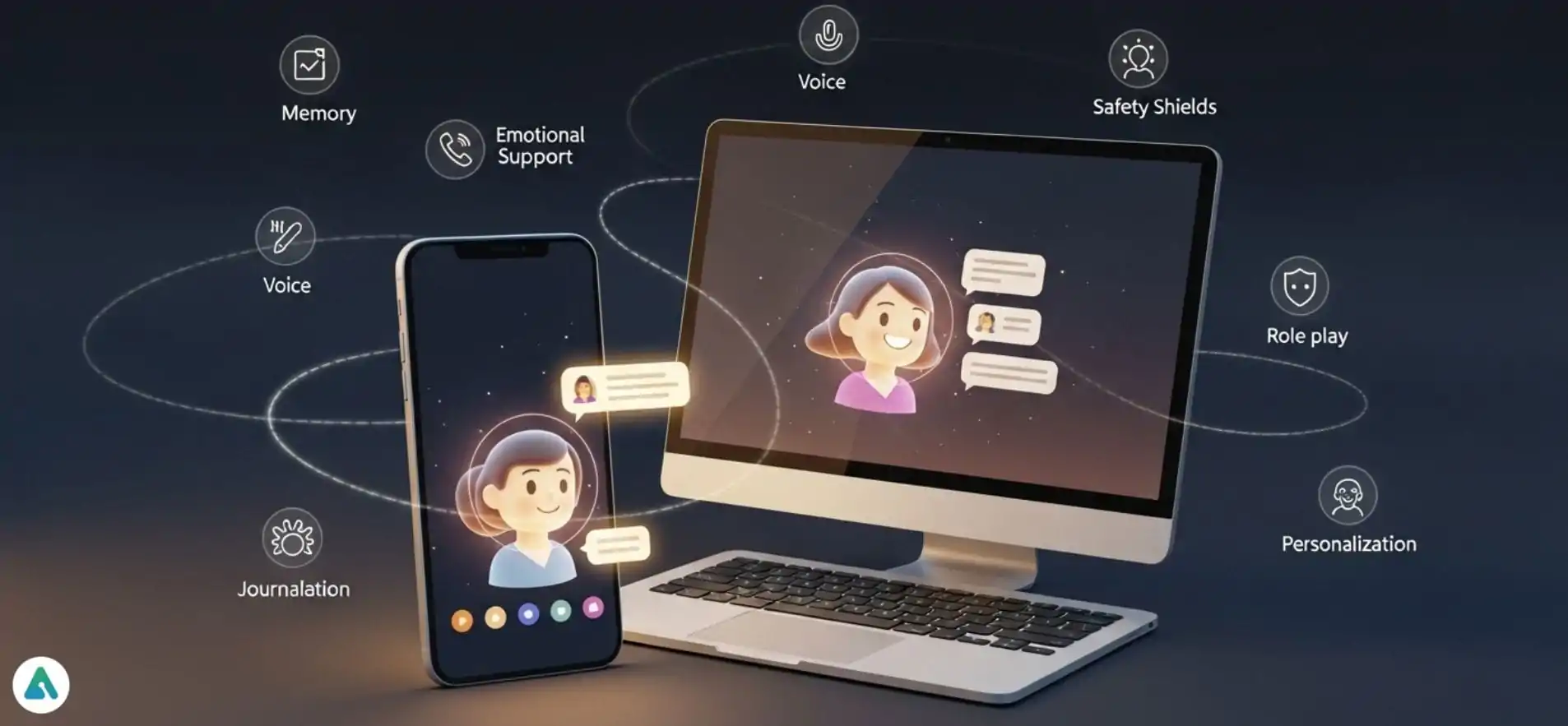
What Actually Determines Whether an AI Companion Follows You Between Devices?
Cross-device continuity depends on three technical layers working together: server-side memory storage (not device-local), unlimited or near-unlimited conversation history retention, and feature parity between the mobile and desktop clients. An app that syncs your login but stores conversation context in a per-session window will feel like a different companion on each device, regardless of how good the marketing sounds. Platforms with genuinely portable relationships include Jenova, Replika, Nomi, and general-purpose assistants like ChatGPT and Claude — each with meaningfully different memory architectures.
What separates real continuity from the appearance of it:
✅ Server-side memory, not device-local caching — your companion's understanding of you lives in the account, not on the phone ✅ History that survives context-window overflow — most apps quietly forget once the conversation exceeds token limits ✅ True client parity — voice, attachments, and personalization settings must exist on both surfaces, not just chat ✅ Persistent personality state — tone, established relationship dynamics, and roleplay continuity carry over, not just facts ✅ Explicit memory controls — the ability to inspect, correct, and delete what the system remembers
The gap between these five requirements and what most apps actually ship is where continuity breaks. The rest of this guide breaks down the architecture, compares the leading options, and covers what to do if you're already stuck on a platform that forgets you.
Why Do AI Companions Lose Memory When You Switch From Phone to Laptop?
Memory loss between devices almost always traces back to a single design decision: the app treats each device as a separate session rather than a shared, continuously-updated account state. As one cross-device assistant review puts it, "Logging in on your phone does not mean the AI knows what you discussed on your laptop. Most tools treat each device as a separate session unless you explicitly manage memory settings," according to Vellum's analysis of cross-device AI assistants.
Three distinct failure modes cause the discontinuity:
1. Context-window dependence. Many companion apps rely primarily on the model's in-context window rather than a durable memory store. Once a conversation exceeds that window, earlier details vanish permanently. Xomi's 2026 comparison testing found that Character.AI "relies almost entirely on the in-context window — once you exceed it, older details fade."
2. Mobile-first or desktop-first product development. The same review notes that "many AI tools built their desktop or web product first and shipped a stripped-down mobile experience later. The result is a meaningfully different product depending on which surface you use."
3. Feature asymmetry. Voice mode, file attachments, and integrations frequently exist on one surface only. Even when the memory syncs perfectly, a companion you can talk to on mobile but only type to on desktop is functionally two different relationships.
Practical diagnostic: Start a conversation on one device, mention a specific and unusual detail, then open the same conversation on your other device 24 hours later and ask about it without re-explaining. If the companion needs a reminder, the memory is not genuinely shared.
What Should You Look for in a Cross-Device AI Companion Platform?
Evaluate cross-device AI companions across six weighted dimensions rather than the generic "does it have memory" checkbox that most roundups stop at. This framework separates apps that sync data from apps that sync relationships.
| # | Dimension | What to Test | Why It Matters |
|---|---|---|---|
| 1 | Memory persistence depth | Recall a detail from 3+ weeks ago on a different device | Determines whether the relationship accumulates or resets |
| 2 | Platform parity | Compare voice, attachments, and settings on both clients | Asymmetry creates two separate experiences |
| 3 | History retention limits | Check whether old conversations are archived or deleted | Deleted history is unrecoverable context |
| 4 | Personality consistency | Ask the same question on both devices; compare tone | Facts syncing without tone syncing still breaks immersion |
| 5 | Memory transparency | Can you view, edit, and delete stored memories? | Wrong memories compound over months |
| 6 | Data governance | Read the training-data and deletion policy | Companion conversations are among the most sensitive data you generate |
Weighting guidance by user type:
- Emotional support / journaling users → weight dimensions 1, 4, and 6 most heavily
- Roleplay and narrative users → weight 1, 3, and 4
- Productivity-blended users (companion plus task help) → weight 2 and 5
On dimension 6 specifically: Xomi's testing standard is a useful floor — reputable apps "encrypt chat in transit + at rest, never train shared models on private conversations, and offer one-click full account + data deletion. If an app does not, treat that as a red flag."
The American Psychological Association's 2026 review of AI relationships is blunter still: "The level of data privacy on many of these tools remains an open question."
How Do the Leading Cross-Device AI Companion Platforms Compare?
No single platform wins on every dimension — the right choice depends on whether you prioritize relationship depth, surface coverage, or breadth of capability beyond companionship. Below is a factual comparison across the six-dimension framework, grounded in published research and platform documentation.
| Dimension | Jenova | Replika | Nomi | Character.AI | ChatGPT |
|---|---|---|---|---|---|
| Memory model | Unlimited chat history; persistent cross-session memory across all chats | Fact-extraction memory; "organizes them into a living understanding of you" per Google Play listing | Shared notes plus automatic long-term recall; rated strongest memory system by SoulLink's 2026 review | Primarily in-context window; older details fade past the limit (Xomi testing) | Cross-session memory that syncs across devices (Vellum review) |
| Platform coverage | Web, iOS, Android with stated full feature parity | iOS, Android, web (App Store) | Web, iOS, Android | Web, iOS, Android | Web, iOS, Android, Mac, Windows — broadest surface coverage on this list |
| Companion depth | Specialized agents (therapist, relationship advisor, roleplay tutors); custom agent creation | Purpose-built single bonded companion; strongest emotional-support framing | Purpose-built companion with high consistency | Largest user-created character library | General-purpose assistant, not companion-designed |
| Model choice | OpenAI, Anthropic, Google, DeepSeek, xAI — switchable, no lock-in | Proprietary | Proprietary | Proprietary | OpenAI models only |
| Knowledge grounding | Document upload and private knowledge bases attachable to agents | Not offered | Not offered | Not offered | File upload supported |
| Training-data policy | Data never used to train public AI models | Publishes data policy (per Xomi review) | Publishes data policy | Publishes data policy | Configurable in settings |
| Pricing | Free tier; Plus $20/mo (30× usage); tiers to Enterprise $1,000/mo | Free tier; emotional features behind Pro | Paid tiers | Free with wait queue; paid tier | Free tier; paid tiers |
| Best for | Users who want continuity plus specialized capability and model flexibility | Single long-term bonded companion with emotional-support focus | Longest-horizon memory in a dedicated companion app | Sampling many characters casually | Broadest device coverage with general assistant utility |
Honest limitations across the board:
- Jenova is a general agent platform, not a purpose-built romantic companion app. It does not offer companion-specific mechanics like avatar customization, relationship-progression levels, or gifting systems that dedicated companion apps ship. Users seeking a single named avatar-driven persona will find the experience more agent-shaped than character-shaped.
- Replika limits meaningful emotional features to its Pro tier, per Xomi's free-tier testing, and offers a single companion rather than domain specialists.
- Nomi has strong memory but a narrower feature footprint than multi-purpose platforms.
- Character.AI offers unmatched variety but the weakest long-horizon memory of the group. Xomi's review notes conversations "can feel less personal since the memory system is more limited."
- ChatGPT has the widest device coverage but is not designed for companionship. The APA notes the essential distinction: general assistants are "sometimes used as digital friends," while companion apps are "specifically designed to initiate and maintain romantic relationships."
Why Is Cross-Device Continuity Suddenly a Mainstream Concern?
Cross-device continuity became a mainstream problem because AI companion usage scaled faster than the infrastructure supporting it. Between 2022 and mid-2025, the number of AI companion apps surged by 700%, according to APA reporting citing TechCrunch data.
The user base is now large enough that fragmented experiences affect millions of daily relationships:
"Character.AI has 20 million monthly users, and more than half of them are under the age of 24. It's been a norm for a while for Replika users to 'marry' their AI companion in virtual weddings to which they invite friends and colleagues." — Rachel Wood, PhD, cyberpsychology researcher, quoted in APA's Monitor on Psychology
Usage extends well beyond companionship into emotional and mental health support. A cross-sectional survey of adults with a mental health condition who had used large language models in the past year found that nearly half — 48.7% — used them for mental health support. Separately, Brown University School of Public Health reported in November 2025 that "more than 1 in 10 adolescents and young adults were using LLMs for mental" health purposes.
Meanwhile, expectations for device-spanning AI have hardened across the board. Microsoft's 2024 Work Trend Index found 75% of knowledge workers now use AI tools daily, and users increasingly expect that context to follow them.
When someone has disclosed months of personal history to a companion, losing that continuity on a device switch is not a minor UX complaint — it's the loss of a relationship's entire accumulated context.
How Does Persistent Cross-Session Memory Actually Work?
Persistent cross-session memory works by extracting durable facts and relational context from conversations and storing them server-side in a user-scoped memory layer, then injecting relevant portions into each new conversation regardless of which device initiated it. This is architecturally distinct from simply keeping a long chat log.
The three-layer model most robust systems use:
- Short-term context — the active conversation window, held in the model's immediate context
- Extracted long-term memory — facts, preferences, and relationship state distilled from past conversations and stored permanently
- Cross-conversation profile — an account-level understanding applied across every chat, not just the one where a detail was mentioned
Xomi documents this pattern explicitly, describing a "3-layer memory system (short-term context + permanent affinity-tier slots + cross-conversation profile) that survives weeks-long gaps."
The critical architectural question is where layer three lives. If it's account-scoped on the server, opening the app on a new device retrieves the same profile. If it's chat-scoped or device-scoped, it doesn't travel.
Layer three is where most apps fail. Layers one and two are relatively easy to implement — they're both features of a single conversation thread. A genuine cross-conversation, cross-device profile requires the platform to treat memory as a first-class account resource, and comparatively few do.
On Jenova, all three layers operate at the account level: unlimited chat history, persistent cross-session memory, and a Global Memory system that carries relevant information from past sessions across all chats. Because settings and memory are account-scoped, the state is identical whether you open the web app, iOS, or Android.
Notably, Global Memory is a per-session toggle rather than an always-on default — when it's off, that session is isolated and nothing new is saved for future conversations. Continuity is opt-in, which is a privacy advantage and a continuity trap simultaneously. Users who want unbroken cross-device relationships need to verify the toggle is enabled.

How Do You Set Up a Companion That Genuinely Follows You Across Devices?
Setting up true cross-device continuity takes under ten minutes on most platforms, but the specific steps differ meaningfully depending on whether the platform uses opt-in or always-on memory.
On Jenova:
- Create an account and sign in on your primary device — memory is account-scoped, so the account is the continuity anchor
- Open Settings from the input bar and enable Global Memory for the session. Without this, the session is isolated and nothing carries forward
- Choose or create your companion agent. The gallery includes relationship and emotional-support specialists — the Personal Therapist agent provides 24/7 empathetic support with evidence-based guidance, and the Relationship Advisor covers interpersonal dynamics. For narrative or roleplay continuity, immersive agents like Learn Russian Through Roleplay are built specifically around unlimited memory and character consistency across sessions
- Seed the relationship with context in your first substantive conversation:
"Here's what you should know about me long-term: I work night shifts, I'm managing anxiety around a career change, and I prefer direct feedback over reassurance. Remember this across our conversations."
- Optionally attach documents or a knowledge base — journals, notes, or personal context files that ground responses in your actual history
- Install the iOS or Android app and sign in with the same account. Settings, memory, and history sync automatically
One important operational detail: memory updates on Jenova process at random intervals rather than instantly. If you add a significant memory on desktop and immediately switch to mobile, allow time for the update to propagate before assuming it failed.
On Replika: setup runs through creating an account, customizing your companion's name and avatar, then engaging in conversation — the app builds its understanding from there, organizing what you share "into a living understanding of you". Install the mobile app and sign in with the same credentials for sync.
On ChatGPT: memory must be enabled in settings and is opt-in and session-managed rather than continuously building context. You can explicitly instruct it to remember specific details, which is more manual but also more controllable.
What Can You Do If Your Current Companion Keeps Forgetting You?
If your existing platform loses continuity between devices, you have three viable options ordered by effort: manual context seeding, structured memory export, or migration.
Option 1 — Manual context seeding (lowest effort). Maintain a personal context document — 300-500 words covering your situation, preferences, relationship history with the companion, and ongoing threads. Paste it at the start of any session on a new device. This is a workaround, not a fix, but it restores functional continuity in under a minute.
Option 2 — Structured memory export. Some platforms let you view and export stored memories. Copy them into a document you control. This gives you portable relationship context that survives platform changes, policy shifts, or account issues — a meaningful hedge given that AI companion apps remain, as one clinical psychologist told the APA, part of an industry where "there isn't a strong regulatory space for this stuff, and it's always changing."
Option 3 — Migration with context transfer. When moving platforms, use your exported memory document as the seeding input on the new platform. On platforms supporting document attachment — including Jenova, which allows attaching documents and knowledge bases to agents — you can upload the file directly rather than pasting it, giving the new companion grounded access to your history from the first message.
The uncomfortable reality: every one of these options exists because portability between AI companion platforms is essentially nonexistent. Your relationship context is locked to whichever platform holds it. Choosing a platform with strong memory architecture and clear export capability upfront is significantly easier than recovering from one that lacks both.
What Do Researchers and Practitioners Say About Persistent AI Relationships?
Researchers consistently find that memory persistence is precisely what makes AI companions psychologically effective — and precisely what makes their design ethics consequential. The mechanism that creates continuity is the same mechanism that creates attachment.
"Furthermore, they are engineered to recall and respond to users' unique characteristics, including their personal lives, preferences, and past conversations. This may give users the impression that AI chatbots and companions know them intimately and serve as a refuge to disclose their innermost private thoughts and receive unwavering support in return. The level of data privacy on many of these tools remains an open question."
— Zara Abrams, reporting in APA's Monitor on Psychology, Vol. 57, No. 1
Practitioners emphasize that continuity itself is neutral — outcomes depend on usage patterns and design incentives.
"It is kind of like a low-stakes way to practice conversations with real people in a way that might feel less overwhelming. With the right guardrails, these tools could actually serve as a social skills mentor, modeling empathy, appropriate turn-taking, and active listening for folks who are lonely."
— Ashleigh Golden, PsyD, Chief Clinical Officer at Wayhaven, quoted in APA's Monitor on Psychology
The counterweight is equally documented. A joint OpenAI–MIT Media Lab study found that voice interactions reduced loneliness more effectively than text alone — but only with moderate use. Heavy daily use correlated with increased loneliness. Separately, a Harvard Business School study published in the Journal of Consumer Research found interacting with an AI companion alleviated loneliness "to a degree on par with interacting with another human."
Practical implication for continuity-seekers: the goal of cross-device memory should be reducing friction, not increasing session time. A companion that follows you seamlessly is useful. A companion that follows you seamlessly and is engineered to keep you engaged is a different product. Research documents that some AI companion apps "deploy various emotionally manipulative tactics—such as guilt appeals and fear-of-missing-out hooks—to keep users engaged when they signal they are exiting the platform."
What Privacy Trade-Offs Come With Cross-Device Memory?
Cross-device memory necessarily requires server-side storage of your most personal conversations — which means the privacy question is not whether your data is stored remotely, but what the platform is contractually permitted to do with it.
The three policies that matter most:
- Training-data policy. Does the platform train public models on your conversations? Jenova states data is never used to train public AI models and is not sold or shared with advertisers. Verify the equivalent policy on any platform before disclosing sensitive material.
- Encryption posture. In-transit and at-rest encryption should be the baseline. Xomi's review treats the absence of a published data policy as a red flag.
- Deletion capability. One-click full account and data deletion is the standard to look for. Memory that cannot be deleted is memory you have permanently ceded control over.
The regulatory environment is actively shifting. In November 2025, New York passed a law requiring chatbots to remind users every three hours that they are not human. In October 2025, California's Companion Chatbots Act (S.B. 243) was signed, adding nonhuman notification requirements, prohibiting exposure of minors to sexual content, and mandating crisis-response protocols. Expect further changes — platforms may alter memory retention practices in response, and users should re-read policies periodically rather than assuming they're static.
On youth safety specifically: Common Sense Media announced in April 2025 that social AI companions pose an unacceptable risk to users under 18, following risk assessments that found companion chatbots repeatedly failed to respond appropriately to teens expressing thoughts of self-harm. Any household setting up cross-device companion continuity for a minor should treat this as disqualifying without substantial parental controls in place.
Which Approach Fits Your Situation Best?
The right cross-device continuity approach depends on which of four common profiles matches your usage. These are contextual recommendations, not universal rankings.
📱 You want one bonded companion with deep emotional continuity. A purpose-built companion app is the better fit. Replika's fact-extraction memory and emotional-support framing, or Nomi's combination of shared notes and automatic long-term recall, are architected around exactly this. General-purpose platforms will feel less character-shaped.
🎯 You want continuity plus specialized capability. Jenova fits when your companion needs to do more than converse — carrying context between a therapy-style conversation, a relationship discussion, and practical planning within one account-level memory. The specialist agent model plus document grounding covers use cases a single-persona app cannot. Trade-off: less avatar-driven persona depth.
💻 You need the broadest possible device coverage. ChatGPT covers web, iOS, Android, Mac, Windows, and Apple Watch — the widest footprint documented in Vellum's cross-device review. If you switch between five surfaces daily and companionship is secondary to availability, coverage wins.
🎭 You want variety over depth. Character.AI's user-created library is unmatched in scale. Accept that memory persistence is the trade-off — the platform is optimized for sampling personalities, not accumulating a single relationship.
A note on model flexibility that most comparisons skip: companion apps running proprietary models mean your relationship's quality is tied to that company's model roadmap. If they degrade the model, your companion changes and you have no recourse. Platforms offering multi-provider access — Jenova provides access to models from OpenAI, Anthropic, Google, DeepSeek, and xAI without vendor lock-in — decouple relationship continuity from any single provider's decisions. For a relationship intended to last years, that structural difference matters more than most feature comparisons acknowledge.
References
- American Psychological Association, Monitor on Psychology — AI chatbots and digital companions are reshaping relationships
- Vellum — 10 Best AI Assistants That Work Across All Your Devices in 2026
- Xomi — 7 Best AI Companion Apps 2026: Memory + Free Tier Tested
- SoulLink — Best AI Companions With Long-Term Memory in 2026
- Google Play — Replika: My AI Friend
- Apple App Store — Replika: AI Companion Chat
- Brown University School of Public Health — One in eight adolescents and young adults use AI chatbots for mental health