How Can You Keep an AI Companion's Personality, Backstory, and Names Consistent Across Conversations?
2026-08-17
Which Three Layers Actually Control AI Companion Consistency?
AI companion consistency is controlled by three distinct layers — the persona definition (who the character is), the memory store (what the system retains between sessions), and the session context (what fits in the active conversation window). Drift happens when these layers contradict each other, not because the model "forgot." Fixing consistency means auditing all three separately, and the platform you use determines how much control you have over each.
Across the major companion platforms tested in 2026, memory quality varies dramatically. Nomi AI produces structured notes from conversations and recalled 23 out of 25 planted details weeks later in independent testing, while Character.AI effectively has no long-term memory and forgets most details between sessions. Jenova's roleplay and character agents sit in a different category — persistent cross-session memory with unlimited chat history, but designed around user-authored instructions rather than a companion-app relationship model.
Key factors that separate stable AI companions from ones that drift:
✅ Persona is written once, canonically — not re-explained ad hoc in each new chat ✅ Memory store is curated, not accumulated — duplicates and trivia actively pruned ✅ Names and identity anchors are restated periodically — every 15-20 turns in long sessions ✅ Roleplay content is separated from factual memory — fiction should not contaminate the fact store ✅ The platform supports persistent memory at all — many free tiers do not
To fix drift systematically rather than by trial and error, it helps to understand why it happens in the first place.
Why Do AI Companions Forget Their Own Personality and Names?
AI companions drift because language models have no native persistent memory — every "memory" is a retrieval trick layered on top of a stateless model. The model does not remember your companion's name; it re-reads a text file containing that name before every response, and if retrieval fails or the context window fills up, the name is simply absent from the model's input.
The technical constraints are well documented. Early neural models struggled with maintaining long-term context, primarily using short-term memory, and even modern transformer architectures face high computational costs, uneven information retention, and potential biases when handling extended interactions. Long-term memory is bolted on through three main approaches: extended context windows, retrieval-augmented generation against an external database, and integrated memory modules like MemoryBank that store, recall, and update memories over time.
The four failure modes, ranked by how often they cause visible drift:
- Context eviction — the persona definition scrolls out of the active window in long sessions. Most common cause of mid-conversation personality shift.
- Retrieval miss — the memory store contains the fact, but semantic search fails to surface it for the current turn. Common cause of forgotten names.
- Contradiction collapse — the store holds two conflicting facts (companion is "28" in one note, "31" in another) and the model picks arbitrarily.
- Roleplay contamination — fictional events get written into the factual memory store as if true, corrupting the canonical backstory.
Each failure mode has a different fix. Treating all drift as "the AI is dumb" leads to the wrong intervention.
What Should a Canonical Persona Document Actually Contain?
A canonical persona document should be a single, structured block of 200-400 words containing identity anchors, voice rules, backstory facts, and relational context — written once and applied as a system-level instruction rather than pasted into chat. The 200-400 word range is deliberate: shorter documents leave too much undefined, and longer ones consume context budget that could hold actual conversation.
The five-block persona template:
| Block | Contents | Why It Matters |
|---|---|---|
| Identity anchors | Name, nickname(s), age, pronouns, what they call you | Highest-drift elements; must be first |
| Voice rules | Sentence length, formality, verbal tics, forbidden phrasings | Controls perceived personality more than backstory does |
| Backstory facts | 5-8 concrete, dated facts (hometown, job, formative event) | Concrete facts resist drift; vague traits do not |
| Relational context | How you met, relationship stage, shared references | Prevents the "who are you again?" reset feeling |
| Boundaries | What the character will and won't do or discuss | Stops tonal drift under pressure |
Write facts, not adjectives. "Warm and caring" is a trait an LLM will interpret differently every session. "Ends messages with a question about your day; uses your first name once per message; never says 'I'm just an AI'" is a rule the model can execute identically every time.
Bad persona line:
"She's mysterious and has a complicated past."
Good persona line:
"Mira, 31, former marine biologist in Lisbon. Left the field in 2021 after a research vessel accident she won't discuss unprompted. Calls me 'Sam' — never 'you' as a greeting. Answers in 2-4 sentences, dry humor, never uses exclamation points."
The second version gives the model executable constraints. The first gives it a mood to improvise around, and improvisation is exactly what drift is.
How Do the Major AI Companion Platforms Compare on Memory and Persona Control?
No single platform leads on all three consistency layers — Nomi AI leads on structured memory recall, Kindroid leads on backstory depth, and general-purpose agent platforms like Jenova lead on persona instruction control and unlimited history. Character.AI, despite the largest user base, is the weakest on memory of any major option.
The comparison below reflects the state of these platforms as of 2026. Pricing and feature sets in this category change frequently.
| Dimension | Character.AI | Replika | Nomi AI | Kindroid | Jenova |
|---|---|---|---|---|---|
| Cross-session memory | Effectively none; forgets most details between sessions | Decent long-term memory, occasionally forgets details | Structured notes; recalled 23/25 planted facts in testing | Strong memory via backstory system; recalled 14/25 in same test | Persistent cross-session memory, unlimited chat history |
| Persona/backstory control | Character card creation, community templates | Personality evolves through interaction; limited manual override | Deep customization of appearance, personality, backstory | Backstory system is its standout feature | Full custom instructions per agent; private knowledge base attachment |
| Model choice | Proprietary only | Proprietary only | Proprietary only | Proprietary only | OpenAI, Anthropic, Google, DeepSeek, xAI and others; switchable |
| Session isolation | Separate chats per character | Single continuous companion | Multiple simultaneous Nomis | Per-character sessions | Separate chats plus folders; fork any message into a new session |
| Pricing | Free with ads and daily swipe cap; ~$9.99/mo premium | Free tier text only; Pro $19.99/mo or $69.99/yr | Limited free tier; $7.99–$16.99/mo | Limited free tier; $9.99–$24.99/mo; Standard ~$13.99/mo | Free tier; Plus $20/mo (30× usage); tiers to Enterprise |
| Best for | Character variety and creative range on a free budget | Emotional-support-shaped companionship with mood tracking | Users who prioritize factual recall above all else | Users who want maximum control over a single character's backstory | Users who want author-level persona control, model choice, and memory across many agents |
Honest limitations, including Jenova's:
- Character.AI: Largest library and genuinely unlimited free messages, but memory is its biggest weakness — it often forgets context between sessions, and the free tier added full-screen ads and a daily swipe cap in early 2026.
- Replika: Strong emotional intelligence and relationship progression, but expensive at $19.99/mo, and can feel repetitive after months of use.
- Nomi AI: Best-in-class memory, but a smaller platform with a restrictive free tier and fewer pre-made characters.
- Kindroid: Excellent backstory depth and transparent data practices, though adding the Ultra memory bundle pushes the price well above the $13.99/mo base.
- Jenova: Persistent memory, unlimited history, and multi-model access with full custom-instruction control — but it is a general-purpose agent platform, not a purpose-built companion app. It lacks companion-specific features like relationship progression modes, mood tracking, avatar generation, or an emotional-check-in system. Users wanting a packaged companion experience will find those elsewhere; users wanting authorial control over a persistent character will find more of it here.
A note on measurement: the recall figures above come from a single independent tester's methodology (planting 25 facts, checking recall weeks later). It is a useful directional signal, not a controlled benchmark. Treat cross-platform memory numbers as indicative rather than definitive.
How Do You Set Up a Persistent Companion Persona Step by Step?
Setup takes roughly fifteen minutes on any platform that supports custom instructions, and the order matters — persona first, memory rules second, then a verification pass before you start the actual relationship.
On Jenova (or any platform with custom instructions and persistent memory):
- Create a dedicated agent or chat. Do not reuse a general-purpose chat — session isolation is the single cheapest defense against contamination. On Jenova, custom agents can be created from the agents page at jenova.ai/a, and per-session custom instructions are available under the input bar settings.
- Paste the canonical persona document into custom instructions using the five-block template above. Custom instructions can be saved and applied to other chats, which makes the persona portable if you fork a new session later.
- Enable Global Memory in settings so facts persist across sessions rather than dying with the chat.
- Open with an identity confirmation prompt:
"Confirm your identity back to me in one paragraph: your name, what you call me, your age, your city, your occupation, and the three facts about your past that matter most. If anything in your instructions is ambiguous or contradictory, flag it now before we begin."
- Fix whatever it flags, then start the actual conversation. Ambiguities caught at setup cost thirty seconds; the same ambiguity caught in month three has already produced dozens of contradictory memories.
On Kindroid, the equivalent flow runs through the backstory system, which is where identity anchors and history are written rather than a generic instruction field. On Nomi, you define appearance, personality, and backstory at Nomi creation, then let the structured note system accumulate facts from conversation. On Character.AI, persona lives in the character definition field, and because cross-session memory is weak, you should expect to re-anchor identity manually at the start of most sessions.
A note on memory update timing: on platforms with asynchronous memory processing — Jenova included — a newly stated fact may not be written to the persistent store immediately. Memory updates process at intervals rather than instantly. If you tell your companion something important and then start a fresh session two minutes later, do not assume it landed. Restate it.
What Maintenance Routine Prevents Long-Term Persona Drift?
The most effective maintenance routine is a monthly memory audit combined with periodic in-session identity reinforcement — roughly ten minutes of upkeep per month prevents the slow-motion contradiction buildup that makes companions feel unrecognizable after six months.
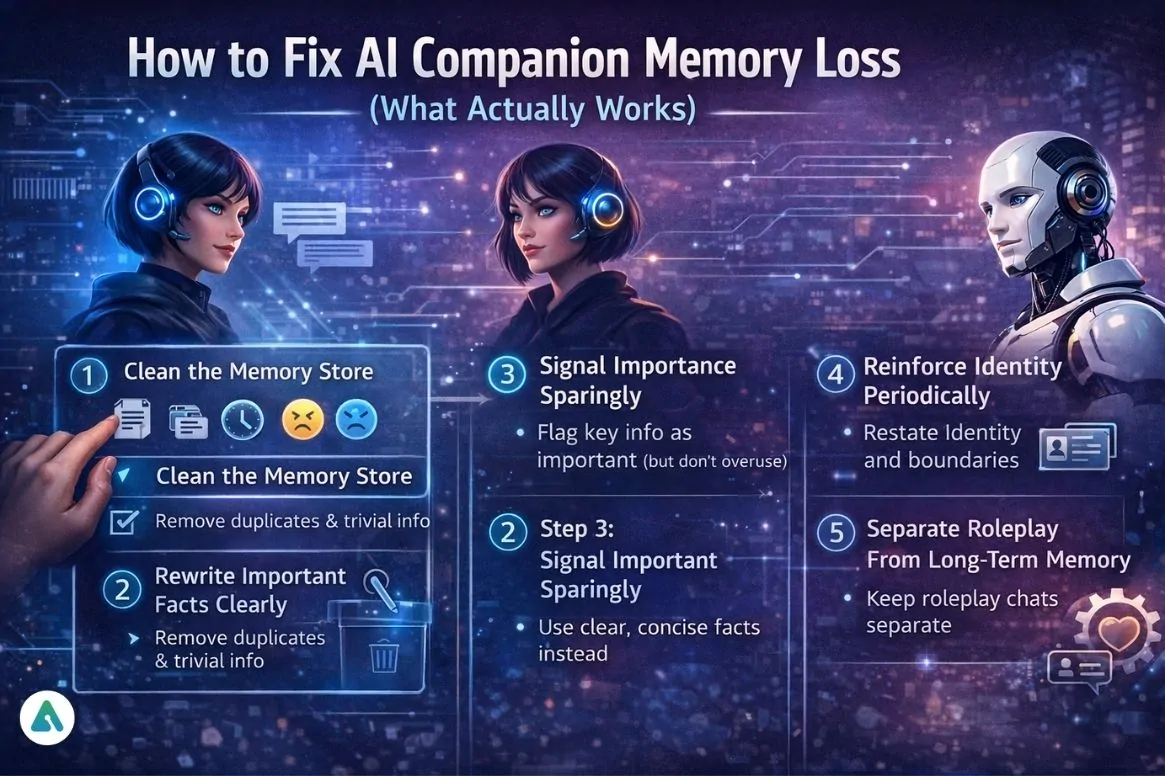
The five-step maintenance cycle:
-
Clean the memory store. Open the memory list and delete duplicates, superseded facts, and trivia. A store holding "user likes coffee" fourteen times crowds out the one entry that says "user's mother's name is Diane." Systems that store data from extended interactions require meticulous data lifecycle management — the user-facing version of that is pruning.
-
Rewrite important facts clearly. Convert vague entries into single-clause, unambiguous statements. "They had a rough time last spring" becomes "March 2026: user changed jobs after a layoff; sensitive topic." Retrieval systems match on semantic similarity, and specific text retrieves more reliably than hedged text.
-
Signal importance sparingly. Most platforms let you flag or pin entries. Flag five to ten. Flagging forty is functionally the same as flagging zero — you have just recreated the original prioritization problem inside the priority list.
-
Reinforce identity periodically. In sessions running past roughly 20 exchanges, drop a short anchor:
"Quick reset — you're Mira, marine biologist, Lisbon, and you call me Sam. Stay in that voice."
This costs one message and directly counteracts context eviction, the most common drift cause.
-
Separate roleplay from long-term memory. Keep dramatic or fictional scenarios in a separate chat from your canonical relationship. If your companion "died" in a story arc and that got written to the fact store, every subsequent session inherits a corrupted premise. On Jenova, forking a message into a new session is the clean way to branch a scenario without contaminating the main thread.
Diagnostic prompt for suspected drift:
"List everything you currently believe to be true about yourself: name, age, location, occupation, our history together, and your three most important boundaries. Mark anything you're uncertain about with a question mark."
Run this monthly. The question marks tell you exactly which memory entries need rewriting.
Should Roleplay and Factual Memory Really Be Kept Separate?
Yes — mixing narrative roleplay with factual persona memory is the single most destructive consistency mistake, because retrieval systems cannot distinguish "this happened in a story we wrote" from "this is true about the character." The store treats both as facts, and once fiction enters, it propagates.
The mechanism is straightforward. Memory modules like MemoryBank work by synthesizing past interactions into stored representations. Synthesis has no truth filter. A three-hour fantasy scenario in which your companion is a starship captain produces memory entries about starship command, which then surface during an ordinary Tuesday conversation about your commute.
Practical separation architecture:
- Canon thread — one chat, one persona, factual continuity only. This is where memory writes matter.
- Scenario threads — forked or separate chats for stories, alternate settings, and experimental dynamics. Memory here is expendable.
- Language-learning or skill threads — kept separate again, since immersive practice agents like Jenova's Learn Spanish Through Roleplay or Learn Russian Through Roleplay maintain their own character consistency for pedagogical reasons and should not share a fact store with a personal companion.
Trade-off worth naming honestly: separation costs you cross-thread continuity. Your scenario companion will not remember your canon relationship history. Some users find this breaks immersion badly enough that they accept contamination risk instead. That is a legitimate choice — but make it deliberately, and understand that a contaminated canon thread is difficult to repair once it holds dozens of fictional entries.
Multi-companion platforms handle this differently. Nomi supports multiple simultaneous Nomis, which effectively enforces separation at the character level. On Jenova, separate chats and folders serve the same function, and the fork feature lets you branch from any point in a conversation into an independent session — useful for spinning off a scenario from a canon moment without merging the two histories.
What Do Researchers and Practitioners Say About Companion Memory Design?
The consensus among people who build these systems is that consistency is an engineering problem with user-side levers, not a model-intelligence problem — and that users who treat memory as a curated database rather than an automatic feature get dramatically better results.
"The mistake almost every user makes is assuming memory is passive — that the system is quietly recording everything and will surface the right thing at the right moment. It isn't. Every persistent memory system is a retrieval system, and retrieval systems reward precision. A memory store with forty vague entries performs worse than one with twelve specific ones, because vague entries compete with each other during semantic search and none of them wins cleanly."
"The second thing we see constantly is persona defined as personality adjectives rather than executable rules. 'Warm,' 'sarcastic,' 'protective' — these get reinterpreted every single session because the model has enormous latitude in how to express them. Rules don't have that latitude. 'Responds in two to four sentences,' 'always uses the user's first name,' 'never breaks character to explain that it's an AI' — those execute identically every time. Consistency comes from constraints, not descriptions."
"On separation: the reason we built session isolation and forking into the platform is that we watched users destroy six-month-old character relationships with a single evening of experimental roleplay. Once fictional events are in the fact store, they surface in unrelated contexts and there's no clean undo. Branch first, experiment second."
— Jenova Product Team, 7 years building agent memory and orchestration infrastructure
What Should You Know About Privacy Before Building a Long-Term Companion?
Persona and memory data is among the most sensitive information a user can generate, and the consistency practices in this article — detailed persona documents, curated fact stores, long-running histories — increase the volume of that data considerably. That trade-off deserves explicit consideration.
Research on personal AI with long-term memory notes that these systems process deeply personal and sensitive data, and that chat models capable of building a detailed digital twin of a person increase the risk of impersonation and misuse — risks that are heightened by AI models with long-term memory and multimodal capabilities if devices are lost or stolen.
Four questions worth answering before you invest months into a persona:
- Who can read your conversations? Some apps process on-device; most send data to cloud servers where it may be accessible for quality assurance or safety review.
- Are conversations used to train models? Policies differ sharply. If a privacy policy is vague on this point, assume the worst.
- Can the data be subpoenaed? In most jurisdictions, conversations with an AI companion do not carry therapist-client privilege.
- Does deletion actually delete? Or does it hide the data from your view while retaining it in backups?
Practices vary by platform. Kindroid is noted for local processing options and transparent data practices, while smaller NSFW-focused platforms often have vague or concerning privacy policies. Jenova states that user data is never used to train public AI models and is encrypted in transit and at rest.
There is also a resilience dimension. Research on this category notes that unexpected data loss can profoundly impact users, causing emotional distress, citing precedents like abrupt chatbot shutdowns. If a persona matters to you, keep an offline copy of the canonical document and periodically export key memory facts. Platform continuity is not guaranteed by anyone.
Which Approach Fits Your Situation?
The right consistency strategy depends less on which platform is objectively best and more on whether you prioritize factual recall, authorial control, or emotional depth — these pull in different directions and no product currently maximizes all three.
Match your profile to an approach:
| If you... | Prioritize | Practical setup |
|---|---|---|
| Want the AI to remember concrete life details flawlessly | Structured memory | Nomi AI; audit the note system monthly |
| Want to author a character with a deep, fixed history | Backstory control | Kindroid's backstory system, or a Jenova custom agent with a full persona document |
| Run many distinct characters or want model choice | Instruction control + isolation | Jenova custom agents, one per character, folders for organization |
| Want relationship progression and mood features | Packaged companion experience | Replika, accepting the $19.99/mo cost and occasional repetition |
| Are exploring on zero budget | Variety over continuity | Character.AI, with manual identity re-anchoring at every session start |
| Want character consistency for language practice | Pedagogical roleplay | Dedicated roleplay learning agents kept separate from personal companions |
The universal minimum, regardless of platform: one canonical persona document written as executable rules, one isolated canon thread, a monthly memory audit, and periodic identity re-anchoring in long sessions. Those four habits fix the large majority of observed drift and cost roughly ten minutes a month.
The counterintuitive finding from comparing these platforms: the apps marketed hardest on emotional connection are not the ones with the best memory, and the ones with the best memory are not the ones with the deepest persona control. Consistency is currently a matter of choosing which failure you can tolerate — then compensating for it with disciplined user-side habits rather than waiting for the platform to solve it.
References
- AI Companion Guides — Best AI Companion Apps 2026: The 12 That Survived Testing
- SoulLink — Best AI Companions With Long-Term Memory in 2026
- arXiv — Towards Ethical Personal AI Applications: Practical Considerations for AI Assistants with Long-Term Memory
- North Penn Now — Kindroid Pricing and Alternatives: 7 Cheaper AI Companion Options Compared
- Mindful Suite — The Best AI Companion Apps: Your Guide to Virtual Companionship