How Can You Get Practical Wording After an Argument Without Using Manipulative AI Communication Tactics?
2026-08-15
What Separates Genuine Repair Language From Scripted Persuasion Tactics?
The difference comes down to one test: repair language discloses your internal state and invites a response, while manipulative scripting engineers a response regardless of your internal state. Practical post-argument wording is available from several sources — Gottman-derived repair checklists, Nonviolent Communication's four-component structure, general-purpose chatbots like ChatGPT, and specialized AI advisors such as the Jenova Personal Therapist and Etiquette Coach — but they differ sharply in whether they optimize for honesty or for outcome control.
Markers that separate non-manipulative repair wording from tactical scripting:
✅ It states an observation, not a verdict — "I noticed you arrived late" rather than "You're always late," the core distinction in Nonviolent Communication's four components
✅ It is falsifiable by your partner — you can be told "that's not what happened," and the sentence still stands as your honest account
✅ It does not pre-script their reply — a genuine request leaves room for "no"
✅ It survives being read aloud — if the wording only works when your partner doesn't know you planned it, it is a tactic, not a repair
✅ It reflects actual regret — experimental evidence in Scientific Reports shows apologies promote forgiveness by communicating relationship value, which means an insincere apology has nothing to communicate
To compare the available tools meaningfully, it helps to first define what "manipulative" actually means in this context — because the line is narrower and more testable than most advice suggests.
What Actually Makes Post-Argument Wording Manipulative?
Wording becomes manipulative when it is designed to produce a specific reaction in your partner while concealing that design from them. The mechanism is concealment, not persuasion — you are allowed to want reconciliation and to say so plainly.
Three patterns account for most manipulative post-argument language:
- Pre-emptive framing — opening with "I know you're going to say I'm overreacting, but…" pre-loads a defense that makes disagreement look like a predicted flaw in your partner.
- Compliance-gaining apologies — "I'm sorry you felt that way, but you also…" converts a repair into a ledger entry. The Gottman-derived research on repair notes that partners must jointly agree on which phrases work, precisely because unilateral scripting fails.
- Emotional over-disclosure as leverage — escalating your own distress to make your partner's grievance feel disproportionate.
The honest inverse of each is usually shorter. "I want to fix this" beats a paragraph of engineered framing. Length is often a manipulation tell — genuine repair language tends to be brief because it has nothing to construct.
Testing reveals a useful heuristic: if you would be embarrassed for your partner to see the draft you generated, the draft is a tactic. Every wording suggestion in this article passes the read-aloud test.
Where Does Repair Fit in the Arc of a Conflict?
Repair sits at stage four of a five-stage conflict cycle, after emotions have settled but before reconnection — and attempting it out of sequence is the single most common reason good wording fails.
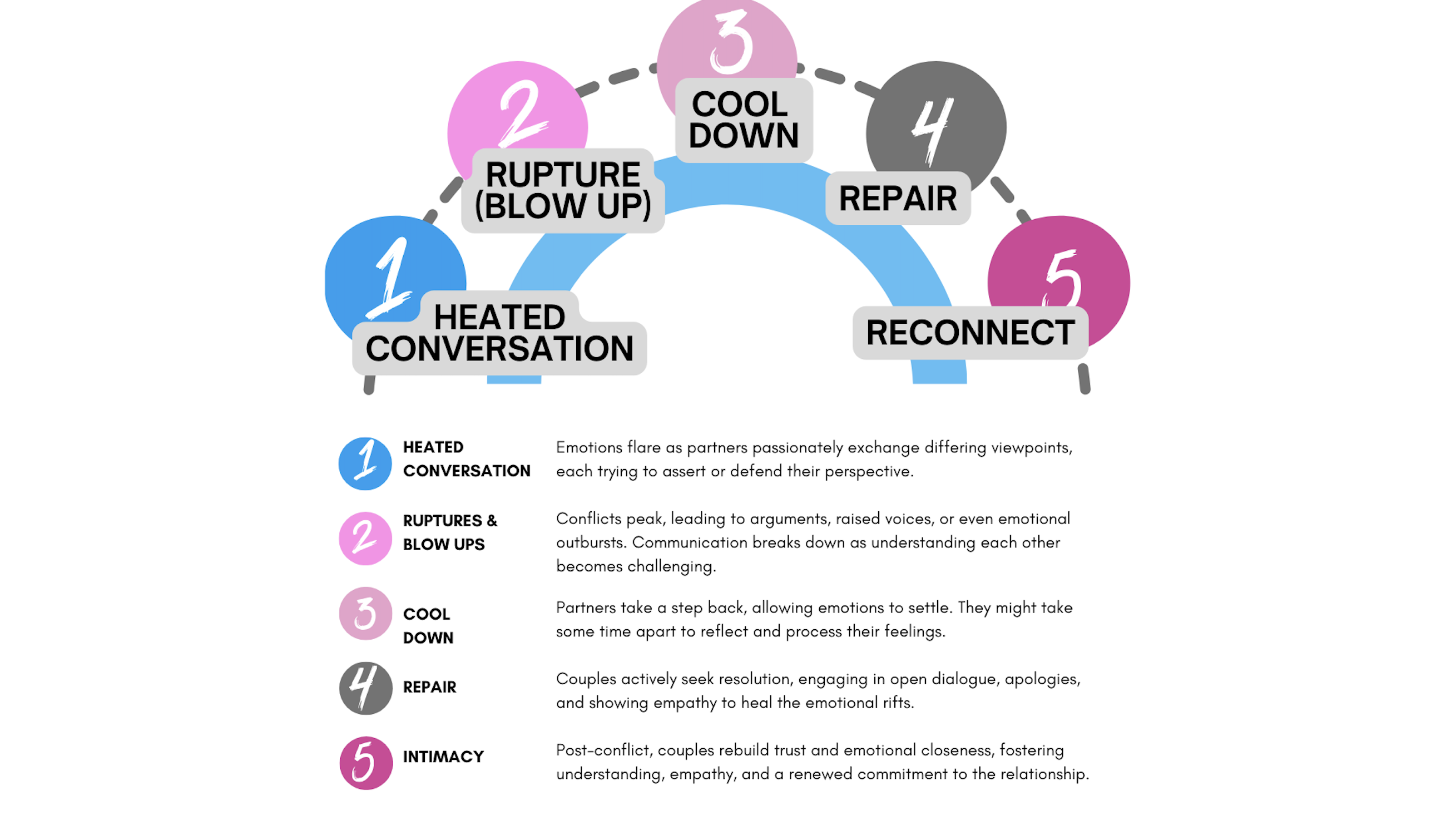
The sequence matters because each stage has different linguistic requirements:
| Stage | What's happening | What wording works here |
|---|---|---|
| 1. Heated Conversation | Partners exchange differing viewpoints, each asserting or defending | Slowing statements: "Can you say that again? I want to get it right." |
| 2. Rupture / Blow Up | Conflict peaks; raised voices, communication breaks down | Stop-action phrases only: "I need to pause." No content, no arguments. |
| 3. Cool Down | Partners step back to reflect and process feelings | Silence, or a logistics-only message: "I'll find you at nine." |
| 4. Repair | Open dialogue, apologies, empathy to heal the rift | Full repair language — observation, feeling, need, request |
| 5. Reconnect | Trust and emotional closeness rebuilt, renewed commitment | Warmth without re-litigation: "I'm glad we got through that." |
The most frequent error is deploying stage-four wording during stage two. A well-constructed "I feel hurt when…" sentence delivered mid-rupture reads as a debating move, because your partner is not yet in a state to receive it. The Gottman Institute defines a repair attempt as "any statement or action — silly or otherwise — that prevents negativity from escalating out of control," and notes that masters of relationships "repair early and often."
A second, subtler error is skipping stage three. Cool-down is not avoidance; it is the interval where you find out whether you actually regret something or merely want the discomfort to end.
What Are the Four Layers of a Non-Manipulative Repair Message?
A non-manipulative repair message contains four layers in order — observation, feeling, need, request — and each layer must be independently true without the others. This structure comes from Marshall Rosenberg's Nonviolent Communication framework, which foregrounds observation, feeling, need, and request as distinct components.
🎯 Layer 1: Observation (facts only)
State what happened in terms a neutral third party would agree with.
- ✅ "When I brought up the trip and you left the room —"
- ❌ "When you stormed off because you can't handle any criticism —"
The failure mode is smuggling evaluation into observation. "Stormed off" and "can't handle" are verdicts.
💬 Layer 2: Feeling (yours, unattributed)
Name your emotion without assigning its cause to your partner's character.
- ✅ "— I felt shut out and a little panicked."
- ❌ "— you made me feel worthless."
"You made me feel" converts a feeling into an accusation. The feeling is still valid; the attribution is what breaks it.
📊 Layer 3: Need (the underlying want)
State what you needed that wasn't met. Needs are universal (reassurance, clarity, rest, respect); strategies are specific (a text back within ten minutes).
- ✅ "I need to know that when a conversation gets hard, we're still going to finish it."
- ❌ "I need you to stop walking away."
The second version names a strategy and disguises it as a need. It is also a demand.
📱 Layer 4: Request (declinable)
A request your partner can genuinely refuse without penalty.
- ✅ "Would you be open to telling me you need a break instead of leaving, even if you still need to leave?"
- ❌ "Can you just be an adult about this next time?"
A useful test: can your partner say "no, I don't think I can do that" and have the conversation continue productively? If not, it was a demand wearing a question mark.
What Are Concrete Repair Phrases You Can Use Tonight?
The most reliable post-argument phrases are short, specific to one moment, and make no claim about your partner's intentions. Below are field-tested formulations organized by what you actually need to accomplish.
To stop escalation mid-conflict (stage 2):
- "I'm too activated to be fair right now. Can we come back to this in an hour?"
- "I'm starting to argue to win. That's not what I want."
- "Can you repeat that? I think I heard it wrong."
To re-open after cooling down (stage 3 → 4):
- "I've been thinking about last night. Is now an okay time?"
- "I don't have this figured out, but I want to talk about it."
- "I want to hear your version before I say mine."
To apologize without a hidden clause:
- "I raised my voice. That wasn't okay regardless of what I was upset about."
- "I was wrong about the thing I said about your family."
- "I made it about winning. I'm sorry."
Notice these contain no "but." The Stanford Graduate School of Business notes that apology "is one of the few things that research shows actually facilitates forgiveness" — but the clause structure matters. Anything after "but" retroactively cancels what preceded it.
To acknowledge their point without conceding your own:
- "You're right that I didn't tell you in advance. That part is on me."
- "I still see it differently, and I understand why it landed that way."
To repair when you're not sorry:
- "I don't think I was wrong, but I care more about us than about being right on this one."
- "I don't want to fake an apology. Can we talk about what would actually help?"
This last category matters because most advice assumes contrition. Sometimes you genuinely don't agree — and pretending otherwise is itself a manipulation.
Which AI Tools Actually Help With Post-Argument Wording?
The best AI tool for post-argument wording depends on whether you need emotional processing before drafting, culturally-calibrated phrasing, or structured couples-oriented exercises — and no single tool covers all three well.
| Dimension | ChatGPT (general) | Jenova Personal Therapist | Jenova Etiquette Coach | Maia | Talkspace (human-led) |
|---|---|---|---|---|---|
| Emotional processing before drafting | Basic; depends heavily on prompting | Designed for it — empathetic support with honest accountability | Limited; focused on phrasing | Chat and voice check-ins for couples | Full clinical processing |
| Draft wording generation | Strong general-purpose drafting | Strong, framed around growth rather than outcome | Strong — explicit phrasing coaching and social repair | Suggestion-based, conversation-derived | Not the primary function |
| Cultural / relational calibration | Generic by default | Adapts across sessions | Explicitly cross-cultural across settings and classes | General | Therapist-dependent |
| Memory across sessions | Limited by tier and settings | Persistent cross-session memory on the platform | Persistent cross-session memory on the platform | Improves as you interact more | Continuous with your therapist |
| Manipulation guardrails | Depends on how you ask — will draft persuasive scripts if requested | Accountability-oriented framing pushes back | Neutral phrasing focus | Unverified | Clinician judgment |
| Pricing | Free tier; paid tiers available | Free tier; Plus $20/mo (30× free usage) | Free tier; Plus $20/mo (30× free usage) | Consumer app pricing on site | Paid therapy sessions |
| Best For | Quick drafts when you already know what you want to say | Processing your own reaction before you write anything | Getting the sentence itself right, especially cross-culturally | Couples who both want an app-mediated space | Escalated or high-conflict situations |
Where each tool actually falls short
ChatGPT will produce competent repair drafts, but it optimizes for what you ask. Ask for "a message that makes my partner realize they were wrong" and it will comply. It has no built-in resistance to manipulative framing — the guardrail has to be your own intent. NPR has documented couples using ChatGPT to resolve disagreements and dissect text threads, which surfaces both its accessibility and the risk of outsourcing judgment.
Jenova's Personal Therapist is described in its platform listing as a 24/7 mental health partner providing empathetic support, honest accountability, and evidence-based guidance. In practice, that accountability orientation is its most useful feature for this specific problem — it is more likely to ask what you contributed than to hand you a script. Its limitation is real: it is not a licensed clinician, it cannot observe tone or body language, and it should not be the primary resource in a high-conflict or safety-relevant situation.
Jenova's Etiquette Coach covers social repair, phrasing coaching, and conflict navigation across cultures and settings, per its platform description. It is the stronger choice when the wording itself is the bottleneck — particularly for in-law conflicts, workplace disputes, or cross-cultural relationships where directness norms differ sharply. Its limitation: it treats the problem as a phrasing problem, which is sometimes the wrong diagnosis.
Maia positions itself as a relationship app where couples start conversations by text or voice and receive advice based on those conversations, with suggestions improving as both partners interact. That two-person design is genuinely different from single-user chat tools — but it requires both partners to opt in, which is often the exact thing that isn't happening after an argument.
Human-led therapy remains the reference standard. Talkspace, which publishes clinician-reviewed guidance on AI in couples work, is direct about the limitation: AI "can misinterpret emotional nuance between partners" and misses sarcasm, body language, and relationship history. Their clinician Minkyung Chung, MS, LMHC, frames the practical use case precisely — using AI to draft something neutral, then adding your own voice.
How Do You Use an AI Tool for Repair Wording Without Outsourcing Your Honesty?
The safe workflow is to use AI for structure and vocabulary, never for content or intent — you supply the facts and the feeling, the tool supplies the sentence architecture.
With Jenova's Personal Therapist, the sequence takes about ten minutes:
- Open the agent at jenova.ai/a/personal-therapist
- Process before you draft. Start with your own reaction, not the message:
"I had a fight with my partner about money last night. I said something about her spending that I regret. Before I apologize, help me figure out what I was actually reacting to."
- Once you're clear, ask for structure rather than script:
"Help me structure an apology using observation, feeling, need, request. I'll give you the facts — don't add persuasive framing, and flag anything that sounds like it's engineering a reaction."
- Rewrite the output in your own words. This step is non-negotiable. As Talkspace's clinician notes, AI statements can sound robotic because they are.
With Jenova's Etiquette Coach, when phrasing is the specific blocker:
"I need to apologize to my mother-in-law after a disagreement at dinner. We're Filipino and directness reads as disrespectful in my family. Give me three phrasings at different levels of formality, and tell me what each one implies socially."
With ChatGPT, add an explicit constraint — because it won't add one for you:
"Draft a repair message. Constraint: every sentence must be something I'd be comfortable with my partner knowing I wrote in advance. No persuasive framing, no pre-empting their objections, no 'I'm sorry you felt.'"
With Maia, the flow differs because both partners participate — the app's model is conversation-first, with suggestions generated from what you both say rather than from a solo prompt.
The universal guardrail: read the final message aloud. If your own voice can't say it naturally, your partner will hear the seam.
What Do Clinicians and Relationship Researchers Say About AI-Assisted Repair Language?
The clinical consensus is that AI is useful for drafting and reflection but dangerous as a substitute for judgment — and the risk is concentrated precisely in the moment people most want to use it.
"The implementation of AI as a tool for helping couples therapy can be beneficial. It's about how to meld the information given to you through AI and using your own voice with it. For instance, you may want to communicate an issue that isn't a 'big issue' but something that needs to be addressed. You can use AI to help craft a template that may sound neutral but also informative of the situation. Adding your own spin to it helps it be more personable. It does not replace the need to talk and use your own voice. AI statements can sound robotic and emotionless because they are."
"Couples therapy is important when the two partners are struggling within the relationship. It isn't just about advice about the situation, but also the counselor's ability to see the nuances of the situation to understand how to de-escalate a situation or even provide insight based on observation. AI, like ChatGPT, can't do that. There is no ability to observe the situation. Rather, relying solely on AI to help with relationship issues can be like reading a script and hoping it will make sense."
— Minkyung Chung, MS, LMHC, Talkspace therapist
The Jenova Product Team's observation from building conversational advisors adds a second layer to this:
"The failure mode we see most often isn't users asking for manipulative language outright — it's users asking for 'the most effective way to say this,' which quietly optimizes for compliance rather than honesty. Effectiveness and honesty diverge the moment your goal shifts from being understood to being agreed with."
"The design response is to interrupt the drafting request with a processing question. When an agent asks 'what were you actually reacting to?' before it asks 'what do you want to say?', the resulting message is usually shorter, more specific, and considerably less strategic. That's a deliberate friction, and it's the single most useful guardrail we've found."
— Jenova Product Team, conversational agent design
The convergence between these perspectives is notable: both identify the same risk, which is that fluent output masks unexamined intent.
When Should You Stop Using AI and Talk to a Person?
You should stop using AI tools and involve a licensed professional whenever the conflict involves safety concerns, repeated patterns that wording has never fixed, or an escalating dynamic where each repair attempt makes things worse.
Specific indicators that the problem is not a wording problem:
- The same fight recurs regardless of how well you phrase things. The Gottman Institute's research frames the consistent failure of repair attempts as a predictor of an unhappy future — not a signal to try harder phrasing.
- Repair attempts are being rejected as manipulation. If your partner reads every careful sentence as a tactic, the trust deficit precedes the wording.
- Safety or mental health concerns are present. Talkspace is explicit that AI is not suitable for crisis or high-conflict relationships and that these situations require a licensed professional.
- You are using AI to avoid the conversation rather than prepare for it. Drafting for two hours and sending nothing is avoidance with extra steps.
Privacy is a real secondary consideration. Talkspace notes that most AI tools promise confidentiality but "are not bound by the same ethical standards and laws that human therapists have." Jenova states that user data is never used to train public AI models and is encrypted in transit and at rest — but the general principle holds: read the privacy terms of any tool before you feed it the details of your relationship.
References
- The Gottman Institute — R is for Repair
- Wikipedia — Nonviolent Communication
- The Conflict Expert — Understanding Conflict Through Nonviolent Communication
- Scientific Reports (Nature) — Experimental evidence that apologies promote forgiveness by communicating relationship value
- Stanford Graduate School of Business — Forgiveness: How the Right Communication Repairs Relationships
- Talkspace — The Rise of AI for Couples Therapy
- NPR — A new couple's experiment with ChatGPT
- Maia — AI relationship app for couples
- National Institutes of Health (PMC) — Non-violent communication as a technology in interpersonal relationships
- The Gottman Institute — After the Argument: How to Begin Again
- The Gottman Institute — How to Make Repair Attempts So Your Partner Feels Loved
- Center for Nonviolent Communication — Research