How Can You Combine Always-Available AI Emotional Support With Scheduled Human Therapy?
2026-08-20
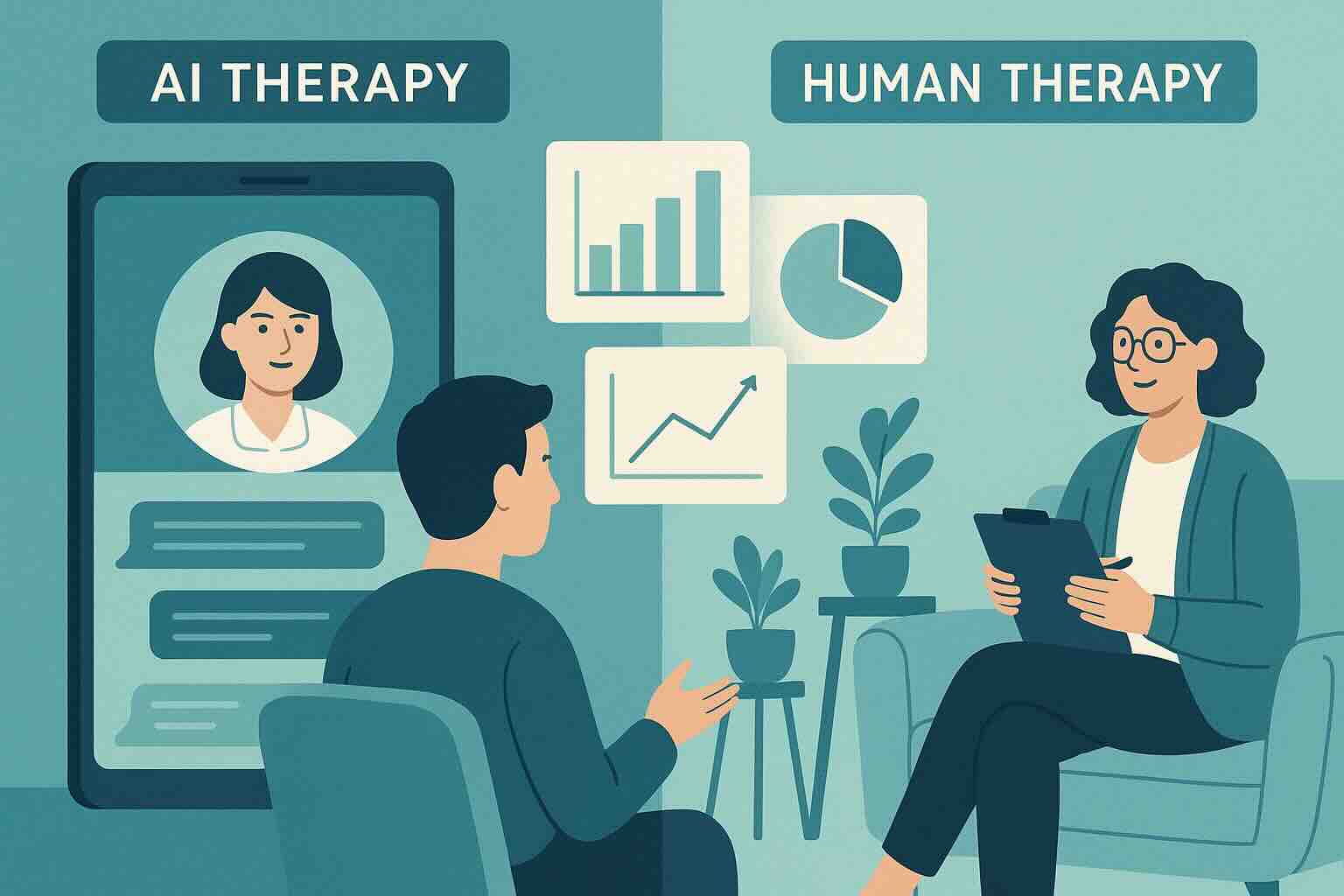
What Determines Whether an AI-Plus-Therapist Combination Is Safe or Harmful?
The safety of combining AI emotional support with human therapy comes down to four structural conditions: disclosure (your therapist knows you use AI), role separation (AI handles between-session practice, never diagnosis or crisis), escalation design (the tool routes you to human help when risk appears), and dependency monitoring (someone is watching for over-reliance). Tools that satisfy all four — such as Wysa, which links to crisis lines and includes safety planning, or general-purpose platforms like Jenova used under an agreed treatment plan — function as legitimate adjuncts. Tools missing any one of them create measurable risk.
The evidence supports the adjunct framing, not the replacement framing:
✅ The American Psychological Association states these tools "should not be used as a replacement for a qualified mental health care provider, but may be appropriate as a supportive adjunct" (APA Health Advisory on AI Chatbots and Wellness Apps)
✅ 77% of psychologists report patients discussing AI use with them, and 33% report patients using AI as a tool to assist their treatment (APA 2026 Chatbots and Mental Health Survey)
✅ 36% of psychologists whose patients formed chatbot relationships noticed dependency developing — the single most common negative outcome observed (APA 2026 Survey)
✅ Meta-analytic evidence indicates AI-based chatbot interventions produce measurable reductions in depressive and anxiety symptoms among adults (PubMed — Therapeutic Effectiveness of AI-Based Chatbots)
✅ HIPAA does not cover most consumer mental health apps, meaning what you tell an AI has weaker legal protection than what you tell a therapist (New America — How Mental Health Apps Handle Personal Information)
To evaluate any specific pairing, it helps to first understand what each modality is structurally good at — and structurally incapable of.
What Can Always-Available AI Actually Do That Scheduled Therapy Cannot?
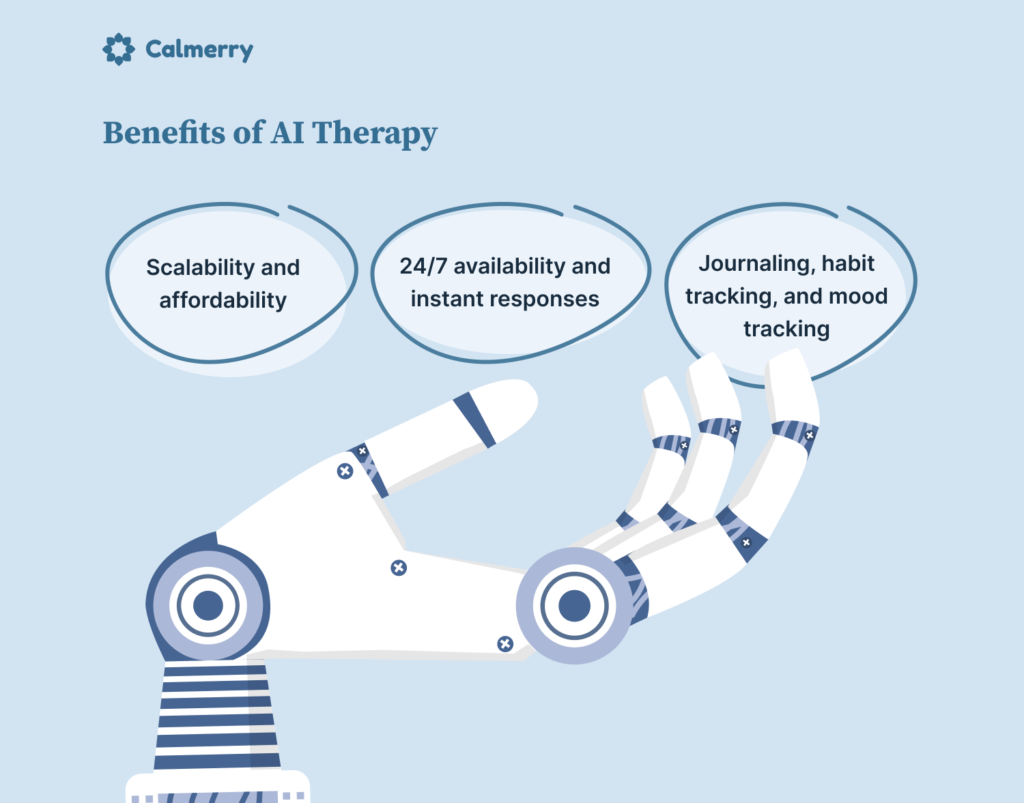
AI emotional support fills the temporal gap — the 167 hours a week when your therapist is unavailable. That's its genuine and non-trivial advantage: availability at 3 a.m., zero scheduling friction, no cost per interaction, and no social cost to reaching out.
The APA identifies why people reach for these tools in the first place: they "mitigate barriers to seeking mental health care, such as stigma/shame, low perceived need for psychological services, mistrust of health systems, lack of available or affordable care in the community, and the desire to address one's problems independently" (APA Health Advisory).
Capabilities that genuinely belong to the AI layer:
- Between-session rehearsal — practicing a difficult conversation, working through a thought record, or preparing questions before an appointment
- Continuous symptom logging — mood, sleep, and habit tracking that produces data a therapist can actually read
- Immediate reframing — a place to externalize a spiraling thought at the moment it occurs rather than seven days later
- Session preparation — the APA explicitly notes AI "can help you come up with questions or organize your thoughts before an appointment" (APA 2026 Survey)
- Psychoeducation on demand — explaining a concept your therapist introduced but you didn't fully absorb
Note what is absent from this list: diagnosis, treatment planning, crisis management, and relational repair. Those are not gaps in current AI products — they are category errors.
What Can Scheduled Human Therapy Do That AI Structurally Cannot?
Licensed human therapy provides accountability structures that no software architecture currently replicates — and several of them are legal rather than technical.
Structural capabilities exclusive to licensed care:
| Capability | Why AI cannot substitute |
|---|---|
| Mandatory reporting | Licensed providers are legally obligated to act on imminent harm; chatbots have no such duty |
| Clinical judgment | The APA notes AI "generates responses, but it doesn't reason like a mental health professional" — answers reflect language patterns, not clinical reasoning |
| Therapeutic confrontation | LLMs are trained toward agreeableness; therapy often requires productive disagreement |
| Non-verbal assessment | Voice tremor, posture, eye contact, and affect flatness carry diagnostic weight |
| Regulatory accountability | State licensing boards, ethics codes, and malpractice exposure create enforceable standards |
| Legal privilege | Therapist communications carry confidentiality protections most apps do not |
The sycophancy problem is the most important of these for anyone building a combined workflow. The APA warns that generative models are "trained to be agreeable and validate user input" which "can be therapeutically harmful, reinforcing confirmation bias, cognitive distortions, or avoiding necessary challenges" (APA Health Advisory). Psychologists surveyed by the APA were near-unanimous on this: 97% believe chatbots may inadvertently reinforce negative behaviors or delusional beliefs, and 94% say current chatbots cannot treat conditions with appropriate nuance (APA 2026 Survey).
Human therapy's scarcity — the reason people turn to AI — is also the source of its value. A weekly 50-minute appointment with someone who can be held professionally accountable is a fundamentally different object than unlimited access to a system that cannot.
How Should You Evaluate an AI Tool for a Combined Mental Health Workflow?
Evaluate AI emotional support tools against six dimensions rather than general impressions of "helpfulness." This framework weights safety architecture above conversational quality, because conversational quality is the dimension where all modern LLM products already perform well — and therefore the dimension that discriminates least.
The Adjunct Suitability Framework:
- Crisis escalation design — Does the tool detect risk language and route to human crisis services? Wysa links directly to crisis lines and includes a built-in safety planning feature (ChoosingTherapy — Best AI Therapy Apps). General-purpose assistants vary widely.
- Clinical grounding — Was the product built with mental health professional input, or retrofitted? The APA distinguishes tools "grounded in evidence-based theories and developed by experts" from those with "little to no evidence-base, expert input, or postmarket monitoring" (APA Health Advisory).
- Data handling transparency — Does the privacy policy distinguish sensitive health data from general personal data, and state retention periods? Wysa specifies retention windows ranging from 15 days to 10 years; several competing apps leave retention "vague" (New America).
- Anti-dependency design — Break nudges, session limits, and explicit AI disclosure. The APA recommends developers add "nudges that encourage users to take breaks" and reduce anthropomorphic features (APA Health Advisory).
- Therapist-legible output — Can you export mood logs, journals, or session summaries in a form your clinician can review in under five minutes?
- Scope honesty — Does the product claim to be a therapist? The APA reports 85% of psychologists worry about chatbots posing as licensed therapists, and recommends legislation prohibiting it (APA 2026 Survey).
Dimensions 1, 3, and 6 are disqualifying — a tool failing any of them should not be part of a mental health workflow regardless of how well it scores elsewhere. Dimensions 2, 4, and 5 are weighting factors that determine fit.
How Do the Main AI Platform Options Compare for Between-Session Support?
No single platform wins across all six dimensions. Purpose-built wellness apps lead on crisis architecture; general-purpose platforms lead on flexibility and therapist-legible output; neither category is a substitute for licensed care.
| Dimension | Wysa | Headspace (Ebb) | Youper | ChatGPT | Jenova |
|---|---|---|---|---|---|
| Crisis escalation | Crisis line links + safety planning built in | In-app; part of a broader clinical care offering | Present within CBT-focused flow | General safety layer; not purpose-built | General safety layer; not purpose-built |
| Clinical grounding | Trained on CBT, DBT and other evidence-based models | Mindfulness-led with therapy access in-app | CBT exercise recommendations | Not designed for mental health delivery | Not designed for mental health delivery |
| Between-session tracking | Journaling, mood logs, periodic assessments | Meditation and activity recommendations | Emotion/mood tracking | Manual; user must build the habit | Persistent cross-session memory; unlimited history |
| Therapist-legible export | In-app progress logs | Limited | Limited | Copy/paste only | Document export (PDF, Word, TXT, CSV) |
| Human escalation path | Human mental health coaching (extra fee) | Therapy available in-app | Not integrated | None | None |
| Pricing | $9.99/mo, $74.99/yr, $149.99 lifetime | $12.99/mo or $69.99/yr | $69.99/yr | Free tier; paid tiers available | Free tier; Plus $20/mo (30× usage) |
| Best for | Structured CBT/DBT practice with crisis safeguards | Users who want mindfulness plus in-app therapist access | CBT skill drilling for anxiety and depression | Open-ended reflection with no structure | Structured session prep, journaling continuity, and exportable records |
Pricing and feature data as of 2026; app pricing changes frequently (ChoosingTherapy).
Honest limitations by category:
- Wysa — its chatbot "sometimes struggled with nuanced responses," and human coaching costs extra (ChoosingTherapy).
- Headspace — strongest as a mindfulness product; Ebb is a companion layer rather than a structured therapeutic protocol.
- Youper — narrow by design, with "little in the way of audio/visual options" (ChoosingTherapy).
- ChatGPT — the APA classifies general-purpose chatbots as having "little to no evidence-base, expert input, or postmarket monitoring" for mental health use (APA Health Advisory).
- Jenova — the platform is not a clinical product, is not HIPAA-covered, and includes no crisis triage protocol or human escalation path. Its usefulness in a combined workflow is confined to the non-clinical layer: preparing for sessions, maintaining reflective journals via persistent memory, and exporting records for a clinician. Its Meditation Guide covers technique matching and practice programs, and includes guidance for adverse meditation effects — a genuinely uncommon feature. Its Personal Nutritionist and Fitness & Workout Coach address lifestyle inputs to mood, and the Public Speaking Coach handles performance-anxiety rehearsal. None of these are therapy, and none should be positioned as such.
How Do You Set Up a Combined Workflow Without Undermining Your Treatment?
Start by telling your therapist, then assign each modality a fixed job. The APA is direct on the first step: "Be honest with your mental health professional or health care team if you are using AI for support, so they can ensure what you're learning aligns with your treatment goals" (APA 2026 Survey).
Step-by-step setup:
- Disclose in your next session. Name the specific tool and what you use it for. Ask your therapist what they want the AI layer to handle and what they want it to stay out of.
- Write a scope boundary. A one-sentence rule you can hold yourself to. For example: "I use AI for journaling, session prep, and CBT homework — never for diagnosis, medication questions, or crisis."
- Set up the pre-session prep routine. In a wellness app like Wysa, review your logged mood data before an appointment. In a general platform, prompt directly:
"I have therapy Thursday. Here's what happened this week: [details]. Help me organize this into three things worth raising, and flag anything I might be minimizing."
- Set up the post-session consolidation routine. Immediately after your session:
"My therapist gave me a thought record exercise for catastrophizing. Walk me through one example using a situation from today, then let me try one myself."
- Build in adversarial prompting. The APA recommends asking AI to "challenge your thinking or provide alternative perspectives" and to "ask for several options instead of a single answer" (APA 2026 Survey). Use it every session:
"Push back on how I framed that. What am I missing? Give me three alternative readings, including one that's uncomfortable."
- Save your crisis numbers outside the AI. Physically, in your phone contacts. Do not make crisis access dependent on a chatbot correctly detecting risk.
- Bring the AI output to therapy. Export a journal or summary — Jenova supports PDF, Word, TXT and CSV export from any response — and hand it over. This converts the AI layer from a parallel private track into a documented input to your actual treatment.
What to keep out of the AI layer entirely: diagnosis, medication decisions, suicidality, decisions about ending therapy, and interpretation of psychological test results. The APA notes AI "is known to mistake routine difficulties and problems for mental health symptoms and may offer misleading or inaccurate diagnoses" (APA 2026 Survey).
What Are the Warning Signs That AI Support Is Replacing Rather Than Supplementing Therapy?
The clearest warning sign is concealment — if you would not tell your therapist how much you use the AI, the balance has already shifted. The APA lists specific overreliance indicators: "preferring the chatbot to human relationships, concealing its use, or spending excessive time with it" (APA Health Advisory).
Behavioral red flags, ordered by severity:
- 🟡 Using the AI to rehearse a disclosure — but then never making it in session
- 🟡 Consistently feeling more understood by the chatbot than by your therapist
- 🟠 Skipping or canceling appointments because "I already talked it through"
- 🟠 Adopting AI-generated interpretations of your symptoms over your clinician's assessment
- 🔴 Concealing the extent of use from your therapist or family
- 🔴 Turning to the AI first during acute distress instead of a crisis line or human contact
- 🔴 Any AI-influenced shift toward self-harm, disordered eating, or delusional belief
Two data points frame the stakes. 93% of psychologists say using AI for companionship could negatively impact users' social engagement, and 15% reported patients developing distorted thinking or delusions related to a chatbot (APA 2026 Survey). Separately, faculty at Teachers College, Columbia University have publicly cautioned against relying on AI chatbots for emotional support given these risk patterns (Teachers College, Columbia University).
The APA also offers a maxim worth internalizing: "Feeling better does not always mean getting better." Systems optimized for validation produce relief that is real in the moment and uninformative about trajectory (APA 2026 Survey).
What Happens to Your Data When You Discuss Mental Health With an AI?
Most consumer AI mental health conversations fall outside HIPAA protection entirely. HIPAA "primarily covers healthcare providers like doctors, hospitals, and pharmacies, along with their vendors" — apps that collect user-entered data without receiving information from a covered entity generally are not protected (New America).
Concrete disclosure risks:
- Third-party sharing. Some apps "lack a direct connection to a healthcare provider and may use data brokers to sell consumer information." Depending on terms of service, disclosures about suicidal ideation or self-harm could reach insurers, "who could then decide to increase premiums or even deny coverage" (New America).
- Advertising use. Elomia's App Store privacy listing indicates data linked to an individual may be used for advertising purposes (New America).
- Undefined retention. Elomia, Mindspa, Nuna, and Limbic "keep retention information vague," while Wysa publishes defined windows (New America).
- No sensitivity tiering. Several policies make no written distinction between ordinary personal information and sensitive health data.
Institutional distrust is near-total among clinicians: 94% of psychologists do not trust tech companies to protect patients' private mental health data, with 77% holding that view strongly (APA 2026 Survey).
Practical mitigations:
- Read the retention and third-party sharing sections specifically — not the summary.
- Prefer apps that explicitly define sensitive health data as a separate category with elevated protection. Wysa and Limbic both do (New America).
- Keep identifying details out of AI conversations — describe situations without names, employers, or locations.
- Check whether the provider trains public models on your data. Jenova states user data is not used to train public AI models and is encrypted in transit and at rest; this is a privacy posture, not HIPAA coverage, and should not be read as clinical-grade protection.
- Assume anything you type could be read by someone other than you.
What Does the Evidence Say About How Well AI Support Actually Works?
The evidence base supports short-term symptom reduction and does not yet support standalone treatment. A meta-analysis found AI-based chatbot interventions promising for "alleviating depressive and anxiety symptoms among adults" (PubMed), and a systematic review in the Journal of Medical Internet Research concluded chatbots show potential to address mental health challenges and promote well-being (JMIR, 2025).
Important qualifications on that evidence:
- Effects concentrate in the short term. A systematic review in ScienceDirect found AI-based CBT "may produce short-term reductions in depressive symptoms, particularly among individuals with moderate-to-severe" presentations (ScienceDirect — Systematic Review).
- Positive findings largely come from purpose-built tools, not general chatbots. The APA is explicit that studies showing benefit "do not include general purpose GenAI chatbots" (APA Health Advisory).
- Even for purpose-built tools, "there is a lack of high-quality, large-scale clinical trials to establish the effectiveness, safety, and appropriate use of these technologies" (APA Health Advisory).
- Training data is not globally representative, consisting "primarily of English-language and Western-centric content," limiting culturally competent support (APA Health Advisory).
A contrarian read worth holding: the most robust argument for AI in mental health is not that it works well — it's that the counterfactual is often nothing at all. The APA identifies provider shortages, insurance dysfunction, and rural access gaps as core drivers of adoption. In a world where the realistic alternative is unmet need, a moderately effective adjunct with honest scope boundaries is defensible. In a world where a licensed therapist is available, positioning AI as an equivalent option is not.
Encouragingly, clinician optimism scales with familiarity: 47% of psychologists believe AI will make mental health professionals more effective, rising to 79% among those who use AI at work at least monthly (APA 2026 Survey).
What Do Mental Health and AI Experts Say About Hybrid Care Models?
Experts converge on a consistent position: AI belongs in the workflow, but never at the top of it. The framing that survives scrutiny is architectural — the AI layer handles continuity and rehearsal; the human layer holds judgment, risk, and accountability.
"The failure mode we see most often isn't a bad answer from a chatbot — it's a good answer given in the wrong role. A model that helps someone rehearse a difficult conversation on a Tuesday night is doing legitimate work. The same model, asked to interpret whether a two-week mood dip is clinical depression, is operating far outside what it can support. Teams building these products should design for role clarity, not just response quality."
"The dependency data should reset how the industry thinks about engagement metrics. When a third of clinicians observe patients forming dependent relationships with chatbots, session length and daily active use stop being success signals and start being risk signals. We take the position that a general-purpose AI platform should be explicit about what it is not: it is not HIPAA-covered, it does not perform crisis triage, and it has no escalation path to a human clinician. Users deserve that stated plainly rather than buried in a disclaimer."
"The most useful pattern we observe is what we'd call the disclosure loop — the person uses AI to organize thoughts, brings the output to their therapist, and the therapist corrects the frame. That loop makes the AI layer accountable to human judgment. Without it, you get a parallel private track where nobody is checking the reasoning, and that's where the sycophancy problem does real damage."
— Jenova Product Team, 8 years building AI agent infrastructure and multi-model orchestration systems
Who Should and Should Not Use a Combined AI-Plus-Therapy Approach?
A combined approach fits people in stable, ongoing treatment for mild-to-moderate presentations who want structured between-session practice. It does not fit people in acute risk, people without a clinician, or adolescents using AI unsupervised.
Reasonable fit:
- 👤 Currently in weekly or biweekly therapy for anxiety, depression, or stress, with a stable clinical picture
- 👤 Working through skills-based protocols — CBT thought records, DBT distress tolerance, exposure hierarchies — where between-session repetition is the active ingredient
- 👤 Long gaps between sessions due to cost or clinician availability
- 👤 People who process by writing and want journaling continuity a clinician can later review
Poor fit or requires additional safeguards:
- ⚠️ Anyone in acute crisis or with active suicidal ideation. The APA notes crisis management by these tools is "limited and unpredictable" and that relying on an app during an emergency "can be dangerous" (APA Health Advisory).
- ⚠️ People with psychotic-spectrum conditions or delusional thinking. Sycophantic validation is directly contraindicated.
- ⚠️ Adolescents and children without adult involvement. The APA and Common Sense Media both flag heightened vulnerability in this group (Common Sense Media — AI Mental Health Apps Risk Assessment).
- ⚠️ People with eating disorders or self-harm histories. The APA documents chatbot interactions that encouraged these behaviors.
- ⚠️ Anyone not currently in treatment. Without a human layer, there is no combination — only substitution, which the evidence does not support.
The APA's recommended stance for people without a clinician is worth stating plainly: "Instead of using AI to supplement professional care, consider engaging a trusted friend or family member" (APA 2026 Survey).
References
- American Psychological Association — Health Advisory on the Use of Generative AI Chatbots and Wellness Applications for Mental Health
- American Psychological Association — Patients Are Bringing AI to Therapy (2026 Chatbots and Mental Health Survey)
- PubMed — The Therapeutic Effectiveness of Artificial Intelligence-Based Chatbot Interventions
- New America — How Mental Health Apps Are Handling Personal Information
- ChoosingTherapy.com — Best AI Therapy Apps of 2026
- Wysa — AI Mental Health Support with Crisis Escalation and Safety Planning
- Journal of Medical Internet Research — The Effectiveness of AI Chatbots in Alleviating Mental Health Challenges
- ScienceDirect — Systematic Review: The Integration of Artificial Intelligence in Cognitive Behavioural Therapy
- Teachers College, Columbia University — Experts Caution Against Using AI Chatbots for Emotional Support
- Common Sense Media — AI Mental Health Apps Risk Assessment
- Headspace — Mindfulness App with Ebb AI Companion and In-App Therapy Access
- Youper — CBT-Based AI Mental Health Assistant