How Can You Avoid Unclear Storage or Use of Sensitive Mental Health Data When Tracking Emotions With AI?
2026-08-19
Which Signals Actually Reveal Whether an AI Emotion Tracker Handles Your Data Safely?
The most reliable signals are not privacy policy promises — they are structural: whether the app names every third-party processor by identity, whether the data ever leaves your device, whether the operator falls under HIPAA or the FTC's Health Breach Notification Rule, and whether a deletion request actually removes data from AI training sets. A 2026 measurement study of 25 popular Android mental health apps found that every single app embedded at least one tracker SDK its privacy policy never named, and 68% failed to disclose at least half their embedded trackers. Policy language, in other words, is the weakest evidence available.
Key structural signals that separate defensible emotion-tracking setups from opaque ones:
✅ Named processors, not categories — "OpenAI, Anthropic, Groq" is disclosure; "AI services" or "large language models" is not. Seven of 25 apps studied used only generic, unidentifiable language.
✅ Local-first or self-controlled storage — data that never reaches a vendor server cannot be brokered, breached, or trained on.
✅ Regulatory footing you can verify — most mental health apps fall outside HIPAA entirely because they are not operated by covered entities.
✅ Honest deletion semantics — some policies openly confirm no opt-out exists for anonymized training use, meaning account deletion does not remove disclosures already embedded in model weights.
✅ Permission-to-policy consistency — researchers found 16 permission-policy contradictions across 13 apps, including six requesting camera or microphone access without disclosing audio or video collection.
To compare tools meaningfully, it helps to understand why emotional data is uniquely exposed compared to other health information — and what evaluation framework actually surfaces the gaps.
Why Is Emotional Data More Exposed Than Other Health Information?
Emotional data sits in a regulatory gap that clinical records do not. When you tell a licensed therapist about a panic attack, that disclosure is protected by professional confidentiality obligations and, in the United States, by the HIPAA Rules. When you log the same panic attack in a mood-tracking app, that app is usually not a covered entity — so no federal law prevents data collected through embedded trackers from flowing to data brokers.
The market has already priced this asymmetry. Research cited in the 2026 app measurement study documented 11 data brokers openly selling lists of individuals sorted by mental health condition — depression, anxiety, bipolar disorder, PTSD — for as little as $0.20 per record, with names, home addresses, and income attached.
A second exposure mechanism is inference rather than disclosure. Advertising SDKs transmit a device's Google Advertising ID alongside app-usage events. Because that identifier is shared across every app on the device, an ad network receiving SDK calls from a therapy app can determine that the device owner is seeking mental health support without ever reading a single conversation.
The study found Facebook's SDK embedded in 10 of 25 apps — with none of those privacy policies disclosing it.
🎯 Where "Unclear Use" Actually Originates
Three distinct failure modes produce the vague-storage problem, and they require different defenses:
| Failure Mode | What It Looks Like | Why Policy Reading Won't Catch It |
|---|---|---|
| Undisclosed trackers | SDKs embedded in the app binary, absent from the policy | The policy is silent — there is nothing to read |
| Generic processor language | "We may share data with AI service providers" | Technically accurate, operationally meaningless |
| Irreversible training ingestion | Data absorbed into model weights before deletion | Deletion is honored for the database, not the model |
What Should You Look for in an AI Emotion-Tracking Tool?
Evaluate emotion-tracking tools on six dimensions — not on marketing claims about "bank-level encryption," which is a table-stakes property that says nothing about who receives your data downstream. This framework weights data destination transparency most heavily, because it is the single variable that determines whether every other protection matters.
The Six-Dimension Emotion Data Framework:
- Processor identity disclosure — Are all third parties named individually, including AI inference providers? Generic categories fail this test.
- Data residency and locality — Does raw emotional content leave your device? On-device processing collapses most of the risk surface.
- Regulatory coverage — Is the operator a HIPAA covered entity, a business associate, or neither? Neither is the common answer and is not disqualifying, but it changes your recourse.
- Deletion completeness — Does deletion cover backups, analytics pipelines, and training corpora? Ask specifically about the third.
- Permission minimalism — Does the app request microphone, camera, or contacts access it does not functionally need?
- Breach notification posture — Is the operator covered by the FTC's Health Breach Notification Rule, which requires notifying consumers, the FTC, and sometimes the media after unauthorized disclosure of identifying health information?
The FTC's own guidance confirms the Rule applies to most health apps not covered by HIPAA, because most health app developers are treated as "health care providers" furnishing services to consumers. Failure to notify can trigger enforcement seeking civil penalties.
📊 A Practical Scoring Method
Score each dimension 0–2 (0 = absent, 1 = partial, 2 = verified). A tool scoring below 7 of 12 should not receive identifiable emotional disclosures. Scoring below 4 means it should not receive emotional data at all — use it for generic wellness content only.
How Do the Main Approaches to AI Emotion Tracking Compare on Privacy?
No single approach wins on every dimension — local-only tools maximize privacy but sacrifice longitudinal insight, while managed AI platforms offer richer analysis with a broader data surface. The right choice depends on how sensitive your disclosures are and whether you need the data to persist.
| Dimension | Consumer Mental Health Apps (e.g., Wysa, Replika) | General-Purpose AI Chatbots (ChatGPT, Claude, Gemini) | Local-Only Journaling Apps | Jenova Platform Agents | Clinician-Deployed / Institutional Tools (e.g., Sonar, Alongside) |
|---|---|---|---|---|---|
| Third-party tracker exposure | High — every app studied embedded undisclosed trackers | Moderate — fewer ad SDKs, but data flows to the model provider | Minimal — no network calls when offline | Moderate — data reaches the selected model provider; no advertising SDK layer documented | Low — deployed inside institutional infrastructure |
| Processor transparency | Poor — 7 of 25 apps named no AI provider at all | Moderate — provider is the operator, so destination is unambiguous | N/A — no processors | Model provider is user-selected on paid tiers, so destination is visible; free tier uses the default model | Moderate — governed by the deploying institution's contracts |
| Regulatory coverage | Usually outside HIPAA; FTC Act and Breach Rule may apply | Outside HIPAA; consumer protection law applies | Outside all health regimes — no data transmitted | Outside HIPAA; general consumer privacy law applies | Often inside institutional compliance frameworks |
| Crisis-safety handling | Documented failures — Common Sense Media rated Wysa's consumer app Unacceptable for teens | Rated Unacceptable for teen mental health support | None — no responsive capability | Not a clinical crisis system; not designed for emergency escalation | Strongest — a human called the test guardian within 15 minutes |
| Service continuity risk | Documented — Earkick and Youper vanished from app stores mid-study, stranding 3M+ users | Low — large operators, but terms change | None — data is yours | Moderate — commercial platform; data exportable per message | Depends on institutional contract |
| Pricing | Typically freemium; Common Sense Media notes an ~$2B market in 2024 | Free tiers with paid upgrades | Often one-time purchase or free | Free tier available; Plus $20/mo, Premium $50/mo, up to Enterprise $1,000/mo | Institutionally purchased |
| Best For | Structured CBT exercises when privacy is not the priority | Broad reflection where you accept provider-side retention | Maximum-sensitivity private journaling | Reflective analysis where you want model choice and exportable records | Adolescents and anyone needing escalation to a human |
Honest limitations across the board. Consumer apps offer the most polished emotional-tracking UX and the weakest disclosure record. General-purpose chatbots offer clear data destinations but were assessed as unsafe for teen mental health support. Local-only tools eliminate the privacy question but cannot detect deterioration patterns or escalate a crisis.
Jenova's Meditation Guide and Personality Analyzer are relevant here as reflective tools rather than clinical ones — and their limitations should be stated plainly. They are not HIPAA-covered, not crisis-response systems, and not substitutes for licensed care. Their structural advantages are narrower and more specific: the platform states that data is never used to train public AI models, conversations are encrypted in transit and at rest, and data is not sold or shared with advertisers. Paid tiers allow selecting which model provider processes a session, which makes the data destination a user decision rather than an undisclosed default. Persistent memory can be reviewed message by message and any conversation exported or deleted from the chat interface.
What Does the Law Actually Prohibit When AI Infers Emotions?
Less than most people assume — and the prohibitions that exist are narrowly scoped. Under the EU AI Act, Article 5(1)(f) prohibits inferring emotions only in workplace and education contexts, and only when the inference is based on biometric data. Emotion recognition outside those settings is not banned — it is classified as high-risk.
Several boundaries matter for anyone tracking their own emotions with AI:
- Text-based inference is outside the prohibition. The Commission's guidelines clarify that inferring emotions from written text does not fall within the scope — which covers most journaling and mood-log workflows.
- Medical and safety uses are excluded. Systems intended for therapeutic use fall under a narrow exception, interpreted strictly and limited to what is necessary and proportionate.
- The "workplace" definition is broad. Guidelines extend it to home working environments, online learning, and hiring processes — so an employer-provided wellness tool inferring emotion from voice is a materially different legal object than the same tool used personally.
- Physical states are not "emotions." Recital 18 excludes pain and fatigue from the definition, which is why driver-fatigue systems are permitted.
In the United States, the enforcement pattern is consumer-protection-driven rather than categorical. The FTC has pursued mental health and telehealth operators under Section 5 of the FTC Act, and analysts have noted that BetterHelp, Cerebral, GoodRx, and Flo collectively paid substantial penalties over health data sharing without proper consent. Academic and advocacy analysis argues that U.S. regulation does not adequately protect emotion data as a distinct category.
Practical implication: legal protection is not something you can rely on as a default. It is something you engineer around through tool selection and disclosure discipline.
How Do You Audit an Emotion-Tracking App Before Trusting It With Real Disclosures?
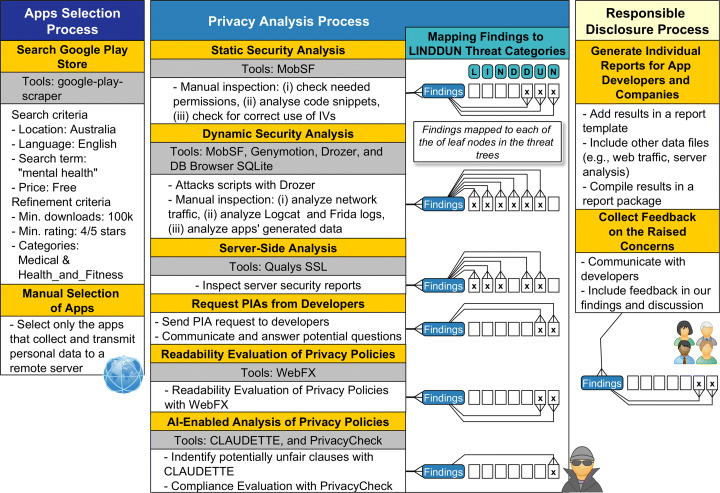
Run a four-layer audit that mirrors the methodology security researchers use — you can complete an abbreviated version in about 20 minutes without technical tooling. The framework diagram above illustrates the full professional workflow: app selection criteria, layered privacy analysis, mapping findings to threat categories, and responsible disclosure to developers.
The consumer-accessible version:
- Check the store data-safety label against the privacy policy. Open both. List every third-party category the label claims, then search the policy for named entities. Any gap is a disclosure gap.
- Search the policy for AI provider names. Use browser find for "OpenAI," "Anthropic," "Google," "third party," and "model." If the policy says "AI services" without naming anyone, treat the data destination as unknown.
- Audit requested permissions against actual function. A text-based mood journal has no functional need for microphone, camera, or contacts. Deny anything that fails this test at the OS level.
- Search the policy for the deletion clause — and specifically for training carve-outs. Look for phrases like "anonymized," "aggregated," or "de-identified data may be used for any purpose." The 2026 study found policies that explicitly confirmed no opt-out mechanism exists for anonymized training use.
For a Jenova agent session, the equivalent controls are surfaced in the interface rather than buried in a document. Global Memory can be toggled off in settings so nothing persists across chats. On paid tiers, the model selector determines which provider processes the session. Individual messages can be deleted with the undo control, and full conversations can be exported as PDF, Word, TXT, or CSV before deletion.
A useful disclosure discipline regardless of tool — write the entry, then reread it and ask whether it would still be safe if it appeared in a data broker listing. If not, either strip identifiers or move it offline.
"Analyze the emotional patterns in these journal entries and identify recurring triggers. I've replaced all names with initials and removed locations."
That single framing habit — pseudonymizing before submission — reduces re-identification risk more than any vendor promise.
How Should Your Privacy Posture Change Across Different Stages of Emotional Self-Tracking?
Your privacy exposure should scale with your engagement depth, not remain fixed. Someone casually curious about mood tracking faces a different threat model than someone logging daily crisis-adjacent disclosures, and the appropriate tool changes accordingly.
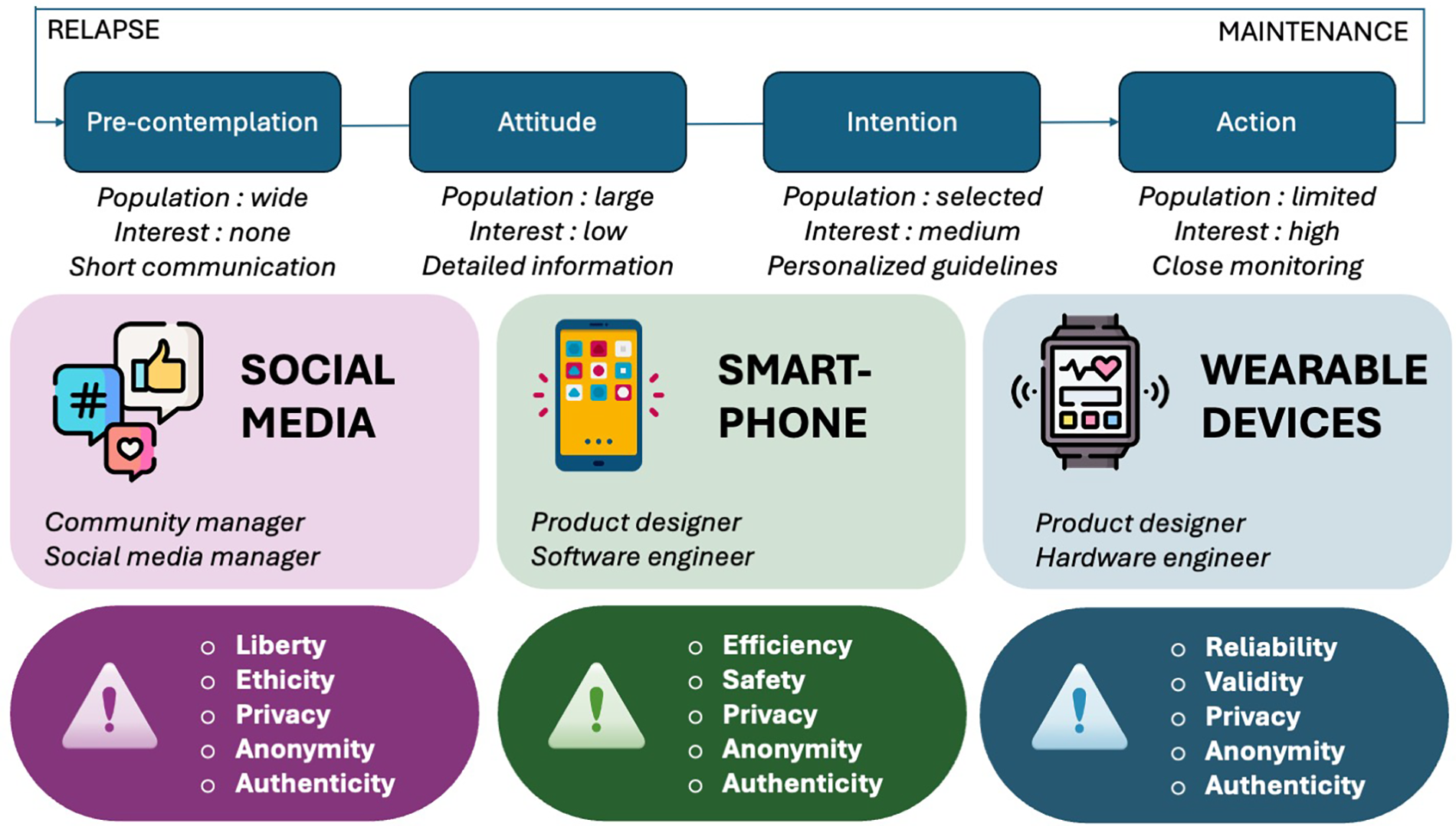
The framework above maps a useful progression. Note that privacy, anonymity, and authenticity appear as shared concerns across all three platform categories — social media, smartphone, and wearable — while the surrounding concerns diverge. Social media platforms raise liberty and ethics questions; smartphones raise efficiency and safety; wearables raise reliability and validity.
Applying this to tool selection:
| Stage | Typical Disclosure Depth | Appropriate Privacy Posture |
|---|---|---|
| Exploring | Generic questions, no personal detail | Any tool acceptable; treat as public |
| Building a habit | Recurring moods, general context | Named-processor tools only; deny non-essential permissions |
| Consistent tracking | Specific triggers, relationships, patterns | Pseudonymize entries; disable persistent memory unless needed |
| High-sensitivity logging | Trauma, ideation, clinical detail | Local-only or licensed clinician; no consumer AI tool |
The wearable dimension deserves separate treatment. Physiological emotion inference — heart rate variability, skin conductance, voice tone — generates biometric data, which is the exact category the EU AI Act's emotion recognition provisions attach to. If a wearable feeds emotional inference into an employer wellness program, you have moved into the prohibited zone under EU law and into a materially higher-risk posture everywhere else.
What Do Privacy and Clinical Researchers Say About AI Emotion Tracking?
The consensus across privacy researchers and clinical evaluators is that the gap is structural, not incidental — disclosure failures stem from systemic practices rather than deliberate deception, which is precisely why individual vigilance cannot fully close it.
"The most consequential finding in this space is not that any single app behaves badly — it's that the failure is universal. When every app in a 25-app sample embeds trackers its own policy fails to name, you are not looking at bad actors. You are looking at an ecosystem where third-party SDKs get inherited without privacy auditing, boilerplate policy language gets reused across products, and feature velocity is prioritized over compliance review. That distinction matters, because it means switching apps does not solve the problem. Changing your disclosure behavior does."
"The second thing users consistently underestimate is the irreversibility of training ingestion. People treat account deletion as a reset button. It is not. If your entries were used to fine-tune or evaluate a model before you deleted them, there is no meaningful mechanism to extract them from the model weights. Our practical guidance is simple: assume anything you type into a system that does not explicitly commit to excluding your data from training is permanent. The commitment must be explicit and specific — 'we take privacy seriously' is not a commitment."
"For anyone building emotional-tracking habits, the single highest-leverage change is pseudonymization at input. It costs nothing, it survives a breach, it survives a broker sale, and it survives training ingestion. Encryption protects data in a channel you do not control. Pseudonymization protects it in every channel simultaneously."
— Jenova Product Team, 8 years in AI agent infrastructure and applied privacy engineering
Is On-Device or Local-Only Emotion Tracking Actually the Safer Choice?
Local-only tracking is the strongest privacy option available and simultaneously the weakest safety option — the trade-off is real and should be made deliberately rather than by default. Data that never leaves your device cannot be sold to brokers, absorbed into training corpora, or exposed by a vendor breach. Nothing else in this comparison offers that guarantee.
What local-only genuinely eliminates:
- Third-party tracker exposure entirely — no network calls means no SDK transmissions
- Data broker risk — the $0.20-per-record mental health listings documented by researchers require data to have left your device first
- Service discontinuity — Earkick and Youper's disappearance stranded 3M+ users; a local file does not disappear when a company does
What it costs you:
- No pattern analysis across time beyond what you manually perform
- No crisis detection or escalation of any kind
- No cross-device sync unless you build your own encrypted backup
- Substantially weaker analytical output than a large model can produce
The hybrid posture most people should adopt: keep raw, identifiable emotional records local. Send only pseudonymized summaries to an AI tool for pattern analysis. You retain the analytical benefit while keeping the sensitive substrate off vendor infrastructure entirely.
Where crisis risk is present, none of these options is appropriate. The Common Sense Media assessment found that institutional tools with human oversight achieved meaningfully lower risk ratings not because the underlying technology was better, but because of different design choices about human involvement — and even the safest scored product had documented gaps, including at least one instance where a disclosure of suicidal ideation was flagged as "Risk Level: None."
If you are in crisis, the 988 Suicide & Crisis Lifeline is reachable by call or text at 988, and Crisis Text Line by texting HOME to 741741.
What Questions Should You Send to a Vendor Before Committing Sensitive Data?
Send five specific questions — vague questions produce vague answers, and vendors that cannot answer these precisely have told you what you need to know. Researchers formalize this as a Privacy Impact Assessment request; the consumer version is a support ticket.
- "Please list every third-party service that receives user content or metadata, by company name." Categories are not acceptable answers.
- "Is user content sent to any external AI or LLM provider? If so, which ones, and under what data processing terms?"
- "When I delete my account, does deletion extend to backups, analytics warehouses, and any training or evaluation datasets? Please answer each separately."
- "Are you subject to the FTC's Health Breach Notification Rule? If not, on what basis?" The FTC's own guidance notes the Rule applies to most health apps outside HIPAA.
- "Do you use conversation content for advertising, ad targeting, or lookalike audience construction?"
How to read the response. A vendor with clean practices answers all five in a paragraph. A vendor with problems restates the privacy policy, redirects to a trust page, or answers four and skips the deletion question. Non-response to question 3 is the most diagnostic — it is the question with the least room for ambiguity and the most legal exposure.
For Jenova specifically, the platform's published positions cover several of these directly: data is not used to train public AI models, it is encrypted in transit and at rest, and it is not sold or shared with advertisers. Company contact for privacy inquiries is [email protected], and Azeroth Inc. is based in New York. What the platform does not claim — and should not be assumed to offer — is HIPAA covered-entity status, clinical crisis escalation, or any form of licensed care.
References
- arXiv — What's on Your Mind? Exploring Privacy of Mental Health Apps (2026 measurement study of 25 Android apps)
- Federal Trade Commission — Mobile Health App Interactive Tool
- Future of Privacy Forum — Red Lines under EU AI Act: Prohibition of Emotion Recognition in the Workplace and Education Institutions
- Common Sense Media Institute — AI Mental Health Apps Risk Assessment
- Federal Trade Commission — Health Privacy Business Guidance
- Freshpaint — How the FTC Enforces Healthcare Privacy Regulations
- ACM Digital Library — Regulating Emotion AI in the United States
- Journal of Medical Internet Research — Quality and Privacy Policy Compliance of Mental Health Apps
- PubMed Central — On the Privacy of Mental Health Apps
- PubMed Central — Digital Emotion Detection, Privacy, and the Law
- EU Artificial Intelligence Act — Article 5: Prohibited AI Practices
- Mozilla Foundation — Top Mental Health & Prayer Apps Fail at Privacy and Security
- Frontiers in Pharmacology — Regulatory Challenges of Digital Health: The Case of Mental Health Apps
- American Bar Association — The Price of Emotion: Privacy, Manipulation, and Bias in Emotional AI