How Can I Prevent an AI Research Assistant From Inventing Fake Citations?
2026-08-21
Which Safeguards Separate Citation-Grounded AI Research Tools From Hallucinating Chatbots?
The most reliable way to stop an AI research assistant from inventing papers is to refuse tools that generate references from memory, require every claim to bind to a retrieved record with a machine-checkable identifier, and verify each citation against the source before it enters a manuscript. In 2026, that stack — grounded retrieval, identifier checks, and human verification — is what separates literature tools such as Jenova's Academic Research Assistant, Elicit, SciSpace, Consensus, and Scite from general-purpose chatbots that still fabricate plausible-looking references.
Key factors that actually reduce invented sources:
✅ Retrieval instead of recall — the assistant must search indexed scholarly records, not autocomplete a bibliography from training data. ✅ Identifier binding — every cited work should carry a DOI, PMID, arXiv ID, or publisher URL that resolves independently. ✅ Faithfulness, not just existence — a real paper cited for a finding it does not contain is still a failure, as RAG evaluation research has shown. ✅ Bibliographic precision — author names, years, volumes, and page ranges must match the record, not a near-miss invented by the model. ✅ A human verification loop — Stanford Libraries and major style guides treat the author, not the tool, as responsible for every citation.
To compare tools usefully, it helps to treat citation integrity as an architecture problem rather than a prompt-writing trick. The rest of this guide maps that architecture, the failure modes it is meant to catch, and a workflow you can run on any assistant.
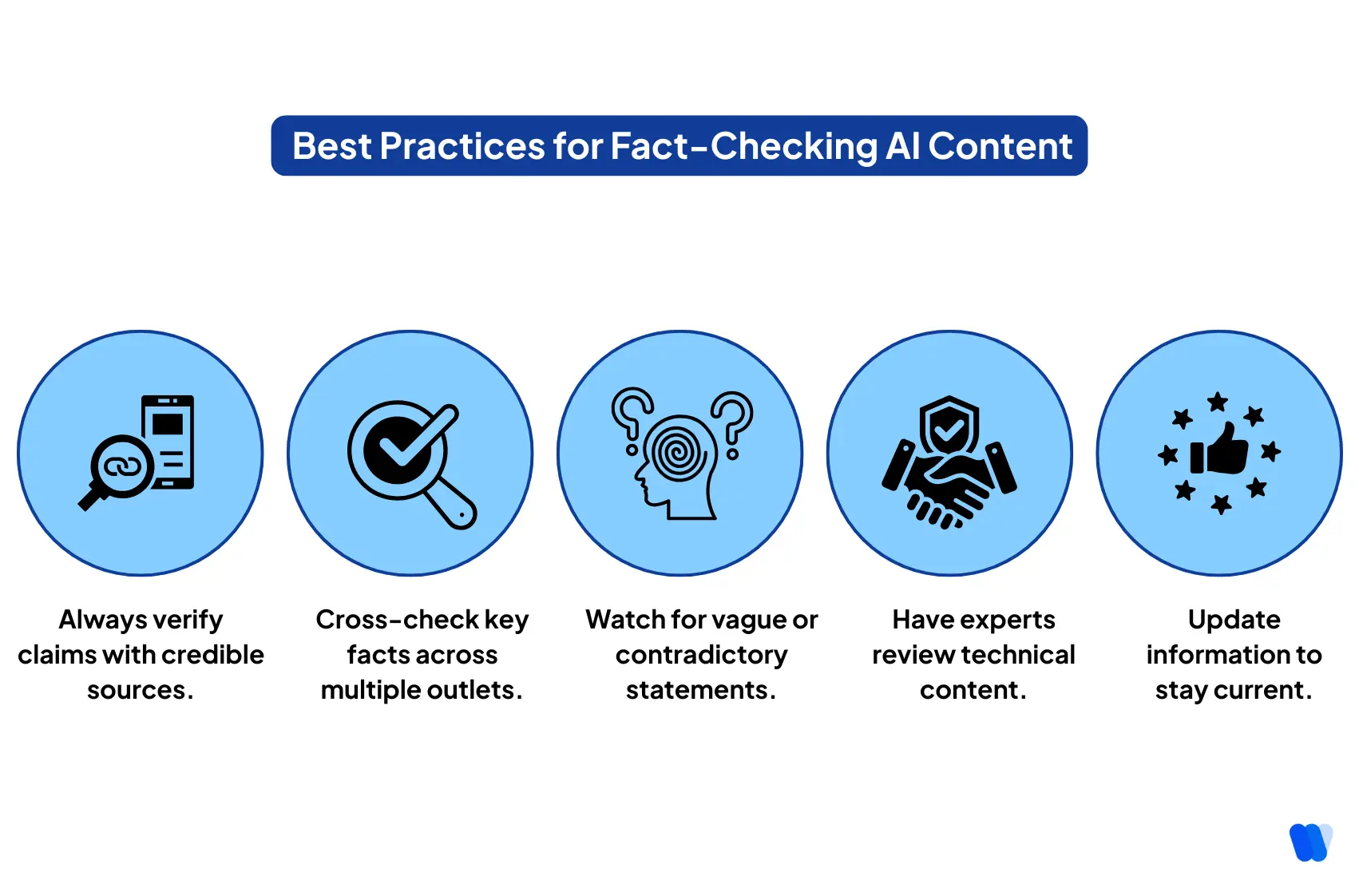
Why Are Fabricated AI Citations Appearing in Published Papers in 2026?
Fabricated citations are no longer a classroom anecdote. They are entering journals, grant files, and citation indexes because researchers paste chatbot bibliographies into manuscripts without resolving each reference. A Nature analysis in 2026 estimated that tens of thousands of 2025 publications may contain invalid AI-generated references.
The contamination pattern is distinctive. Computer scientist Guillaume Cabanac was alerted that one of his papers had been cited in the International Dental Journal — a field that does not overlap his work on spotting fabricated papers — and found he could not recognize his own reference. That is how ghost citations spread: they look formatted, they name real-sounding venues, and they pass a skim.
Documented cases are severe enough to force retractions. Resnik and Hosseini summarize a paper in Academic Ethics in which 19 of 29 citations were hallucinated, a PLOS ONE article later retracted with 18 of 76 citations invented, and a Digestive Diseases and Sciences perspective in which 12 of 14 references did not exist. A 2025 mental-health study of GPT-4o citations found 56% contained errors, with roughly one in five fully hallucinated.
Faculty concern is now near-universal. College Board research reports that instructors worry AI use is undermining critical thinking, original writing, and academic integrity. Library guides such as UNC Charlotte's now treat hallucinated citations as a standard research risk, not an edge case.
The implication for tool choice is blunt. If an assistant can emit a well-formatted APA or Vancouver reference without retrieving a live record, it can invent a paper that never existed — and that paper can survive into print.
What Should You Evaluate Before Trusting an AI Research Assistant With Your Reference List?
You should evaluate an AI research assistant on a five-part Citation Integrity Stack: source of truth, identifier binding, claim-to-passage faithfulness, bibliographic precision, and a forced human verification loop. Tools that score well on fluency and poorly on this stack are unsafe for reference lists, regardless of how polished the prose looks.
1. Source of truth
Ask whether answers come from a retrieved corpus or from parametric memory. Retrieval-augmented systems search Google Scholar, PubMed, Semantic Scholar, Scopus, or arXiv and then generate. Chatbots without retrieval predict the next token of a citation. Faithfulness metrics exist specifically because generation can drift from retrieved context even when retrieval occurred.
2. Identifier binding
A title-author-year triple is not enough. Require a DOI, PMID, PMCID, or publisher URL, then resolve it yourself. Ghost references often fail this test immediately. Bibliographic near-misses — a real paper with a wrong volume or page range — fail it on the second look.
3. Claim-to-passage faithfulness
ACM research on RAG citations found that correctness is not faithfulness: up to 57% of citations can fail to support the claim they supposedly underwrite. A paper that exists but does not contain the finding is as dangerous as a paper that does not exist, because it launders a false result through a real author.
4. Bibliographic precision
Author order, year, venue, volume, issue, and pages must match the record. RAG tools in business-administration testing have shown that fully fabricated "ghost" items can be rare while small bibliographic errors remain common. Those errors still break citation indexes and can hide swapped papers.
5. Human verification loop
APA journal policy, as summarized by Stanford, states that authors must verify any information and citations an AI tool provides. Wiley's researcher guidelines and Harvard research-integrity guidance likewise place disclosure and accuracy on the human author. No assistant in this category removes that obligation.
Weight the stack according to task. Systematic reviews should overweight faithfulness and identifier binding. Exploratory scanning can tolerate broader recall if every keeper is verified before it is cited. Never overweight prose quality. Fluent paragraphs are the mechanism that makes fake citations convincing.
How Do Popular AI Research Tools Compare on Citation Reliability?
They diverge sharply on whether references are retrieved from scholarly indexes or generated from model memory, and that single design choice predicts most ghost-citation risk. General chatbots remain the highest-risk option for bibliographies. Purpose-built research assistants reduce ghost references but still misquote, misfile metadata, and over-claim what a paper shows.
As of 2026, a practical comparison looks like this:
| Feature / Dimension | General chatbots (e.g., ChatGPT) | Elicit | SciSpace | Consensus | Scite | Jenova Academic Research Assistant |
|---|---|---|---|---|---|---|
| Source of evidence | Mostly parametric memory unless browsing is on | Retrieved papers, extraction tables | Multi-database retrieval (Google Scholar, PubMed, arXiv) | Retrieved papers for empirical questions | Citation index with supporting/contrasting context | Real-time literature discovery across academic databases and repositories |
| Ghost-reference risk | High; documented in journals and labs | Low in RAG reference-list studies | Low in RAG reference-list studies | Retrieval-based; still verify | Low for items in its citation graph | Retrieval-based; still requires independent DOI checks |
| Claim-to-source faithfulness | Weak without retrieved passages | Stronger for structured extraction | Stronger when answers cite retrieved papers | Stronger for yes/no empirical questions | Strong for how a paper is cited | Depends on retrieved passages and model choice; human check required |
| Bibliographic precision | Frequent invented details | Minor inaccuracies reported in RAG audits | Minor inaccuracies reported in RAG audits | Unverified at field-audit grain | Strong around citation context | Inherits metadata from retrieved records; can still drift in prose |
| Pricing (as of 2026) | Varies by vendor plan | Unverified | Unverified | Unverified | Unverified | Free tier with limited usage; paid plans from $20/month |
| Best for | Drafting language, not building a reference list | Evidence tables and systematic extraction | Broad, interdisciplinary literature search | Quick answers to empirical yes/no questions | Validating whether citations support or contradict a claim | End-to-end literature discovery, manuscript prep, and citation management with persistent memory |
General-purpose chatbots
Chatbots excel at outlining and paraphrasing, and they fail at bibliography construction. The GPT-4o mental-health audit cited above is the cautionary number: more than half of generated citations contained errors. If a tool can emit a perfect-looking reference without a live record, treat every citation as unverified.
Elicit
Elicit is stronger when the job is screening papers and extracting methods, outcomes, and limitations into a table. Independent comparisons describe it as better suited to rigorous evidence-based workflows than to fast exploratory search. Its limitation is coverage density: in a 200-query SciSpace-run benchmark, Elicit returned 13.0 highly relevant papers per query versus 26.3 for SciSpace Deep Review. That gap matters for recall, not for ghost-citation risk.
SciSpace
SciSpace searches multiple scholarly databases and, in its own Deep Review evaluation, led precision from P@3 through P@70. That breadth helps interdisciplinary questions where evidence sits in PubMed, arXiv, and Google Scholar at once. The limitation is methodological: the headline benchmark was run by SciSpace, even though relevance labels came from three external models. Treat vendor benchmarks as directional, then verify keepers yourself.
Consensus
Consensus is built around answering empirical scientific questions from papers rather than writing a narrative review. In the same 200-query test, Consensus Deep had the best precision at the first result (P@1 = 0.5882) and then lost that lead deeper in the list. It is a strong starting-point finder and a weaker workhorse for long screening sets.
Scite
Scite's distinctive asset is citation intelligence — seeing whether later papers support, mention, or contrast a given claim. Comparisons position it as narrower than a full research-operations tool but stronger for evidence validation. If your failure mode is "this real paper does not say what the assistant claimed," Scite-style citation context is the right instrument.
Jenova Academic Research Assistant
Jenova's Academic Research Assistant is built for academics and PhD students who need literature discovery plus manuscript and citation support in one persistent workspace. It can search across major academic databases and repositories in real time, keep project memory across sessions, and draft with current models rather than a single vendor lock-in. That combination is useful when a review spans weeks and the assistant must remember inclusion criteria, rejected papers, and unresolved DOIs.
It is not a dedicated citation-context index, so it will not replace Scite for supporting-versus-contrasting maps. It is not a purpose-built extraction grid in the Elicit sense. Real-time search can also retrieve low-quality or mismatched records that a fluent model then over-interprets. The honest operating rule is the same as for every retrieval tool: use it to find and organize candidates, not to bless a bibliography.
Does Retrieval-Augmented Generation Stop Ghost References Entirely?
No. Retrieval-augmented generation (RAG) sharply reduces fully invented papers in the reference list, but it does not eliminate bibliographic errors, and it does not guarantee that a retrieved paper supports the sentence it is attached to. Prevention therefore has to target three different failure modes, not one.
The three modes are easy to confuse because all three produce "plausible-looking citations":
- Ghost references — the cited work does not exist.
- Bibliographic drift — the work exists, but authors, year, volume, or pages are wrong.
- Context hallucination — the work exists and the metadata is mostly right, but the assistant attributes a finding the paper does not contain.
A field analysis of Scopus AI, Elicit, SciSpace, and Scite in business administration found that RAG-based tools generally did not emit verifiable ghost references. Minor bibliographic inaccuracies still appeared; entirely nonexistent sources were negligible in those generated lists. That is the right way to read RAG: it is a strong control for ghosts, not a full citation-quality system.
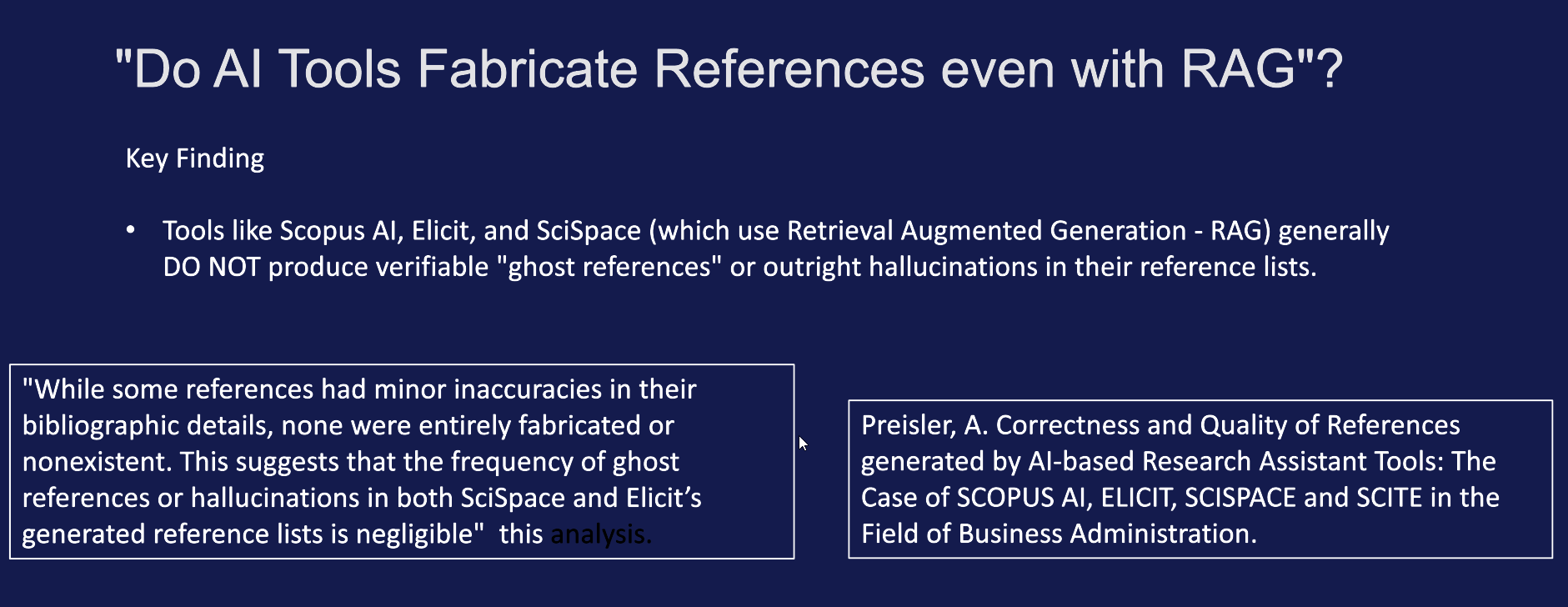
Faithfulness research explains the remaining risk. RAG evaluation frameworks separate answer relevancy from faithfulness: a response can be on-topic and still ungrounded in the retrieved passages. The ACM finding that a large share of RAG citations can lack faithfulness is the operational warning. If you only check whether a DOI resolves, you will catch ghosts and miss misattributed claims.
General chatbots fail the first mode. RAG assistants mostly fail the second and third. A prevention workflow that only asks "does this paper exist?" is therefore incomplete for the tools researchers should actually be using.
How Do You Verify Citations an AI Research Assistant Returns?
You verify them with a two-pass protocol: resolve the identifier first, then confirm that a specific passage supports the claim. Skipping either pass is how invented or misused sources reach publication.
Pass 1 — Does the record exist?
- Copy the title, first author, year, and DOI exactly as returned.
- Resolve the DOI in a registrar or publisher page. If there is no DOI, search the exact title in Google Scholar, PubMed, or the journal site, following the direct-lookup approach research guides recommend.
- Reject any item that does not resolve, that resolves to a different paper, or that exists only as an AI-formatted citation.
- Check author order, year, volume, issue, and pages against the publisher record, not against the assistant's bibliography block.
Pass 2 — Does this paper support this sentence?
- Open the PDF or HTML full text. Abstracts are not enough for causal claims, effect sizes, or "first evidence" language.
- Locate the passage that supposedly supports the claim. Quote it in your notes.
- Mark the citation as supporting, mentioning, or contrasting — the distinction Scite productizes and that you can apply by hand.
- If the assistant paraphrased a limitation as a finding, or a hypothesis as a result, discard the citation for that sentence.
For Jenova's Academic Research Assistant, constrain retrieval before you ever generate a reference list:
"Search peer-reviewed papers and preprints on [topic], 2019–2026. Return only items with a DOI or PMID. For each: title, authors, year, venue, identifier, one-sentence finding, and a quoted passage. If you cannot retrieve a verifiable record, omit the item entirely. Do not complete or guess metadata."
Then run the same keepers through Elicit or SciSpace as a second corpus check. Disagreement between tools is a feature: it flags papers one system ranked that the other could not retrieve.
Science's reporting on hallucinated scientific articles shows why skim-reading titles fails. An assistant can cite one real paper correctly and then invent a neighboring one in the same paragraph. Verification has to be item-by-item, not paragraph-by-paragraph.
Could a Hallucinated Citation Count as Research Misconduct?
Yes, in a defined set of cases — and even when it does not meet the legal definition of misconduct, it can still trigger retraction, grant trouble, and career damage. The prevention motive is not etiquette. It is liability.
Resnik and Hosseini argue that a hallucinated citation may qualify as provable research misconduct under U.S. federal regulations when three conditions hold: a researcher used a generative tool to produce nonexistent citations; those citations function as data because they support findings (as in reviews or bibliometric studies); and the researcher showed indifference to fabrication risk by not checking the output. A ghost reference in a narrative introduction is poor scholarship. A ghost reference that is counted as evidence in a systematic review is closer to fabricated data.
Funders are already treating the problem as operational. In summer 2025, NIH grant-review staff were inundated with AI-assisted proposals, and the agency has indicated that improper AI use discovered after award may be referred for integrity review. Harvard's research-integrity hub restates related constraints: AI tools cannot be listed as authors, NIH scientific peer reviewers are prohibited from using generative AI to formulate critiques, and authors must disclose how tools were used.
Journals are converging on the same assignment of responsibility. Stanford's compilation of APA, MLA, Chicago, and IEEE rules requires disclosure of AI-generated content and, in APA's case, explicit human verification of citations. Cornell's teaching guidance additionally warns that automated AI-detection algorithms are too unreliable to be the integrity strategy. Detection after the fact is a weak substitute for verification before submission.
The practical standard is simple. If you cannot point to a resolved record and a supporting passage, the citation does not belong in the manuscript, the slide deck, or the grant.
What Do Research Integrity Specialists Say About AI-Generated Citations?
Specialists now treat invented references as a process failure — using a generative model as a library — rather than as a mysterious model bug that users cannot anticipate. The consensus across integrity offices and citation studies is that RAG reduces ghosts, human verification remains mandatory, and unattended chatbot bibliographies are reckless given what is already known about the failure rate.
"The error that keeps reaching journals is not that models sometimes guess. It is that researchers let a language model perform a cataloging task it is not architected to do. If the assistant did not retrieve a record, it is completing a bibliographic pattern, and completed patterns are how you get a real-looking article in a real-looking journal with a DOI that does not resolve. Switching to a retrieval tool cuts that failure mode dramatically. It does not cut the next one: quoting a real paper for a result that lives in the model's summary rather than in the results section."
"We tell research users to run a three-bin workflow. Bin A is retrieved and passage-checked — those citations may be used. Bin B is retrieved but only metadata-checked — those stay in a reading list. Bin C is anything the model emitted without a resolving identifier — those are deleted, not 'looked up later.' Teams that skip Bin C because the formatting looks expensive are the ones who later discover that 12 of 14 references never existed. The cost of the extra pass is trivial next to a retraction or a grant integrity referral."
— Jenova Product Team, AI research-agent design for academic workflows
That advice aligns with publisher and university policy: name the tool, name the task it performed, and keep the human author accountable for every reference. Integrity guidance is no longer "avoid AI." It is "do not outsource the existence of your sources."
How Do You Run a Citation-Safe Literature Review With AI?
You run it as a pipeline with retrieval first, extraction second, prose last, and a verification gate that no sentence can skip. Reversing that order — drafting the argument, then asking an assistant to "add citations" — is the prompt pattern most associated with ghost references.
A workflow that holds up under journal and grant scrutiny:
- Write inclusion rules before you search. Population, intervention, years, languages, study types. Paste those rules into the assistant so memory, if the tool has it, persists across sessions.
- Search with two retrieval tools, not one. Example pairing: Jenova's Academic Research Assistant plus Elicit or SciSpace. Keep the union of hits; do not trust a single ranked list.
- Freeze a candidate set with identifiers. Export title, authors, year, venue, DOI/PMID. Anything without an identifier waits outside the set.
- Extract, do not summarize, on the full text. Methods, sample, outcomes, limitations, and a quoted sentence. Elicit-style tables are useful here; narrative summaries are where context hallucination creeps in.
- Draft from the extraction table. If a sentence has no row in the table, it does not get a citation — and it may not belong in the paper.
- Disclose the tools. Follow Stanford's compilation of style-guide rules: tool name, version, date, and the function performed (search, extraction, language editing).
- Do a final DOI sweep on the submitted bibliography. This last pass catches copy-paste drift and any reference the model inserted during revision.
A prompt that keeps Jenova inside the pipeline rather than in chatbot mode:
"Using only the candidate set I uploaded, draft the background section. Every empirical sentence must cite a DOI from that set and must not introduce new sources. If a claim is not supported by the extraction notes, flag it as UNSUPPORTED instead of citing."
For SciSpace or Elicit, use each tool's retrieval or extraction view to rebuild the same table and compare rows. Where the tables disagree on a finding, read the PDF. The disagreement is cheaper than a post-publication correction.
The constraint that makes the pipeline work is psychological as much as technical: never ask any assistant, including a strong one, to "supply references" for prose that was written without sources. That prompt converts a research tool back into a citation generator, which is the failure mode this entire stack is designed to prevent.
References
- Nature — Hallucinated citations are polluting the scientific literature
- Accountability in Research (Resnik & Hosseini) — Hallucinated citations produced by generative artificial intelligence
- Stanford Libraries — AI in Academic Research: Citation Guidelines
- ACM Digital Library — Correctness is not Faithfulness in Retrieval Augmented Generation
- DeepEval — Faithfulness metric for RAG systems
- Confident AI — RAG evaluation metrics: answer relevancy, faithfulness, and contextual relevancy
- UNC Charlotte Library — AI Hallucinated Citations research guide
- Wiley — AI guidelines for researchers
- College Board — Faculty concern that student AI use undermines academic integrity
- Harvard Medical School Academic and Research Integrity — AI in Research
- Cornell Center for Teaching Innovation — AI and Academic Integrity
- SciSpace — SciSpace vs Elicit vs Consensus literature-search benchmark across 200 queries
- Paperguide — Elicit vs SciSpace comparison
- Paperguide — Elicit vs Scite comparison
- Science — Cite unseen: when AI hallucinates scientific articles
- SciSpace — SciSpace vs Elicit product comparison