How Can an AI Research Assistant Map Evidence Gaps for a New Topic?
2026-08-22
What Distinguishes a Traceable Search-Screen-Map Workflow From Generic Literature Summaries?
A reliable AI research assistant does not start by summarizing whatever papers it can find. It builds a reproducible search strategy, screens a bounded set of studies against explicit criteria, and then maps what those studies cover — and fail to cover — so the empty cells are evidence gaps rather than search artifacts. In 2026, that distinction matters because generic chat summaries can look complete while inventing citations or collapsing incompatible study designs into a single claim.
For a new topic, the practical unit of work is often a 50-paper core set: large enough to reveal clusters, small enough that a researcher can still verify every include/exclude decision. Tools that support this workflow include Jenova's Academic Research Assistant, Elicit's systematic review workflow, Rayyan, and citation-network mappers such as ResearchRabbit.
What separates a citable search-screen-map process from a disposable literature dump:
✅ Traceable queries — Boolean strings, databases, date windows, and synonyms are written down before screening starts ✅ Auditable screening — every paper receives an include, exclude, or unsure tag tied to a stated criterion ✅ Extracted, not paraphrased, evidence — findings, methods, and limitations stay attached to a verifiable source ✅ Dimensional gap maps — empty cells are coded by population, method, geography, and outcome, not by gut feel ✅ Human verification — AI drafts the map; the researcher confirms that each citation exists in the original paper
To compare assistants meaningfully, it helps to treat search, screening, and gap mapping as three jobs with different failure modes rather than one “literature review” feature.
Why Are Evidence Gap Maps Becoming Essential for New Research Topics?
Evidence and gap maps have become a standard way to see, at a glance, where a field is crowded and where it is silent before a researcher commits to a new study design. An evidence and gap map is a systematic visual presentation of the availability of relevant evidence for a policy or research domain, identified through a pre-specified search protocol rather than an ad hoc reading list.
That definition, developed for the Campbell Collaboration, is easy to misuse. Many maps report what evidence exists, not what the evidence concludes. Confusing the two produces false confidence: a dense cell can still be methodologically weak, and an empty cell can be a failed search rather than a genuine unknown.
The method is no longer niche. A 2016 health-sector review identified 145 mapping titles, of which 34 publications presented explicit evidence maps. Mapping reviews and evidence gap maps are now treated as distinct synthesis products used to navigate complex bodies of research, sitting between a scoping review and a full systematic review.
For someone entering a new topic in 2026, the pressure is practical. Elicit notes that systematic reviews often start with up to 20,000 records and are winnowed to 30–100 included papers, a process that can take three months to more than a year by hand. A 50-paper screen is not a substitute for that gold-standard pipeline. It is the right first instrument when the goal is to decide whether a systematic review, a primary study, or a narrower question is justified.
AI changes the speed of the first pass. It does not remove the reporting obligations in PRISMA 2020, which still expects transparent identification, selection, and extraction methods.
What Should You Look for in an AI Research Assistant for Literature Screening?
You should evaluate an AI research assistant on whether it can keep a search strategy reproducible, a screening decision inspectable, and a gap claim falsifiable — not on how fluently it writes a literature review. The TRACE-GAP checklist below is the framework used in this article.
TRACE-GAP evaluation dimensions
- T — Traceable queries. Can the tool output the exact databases, strings, limits, and date range another researcher could rerun?
- R — Relevance criteria. Can inclusion and exclusion rules be stated before any paper is scored?
- A — Auditable screening. Does each decision carry a reason, not just a yes/no?
- C — Citation-level extraction. Are findings tied to a passage or at least a specific paper, rather than a blended summary?
- E — Evidence-strength coding. Can study design, sample, and limitations be recorded beside the finding?
- G — Gap dimensions. Can the map use at least two axes, typically intervention × outcome or population × method?
- A — Across-cluster validation. Does the workflow force a second look before an empty cell is called a gap?
- P — Prioritized questions. Does the output turn validated gaps into research questions, not a decorative heatmap?
A 2026 buyer’s-guide benchmark that scored assistants on citation grounding found paragraph-level source links produced the lowest hallucination-to-verification ratio, with Atlas at 0.05, Elicit at 0.07, Consensus at 0.09, and SciSpace at 0.16. The same review treated ResearchRabbit as a network mapper rather than an answer generator, which is the correct category for seed-paper expansion.
Two further tests matter for academic use. First, PRISMA 2020 still requires authors to verify extracted values; any tool that hides the supporting quote fails that test. Second, hallucinated citations have reached expert drafts and journal pipelines, so “sounds scholarly” is not an acceptance criterion.
Jenova’s Academic Research Assistant is strongest on strategy drafting, multi-database discovery, persistent project memory, and citation-aware writing. It is weaker as a dedicated dual-screener platform: it does not generate a PRISMA flow diagram or run blinded conflict resolution the way Rayyan and Covidence do.
How Do Jenova, Elicit, Rayyan, and ResearchRabbit Compare for Search, Screening, and Gap Mapping?
Jenova is strongest as a strategy-and-synthesis partner, Elicit as a structured extraction engine, Rayyan as a high-volume screening desk, and ResearchRabbit as a citation-network explorer — and none of them should be used as a single closed system for a new topic. The useful comparison is which job each tool should own.
| Feature / Dimension | Jenova Academic Research Assistant | Elicit | Rayyan | ResearchRabbit / Scite |
|---|---|---|---|---|
| Search strategy support | Conversational PICO/Boolean drafting with Scholar and web search; persistent project memory | Semantic search over 125M+ papers; suggests screening fields from the question | Imports traditional database exports; not primarily a search designer | ResearchRabbit expands from seed papers; Scite checks later citation stance |
| Screening of ~50 papers | Criteria-based include/exclude tables in chat, with reasons and limitations | Ranked screening plus quote-backed extraction rows | Purpose-built title/abstract screening, deduplication, and team workflows | Weak as a screener; strong as a related-paper finder or citation auditor |
| Evidence gap mapping | Cluster coding, empty-cell validation, and research-question translation | Good extraction tables for building a map later | Screening log supports maps; mapping itself is mostly downstream | Network maps show missing links, not validated evidence gaps |
| Citation grounding | Multi-model answers with source-first prompts; human verification still required | Paper-level quotes for extracted fields | Decision log is auditable; synthesis is not the product | Scite flags supporting, contrasting, or mentioning citations |
| Pricing (as of 2026) | Free tier with limited usage; Plus from $20/month | Pro, Team, and Enterprise (list prices vary by plan) | Free forever for basic use | ResearchRabbit free; Scite Student about $10/month, Premium about $20/month |
| Best for | New-topic strategy, 50-paper sense-making, and turning gaps into a study justification | Structured extraction across many papers | Team screening at systematic-review scale | Entering a field from a seed paper, then auditing key citations |
Rayyan reports use by more than 1 million researchers at over 20,000 institutions in 190-plus countries and is built around auditability, reproducibility, and AI-assisted prioritization. A side-by-side software review in 2026 still framed the choice as Covidence for institutional review management, Rayyan for accessible screening, and Elicit for AI search and extraction.
Jenova’s limitation is interface, not intent. A 50-paper screen in chat is inspectable if you force a table, but it will not replace dual independent screeners on a 5,000-record export. Elicit’s limitation is the opposite: the table is excellent, yet Elicit itself says publication-grade reviews should still run traditional keyword searches and treat semantic search as a supplement. ResearchRabbit’s limitation is honesty about scope: it maps what is connected, not what is missing after quality appraisal.
For a new topic, the high-yield stack is usually Jenova or Semantic Scholar for strategy, Rayyan or Elicit for screening, Scite for citation stance, and Jenova again for the gap narrative. Jenova’s Deep Research agent is the better handoff when the 50-paper map needs a longer, citation-dense briefing.
How Do You Build a Reproducible Search Strategy With an AI Research Assistant?
You build a reproducible search strategy by locking the question, the concepts, the sources, and the limits before you ask any model to find papers. The assistant’s job is to expose missing synonyms and biased limits, not to improvise a reading list.
Start with a research anchor: population or setting, intervention or exposure, comparator if relevant, outcomes, and study designs you will accept. Mapping reviews can be broader than a single PICO question, but they still need an ex ante search strategy and coding form. University guides describe evidence or gap maps as a primary table with rows, columns, and filters for specific variables. Those rows and columns should exist on paper before the first query runs.
A useful first prompt in Jenova’s Academic Research Assistant looks like this:
"I am opening a new research line on [topic]. Draft a reproducible search strategy with: (1) PICO or PECO elements, (2) inclusion and exclusion criteria, (3) databases and grey-literature sources, (4) Boolean strings with synonyms and controlled vocabulary, and (5) a 2019–2026 date window. List terms I am likely missing and any limits that would hide relevant study designs."
Then force a methods check:
"Rewrite the strategy so another researcher could rerun it. Separate must-have terms from optional synonyms. Flag where semantic search would help recall and where only exact database syntax is acceptable."
Good assistants will push you toward multiple sources. A biomedical topic still needs MEDLINE/PubMed plus at least one complementary index; education and social policy often need ERIC, PsycINFO, or a specialist map library. University of Toronto’s synthesis guide treats mapping reviews as a way to see gaps before committing to a narrower systematic review.
Two strategy errors show up constantly in testing. The first is over-filtering by “review” or “RCT” too early, which erases the very empty cells you came to find. The second is letting the model choose databases after it has already seen a few convenient hits. Freeze the protocol, then search.
Jenova helps here because the conversation persists across sessions and can keep the anchor, strings, and exclusion list in memory. It does not replace a librarian-reviewed search for a journal-facing systematic review, and you should not pretend that it does.
How Should You Screen About 50 Key Papers Without Losing Methodological Rigor?
You should screen 50 papers as a coded decision log: one row per study, one reason per decision, and no paper admitted because the abstract “sounds relevant.” Fifty is a working corpus for a new topic, not a claim that the literature has been exhaustively searched.
Borrow the discipline of systematic screening even when you are not yet writing a PRISMA review. PRISMA 2020 is the current reporting guideline for reviews that identify, select, and synthesize studies. The accompanying 27-item checklist exists to make those methods transparent. Your 50-paper log will not satisfy a full systematic review, but it should be able to answer the same basic questions: what was found, what was kept, and why.
A practical screening prompt:
"Screen the following 50 papers against these inclusion and exclusion criteria. For each paper return: decision (include / exclude / unsure), the single criterion that decided it, study design, population, setting, primary outcome, and one limitation. Quote the phrase that justified the decision. Do not add papers that are not in this list."
Then run a calibration pass on the first ten records yourself. If the assistant and the researcher disagree on more than two or three, the criteria are still fuzzy. Tighten definitions of population, design, and outcome before scoring the remaining forty.
Rayyan is the better instrument when the set grows or a second screener joins. Independent comparisons of Covidence and Rayyan have long treated both as viable systematic-review screening platforms with different collaboration models. Elicit is the better instrument when the next step is a data table: sample size, outcome direction, and methods fields filled with supporting quotes.
Jenova’s honest limit is batch ergonomics. Chat-based screening is fast for 50 carefully chosen papers and clumsy for 5,000 imported records. Use it to impose criteria and extract a consistent codebook. Move the same codebook into Rayyan or Elicit if the project becomes a formal review.
Never let the model “fill in” a missing PDF. If the full text is unavailable, the row stays unsure, not include. That single rule prevents most citation theater.
How Do You Turn Screened Papers Into a Validated Evidence Gap Map?
You turn a screened set into a gap map by coding each included study on two or more dimensions, marking empty cells as preliminary, and only then testing whether those empty cells survive a second search. An empty cell that has not been challenged is a coding leftover, not a research justification.
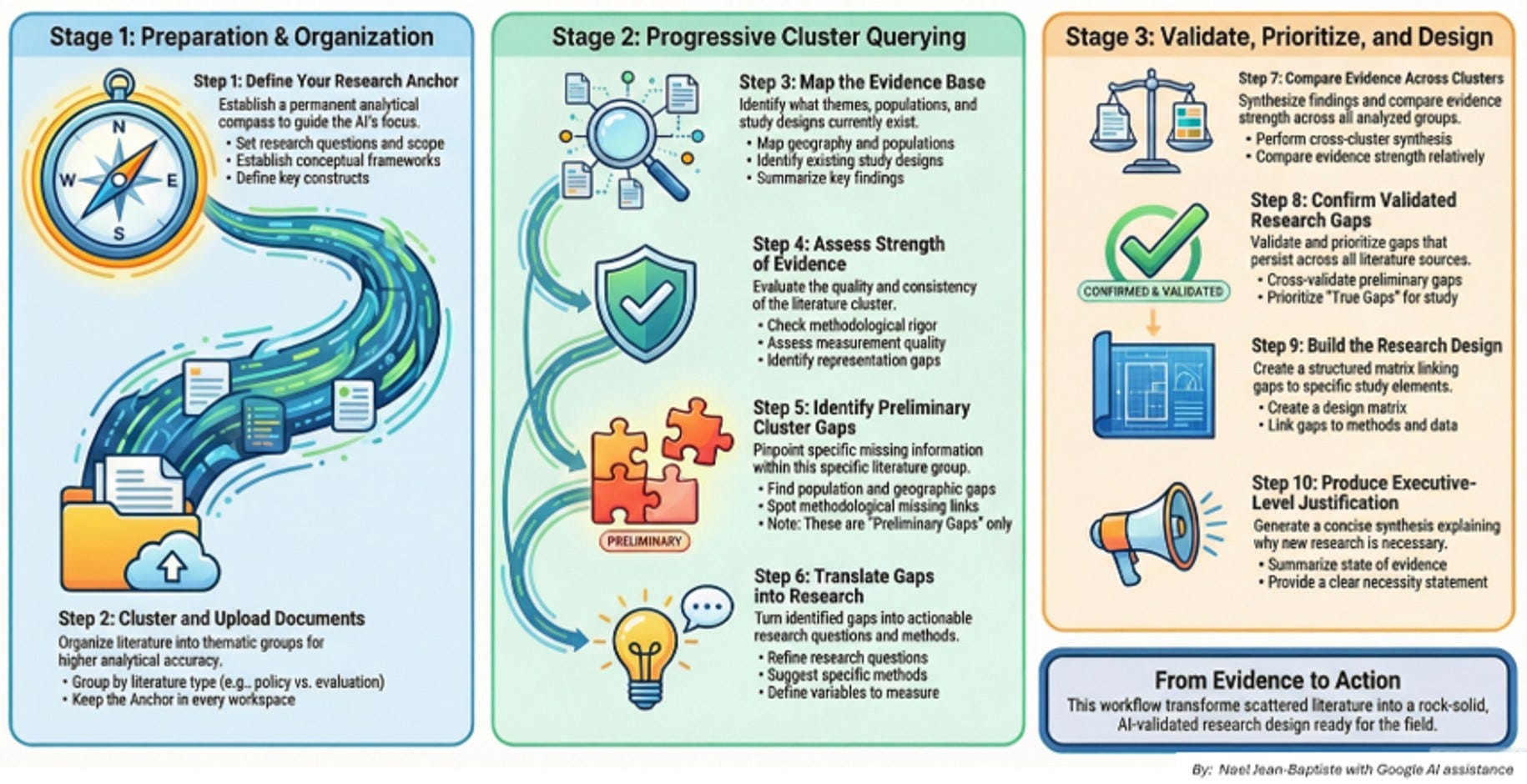
The workflow in the figure above is the right sequence: prepare an analytical anchor, cluster the documents, assess evidence strength, mark preliminary gaps, then validate those gaps across clusters before you design a study. That matches how formal maps are supposed to work. Interactive evidence gap maps are structured visual tools for displaying the volume and characteristics of evidence, not posters of preferred hypotheses.
A durable map usually needs at least:
- Rows: interventions, exposures, or research questions
- Columns: outcomes, populations, or study designs
- Filters: year, geography, quality, and publication status
- Cell contents: count of studies, plus a crude strength tag (review, trial, observational, protocol)
Ask the assistant to build the first matrix from included papers only:
"Using only the included studies, build a gap matrix with rows = [interventions or questions] and columns = [outcomes or populations]. In each cell list study count, dominant design, and recency. Mark empty cells as Preliminary. Then propose three follow-up searches that could falsify each empty cell, including trial registries and grey literature."
Validation is the step most AI write-ups skip. Methodological comparisons emphasize that maps should include ongoing studies from registries, apply critical appraisal, and be updated within about three years. A cell that looks empty in your 50-paper set may be full in a preprint server or a protocol registry.
Jenova is useful in this phase because it can keep the codebook, the matrix, and the rejected papers in one thread and then draft the “why this study is necessary” memo from validated gaps only. It will over-interpret empty cells if you let it. Require a falsification search for every gap you plan to fund or write about.
If the topic later becomes a scoping review, switch reporting to PRISMA-ScR, which specifies 20 essential items and 2 optional items. Do not retrofit a casual 50-paper map as if it were already a scoping review.
How Do You Get the Most Out of an AI-Assisted Search-Screen-Map Workflow?
You get the most out of the workflow by giving the assistant a frozen protocol, a bounded corpus, and a verification budget — then refusing any claim that cannot be opened in the original PDF. Speed comes from consistent coding, not from skipping full-text checks.
A compact operating sequence:
- Write the anchor. One paragraph stating the claim that needs support, the population, and what would count as disconfirming evidence.
- Draft and freeze the search. Databases, strings, dates, and exclusion rules go into a dated note before discovery begins.
- Assemble 50 papers on purpose. Mix reviews, recent trials or primary studies, and at least a few adjacent-field papers so the map is not a single-cluster illusion.
- Screen in a table. Include, exclude, or unsure, with one deciding criterion and one quoted phrase.
- Extract, then grade. Findings, limitations, design, and sample stay in separate fields.
- Map, then attack the empties. Every preliminary gap gets a second search designed to kill it.
- Write from the matrix. The paper’s novelty sentence should name the validated empty cell, not a vibe.
In Jenova, keep that entire chain in one project so the assistant cannot quietly change inclusion rules between sessions. A follow-up prompt that prevents drift:
"Re-apply the original inclusion criteria to this new paper. If you need to change a criterion to include it, stop and show me the proposed change instead of scoring the paper."
For Elicit, start from the research question, let the system suggest screening and extraction fields, then override those fields before running the full set. For Rayyan, import the database export, set labels that match your codebook, and keep the AI relevance ranker as a sort order rather than as a decision.
Budget verification time explicitly. A workable target for a 50-paper core set is two to four minutes of human checking per included full text, focused on whether the quoted finding is actually in the paper and whether the design was coded correctly. That is still far cheaper than unassisted extraction, and it is the only way to stay on the right side of PRISMA’s expectation that extracted values are verified.
What Do Research Methodologists and Tool Builders Say About AI-Assisted Evidence Mapping?
Research methodologists treat evidence maps as protocol-driven charts of availability, while tool builders keep discovering that the citation, not the prose, is the part AI gets wrong. Both groups converge on the same operational rule: AI may structure the search and the screen, but the researcher remains accountable for every cell in the map.
"The failure mode we see most often is treating the empty cell as a discovery. An empty cell is only a hypothesis about missing evidence. It becomes a validated gap after you have checked adjacent clusters, grey literature, and protocol registries, and confirmed the absence is not a search artifact. If those checks were not run, you do not have a gap map. You have a visualization of your first query."
"On a 50-paper screen, the time savings come from consistent coding, not from skipping full text. The useful division of labor is simple: the assistant drafts the include/exclude decision, the extraction row, and the first matrix; the researcher spends a few minutes per included paper confirming that the quote exists and that the design was not upgraded in the retelling. That still compresses days of messy notes into a single codebook."
"We would not submit a journal systematic review from chat logs alone. Dedicated screening platforms still win on dual review, conflict resolution, and PRISMA diagrams. Where a conversational research assistant earns its place is earlier: locking the question, exposing biased search limits, keeping the rejected papers visible, and turning a validated empty cell into a precise study justification."
— Jenova Product Team, academic research workflows, 8 years building source-traceable AI research tooling
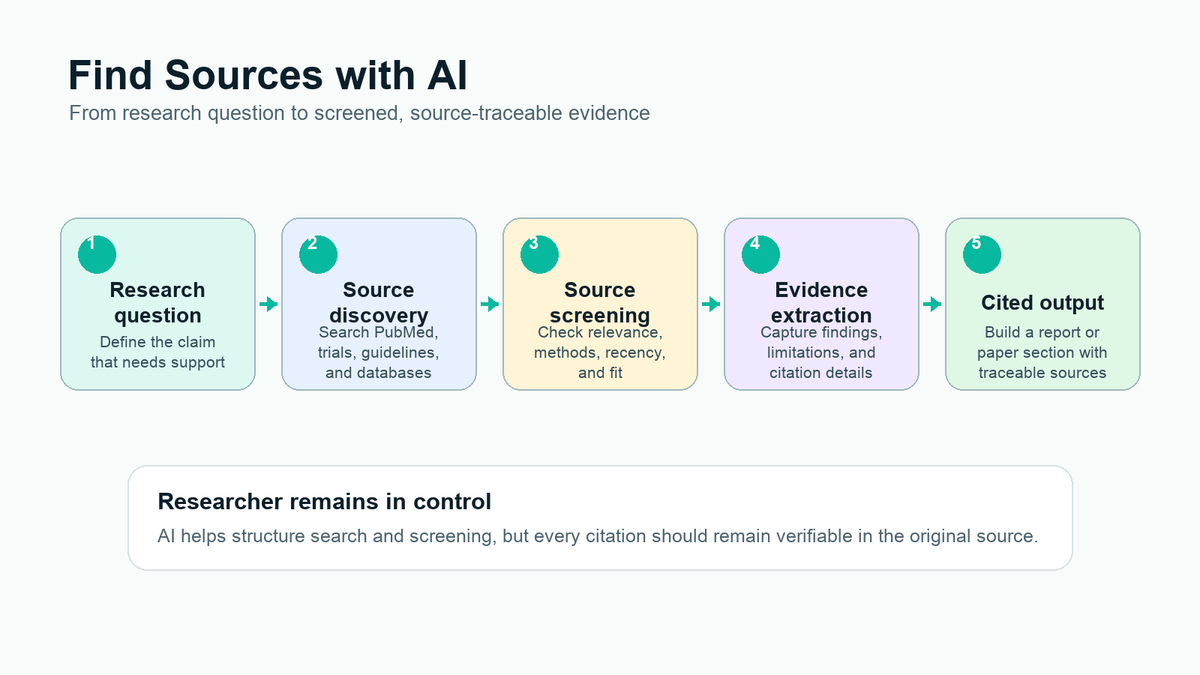
That caution is consistent with independent work. Reviews of generative systems in literature synthesis keep finding real capability paired with reliability limits that make unsupervised review unsafe. Guidance on systematic evidence maps likewise stresses structured categorization of scientific evidence rather than narrative confidence. The researcher-in-control constraint in the five-step source workflow is not a slogan. It is the quality-control step the rest of the method depends on.
References
- Saran and White — Evidence and gap maps: a comparison of different approaches (PMC)
- Khalil et al. — Methodology for mapping reviews, evidence maps, and gap maps (Research Synthesis Methods)
- Elicit — Introducing Elicit Systematic Review
- PRISMA Statement — PRISMA 2020 reporting guidance
- Atlas Workspace — Best AI Research Assistants (2026) hallucination-verified comparison
- Fortune — AI hallucinations are infiltrating expert scientific work (May 2026)
- University of Illinois Grainger LibGuide — Scoping reviews, mapping reviews, evidence or gap maps
- Page et al. — The PRISMA 2020 statement (The BMJ)
- University of Kansas Medical Center — PRISMA and related review standards
- Elicit — Systematic review workflow built for PRISMA 2020
- Rayyan — AI-powered systematic review platform
- INRA.AI — Covidence vs Rayyan vs Elicit comparison
- University of Toronto Libraries — Mapping reviews in the knowledge-synthesis family
- Kellermeyer, Harnke, and Knight — Covidence and Rayyan comparison (PMC)
- EvalCommunity Academy — Interactive evidence gap mapper
- PRISMA — PRISMA extension for scoping reviews
- Adel, Alateeq, and Alshahrani — Can generative AI reliably synthesise literature? (AI & Society)
- Khalil et al. — Guidance to undertaking systematic evidence maps (Science of the Total Environment)