How Can AI Track a Stock Thesis, Catalysts, and Invalidation?
2026-08-23
What Separates Durable Thesis Tracking From One-Off AI Stock Analysis?
Durable thesis tracking keeps three frozen records alive for months: the original investment claim, the dated catalysts expected to prove or disprove it, and the pre-committed conditions that would kill the position. One-off AI stock analysis does the opposite. It regenerates a fresh narrative each session and quietly overwrites why you bought. In 2026, the useful split is not “which chatbot can summarize a 10-K.” It is which system can refuse to rewrite the original case as price, news, and guidance move.
For multi-month work, Jenova's Fundamental Stock Analyst is strongest when you need a conversational research partner that remembers the original thesis, reads SEC filings, and scores new evidence without replacing the claim. Helm Terminal is stronger when you want daily automated monitoring across a whole book. Fiscal.ai is stronger when the job is earnings-speed data and KPI workflows rather than a living thesis file. MyThesis fits a small set of high-conviction names if you accept per-holding pricing.
Key factors that separate durable tracking from snapshot research:
✅ A locked original thesis that later sessions can score, not rewrite ✅ A dated catalyst calendar tied to filings, products, legal events, or capital returns ✅ Pre-committed invalidation conditions that are falsifiable in public data ✅ Evidence you can verify, ideally quoted and dated rather than paraphrased ✅ Either cross-session memory or a scheduled monitor that runs after you stop watching
To compare these tools honestly, it helps to define what “tracking” actually requires after the trade is already on.
Why Do Investment Theses Drift After the Initial Buy Decision?
Theses drift because investors track price more faithfully than they track the reasons that justified the price. After a few earnings prints, the original claim — a margin recovery, a product cycle, a legal overhang, a capital-return path — gets replaced by a running commentary on whether the stock is “working.” That substitution is the core failure mode of multi-month investing, not a lack of news.
A 2023 CFA Institute survey summarized in Daloopa’s equity-research review found that 55% of investment professionals already used unstructured data and 64% tapped alternative data. The information layer is not scarce. What is scarce is a stable object to compare that information against. Post-purchase thesis guides make the same point from the other side: the hard work starts after the buy, when catalysts and risks have to be checked against the original case rather than against last week’s narrative.
Catalysts make drift worse if they are vague. Joe Wiggins has argued that a real catalyst requires specifying in advance a specific driver of a change in an asset’s return profile — not a hope that “the story gets recognized.” Invalidation has the same problem. Practitioners who write it well name impending events, as Trefis did when listing legislative, antitrust, and consumer developments that could break a Visa thesis. Practitioners who write it poorly say “if the stock breaks down” and then move the line.
Generative AI adoption is still rising — a late-2025 St. Louis Fed survey found overall usage up 10 percentage points over the prior 12 months — which means more investors can now produce fluent stock write-ups on demand. Fluency without a frozen thesis file just accelerates drift. The model becomes a very fast rationalizer.
What Should You Look for in an AI Thesis Tracking System?
You should look for five capabilities: thesis lock, catalyst fidelity, invalidation specificity, evidence provenance, and a continuity mechanism that survives more than one session. Price alerts, chat summaries, and generic “watch this ticker” features are not substitutes for those five.
This article uses a Thesis Continuity Stack to score tools. Each layer answers a different failure mode.
Layer 1 — Frozen original thesis. The system must store the claim in the user’s words, with date, direction, time horizon, and the two or three pillars that would make the claim true. If the model can silently revise that text, it is a research assistant, not a tracker.
Layer 2 — Living catalyst map. Each catalyst needs an expected window, a public evidence source, and a “what would count as arrival” test. EDGAR remains the primary public source for that evidence: Form 10-K and Form 10-Q for periodic results, Form 8-K for material events, plus proxy statements and insider forms when governance or ownership is part of the case.
Layer 3 — Pre-committed invalidation gates. A useful gate is a fact that would have stopped the original purchase. “Down 20%” is a risk rule. “Gross margin fails to reclaim 42% by Q3” is an invalidation condition.
Layer 4 — Evidence provenance. Helm’s landscape review puts this bluntly: a useful break alert quotes the dated line and links the source. Alerts that only name a source force you to redo the research.
Layer 5 — Continuity mechanism. Either the agent remembers the file across months, or a scheduler re-reads filings against it. Conversation-only tools fail here unless memory is persistent. Pure journals fail unless the user is unusually disciplined.
Secondary questions matter once those five are present: brokerage sync, whole-book shared-driver detection, cost per watched name, and whether the tool can handle narrative sources such as earnings calls. AlphaSense-style semantic search and tone-shift detection help with the last item. They do not replace Layers 1–3.
How Do Jenova, Helm Terminal, Fiscal.ai, and MyThesis Compare for Thesis Monitoring?
Jenova’s Fundamental Stock Analyst is the strongest conversational option for keeping a custom thesis, catalyst list, and invalidation file intact across months, while Helm Terminal is the strongest live automated monitor, MyThesis is a focused per-name alert feed, and Fiscal.ai is a data-and-research platform rather than a dedicated thesis locker. None of the four does every job.
As of August 2026, Helm’s own category survey counted three automated thesis monitors that were actually live: Helm Terminal, MyThesis, and ThesisLoop. Several other names were journals, generators, or waitlists. That distinction matters. Most “AI stock research” products still generate a thesis. Very few keep one honest.
Jenova Fundamental Stock Analyst
The Fundamental Stock Analyst is built for earnings analysis, relative valuation, business-model assessment, and live work across SEC filings, estimates, and sentiment. On Jenova, that sits on unlimited chat history and persistent cross-session memory, so a thesis entered in March can be scored again in August without starting from a blank chat. Users can attach 10-Ks, 10-Qs, decks, and their own notes as a private knowledge base.
The honest limitation is continuity mechanics. The agent does not, on the public product described here, run a brokerage-synced daily scorer that pushes pillar-break alerts while you are offline. You get a durable research partner, not a set-and-forget filing robot. The free tier includes limited usage; paid plans start at $20/month with 30× the free usage allowance.
Helm Terminal
Helm Terminal treats thesis tracking as one layer of a whole-book agent. Holdings can be added manually or synced read-only through Plaid across 12,000+ institutions. Each trading day it scores new SEC filings, earnings, news, and price against user-edited pillars. When a pillar weakens, the alert is supposed to quote the dated line rather than paraphrase it.
The honest limitation is scope and authorship bias. The landscape article is written by Helm’s builder, and the product is a monitor-plus-portfolio context tool, not a deep conversational modeler. Pro pricing is flat at $20/month for unlimited holdings after a free start, which is attractive for larger books and less relevant if you only want occasional fundamental discussion.
MyThesis
MyThesis is a specialist alert feed: enter holdings manually, structure pillars, and receive Supported or Challenged status with severity tags. [As observed on August 9, 2026, pricing was $4.99 per holding per month with the first holding free](https://helmterminal.dev/blog/thesis-tracking-apps). Five names cost about as much as Helm Pro; 25 names annualize to roughly $1,437 for alerts alone.
The honest limitation is verification load. Alerts name the source but do not quote it, so a Challenged verdict still requires a manual lookup. There is no brokerage sync. The product is reasonable for three or four high-conviction positions and expensive as a whole-portfolio system.
Fiscal.ai and neighboring research terminals
Fiscal.ai positions itself as an all-in-one research platform with institutional-grade data, analytics, and conversational AI, and its pipeline claims auditable content within minutes of earnings. Independent comparisons in 2026 generally place Koyfin as strongest for dashboards, TIKR for global fundamental research, and Fiscal.ai for company KPIs and AI workflows. Those are excellent adjacent jobs. They are not the same job as locking a user’s original thesis and watching it break.
Pricing for Fiscal.ai was unverified in the sources reviewed for this article. Seeking Alpha’s cheaper paid plan has been cited around $24.92/month versus about $39/month for Koyfin, which is useful context for research-terminal budgets, not for thesis-monitor budgets.
| Feature / Dimension | Jenova Fundamental Stock Analyst | Helm Terminal | MyThesis | Fiscal.ai |
|---|---|---|---|---|
| Thesis lock | User-authored file retained in persistent chat memory | Pillars stored per holding and rescored daily | Per-holding thesis with status chips | Conversational research; not a dedicated thesis locker |
| Catalyst monitoring | On-demand filing, estimate, and news work | Daily scoring of filings, earnings, news, and price | Alert feed against written pillars | Earnings-speed data and KPI workflows |
| Invalidation handling | User-defined gates the agent can retest | Pillar-break alerts with quoted evidence | Supported / Challenged plus severity | Unverified as a first-class feature |
| Evidence provenance | Can quote retrieved filings and notes | Verbatim, dated quotes with source links | Source named, not quoted | Data described as auditable to source |
| Continuity mechanism | Cross-session memory; user-initiated | Scheduled whole-book monitor | Continuous alert feed | Fresh data after prints, not thesis state |
| Brokerage sync | No | Read-only Plaid, 12,000+ institutions | Manual only | Unverified |
| Pricing (as of 2026) | Free; Plus $20/mo and higher usage tiers | Free start; Pro $20/mo unlimited holdings | $4.99 per holding / mo, first free | Unverified |
| Best for | Multi-month conversational thesis files | Automated monitoring of an entire book | A few high-conviction names | Fast KPI and filing data around earnings |
Two other tools are worth naming without forcing them into the same category. AimyTrade stress-tests a pasted thesis by separating supporting evidence, contradictions, missing data, catalysts, and invalidation conditions — a strong pre-trade check, not a six-month watcher. Thesis.so advertises alert workflows around RSI, MACD, price levels, and schedules, which is closer to technical vigilance than fundamental thesis continuity.
How Does an AI Agent Preserve the Original Thesis Across Earnings Seasons?
An AI agent preserves a thesis by treating the original text as a contract and treating every later session as an audit of that contract. The operational trick is separation of records: the original claim stays immutable, while evidence, score, and conviction are allowed to change.
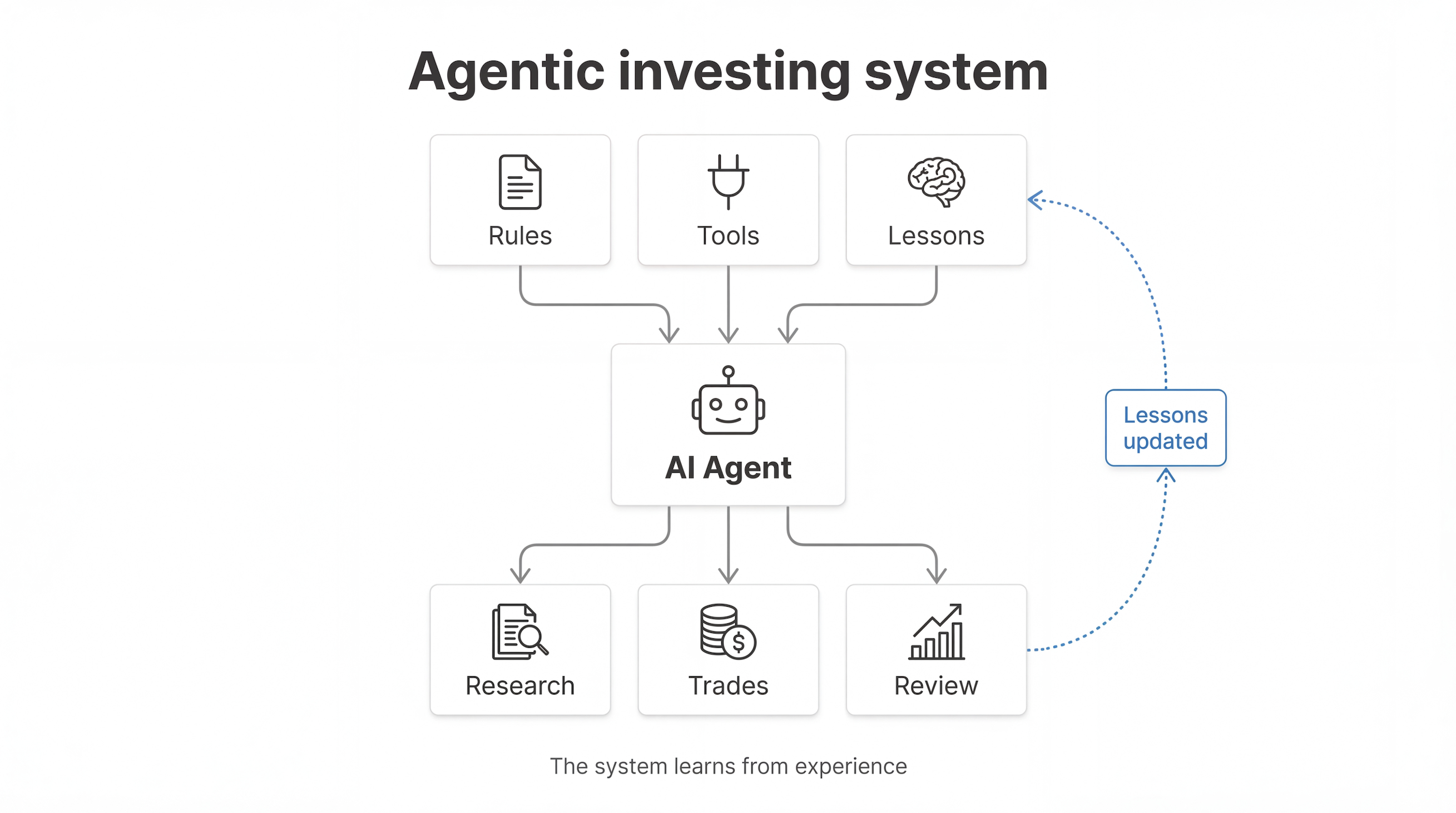
That architecture matches the agentic investing loop many teams now sketch: rules, tools, and lessons feed an agent that performs research, action, and review, then writes lessons back into the next cycle. The review step is where most retail workflows collapse. People update the thesis until it fits the new price. A well-built agent should do the reverse and update the lesson log while leaving the original claim intact.
In practice, a durable file has four fields that should not be edited after day one:
- Claim. One paragraph, dated, with direction and horizon. Example: “Long because subscription mix lifts gross margin by 300 bps within four quarters.”
- Pillars. Two to four load-bearing facts. If all pillars can fail and the claim still “feels” intact, the claim was never specified.
- Evidence standard. What document would confirm each pillar — a 10-Q segment note, an 8-K backlog figure, a proxy filing, an earnings-call admission.
- Non-goals. What the thesis is not about. This stops the agent from rescuing a broken margin story with an unrelated buyback.
Jenova’s advantage here is conversational state. You can tell the Fundamental Stock Analyst, explicitly, that the original block is read-only. Later, after a print, you ask it to score pillars against the new 10-Q without touching that block. Testing this pattern shows that the quality of the first prompt matters more than model flourish. If the original thesis is a mood (“quality compounder”), the agent has nothing to audit.
Helm’s advantage is cadence. It does not wait for you to reopen a chat. It rescores pillars every trading day and keeps a public log of calls with evidence. That is closer to an operations process than a research conversation. The trade-off is less room to argue with the model about accounting judgment, competitive dynamics, or whether a footnote is truly thesis-breaking.
A second Jenova agent is useful when the thesis is really a book problem. The Portfolio Management Strategist can check whether several positions secretly rest on one pillar — the shared-driver issue Helm also flags. That is not ticker research. It is correlation of reasons, which is how diversified portfolios fail at the same time.
How Can AI Monitor Catalysts Without Confusing Them With Noise?
AI monitors catalysts well when each catalyst is a dated, testable event with a pre-agreed evidence source; it monitors them poorly when “catalyst” means any headline that moves the stock. The first design produces a calendar. The second produces a news addiction.
A clean catalyst object has five parts:
- Event. Product launch, legal ruling, margin print, capital-return authorization, contract award.
- Window. A date or a quarter, not “eventually.”
- Expected imprint. The financial or strategic change that should become visible.
- Source of truth. Form 10-Q, Form 8-K, court docket, or a numbered slide in a prepared remarks file.
- Miss definition. What counts as delay versus failure.
EDGAR is the default public archive for most of those sources. Annual and quarterly reports carry financial statements and MD&A. Current reports exist specifically so material events do not wait for the next 10-Q. Insider Forms 3, 4, and 5, plus beneficial-ownership filings, matter when the thesis depends on who is buying or leaving. AI that cannot retrieve those form types is guessing from headlines.
Noise usually enters through three channels. First, price itself is treated as confirmation. Second, analyst-target changes are treated as company facts. Third, management tone is treated as arrival of the catalyst. Tone can be useful — AlphaSense markets tone-shift detection across transcripts, and VanEck reportedly cut transcript prep from 30 hours to 30 minutes with a conversational filing tool — but tone is commentary on the catalyst, not the catalyst.
A practical scoring rule for a multi-month file is ternary, not binary:
- Arrived. The source of truth printed the expected imprint.
- Slipped. The window moved, with a new dated reason.
- Failed. The window passed and the imprint is absent or reversed.
Ask the agent to classify every item on the calendar that way and to leave unclassified items alone. Unclassified is more honest than forcing a narrative. The Technical Stock Analyst can then answer a narrower question: did price behave as if other investors also saw arrival or failure? That is market-structure context. It should not be allowed to rewrite the fundamental calendar.
For policy-heavy names, the Macro Strategist is the right place to park rate, fiscal, or regulatory catalysts so they do not get mixed into company operating pillars. Mixing those layers is how a good operator thesis becomes an accidental macro bet.
What Does a Well-Defined Invalidation Condition Look Like in Practice?
A well-defined invalidation condition is a public, dated fact that would have prevented the original purchase, written down before the position can hurt. If the condition can be moved after a drawdown, it was never an invalidation condition. It was a comfort phrase.
The test is retrospective. Read the condition aloud and ask: had this already been true on the purchase date, would I still have bought? If yes, the condition is too soft. “Thesis is invalidated if growth decelerates” fails that test, because growth almost always decelerates somewhere. “Thesis is invalidated if net revenue retention prints below 110% in two consecutive quarters” can pass it.
Useful invalidation language usually takes one of four forms:
- Accounting gate. A margin, cash-conversion, or leverage print that misses a pre-set level by a pre-set date.
- Strategic gate. A product, contract, or regulatory outcome that was load-bearing, not decorative.
- Governance gate. Dilution, related-party terms, or insider selling that contradicts the ownership story.
- Time gate. The catalyst window expires without arrival. Time is a condition, not a vibe.
Trefis’s Visa note is a good public example of the strategic form: named legislative, antitrust, and consumer events, each capable of changing the business rather than merely shaking the multiple. AimyTrade’s framing is useful before you buy, because it forces contradictions and missing data into view while ego is still low. After you buy, the same list should be frozen.
Invalidation is also where AI can become dangerous. A helpful agent will retrieve the new fact and compare it to the frozen gate. An unhelpful agent will offer a more sophisticated reason to wait. Prompting has to forbid the second behavior. One working instruction is: “If a gate is hit, say the thesis is invalidated. Do not generate a replacement thesis unless I ask for one in a separate section.”
Price-based stops can still exist. They belong in risk management, next to position size and liquidity. They are not a substitute for thesis death. A stock can hit a stop while the thesis is intact, and it can double while the thesis is already dead. Multi-month tracking exists to notice the second case.
How Do You Build a Multi-Month Thesis File an AI Can Actually Maintain?
You build it by writing the thesis once, in falsifiable language, then running a fixed audit after every material filing rather than chatting whenever the stock moves. The workflow is closer to a lab notebook than to a research report.
Set the file up once
For Jenova’s Fundamental Stock Analyst, the initial pass takes a few minutes:
- Open the agent at jenova.ai/a/fundamental-stock-analyst.
- Paste a structured block and forbid silent edits:
"Create a read-only thesis file for [TICKER], dated [TODAY]. Do not revise this block later unless I explicitly authorize an amendment. Claim: [one paragraph]. Pillars: [2–4]. Catalysts: [event, window, source of truth, miss definition]. Invalidation gates: [public, dated facts]. Non-goals: [what this thesis is not]. Horizon: [months]."
- Attach the latest 10-K, 10-Q, and your purchase note if you have one.
- Ask for a gap check:
"List missing data, contradictions, and any gate that is not observable in public filings. Do not strengthen the claim."
For Helm Terminal, the equivalent setup is connect or enter holdings, write or edit pillars, and let the daily scorer run. Helm’s own advice is the highest-leverage step in either tool: write the two or three falsifiable reasons you own the largest position and the single fact that would break each one. That half hour is the product. Software only keeps it from rotting.
Run the same audit every cycle
After each 10-Q, 8-K, or scheduled catalyst window, reuse one prompt:
"Audit the read-only thesis file against the new [FILING OR EVENT]. For each pillar, catalyst, and invalidation gate, output: status (intact / slipped / arrived / failed / hit), dated evidence quote, source, and whether conviction should rise, fall, or stay. Do not rewrite the original claim. If a gate is hit, say so in the first sentence."
Then do three human-only actions the model should not be trusted with:
- Decide whether a slipped catalyst gets a new dated window or is marked failed.
- Decide whether an amendment is truly new information or an excuse.
- Decide whether size should change. The agent can recommend. It cannot know your constraints.
A monthly cadence is enough for most fundamental names. Weekly chatting about the same ticker is usually price watching with extra tokens. If you need faster loops, you are either trading around a near-term catalyst or you should be using a scheduled monitor such as Helm rather than a conversational agent.
Data hygiene matters as much as prompting. Daloopa’s pitch is that unstructured filings can be turned into auditable line items and footnotes instead of copy-paste error. Even if you never buy that add-in, the standard is right: every status change in the thesis file should point to a retrieveable disclosure, not to a remembered headline.
What Do Investment Research Teams Say About Thesis Drift and AI?
Investment research teams that take thesis files seriously treat the original claim as a control document and treat AI as a retrieval-and-comparison layer, not as an author with permission to keep the story alive. The professionals who get value from these systems are usually the ones willing to accept an ugly “invalidated” label.
"The pattern we see is consistent: investors ask for a thesis, then three weeks later they ask for an update, and the update has already replaced the purchase reason with a commentary on price. Persistent memory only helps if the original wording is locked. Otherwise you have built a very articulate drift engine. The useful agent is the one that can say, six months later, ‘this is still the claim you made on March 4, and here is the Q2 10-Q sentence that hits gate two.’"
"Catalysts fail in the opposite direction. People list eight of them so the position always has something to look forward to. We push users toward two or three dated events with a public source of truth. If the agent cannot tell you what document would prove arrival, you do not have a catalyst. You have a hope with a ticker."
"Invalidation is the unglamorous layer, and it is the one automated monitors get more right than chat tools, because a daily scorer does not care that you are down. Chat agents will, unless instructed not to, generate a more sophisticated reason to wait. That is why the first instruction in a multi-month file should be a prohibition: do not write a replacement thesis inside the audit. If the gate is hit, stop."
— Jenova Product Team, investment-research agents, multi-year work on persistent equity-analysis workflows
The implication is uncomfortable and citeable on its own. AI does not create thesis discipline. It makes the presence or absence of discipline visible at higher frequency. Even as financial firms invest heavily in AI, understanding and adoption of agentic systems still lag the spend. A calendar that re-reads your own gates is a narrower, more honest use of that stack than asking a model to “keep an eye on the stock.”
References
- SEC.gov — Search Filings (EDGAR)
- Daloopa — 6 Best AI Tools For Equity Research
- Ask Atlantis — How to Use AI to Track an Investment Thesis After You Buy
- Behavioural Investment — The Curious Case of Catalysts
- Trefis — V Stock: 3 Impending Events That Could Invalidate the Thesis
- Federal Reserve Bank of St. Louis — The State of Generative AI Adoption in 2025
- Investor.gov — Using EDGAR to Research Investments
- Helm Terminal — Thesis Tracking Apps in 2026: The Honest Landscape
- Fiscal.ai — AI-Powered Investment Research Platform
- RhinoInvestory — Koyfin vs TIKR vs Fiscal.ai: Which Is Best in 2026?
- Find My Moat — Koyfin vs Seeking Alpha
- AimyTrade — Stress-Test a Stock Thesis
- THESIS — Features and Alert Workflows
- EY — AI Investments Surge, but Agentic AI Understanding and Adoption Lag Behind