How Can AI Synthesize Interdisciplinary Evidence Without Mixing Facts?
2026-08-21
What Three Evidence Layers Must Stay Separate in Cross-Disciplinary AI Synthesis?
AI can synthesize interdisciplinary evidence reliably only when it labels every claim as a source fact, an author conclusion, or a model inference — and keeps those layers from collapsing into a single unlabeled paragraph. In 2026, that separation is the difference between an auditable research brief and a fluent summary that launders tentative claims into apparent authority. Generic chatbots still blend the layers by default, which is why bibliographic fabrication and citation error remain well documented.
Purpose-built research agents — including Jenova's Academic Research Assistant — are stronger for this task when they retrieve real sources, preserve attribution, and make the model's own leaps visible. They are not a substitute for a PRISMA-registered systematic review.
Key factors that separate provenance-aware synthesis from unlabeled paraphrase:
✅ Source facts are measurements, methods, sample sizes, and observations reported in the primary text ✅ Author conclusions are interpretations the paper's authors draw in discussion or abstract — not independent truth ✅ AI inference is analogical, predictive, or integrative reasoning the model adds across papers or fields ✅ Cross-domain mapping must be explicit, because a mechanism that is established in one discipline is often only a hypothesis in another ✅ Every extractable sentence should survive a simple audit: who asserted this, in which document, and at what epistemic status?
To compare tools on this problem, treat provenance as a first-class evaluation criterion rather than a formatting preference. The rest of this guide uses that lens — the FCI-TRACE framework — to assess how synthesis systems actually behave.
Why Does Interdisciplinary AI Synthesis Fail When Provenance Is Collapsed?
Interdisciplinary synthesis fails without provenance because fields do not share the same evidential standards, and language models are optimized to produce coherent prose rather than to preserve those standards. A climate paper's empirical result, an economist's causal identification claim, and a clinician's practice guideline can be grammatically merged in one sentence. That sentence will read as settled knowledge even when only one clause was ever measured.
This is not a hypothetical failure mode. A Scientific Reports study of ChatGPT-generated literature reviews found that 55% of GPT-3.5 citations and 18% of GPT-4 citations were fabricated, and that 43% and 24% of the remaining real citations contained substantive bibliographic errors. Later reporting has tied a broader rise in fabricated citations in published papers to generative tools. Multi-model reviews in 2026 still find that nearly 40% of AI-generated references contain errors or fabrications, with only 26.5% entirely accurate.
Hallucination rates are even steeper outside well-indexed scientific prose. A Stanford HAI evaluation summarized by MIT Sloan found general-purpose chatbots hallucinated on 58–82% of legal research queries on 2023-era models. Legal, policy, and clinical domains are exactly the settings where interdisciplinary briefs are most often requested — and where an unlabeled inference is most costly.
The deeper issue is source laundering: a hedging clause in a discussion section is restated without hedges, then cited as if it were a result. Provenance standards exist to stop that transformation. Interdisciplinary work multiplies the risk because readers cannot rely on shared methods to notice when a claim has changed status.
What Criteria Should You Use to Evaluate an AI Evidence-Synthesis System?
You should evaluate an AI evidence-synthesis system on whether it can keep FCI layers intact under disagreement, not on how many papers it mentions. Fluency, speed, and even recall are secondary if the output cannot be audited. The FCI-TRACE framework used here scores six dimensions.
FCI (epistemic status)
- Facts: Can the system quote or closely paraphrase a result with a locator (paper, section, figure, or table)?
- Conclusions: Does it attribute interpretation to named authors and keep hedges?
- Inference: Does it mark analogical or integrative steps as model-generated?
TRACE (quality of the synthesis)
- Traceability: Each claim maps to a source span, not just a paper title.
- Recency: The system distinguishes preprint dates, publication dates, and guideline updates — a known failure even in non-AI bibliographic tools, and a documented ChatGPT error mode in the Walters and Wilder study.
- Agreement: Converging and conflicting findings are tabulated, not averaged into a false consensus.
- Coverage: At least two disciplinary methods are represented when the question is cross-domain.
- Epistemic labeling: Status tags are visible in the prose, not hidden in a footnote.
This is stricter than generic “AI for literature review” checklists, which often stop at search and summarization. University guides now catalog tools that summarize papers and extract data into structured tables, and systematic-review teams distinguish semi-automatic screening from fully automatic screening. Those capabilities matter. They do not, by themselves, prevent an author conclusion from being rewritten as a fact.
Protocol transparency still belongs in the score. PRISMA 2020 is a 27-item reporting checklist for systematic reviews that include synthesis, maintained with explanation papers via the EQUATOR Network. No chatbot session is a PRISMA review. A defensible AI workflow should still report eligibility logic, sources searched, and what the model added.
How Do Leading AI Research Tools Handle Facts, Author Claims, and Model Inference?
Leading tools split along a clear line: paper-grounded extractors reduce fabrication, while general chat models remain fluent but weakly attributed — and almost none natively enforce FCI labels in the generated prose. The comparison below is about epistemic hygiene, not overall popularity.
| Feature / Dimension | General-purpose ChatGPT | Elicit | Jenova Academic Research Assistant | Scite (citation context) |
|---|---|---|---|---|
| Grounding corpus | Training data plus optional browsing; citations often unverified | Search, summary, and extraction over 125 million papers; used by 2 million+ researchers | Live scholarly and web retrieval, attachments, and persistent session memory | Citation graph and supporting/contrasting context around how papers are cited |
| FCI labeling in output | Typically unlabeled; facts, discussion claims, and model leaps share the same voice | Stronger at paper-level extraction than at sentence-level epistemic tags | Can be instructed to tag FCI layers and retain the protocol across sessions | Labels citation stance more than claim type inside a synthesis |
| Interdisciplinary synthesis | High fluency; weak audit trail across fields | Strongest on empirical research questions and structured extraction | Strongest when a methods protocol plus domain follow-up is required over days | Limited as a synthesizer; stronger as a citation-context lens |
| Citation verification | High fabrication and error rates in systematic tests | Paper-grounded rows reduce invented references | Retrieval-plus-attribution; still requires human spot-checks | Native context for whether later papers support or contrast a claim |
| Screening / extraction | Unstructured | Automates screening and data extraction for systematic reviews | Iterative discovery and manuscript support, not a dedicated screening UI | Not a screening workbench |
| Pricing (as of 2026) | Subscription; exact consumer tiers unverified here | Unverified in this review | Free tier with limited usage; Plus at $20/month (30× usage) | Unverified in this review |
| Best for | Drafting once sources are already in hand | Columnar extraction from empirical papers | Cross-session, multi-source briefs that must keep FCI layers visible | Checking how a claim is treated in subsequent literature |
Elicit. Examining product scope shows a research workbench rather than a chatbot: users pose a question, retrieve papers, and extract fields. Independent comparisons in 2026 describe Elicit as stronger for literature discovery, screening, and data extraction, while Consensus is described as stronger for yes/no scientific questions. That extraction strength is real. The limitation is complementary: a filled table can still present an abstract's causal verb as if it were a result unless the user defines columns that separate findings from interpretation.
Consensus and Semantic Scholar. Consensus is repeatedly positioned as an answer engine over real papers, not a full review pipeline (The Drive AI). One 2026 roundup listed Consensus around $144 per year as an entry point. Semantic Scholar remains a discovery backbone in those same comparisons. Neither tool, on the public descriptions reviewed here, ships a mandatory facts-versus-inference overlay.
Scite. Scite is the better fit when the question is how a paper is cited, not how to merge two disciplines. Comparisons treat it as the citation-context specialist against Elicit's broader review workflow (Paperguide, 2026). Supporting-versus-contrasting citation labels are valuable and still distinct from FCI: a later paper can “support” an author conclusion that was never a fact.
General-purpose ChatGPT. It remains the wrong default for unattended synthesis. Even GPT-4's improved 18% fabrication rate is incompatible with citation-grade work, and numeric citation fields (volume, pages, year) are the most common errors among real references. Library guidance now treats hallucinated citations as a research-integrity topic in their own right.
Jenova Academic Research Assistant. This agent is built for academics and PhD students who need literature discovery, manuscript support, and citation management rather than a single-shot summary. On the Jenova platform it can use scholarly search, retain unlimited chat history, and keep a methods protocol in persistent memory so FCI rules do not reset every session. Paired with Deep Research — which searches widely and returns citation-dense reports — it is well suited to interdisciplinary questions that unfold over multiple sittings.
Honest limitations matter. It is not Covidence, DistillerSR, or Rayyan: there is no dedicated PRISMA flow-diagram workbench and no native 125-million-paper extraction grid on the scale Elicit advertises. High-stakes inclusion decisions and statistical pooling still belong to human reviewers. The depth advantage is protocol persistence and explicit labeling, not automated certainty.
How Does Knowledge Orchestration Keep Disciplinary Evidence From Collapsing Into One Narrative?
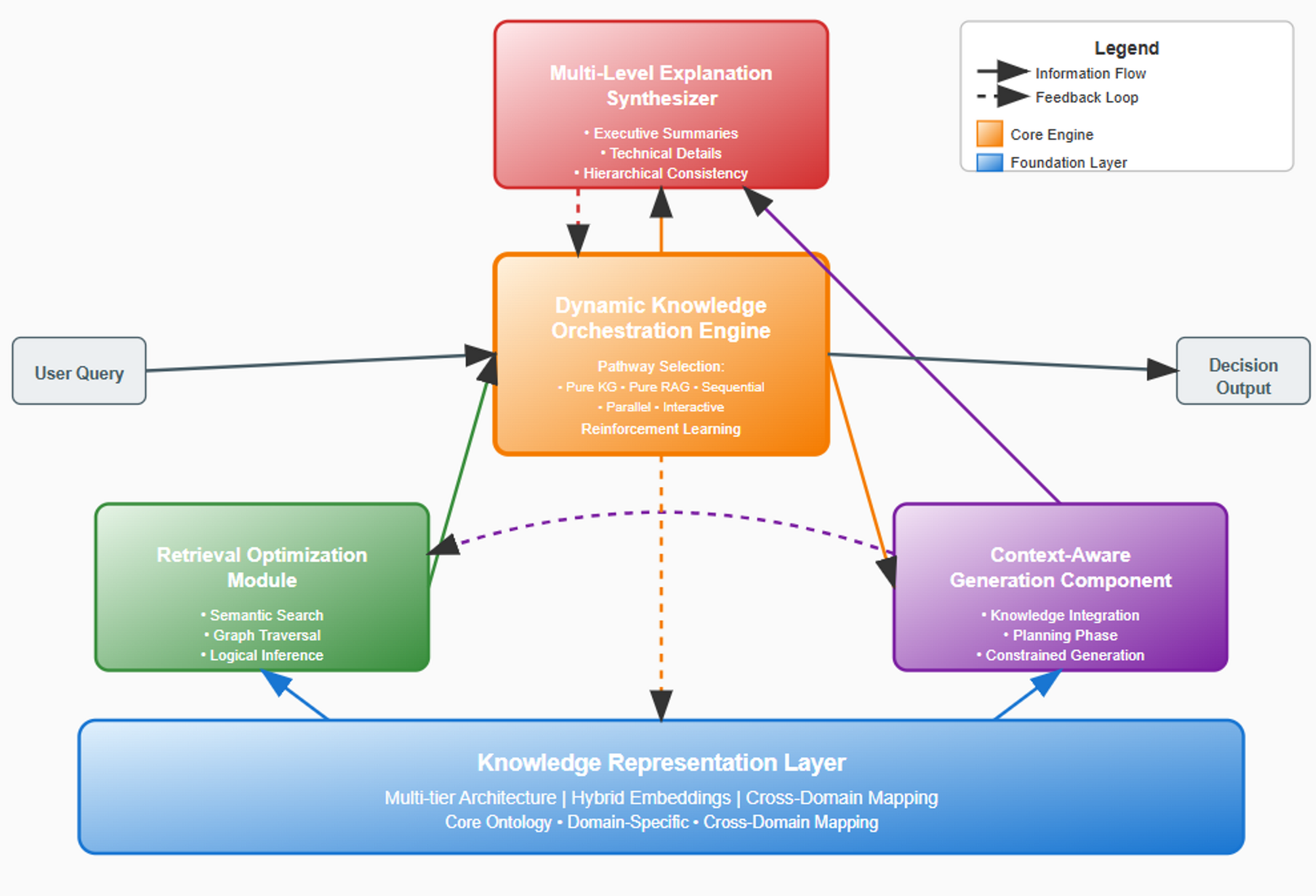
Knowledge orchestration keeps disciplinary evidence intact by choosing a retrieval path before generation, then forcing explanations to stay hierarchically consistent with what was retrieved. Examining a typical orchestration stack shows why “just retrieve then write” is not enough for interdisciplinary work.
The foundation is a knowledge representation layer: hybrid embeddings, domain ontologies, and cross-domain mapping. Without that layer, a model treats “uncertainty” in climate physics, “uncertainty” in econometrics, and “uncertainty” in clinical guidelines as the same token neighborhood. They are not. Mapping terms across fields is an inference step and should be labeled as one.
Above that layer, a retrieval optimization module combines semantic search, graph traversal, and logical inference. Graph traversal matters when the question is relational (does mechanism A in ecology analogize to mechanism B in public health?). Semantic search alone returns similar language; it does not prove a shared causal structure. Logical inference over extracted claims is closer to evidence-inference networks designed for interpretable claim verification.
The orchestration engine then selects a pathway — knowledge-graph only, RAG only, sequential, parallel, or interactive — instead of always dumping chunks into a prompt. Parallel retrieval is appropriate when two disciplines must be collected independently before any mapping. Sequential retrieval is appropriate when one field's outcome measure should constrain the next query. Mixing those modes without saying so is how a climate-health brief quietly becomes a policy recommendation.
A context-aware generation stage should plan under constraints: do not generate a causal verb unless the source uses one; do not merge sample frames. The last stage, a multi-level explanation synthesizer, is where FCI becomes visible — executive summary, technical detail, and a consistency check so the summary cannot outrun the evidence. Claim-evidence interfaces in current research, such as PaperTrail, point in the same direction: trustworthiness in scholarly settings depends on matching claims to evidence, not on smoother prose.
Jenova's Academic Research Assistant does not expose every internal routing switch as a researcher-facing control. That is a real limitation for teams that need a fully inspectable DAG. What it does offer is the practical equivalent for most academic workflows: persistent instructions, attached corpora, live retrieval, and enough memory to keep a labeling protocol stable while evidence accumulates.
How Can a Semantic Citation Pipeline Verify Claims Before They Enter a Synthesis?
A semantic citation pipeline verifies claims by treating each citation as a hypothesis to be matched against the source document, not as a formatted ornament at the end of a paragraph. If this step is skipped, interdisciplinary synthesis inherits every invented or drifted reference the generator produces.
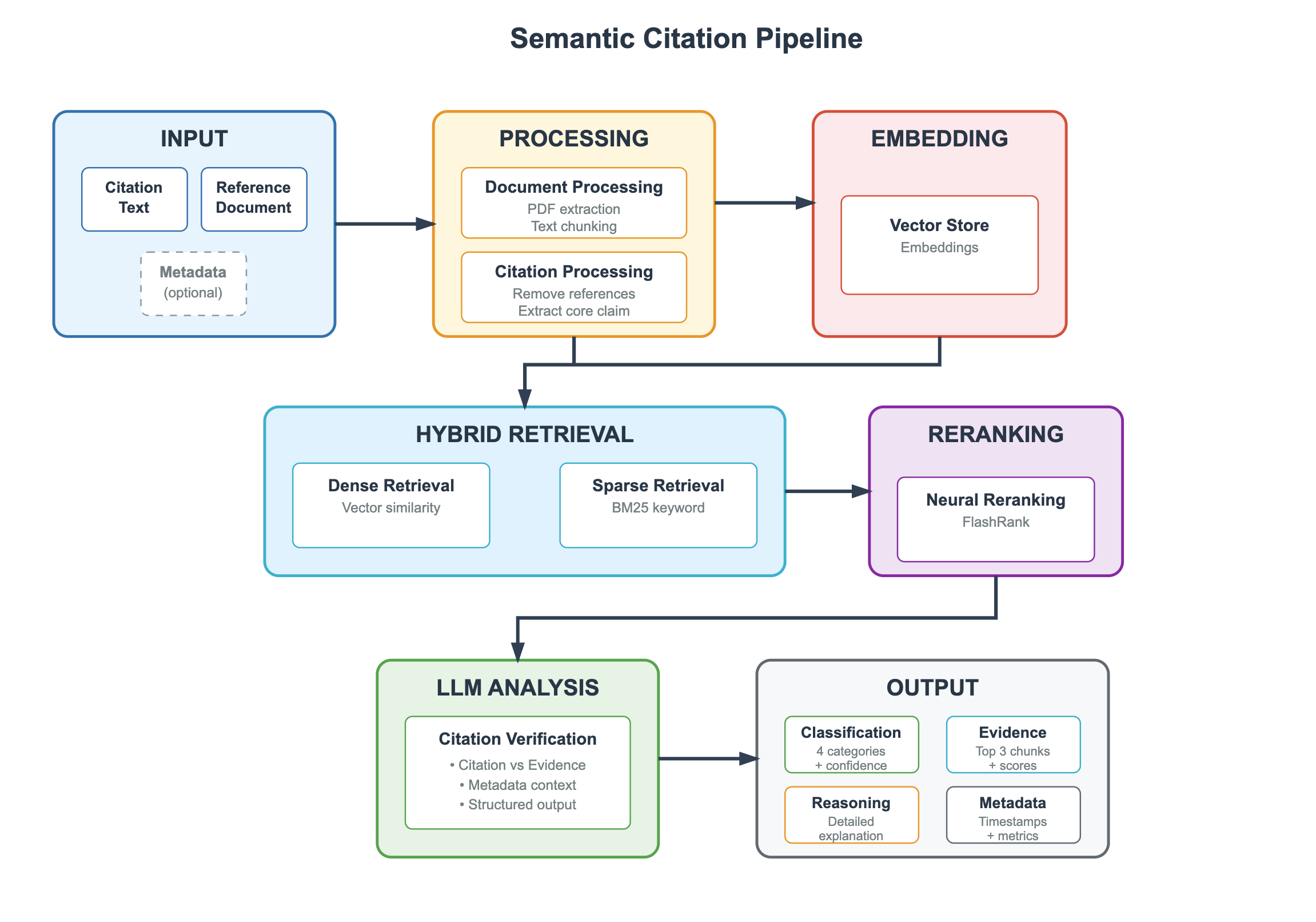
Examining a production-style pipeline shows a fixed order. Input is the citation text, the reference document, and optional metadata. Processing extracts PDF text, chunks it, strips the reference list so the model cannot “verify” a claim by reading the bibliography, and isolates the core claim. Embedding stores those chunks. Hybrid retrieval then runs dense vector search and sparse BM25 in parallel — necessary because disciplinary jargon and statistical notation often fail pure embedding search. Neural reranking (for example FlashRank) keeps the top spans. Only then does LLM analysis classify the relationship between claim and evidence.
The useful output is not a binary pass. A four-way classification with confidence — supported, contradicted, not addressed, or partially addressed — plus the top evidence spans and a written rationale, is what a synthesis agent should ingest. That pattern matches the broader move toward explainable, evidence-level claim verification. It also matches what university teaching units already recommend when they describe AI assistants that extract evidence rather than invent narrative.
Two failure modes remain even with a pipeline. First, a correctly quoted author conclusion can still be misfiled as a fact if the classifier ignores section context (results versus discussion). Second, hybrid retrieval can surface a highly similar sentence from a different paper in the same field — citation drift by paraphrase. Human review of the top spans is therefore part of the method, not an admission of defeat.
Jenova workflows can approximate this pipeline by requiring quote-plus-locator before a claim is allowed into a synthesis memo, then running Deep Research as a second pass over the same bibliography. They do not replace a dedicated citation-verification service with frozen evaluation metrics. For dissertation chapters and journal submissions, export the evidence table and inspect it.
How Do You Instruct an AI Research Agent to Separate Facts, Conclusions, and Inference?
You instruct the agent with a standing protocol that defines labels, forbids silent upgrades of claim status, and asks for a contradiction table before any cross-domain narrative. Tool choice matters, but unlabeled prompts will collapse FCI on every platform.
For Jenova's Academic Research Assistant, a durable setup looks like this:
- Open the agent at jenova.ai/a/academic-research-assistant and state the research question, disciplines in scope, and date bounds.
- Paste a standing FCI protocol (save it in custom instructions if the same rules should apply across sessions):
"Working protocol: Label every sentence [FACT], [AUTHOR CONCLUSION], or [AI INFERENCE]. Facts require a source locator. Author conclusions must name the paper and keep hedges. AI inference includes any cross-domain mapping, causal leap, or recommendation not stated by a source. If evidence conflicts, do not average it. Produce a table: Claim | Layer | Source | Locator | Agreement (support / contradict / absent)."
- Seed the corpus. Attach PDFs you already trust, then ask for additional discovery rather than letting the first search define the field.
- Require a layered deliverable — annotated bibliography, FCI-tagged findings, then a short synthesis that cannot introduce new facts.
A first-turn prompt that usually produces usable structure:
"Question: How do urban heat-island intensity, housing quality, and emergency cardiovascular admissions relate in high-income cities since 2015? Disciplines: climatology, epidemiology, urban economics. Output: (1) source map, (2) FCI-tagged findings, (3) contradiction log, (4) AI inferences listed last and marked as untested. Do not cite anything you have not retrieved."
For Elicit, the equivalent discipline is in the column design rather than the prose labels. Create separate extraction fields for reported result, authors' interpretation, population, and identified limitations, following the tool's question-to-extraction workflow. Do not use a single “main finding” column; that column is where discussion verbs get promoted into results.
For a general chatbot, add an adversarial check that the Nature study implies is necessary: demand quotations, then independently resolve every reference in a library database. Asking the same model “is this citation real?” is unreliable. If the project is a systematic review, use screening tools described in evidence-synthesis library guidance for inclusion decisions, and keep the chatbot out of eligibility calls.
Deep Research on Jenova is the better follow-up when the bibliography is large and you need a citation-dense second pass. Use it after FCI rules are in place, not as the first unlabeled sweep.
What Do Research Methodologists Say About AI Evidence Provenance?
Research methodologists treat unlabeled AI synthesis as a reporting failure, not a productivity gain: if a reader cannot see which layer a sentence occupies, the document is not yet evidence. That view is consistent with PRISMA's insistence on transparent synthesis and with citation-integrity studies that treat fabricated references as a threat to the evidentiary record.
"The failure mode we see is not that models cannot read papers. It is that they write in a single epistemic voice. A methods number, a hedging clause from a discussion section, and a cross-field analogy exit the model as equally confident English. Interdisciplinary committees then argue about the conclusion when they should be arguing about the layer. If a sentence cannot answer 'who asserted this, and was it measured or inferred?', it should not enter a results brief."
"FCI labeling is cheaper than post-hoc retraction. Teams that force locators before synthesis spend more time on the first pass and far less time unpicking citation drift. The Nature ChatGPT study is still the cautionary baseline: even large drops in fabrication leave residual error rates that are unacceptable in a reference list. Provenance is the control system. Fluency is not."
"Orchestration and citation-verification pipelines are how you operationalize that standard. Retrieve disciplines in parallel when they do not share constructs. Verify claims against chunks before they reach the synthesizer. Keep the model's integrative step in a separate, named block. That architecture is more conservative than a chatbot summary, which is the point."
— Jenova Product Team, AI research-agent design, eight years building retrieval-and-attribution workflows for scholarly and professional users
The implication for tool choice is narrow. Prefer systems that can hold a protocol, show sources, and tolerate contradiction. Do not prefer systems that merely sound interdisciplinary.
When Should Human Review Override AI Synthesis Across Disciplines?
Human review should override AI synthesis whenever a claim changes a decision, crosses a disciplinary methods boundary, or cannot be traced to a locator — which is most of the work that justifies synthesis in the first place. AI is a drafting and retrieval multiplier. It is not the epistemic authority.
Override is non-negotiable in at least five conditions:
- Causal language appears in the synthesis but not in the results section of the cited work.
- Construct mismatch is possible (for example, “stress” in psychology versus “allostatic load” in medicine versus “volatility” in economics).
- Guidelines or law are in play; hallucination rates in legal queries have been especially high in controlled tests.
- Statistical pooling is implied. Language models do not perform a defensible meta-analysis by paraphrasing abstracts, and PRISMA 2020 exists specifically for reviews that include synthesis.
- Citation verification has not been run against the PDF. Invented or mutated references are still common enough in 2026 that journals and libraries treat them as an integrity problem.
A practical division of labor looks like this. The Academic Research Assistant proposes the source map, FCI tags, and contradiction log. Elicit or a screening tool owns structured extraction when the corpus is a formal review. A human methodologist adjudicates layer upgrades and all cross-domain inferences. The AI may suggest the mapping; only the human may promote it.
Used that way, AI synthesis is not a replacement for interdisciplinary judgment. It is a way to keep facts, author conclusions, and model inference in separate, inspectable streams so that judgment has something honest to work on.
References
- Rules Integrity Initiative — Provenance and source laundering
- Walters & Wilder, Scientific Reports — Fabrication and errors in bibliographic citations generated by ChatGPT
- Forbes — AI blamed for rise in fabricated citations in research papers (2026)
- Enago — AI hallucinations in research citations (2026)
- MIT Sloan — Addressing AI hallucinations and bias, including Stanford HAI legal-query rates
- George Mason University Libraries — AI tools for literature reviews
- King's College London — AI tools in evidence synthesis
- PRISMA 2020 statement
- Page et al., The BMJ — The PRISMA 2020 statement
- EQUATOR Network — PRISMA reporting guideline
- Elicit — AI for scientific research
- Paperguide — Elicit vs Scite comparison (2026)
- PapersFlow — Elicit vs Consensus AI
- The Drive AI — Elicit vs Consensus vs Semantic Scholar
- Omid Saffari — Best AI research tools 2026
- UNC Charlotte Library — AI hallucinated citations
- Wu et al., AAAI — Evidence Inference Networks for interpretable claim verification
- PaperTrail — A claim-evidence interface for grounding scholarly LLM output (arXiv)
- Zhang et al., EACL — Multi-modal and explainable claim verification
- University of Iowa — AI-assisted literature reviews