How Can AI Locate Evidence and Draft Reviewer Responses?
2026-08-22
What Separates Evidence-Grounded Response Tools From Generic AI Drafting?
The tools that help authors answer reviewers well in 2026 are not the ones that write the smoothest prose. They are the ones that map each reviewer comment to citable evidence, check whether that evidence actually supports the claim, and then draft a reply whose wording is no stronger than the record. Jenova's Academic Research Assistant is built for that evidence-first loop — literature discovery, citation management, and manuscript-grounded drafting — while Scite, Elicit, SciSpace, and Consensus each cover part of the same job with different strengths.
What separates a usable AI rebuttal workflow from a fluent but risky one:
✅ Comment-level retrieval, not a single literature dump for the whole letter ✅ Citation checks that open the source sentence, not just the bibliography string ✅ A support label for every claim — fully aligned, partial, contradicted, or indeterminate ✅ Hedged drafting that matches the label instead of upgrading “suggests” into “demonstrates” ✅ A human pass that can reject, narrow, or delete an AI-proposed sentence
A 2026 Nature report on a Frontiers survey of about 1,600 academics in 111 countries found that more than half of researchers have already used AI while peer reviewing. The same pressure now sits on authors writing response letters. To compare tools usefully, it helps to treat evidence location, citation verification, and claim calibration as three separate jobs rather than one writing task.
Why Do Reviewer Response Letters Fail When Citations Are Unverified?
Most failed or delayed revisions do not collapse because the author was rude. They collapse because a citation does not say what the letter claims, a promised analysis is not in the manuscript, or the reply overstates a finding the paper only weakly supports. Editors and reviewers can check those mismatches in minutes.
General-purpose models make this failure mode easier, not harder. University guidance is blunt: AI systems frequently invent citations that look real but do not exist, and submitting a fabricated reference is treated as academic fraud. Stellenbosch University’s responsible-use guidance adds that many tools cannot verify references against live databases in real time. A response letter is a high-risk place to learn that lesson, because every new citation is an implicit promise that the source exists and supports the exact sentence you just wrote.
There is a second, quieter failure: true papers, wrong use. A method paper cited as outcome evidence, a review cited as a primary trial, or a result from a different population presented as direct confirmation all survive a DOI check and still mislead. Scite’s Smart Citations exist specifically to show whether later work supports, challenges, or only mentions a claim, which is a different problem from checking whether the reference is formatted correctly.
Rule-based reference checkers are genuinely strong at the mechanical layer. PoolText notes that AI reference checkers are highly accurate on style errors, missing fields, punctuation, and DOI formatting. That is necessary and not sufficient. A perfectly formatted unsupported claim is still an overstatement.
What Should You Look for in an AI Reviewer-Response Workflow?
You should evaluate tools on six dimensions: comment segmentation, evidence retrieval, source-sentence verification, claim-support classification, calibrated drafting, and revision memory. A tool that scores well on only one of those dimensions will still produce a letter that looks finished and is not.
The Comment-to-Evidence Alignment Framework used in this article weights the six dimensions as follows:
- Comment segmentation (15%) — Can the system isolate each reviewer request, including compound comments that hide two demands in one paragraph?
- Evidence retrieval (20%) — Does it search the manuscript, the author’s data, and the external literature separately, then say which pool the support came from?
- Source-sentence verification (20%) — Can a human open the exact sentence that supposedly backs the reply?
- Claim-support classification (20%) — Is every proposed citation labeled supported, partially supported, unsupported, or uncertain?
- Calibrated drafting (15%) — Does the prose inherit the label, or does it default to confident academic English?
- Revision memory (10%) — Can the system remember earlier rounds, promised analyses, and rejected phrasings?
This weighting is deliberate. Drafting is the cheapest part of the job. Retrieval and classification are where letters either become citable or become a second review problem. Research comparing AI-generated and human peer reviews has not shown conclusive added value of AI over human reviewers, which is a useful caution for authors as well: fluency is not a validity signal.
Practical tests that expose weak tools quickly:
- Give the model a reviewer comment that your paper cannot fully answer and see whether it invents a result.
- Ask it to quote the supporting sentence from each cited paper, not just the citation key.
- Force a four-way support label before any reply sentence is drafted.
- Re-run the same comment a week later and check whether the letter contradicts an earlier concession.
If a product cannot fail those tests in a visible way, it is not helping you. It is hiding the uncertainty you are supposed to manage.
How Do Leading AI Research Tools Compare on Evidence Retrieval and Citation Checks?
No single product currently dominates all three jobs — finding evidence for each comment, verifying the citation, and drafting a reply that does not overclaim. The useful comparison is which job each tool is actually built to do.
| Feature / Dimension | Elicit | Jenova Academic Research Assistant | Scite | SciSpace Response-to-Reviewers |
|---|---|---|---|---|
| Evidence retrieval | AI search and data extraction across 125+ million papers | Real-time literature discovery plus manuscript-attached knowledge bases | Licensed scholarly full text and citation context across a large publisher-backed corpus | Paper-grounded agent workflow aimed at reviewer comments |
| Citation verification | Strong at structured extraction; 1,502 of 1,511 data points correct (99.4%) in Elicit’s reported test | Retrieves candidate sources and citation details; human confirmation of the source sentence still required | Every AI claim links to the specific sentence in the specific paper | Useful for assembling a reply package; verification depth depends on the underlying sources |
| Response-letter drafting | Indirect — better for tables and literature answers than a full letter | Strong at point-by-point drafts once comments and the manuscript are in session | Indirect — built to test whether findings hold up, not to write the letter | Purpose-built response-to-reviewers drafting workflow |
| Claim-support signals | Extraction accuracy, not a four-label support scheme | User-imposed classification inside the drafting loop | Supporting, contrasting, and mentioning citation context | Reviewer-aligned structure more than formal support taxonomy |
| Pricing (as of 2026) | Unverified in this review | Free tier with limited usage; paid plans from $20/month | Unverified in this review | Unverified in this review |
| Best for | Systematic extraction and evidence tables | End-to-end revision cycles that stay attached to one manuscript | Checking whether the literature actually supports a sentence | Authors who want a dedicated rebuttal drafting agent |
Elicit is strongest when a reviewer asks for a missing comparison, a clearer related-work map, or extracted numbers from a set of studies. George Mason University’s research-guide summary describes it as a tool that summarizes papers and extracts data into structured evidence views. Its limitation for rebuttals is scope: an excellent evidence table is not yet a tone-calibrated letter, and it will not automatically stop you from promoting an extracted finding into a causal claim.
Scite is strongest when the risk is misreading the literature. It searches 300 million-plus scholarly articles and, more importantly, shows how later papers treated a given claim. That is the right tool when a reviewer says “this citation does not support your conclusion” or when you are tempted to cite a landmark paper as if the field still agrees with it. It is weaker as a full revision secretary: it will not, by itself, maintain a 14-comment response letter, track manuscript line numbers, or remember what you conceded in round one.
SciSpace is one of the few products that treats “response to reviewers” as a first-class workflow rather than a chat prompt. That focus is a real advantage when you need structure. The corresponding limitation is the same one that attaches to any drafting agent: structured output can still overstate a result if the evidence layer underneath is thin.
Consensus is a peer-reviewed-literature search engine designed to find, organize, and analyze scientific claims quickly. It is useful for the “what does the field currently say?” slice of a rebuttal. It is not a citation auditor and not a letter formatter.
Jenova's Academic Research Assistant sits between these specialized tools. It can keep the manuscript, reviewer PDF, and prior correspondence in one persistent workspace, search the literature, and draft comment-by-comment replies. It does not natively provide Scite-style supporting-versus-contrasting citation tallies, and it is not a Word-ready revision-package exporter in the sense that PeerReply’s respond-to-reviewers workflow advertises. Those are honest gaps. The compensating strength is continuity: a revision that lasts six weeks needs memory more than it needs a one-shot letter generator.
Paper Digest is worth adding as a narrow specialist. Its claim-verification orientation is closer to Scite than to a drafting chatbot, which makes it a better second-pass checker than a first-pass writer.
How Does a Multi-Aspect Q&A Engine Locate Supporting Evidence for Each Comment?
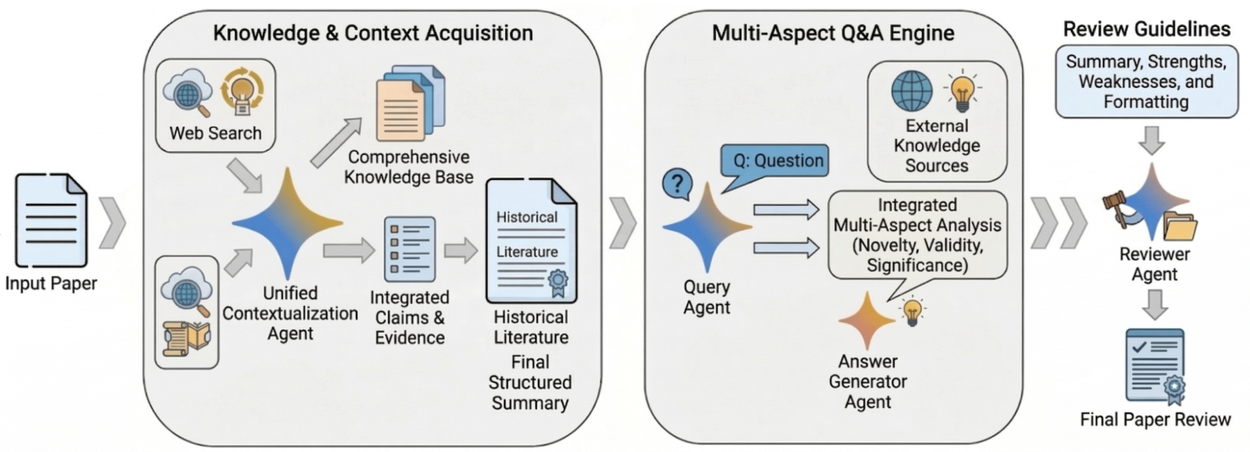
A reliable system does not “read the reviews and write a letter.” It turns each reviewer comment into a query, retrieves from three separate knowledge pools, and only then decides whether a reply can be written. That architecture is what the pipeline diagram above is showing: knowledge acquisition first, multi-aspect question answering second, synthesis last.
The three pools should stay distinct:
- The manuscript pool — figures, tables, methods, limitations, and any analysis you already ran.
- The author pool — lab notes, extra robustness checks, data dictionaries, and prior response letters.
- The literature pool — papers that actually speak to the reviewer’s objection, retrieved through Scholar-style search rather than model memory.
Mixing those pools is how overstatement starts. A sentence that is true in the literature is not a result in your paper. A sensitivity check in a notebook is not a published table. An effective query agent asks three different questions for one comment: Is this already in the manuscript? If not, do the authors have unpublished support? If not, does the literature justify a bounded claim, a revision, or a concession?
In practice, the retrieval step looks like this for Jenova's Academic Research Assistant:
- Attach the manuscript, the decision letter, and any supplement.
- Ask for a numbered inventory of reviewer demands, including implied requests.
- For each demand, force a three-pool search before any drafting:
“Reviewer 2, comment 3 asks whether the effect survives excluding the 2019 subsample. Search only the attached manuscript first. Quote the table, section, or sentence that answers it. If nothing is found, say ‘not in manuscript’ and list what analysis would be required. Do not cite external papers as if they were our results.”
- Only after a miss in the manuscript should the agent search the literature or propose a new analysis.
Dedicated rebuttal products follow a similar split. Manusights argues that general language models remain the most practical tools for drafting the letter itself, which is true as far as prose goes. The evidence engine still has to sit in front of that prose model. Otherwise the letter becomes a confident restatement of whatever the chatbot found most adjacent, not what the record contains.
Novelty, validity, and significance — the three analysis axes in a multi-aspect review engine — are also the three axes most reviewer comments actually occupy. A comment about missing baselines is a validity question. A comment about incremental contribution is a novelty question. A comment about whether anyone should care is a significance question. Tagging comments that way prevents a validity objection from being answered with a significance paragraph.
How Should AI Classify Citation Support Before You Quote a Source?
Every citation in a response letter should receive one of four labels before it is allowed into the draft: supported, partially supported, unsupported, or uncertain. If the system cannot assign a label, it should not assign a footnote.
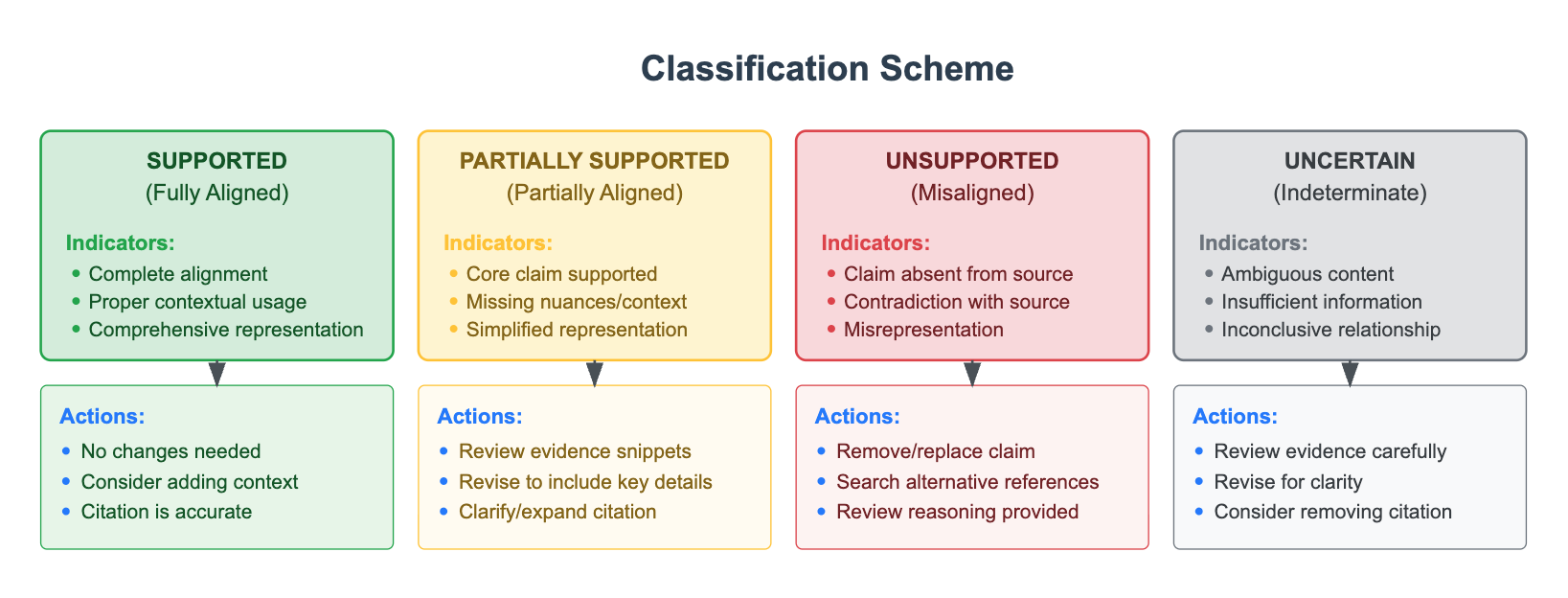
This classification is the difference between a citation checker and a claim checker.
Supported means the source states the claim in the same scope, population, and causal strength you are about to use. Action: keep the citation. Consider adding a five-word context clause so the reviewer sees the alignment.
Partially supported means the core fact is in the source but your sentence dropped a qualifier, a sample restriction, or a conflicting secondary result. Action: rewrite the sentence to include the missing nuance, or replace the citation with a better primary source. This is the most common honest label in real rebuttals, and the one generic chatbots flatten into “supported.”
Unsupported means the claim is absent, contradicted, or used in a way the source does not license. Action: delete or replace. Do not keep the citation because the author list is prestigious or the DOI resolves.
Uncertain means the PDF is paywalled, the relevant section is ambiguous, or the relationship between claim and source cannot be determined from the available text. Action: open the paper, or drop the citation. Uncertainty is not a soft form of support.
Scite operationalizes a close cousin of this scheme at literature scale by showing whether later papers support, challenge, or discuss a finding. That is invaluable for external citations. It does not classify your own new sentences against your own figures. For manuscript-internal claims, the four-label scheme has to be applied by the drafting workflow itself.
A prompt that enforces the scheme:
“For each sentence you propose in the response to Reviewer 1, output: (1) the sentence, (2) the citation, (3) a verbatim quote from the source or manuscript, (4) one label — Supported / Partially supported / Unsupported / Uncertain, and (5) the rewrite required by that label. Do not include any sentence labeled Unsupported. Rewrite every Partially supported sentence before showing it to me.”
Columbia Journalism Review’s comparison of AI search engines found systematic citation failures even when the named sources were well-known brands. Academic tools are better than open-web answer engines on this dimension, but the failure mode is the same: a trusted venue name is used as a substitute for a checked sentence. The four-label gate exists to stop that substitution.
How Do You Draft a Point-by-Point Response Without Overstating Conclusions?
You draft after the labels exist, and you let the label choose the verb. “Shows,” “demonstrates,” and “proves” are reserved for Supported claims with matching scope. Partially supported claims get “is consistent with,” “partially addresses,” or “holds under [stated restriction].” Uncertain claims do not get verbs. They get a plan or a deletion.
A clean response-letter skeleton looks like this:
- Restate the reviewer’s point in neutral language.
- State what you did: already in the paper, newly analyzed, or conceded.
- Point to a location: page, line, table, figure, or supplement.
- Cite external work only if the comment is about the literature, and only with a support label.
- Close with the exact manuscript change, or with a bounded reason you did not make one.
Jenova's Academic Research Assistant can hold that skeleton across a long letter if you give it the constraint up front:
“Draft the reply to Reviewer 2 using only Supported and rewritten Partially supported items from the evidence table. Use the verb list I provided. Every paragraph must include a manuscript locator or an explicit concession. Do not preview future experiments as if they are completed. Do not describe a cited paper’s discussion section as if it were our result.”
For SciSpace or a general model used as a letter writer, the same constraint has to be pasted in, because drafting products optimize for completeness and politeness. Completeness is how phantom analyses appear. Politeness is how a disagreement gets upgraded into “we agree and have now shown.”
Hedging is not decorative. It is a fidelity feature. Useful hedges are specific:
- Scope hedges: “in this sample,” “under the linear specification,” “among participants with complete follow-up”
- Epistemic hedges: “consistent with,” “does not rule out,” “provides preliminary support”
- Process hedges: “we now report,” “we have added,” “we cannot test with the present design”
Banned upgrades in a rebuttal draft include turning a correlation into an effect, a robustness check into a replication, a non-significant result into “no difference,” and a single supporting citation into “it is well established.” Guidance on AI-assisted academic writing emphasizes that authors remain responsible for checking that generated text matches the manuscript’s actual claims. Journals vary on disclosure, but The Conversation’s summary of publisher rules is that routine mechanical help may not need citation, while substantive AI-generated content often does. A response letter that contains literature interpretations drafted by a model is usually the second case.
ProofreaderPro’s practical guide to response letters is right about structure and tone. Structure and tone are not the hard part. The hard part is refusing to answer a comment more strongly than your table allows. If the reviewer asked for a causal identification strategy you do not have, the honest draft is a limitation paragraph and, if feasible, a weaker but identified analysis — not a more confident restatement of the original regression.
A second-pass prompt that catches overstatement:
“Compare each reply paragraph to the evidence table. Flag any sentence whose verb is stronger than its support label. Flag any citation that is not quoted. Flag any promise that does not correspond to a tracked manuscript edit.”
What Do Research Integrity Specialists Say About AI-Assisted Rebuttals?
Researchers who work on peer-review integrity keep returning to the same point: AI can accelerate retrieval and formatting, but the author still owns the truth-value of every sentence that goes back to the editor.
“The failure we see is rarely a missing comma in the reference list. It is a sentence that is one epistemic notch too strong for the paper it cites. A model that is rewarded for being helpful will close that gap for you unless you forbid it. The cheapest control is architectural: retrieve, label, then draft. If you reverse that order, the letter will contain claims you only later try to justify.”
“Smart citation tools changed the cost of checking whether the field still believes a paper. They did not change the cost of checking whether your own Table 3 supports the verb in paragraph 6 of the response. That second check is still a human reading a number next to a sentence. Authors who skip it are not saving time. They are borrowing it from the next review round.”
“We also advise teams to keep a denial log. Every time the model wants to say ‘we show’ and the label is only partial, write down the rejected sentence. After two or three papers, you will see your lab’s default overclaims — usually causal verbs, generalizing beyond the sample, and citing reviews as if they were trials. Custom instructions are just a way of encoding that log.”
— Jenova Product Team, academic-workflow design, eight years supporting manuscript and citation systems
That advice lines up with the research literature around AI in review itself. A PMC review of AI in peer review stresses that reviewers must still critically evaluate AI-generated content before any decision. The same obligation applies when the AI is sitting on the author’s side of the decision letter. Authors using ChatGPT-class models in peer-review correspondence are specifically warned to test suggestions against the manuscript’s core claims and research integrity.
Editage’s hands-on test of AI on peer-review responses is useful less for a winner-takes-all ranking than for the pattern it surfaces: models can judge whether a reply looks complete while remaining weak at whether the reply is true. Looking complete is the property that gets letters submitted too early.
When Should You Override an AI-Drafted Reviewer Response?
You should override the draft whenever the support label is weaker than the sentence, whenever the comment asks for a judgment the model cannot ground, or whenever agreeing would commit you to a claim you cannot defend in the next round. Overriding is the normal path, not an exception path.
Override immediately in these cases:
- The agent cites a paper you have not opened.
- The agent answers a methods critique with additional introduction text and no new test.
- The agent treats a reviewer’s misunderstanding as a request for more citations rather than a rewrite of your explanation.
- The agent “finds” an analysis that is not in the repository.
- The agent agrees with two reviewers who have asked for incompatible analyses, and it has not flagged the conflict.
- The agent uses a review article to underwrite a primary empirical claim.
Some comments should never be fully delegated. Requests about research ethics, data access, conflicts of interest, and whether a result is clinically or policy-significant require a human decision about what you are willing to stand behind. AI can assemble the documents. It cannot accept responsibility for them.
There is also a growing reverse problem: authors now encounter reviewer comments that themselves appear AI-generated. The correct response is still evidence-first. Restate the actionable scientific request inside the comment, ignore the generic padding, and answer the request you can document. Matching an AI-sounding review with an AI-sounding letter simply doubles the ungrounded text in the file.
A workable human-in-the-loop close for each comment:
- Read the reviewer’s sentence and write a six-word summary yourself.
- Accept or reject the agent’s evidence row before you look at the drafted paragraph.
- If you reject the row, do not edit the paragraph. Send the agent back to retrieval.
- If you accept a Partially supported row, edit the verb yourself.
- Only then drop the paragraph into the letter.
Used this way, Jenova's Academic Research Assistant, Scite, Elicit, and a dedicated drafting agent like SciSpace are complementary rather than interchangeable. Retrieval tools reduce the chance you miss a paper. Classification reduces the chance you misuse one. Drafting tools reduce the chance the letter is disorganized. None of them reduces the chance of overstatement unless you refuse to draft from unlabeled claims.
The standard worth holding is simple enough to put above the prompt window: if you cannot point to a sentence, table, or concession that justifies the verb, the sentence does not belong in the response.
References
- Nature — More than half of researchers now use AI for peer review
- University of Pretoria Library — Citation management and AI hallucination risks
- Stellenbosch University — Guidelines for responsible AI use in academic writing
- Scite — Smart Citations and sentence-level claim verification
- PoolText — What AI can and cannot do in peer review, including reference checking
- ScienceDirect — Comparing AI-generated and human peer reviews
- Elicit — AI literature search and reported extraction accuracy
- George Mason University Libraries — AI tools for literature reviews
- SciSpace — Response to Reviewers agent workflow
- Consensus — AI search over peer-reviewed literature
- PeerReply — Point-by-point response and revision-package workflow
- Paper Digest — Claim verification against academic evidence
- Manusights — Best AI tools for responding to reviewers
- Columbia Journalism Review — AI search engines and citation failures
- PMC — Artificial intelligence-assisted academic writing
- The Conversation — Publisher guidelines on AI in journal papers
- ProofreaderPro — How to write a response-to-reviewers letter with AI help
- PMC — Artificial intelligence in peer review
- PMC — Navigating peer review with ChatGPT 4
- Editage — Tests of AI on peer-review responses
- ResearchGate — Discussion of AI-generated reviewer comments