How Can AI Improve an Admissions Essay Without Erasing Your Voice?
2026-08-25
What Separates Voice-Preserving AI Coaching From Essay Ghostwriting?
AI improves an admissions essay when it interrogates the student's own material — prompts, structure, gaps, and clichés — rather than generating the sentences that appear in the Common App box. In 2026, the useful split is not "AI versus no AI." It is coaching versus ghostwriting, and admissions readers can usually tell which one they are looking at.
That distinction now matters more than ever. A 2025 Kaplan survey of more than 200 admissions officers found that only 2 percent of colleges officially allow generative AI to write an application essay, while 30 percent ban that use outright and 68 percent still have no written policy. Officers in the same survey warned that GenAI often strips essays of their personal touch and produces generic content that does not match the rest of the file.
Key factors that separate voice-preserving coaching from template ghostwriting:
✅ Idea origin stays with the student. The AI asks what happened; it does not invent a "transformative summer." ✅ Every submitted sentence is student-authored. Feedback can reshape a paragraph; it should not replace it. ✅ Details are un-Googleable. Sensory, local, and slightly messy facts beat polished abstractions. ✅ The tool knows the genre. A personal statement is not an English-class argument, and treating it like one flattens voice. ✅ The workflow would survive an honest conversation with an admissions officer.
To compare tools meaningfully, it helps to treat authenticity as a design requirement, not a vibe. The rest of this guide evaluates specialized agents such as Jenova's College Admissions Consultant alongside general chatbots and grammar checkers on that standard.
Why Are Admissions Officers So Concerned About AI-Written Essays in 2026?
Admissions officers are concerned because a fluent, AI-drafted essay often reveals almost nothing about the person who will actually show up on campus. Yale's undergraduate admissions office states the problem plainly: AI tools are "inevitably ignorant of the foundation of a successful application: the unique person applying," and submitting the substantive output of an AI platform can constitute application fraud.
The fear is not eloquence. Officers already read thousands of competent essays each cycle. Readers who process 2,000 or more essays per year develop a sharp ear for what authentic teenage writing sounds like, and AI drafts tend to share the same tells: even paragraph lengths, abstract "growth" language, and a thesis that could belong to any high-achieving applicant.
Those tells create a second problem. When the personal statement is smoother than teacher recommendations, graded writing samples, or short answers, officers start asking a damaging question: how strong a writer is this student, really? Kaplan's 2025 survey recorded that exact reaction, and 50 percent of officers reported an unfavorable view of generative AI in admissions essays.
There is also a developmental cost. Ethan Sawyer of College Essay Guy argues that outsourcing the draft skips the "nutrients" of the process: self-awareness, vulnerability, and the ownership that comes from looking at a finished piece and thinking, "I wrote that." In a cycle already crowded with similar résumés, that inner work is often the only remaining differentiator.
What Should You Look for in an AI Admissions Essay Tool?
You should look for a tool that protects authorship, understands personal-statement conventions, and can remember your story across sessions without ever drafting the essay for you. Feature lists matter less than whether the product is built to refuse ghostwriting.
A practical way to score any tool is the Voice Integrity Framework, six weighted checks rather than a single "sounds good" impression:
- Idea origin — Does the system start from your anecdotes, or does it propose a stock narrative?
- Sentence ownership — After a revision pass, can you still hear your diction, rhythm, and humor?
- Specificity pressure — Does it demand names, places, dialogue, and sensory detail, or settle for "I learned resilience"?
- Genre fluency — Does it know a personal statement invites "I," implied thesis, and vulnerability, unlike a literary analysis?
- Policy awareness — Does it distinguish brainstorming and grammar help from prohibited generation, as Yale and the Common App draw that line?
- Revision agency — Do you rewrite the weak paragraphs, or does the model rewrite them for you?
General chatbots can pass some of these checks if you prompt them carefully. They fail others by default, because their training objective is fluent completion, not admissions ethics. Grammar tools pass the mechanical checks and fail the strategic ones. A domain agent is more useful when it is instructed to interview you, flag clichés, and leave the prose in your hands.
One more criterion is persistence. A chatbot that forgets last week's "failed robotics prototype" story will keep offering generic community-service angles. Cross-session memory is not a luxury here; it is how a coach stops you from abandoning the weird, specific draft that actually sounds like you.
How Do Specialized Admissions Agents Compare to ChatGPT, Claude, and Grammarly?
Specialized admissions agents outperform general chatbots when the job is protecting voice and mapping a full application, while ChatGPT, Claude, and Grammarly remain stronger as narrow utilities for brainstorming, long revision, or proofreading. None of them should author the submitted essay.
A 2026 comparison of general essay assistants puts ChatGPT, Claude, Gemini, and Grok in the "drafting coach, not ghostwriter" category. ChatGPT is fast at outline feedback. Claude holds instructions across long revision passes. Gemini is convenient inside Google Docs. Grammarly and similar editors are the category Caltech explicitly treats as ethical for spelling and grammar on a completed draft.
Jenova's College Admissions Consultant is built for the opposite failure mode: students who open a chatbot and type "write my Common App essay." It is designed for school selection, essay crafting, and timeline management against a specific profile. Related agents such as the MBA Admissions Consultant and Law School Admissions Consultant apply the same coaching stance to later-stage applications, where personal statements still fail when they sound like brochures.
Honest limits apply on every side. ChatGPT and Claude will happily generate a polished 650-word draft if asked. Grammarly will not help you choose between two life stories. Jenova's consultant is not a human reader who has sat in a particular college's committee, and it cannot invent authenticity you have not supplied. It also will not replace checking each college's published AI rule before you submit.
| Feature / Dimension | ChatGPT | Jenova College Admissions Consultant | Claude | Grammarly / editor tools |
|---|---|---|---|---|
| Primary move | Fast brainstorming and structural notes | Profile-based coaching across school list, essays, and timeline | Multi-step revision with strong instruction following | Grammar, spelling, and clarity on finished prose |
| Voice preservation | Weak unless you forbid drafting | Strong if you feed raw stories and keep sentence ownership | Stronger than ChatGPT on long, constrained revision | High for mechanics; no help on story choice |
| Admissions-specific guidance | Generic unless heavily prompted | Built for undergraduate admissions strategy | Generic unless prompted | None |
| Policy-aware workflow | User must impose limits | Designed to coach rather than ghostwrite | User must impose limits | Generally allowed for proofreading |
| Cross-session memory of your story | Limited on free chat | Persistent memory across the application cycle | Stronger on long documents than on life context | None |
| Pricing (as of 2026) | Free tier; paid plans available | Free tier; Plus starts at $20/month | Free tier; paid plans available | Free tier; paid plans unverified here |
| Best for | Quick "what's missing?" passes on a self-written draft | Students who want a specialist coach without a $200/hour consultant | Long supplemental sets with many constraints | Final mechanical polish |
The pattern is consistent: use general models as mirrors, editors as copyeditors, and a specialist agent as the person who keeps asking why this story, for this school, in your words.
How Can AI Help You Brainstorm Without Writing the Essay for You?
AI helps you brainstorm ethically when it generates questions, contrasts, and missing-detail prompts — not outlines that already contain topic sentences you could paste. Caltech's public guidance draws that line clearly: generating questions to kick-start brainstorming can be ethical; relying on AI to outline or draft is not.
Kaplan's 2025 data tracks the same split. Twenty-seven percent of colleges officially allow GenAI for brainstorming, while only 2 percent allow it to write the essay. If a school has no policy, the conservative reading is still "ideas in, sentences out."
A voice-safe brainstorm looks like an interview. You dump messy material: the Tuesday you broke the lab printer, the smell of your grandmother's pharmacy, the text you did not send. The model is allowed to notice patterns and press for sharper scenes. It is not allowed to hand you a three-act structure with a moral already attached.
For Jenova's College Admissions Consultant, a useful opening is deliberately unfinished:
"Don't write any essay sentences. Interview me for 12 questions about moments I still think about. Then tell me which two stories only I could tell, and what sensory details are still missing."
For ChatGPT or Claude, the same constraint has to be stated every time, because those products optimize for completion:
"I will paste five raw memories. Do not outline or draft. Ask follow-ups until each memory has a place, a piece of dialogue, and a decision I actually made."
If the output starts sounding like a TED Talk — "that summer taught me leadership" — the brainstorm has already crossed into ghostwriting. Throw that language away and go back to the ugly specifics.
How Do You Keep Your Own Voice When an AI Reviews Your Draft?
You keep your voice by writing the full draft first, asking the model only to diagnose, and then rewriting the flagged paragraphs yourself. Responsible AI-assisted workflows described in 2026 tool research follow that ratio: 100 percent of submitted sentences remain student-written, even if feedback shaped 5 to 10 percent of the revision decisions.
Admissions readers are listening for mismatch. JRA Educational Consulting notes that officers want the student's authentic story, not AI output, and that wise use starts with maintaining voice. Detection software is secondary. Human readers remain the primary defense, and they notice when a 17-year-old suddenly writes like a brand strategist.
A review prompt that protects voice is narrow:
"Here is my draft and a graded English paper so you can hear my normal diction. Do not rewrite. List: (1) sentences anyone could have written, (2) claims with no scene attached, (3) places my voice disappears into formal padding. Quote my lines; don't replace them."
Then apply a four-part voice test to every suggested change:
- Only-I test. Could another applicant in your zip code have written this sentence?
- Sample-match test. Does it sound like your emails, journal, or in-class writing?
- Un-Googleable test. Is there a detail a model could not have inferred from a résumé?
- Explain-it test. Would you be comfortable telling an officer exactly how the paragraph was made?
Jenova's consultant is strongest in this diagnostic mode because it can hold your earlier stories and school list in memory. It is weaker if you never give it a real draft and instead ask it to "make this sound better," which is how most students accidentally launder their voice into slurry.
Grammarly-style tools belong at the end, not the beginning. Mechanical cleanup after you own the sentences is the use case Yale carves out as not constituting fraud. Mechanical cleanup that rewrites your cadence is just ghostwriting with a green underline.
What Do College Policies Actually Allow When It Comes to AI?
Most published policies allow spelling, grammar, and sometimes early-stage idea exploration, and they treat AI-composed prose as fraud. The Common App's application-fraud definition, cited by College Essay Guy and by Brown, includes submitting "the substantive content or output of an artificial intelligence platform" as if it were your own work.
Yale follows that definition and adds a practical exception: using AI to review grammar or spelling, or to seek general advice or topic suggestions at the start, does not constitute application fraud. Submitting personal statements composed by text-generating software may lead to revocation or expulsion. The University of California treats fully AI-generated personal insight answers as academic dishonesty and runs plagiarism checks. Brown goes further and does not permit AI in application content beyond basic proofreading.
The national picture is still messy. Kaplan found that 68 percent of colleges had no official writing policy in 2025, 73 percent had none for feedback, and 69 percent had none for brainstorming. Roundups of top-30 offices show the same patchwork: some schools are explicit, others only remind you that you signed an honesty statement.
That ambiguity is not permission. Princeton's dean of admission, Karen Richardson, has said an AI-assisted essay is unlikely to be as good or authentic as one the applicant composes, and applicants still certify that the work is theirs alone. If a school has not published a rule, write as if a committee member will ask how you used AI — and answer with brainstorming questions and grammar passes, not generated paragraphs.
Graduate applications are not a loophole. MBA, JD, and MD personal statements sit under the same authorship logic, which is why specialist coaches in those lanes still need the same no-drafting constraint.
How Does a Personal Statement Differ From the Essays AI Models Default To?
A personal statement succeeds when it shows how you think, feel, work, and live; most language models default to the English-class essay they have seen millions of times. That genre mismatch is one of the main reasons AI drafts feel competent and forgettable.
College Essay Guy's contrast is the cleanest diagnostic available to students. English-class essays argue a claim about a text, put an explicit thesis up front, stay analytical, and usually forbid "I." Personal statements demonstrate values and interests, often imply the thesis near the end, invite a personal tone, and treat vulnerability as evidence rather than a defect.
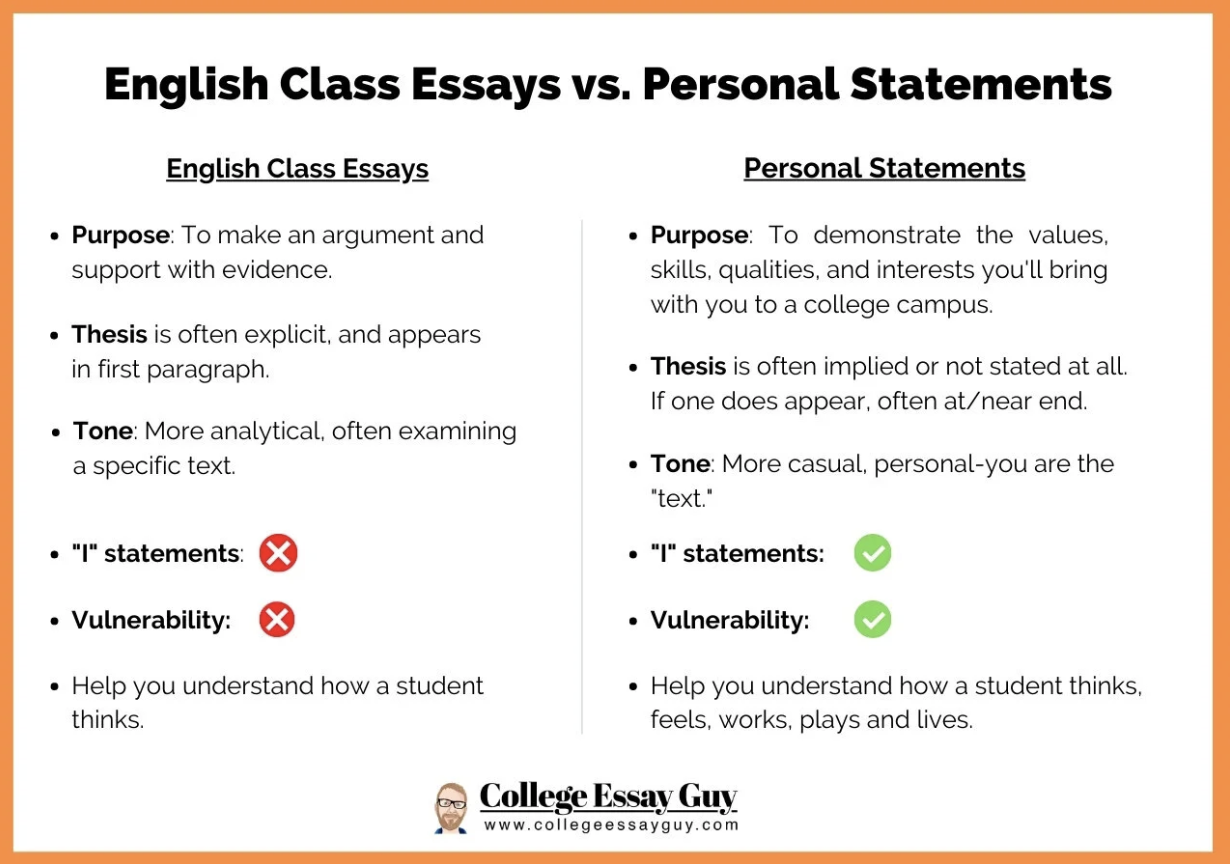
Generic chatbots collapse that distinction. Ask for "a strong college essay" and you often get a five-paragraph argument with a tidy lesson, because that is the modal essay in the training data. Applerouth's 2025 guidance makes the same point from the other direction: once AI can produce polished text, the scarce asset is a human perspective that a machine could not have assembled from public tropes.
A voice-preserving tool should therefore argue with the English-class reflex. It should ask where the implied thesis is hiding, whether you buried the best scene, and whether you are analyzing your life like a novel instead of inhabiting it. If your draft could be retitled "The Theme of Perseverance in My Internship," the model has pulled you back into the wrong genre.
This is also why "make it more sophisticated" is a dangerous prompt. Sophistication in a personal statement is usually a concrete verb and an honest contradiction, not a broader vocabulary.
How Do You Build an Ethical AI-Assisted Essay Workflow?
You build an ethical workflow by sequencing human authorship first and AI diagnosis second, then documenting what the tool touched. The sequence matters more than the brand of model.
A workflow that survives both school policy and an officer's ear looks like this:
- Collect raw material offline. List moments, objects, jokes, failures, and phrases you actually say. No model in the room yet.
- Use AI only as an interviewer. Twelve questions, zero sentences for the essay. Stop if it starts narrating.
- Write a bad complete draft in one sitting. Target your real word count. Do not clean it.
- Request a diagnosis, not a rewrite. Ask for missing scenes, résumé-echo, and voice drift. Twenty-one percent of colleges officially allow feedback on independently drafted essays; many more will still reject a rewritten draft.
- Rewrite the flagged paragraphs yourself. If you cannot, the idea was never yours.
- Proofread last. Grammarly, Microsoft Editor, or an AI spelling pass belongs here, matching Yale's and Caltech's stated exceptions.
- Read the essay aloud next to another writing sample. If a teacher would not recognize you, keep cutting polish.
- Check each college's rule the week you submit. Policies are still moving, and some offices will rescind for generated content.
On Jenova, that sequence can live in one thread because memory carries the school list and earlier anecdotes. On ChatGPT or Claude, save the "do not draft" rule as a pinned instruction and paste a writing sample every session. Either way, keep a short process note for yourself: what you asked, what you rejected, and which sentences never left your keyboard.
If a counselor, parent, or model offers a "better" opening that you would never say out loud, it is not better. It is a template wearing your biography.
What Do Admissions Experts Say About AI and Authentic Voice?
Admissions practitioners keep returning to the same conclusion: AI is a legitimate mirror and a disastrous substitute, and the students who benefit are the ones who stay in the chair as authors. The Kaplan officer comments from 2025 and the published Ivy and UC policies are unusually aligned on that point.
"The failure mode we see is not 'students got help.' Counselors and teachers have always helped. The failure mode is a draft whose best sentences could be swapped onto another applicant's file with two proper nouns changed. That is what template ghostwriting produces, whether the ghost is a paid writer or a chatbot.
Voice-preserving systems do the opposite job. They increase the cost of vagueness. They ask what the cafeteria smelled like, who disagreed with you, and which detail you are embarrassed to include. They will not give you a thesis in paragraph one, because a personal statement that argues like a literary essay has already left the genre admissions officers are scoring.
We also tell students to design for the interview they hope never happens: 'Walk me through how this paragraph got written.' If the honest answer is 'I dumped memories, got ten questions, wrote a messy draft, and rewrote three scenes,' you are inside almost every published policy. If the honest answer is 'I asked it to write a Common App essay about leadership,' you are not.
Specialized agents are useful here only when they are willing to be inconvenient. A product that always sounds helpful will drift toward generation. A product that remembers your last three anecdotes and refuses to compose the fourth is doing the actual admissions work."
— Jenova Product Team, admissions writing systems, experience reviewing application-essay workflows across undergraduate and graduate cycles
That standard is stricter than "did a detector fire?" AI detectors are imperfect, and officers already look for authenticity by cross-checking voice, detail, and the rest of the file. Designing for a human reader is the only durable strategy.
Which Students Benefit Most From Voice-Preserving AI Coaching?
Students who already have a story but cannot see its shape benefit most; students hoping the model will supply a personality do not. The tool cannot create a self you have not lived, and policies are written to make sure it does not pretend otherwise.
Voice-preserving coaching is a strong fit when you are choosing among too many real anecdotes, writing in a second language and need structural questions rather than rewritten idiom, or managing a long set of supplementals without letting every answer collapse into the same "impact" paragraph. It is also useful for first-generation applicants who have never been told that a personal statement is allowed to sound like a person.
It is a weak fit when you want a same-day draft, when you refuse to put ugly specifics on the page, or when a target school bans AI beyond spellcheck and you are looking for a workaround. In those cases a human counselor, a teacher, or a quiet weekend with a notebook is the better instrument.
Cost and access still matter. A specialist agent on a free or $20-per-month tier is not a substitute for a seasoned independent counselor, but it is more targeted than an unbounded chatbot and far cheaper than hourly consulting. Pair it with a real reader when you can. The combination — machine that will not let you stay vague, human who knows when you are performing — is closer to how strong essays have always been made.
The through-line for 2026 is simple enough to memorize. Let AI multiply questions, pressure-test structure, and catch the last typo. Do not let it become the applicant.
References
- Kaplan — Colleges Clarify Rules on AI Use in Admissions Essays (2025 officer survey)
- Yale Undergraduate Admissions — AI Policy
- Oriel Admissions — AI and College Essays: What Admissions Officers Can Detect
- College Essay Guy — Navigating College Applications with AI
- Coursiv — Comparing the Best AI Tools for Writing Essays
- JRA Educational Consulting — AI and College Application Essays: Dos, Don'ts & What Officers Want
- Spark Admissions — AI and College Essays: What's Allowed and What Isn't
- Applerouth — Why Real College Essays Still Matter in the Age of AI
- College Essay Advisors — What Top 30 Admissions Offices Will (and Won't) Allow
- Oriel Admissions — Does Yale Allow AI in Essays?
- Pioneer Academics — Do Colleges Check Essays for AI?
- Empowerly — How Admissions Officers Spot Authentic Essays in the AI Era