How Can AI Extract Evidence by Research Question From Hundreds of Papers?
2026-08-21
How Do Question-Anchored Extraction Workflows Differ From Summary-First AI Tools?
Question-anchored workflows return comparable, source-linked fields for a predefined research question; summary-first tools return fluent paragraphs that restate each paper on its own terms. In 2026, that distinction matters more than model brand. Jenova's Academic Research Assistant is strongest for iterative, question-driven extraction with persistent memory and manuscript support. Elicit is stronger for empirical research matrices. Covidence remains the standard for dual-reviewer systematic reviews that must follow PRISMA 2020 reporting.
Key factors that separate evidence extraction from paper-level summarization:
✅ Question fidelity — every cell answers your question, not the paper's own framing of its contribution.
✅ Field-level structure — methods, sample size, outcomes, and effect direction sit in custom columns linked to source spans.
✅ Cross-paper comparability — contradictions and design differences become visible only when fields align.
✅ Citation-context checks — a cited finding is re-tested against later literature, not assumed true because it was cited.
✅ Human adjudication — large language models accelerate extraction, but unsupervised use is not yet ready for high-stakes synthesis.
To compare tools meaningfully, it helps to treat extraction as a pipeline — ingest, question-filter, structure, compare, validate, then write — rather than as a single “summarize these PDFs” prompt.
Why Do Broad AI Summaries Fail When the Unit of Analysis Is a Research Question?
Broad summaries fail because they collapse incomparable studies into a narrative, which hides the exact cells a research question needs. A paper-level synopsis can sound complete while omitting sample size, comparator, follow-up window, or whether the result was an increase, decrease, or null. Those omissions are fatal once you move from “what is this paper about?” to “what does this corpus say about this question?”
Evidence synthesis exists to answer structured questions, not to paraphrase abstracts. PRISMA 2020 is built around reporting why a review was done, what methods were used, and what was found — not around generating a readable digest. Classic reviews still take approximately a year for a team when recommended methods are applied. The literature volume that created that bottleneck is the same volume summary-first chat tools try to compress into a few paragraphs.
Summaries also inherit the paper’s rhetoric. Authors emphasize significant findings; abstracts under-report nulls; citations propagate claims that later work weakens. Question-level extraction inverts that bias: you define the fields first, then ask every paper the same questions. Testing of LLM extraction shows the opposite failure mode as well. Models can miss outcome data even when they handle background fields reliably, which is why outcome extraction remains harder than study-characteristic extraction.
The practical implication is simple. If your output cannot be dropped into a table with one row per study and one column per question element, you do not yet have evidence. You have a synopsis.
What Should You Look for in an AI Evidence Extraction Workflow?
You should look for six capabilities that together form a Question-Anchored Extraction Framework: question fidelity, structured fields, source traceability, cross-paper alignment, citation-context validation, and a documented human-verification loop. Tools that score well on fluent writing but poorly on those six will still produce broad summaries.
Question fidelity. The system must accept a protocol-style question — PICO, PECO, or a custom schema — and refuse to drift into adjacent findings. “Filter by question” is the load-bearing step in modern LLM extraction pipelines, not an optional refinement.
Structured fields. Sample size, design, intervention or exposure, comparator, outcome, effect direction, and limitations should land in custom columns, each linked to a source span. Free text in a chat window is not a data extraction form.
Source traceability. Answers need highlights or locators in the PDF. Without that, you cannot adjudicate model errors against the record, and you cannot report methods transparently.
Cross-paper alignment. The same field must mean the same thing across rows. Otherwise you cannot see contradictions, dose differences, or design effects.
Citation-context validation. A finding that was true in 2018 may not hold after subsequent trials. Extraction that never re-checks cited claims will launder outdated evidence into new manuscripts.
Human verification. Up to 63% of human-extracted studies contain at least one data extraction error. LLMs introduce different errors and can also catch human ones. The workflow must treat disagreement as a signal to open the PDF, not as a scoreboard.
University library comparisons in 2026 still rate tools by role, corpus, and failure mode rather than by marketing claims. Oregon State University’s review notes that Consensus can misread sources, while Elicit’s matrix is most useful for empirical papers and can lack nuance in summaries. Those are evaluation findings, not deal-breakers — and they are the right grain of assessment.
Which AI Tools Extract Structured Evidence Across Multiple Papers?
No single tool dominates every stage. Elicit leads for empirical matrices, Covidence for team systematic reviews, Consensus for quick agreement overviews, and Jenova’s Academic Research Assistant for iterative question-driven analysis that continues into citation management and drafting. Paperguide-style pipelines illustrate the extraction-first sequence even when you assemble the same steps across tools.
| Feature / Dimension | Elicit | Jenova Academic Research Assistant | Consensus | Covidence |
|---|---|---|---|---|
| Question-level custom columns | Research matrix with customizable columns for methods, sample size, and findings | Prompt-defined schemas retained in persistent memory across sessions | Tabular summaries and a consensus meter; less custom-field control | Data extraction forms on included studies after screening |
| Typical synthesis scale | Protocol-to-extract workflow on gathered sources; Plus summaries cite a small set of papers | Batched extraction over uploaded PDFs and Scholar-linked records | Up to 20 papers (Pro) or 50 (Deep) per synthesis | Team-scale screening corpora for formal reviews |
| Source traceability | Links back to included literature | Document-grounded answers with attached PDFs | Links to sources used in the overview | Full screening and extraction audit trail |
| Dual-reviewer workflow | Not the core design | Not built in | Not built in | Independent dual screening and conflict resolution |
| Citation-context checks | Limited beyond the extracted set | Cross-session literature follow-up via Scholar and search | Consensus meter as an agreement signal | Manual; review protocol governs updates |
| Manuscript handoff | Export to reference managers | Citation management plus drafting; Word Doc Generator can format the write-up | Export for Plus users | Review write-up remains a separate stage |
| Pricing (as of 2026) | Institutional Plus subscriptions; consumer tiers unverified here | Free tier; Plus starts at $20/month | Freemium; some campuses license Pro | Annual individual, package, or organizational plans |
| Best for | Empirical extraction tables | Iterative, question-driven analysis with long-running projects | Fast biomedical/STEM consensus snapshots | PRISMA-compliant team systematic reviews |
Elicit is explicitly positioned to refine a protocol, gather sources, screen, extract, and synthesize. That is the right job description for question-level work. Its limitation, recorded in library evaluations, is that generated summaries often focus on findings and lack nuance, and the matrix is tuned to empirical reporting conventions. Qualitative, theoretical, or poorly structured papers will extract less cleanly.
Consensus is useful when the question is already close to a yes/no empirical claim. It synthesizes narrative overviews, tables, and a consensus meter, and can run deeper searches that flag gaps. It can also misread sources, and the Deep tier’s paper cap still sits far below “hundreds of full texts.” Treat it as a scouting instrument, not a coding form.
Covidence is widely described as leading software for managing systematic reviews. Together with EPPI-Reviewer, DistillerSR, and JBI-SUMARI, it belongs to the small set of platforms that support the full interventional review stack — records, screening, extraction, and team conflict resolution. It is heavier than exploratory research requires. Conversational “chat with this PDF” extraction is not its center of gravity, and most projects still rely on human-completed extraction forms.
Jenova’s Academic Research Assistant sits in a different part of the stack. It searches live scholarly sources, accepts uploaded PDFs, keeps unlimited chat history, and remembers the protocol across sessions so column definitions do not have to be re-taught every day. It is not a dual-screener, it does not generate a PRISMA flow diagram, and hundreds of papers must be batched rather than poured into one context window. Those are real limits. The compensating strengths are persistence, multi-model access, and the ability to carry the same research question from extraction into citation-grounded drafting without exporting out of the project.
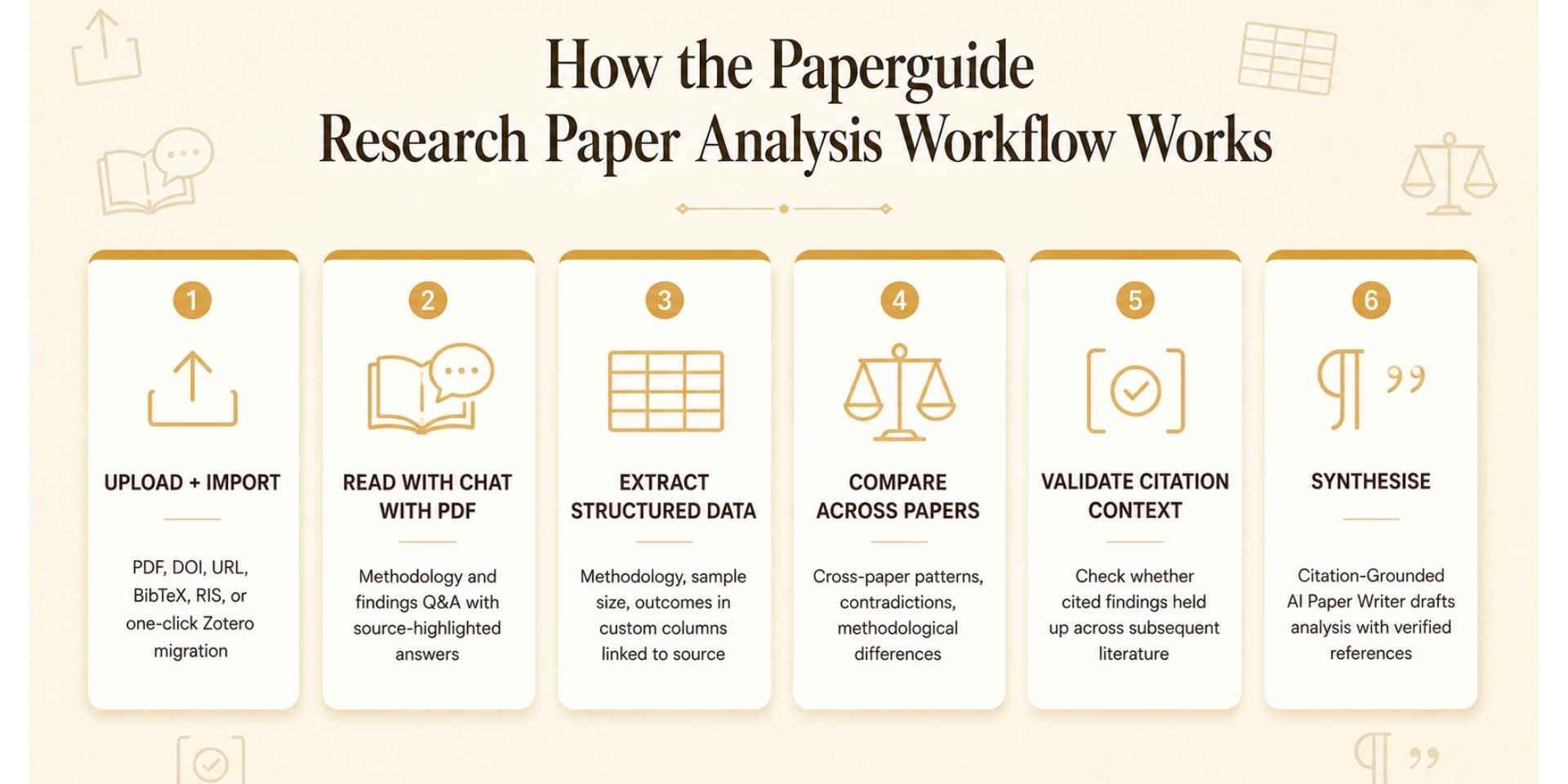
Paperguide’s published six-step sequence — upload, chat-with-PDF, structured columns, cross-paper compare, citation-context validation, then citation-grounded writing — is a clear statement of the extraction-first pattern. Independent accuracy and pricing figures for Paperguide were not verified for this article; the workflow itself is the useful object of comparison.
How Does Structured Data Extraction Work When the Corpus Spans Hundreds of Papers?
It works by converting each paper into rows of protocol-defined fields, then filtering those rows by the research question before any synthesis text is written. Scale comes from repetition of a schema, not from a longer summary.
The first move is ingest. PDFs, DOIs, URLs, BibTeX, RIS, or a reference-manager export establish the corpus. Chat-with-PDF is the second move, not the last: you use it to locate methods and results spans, then you lock those spans into columns. A living review of automated extraction found 76 publications on the topic but only six implemented end-user tools, and 84% of algorithms mined titles and abstracts only. Abstract-only extraction will miss outcomes, subgroup analyses, and risk-of-bias details that live in full text. Any workflow that claims “hundreds of papers” on abstracts alone is summarizing, not coding.
Custom columns should match the question, not the vendor’s default template. For an effectiveness question, typical fields are design, population, intervention or exposure, comparator, primary outcome, effect direction, effect size with interval, follow-up, and limitations. For a mechanisms question, replace effect size with hypothesized pathway and whether the study actually tested it. Linking each cell to a source span is what makes later comparison possible. Without locators, a table is just another summary with extra whitespace.
Hundreds of papers also force batching. Context windows, rate limits, and PDF parsing errors make one-shot extraction of a full systematic-review corpus unreliable. A durable pattern is: define the schema on a pilot set of 8–15 papers, measure concordance against human coding, freeze the prompt, then run remaining papers in waves. Prompt text determines completeness and format; unique prompts per article do not generalize. Pilot on a subset, then hold the prompt constant.
Jenova’s Academic Research Assistant supports that pattern because the schema can live in persistent memory and the PDFs can stay attached to the project. It still requires you to batch. Elicit’s matrix is closer to a native coding sheet for empirical fields. Covidence assumes the corpus has already survived screening. Choose the tool that matches which stage you are actually in.
How Do You Validate Extracted Findings Against Citation Context and Study Design?
You validate by checking whether the extracted claim still holds in the cited passage, in later literature, and across study designs that answer the same question. Extraction without those checks will reproduce citation bias at machine speed.
Citation-context validation means opening the cited span, not trusting the citing sentence. Papers routinely overstate what a reference showed, cite abstracts instead of results, or carry forward a finding that subsequent trials reversed. A dedicated “does this cited finding hold?” pass is therefore a separate step from “what did this paper report?” Paperguide-style workflows place that check immediately before synthesis, which is the right order: do not write the paragraph until the cell is stable.
Design-aware validation goes further. A 2025 methods figure in Nature Communications shows a two-stage pipeline that is a useful reference architecture even if you never adopt its scoring formulas. Large language models parse free text into population, intervention or exposure, relation, and outcome, then classify effect direction as increase, decrease, or no change. Those records are stratified by design — randomized trials, Mendelian randomization, observational studies — so a result is not treated as interchangeable across methods.
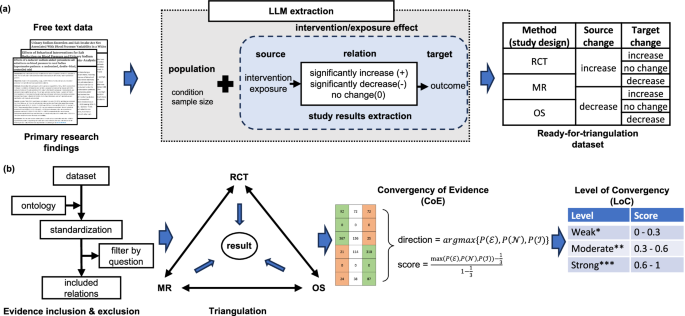
The second panel is the part most summary tools skip. After standardization and inclusion filtering, results are triangulated across designs. A Convergence of Evidence score uses the direction with the highest probability mass; a Level of Convergence band then labels the body of evidence as weak, moderate, or strong. You do not need that exact metric to apply the idea. You do need to stop pooling a significant observational association with a null trial as if they were one “literature says X” sentence.
Human–model disagreement should be adjudicated against the PDF by a third pass, not scored as automatic model failure. In one proof-of-concept, Claude 2 made one major and five minor extraction errors — and detected 21 minor errors in the human reference standard. Treating published extractions as gold standard underestimates models and overestimates humans. The correct unit of analysis is factual concordance of each field, with composite statistics (point estimate plus interval) counted coherently rather than as three unrelated numbers.
Jenova can run the citation-context pass because it can search subsequent literature and keep the original extraction table in memory. It cannot replace a second human reviewer for a Cochrane-style review. Covidence can enforce that second reviewer. Use both facts without collapsing them into a single winner.
How Do You Run a Question-Driven Extraction Workflow in Practice?
You define the question and fields first, pilot the schema, extract in batches with source locators, compare rows, re-check citations, then write from the table. Reversing that order — write first, retrieve quotes later — recreates the summary problem.
For Jenova’s Academic Research Assistant, a typical sequence looks like this:
- Open the agent and state the protocol in one block, including inclusion criteria and the exact columns you want.
- Attach a pilot set of PDFs (or DOIs) rather than the full corpus.
- Extract into a table, requiring a locator for every cell.
- Freeze the prompt after you correct the pilot.
- Batch the remaining papers, then run a contradiction pass and a citation-context pass before any narrative synthesis.
A useful opening prompt:
“Research question: In adults with treatment-resistant depression, does adjunctive ketamine reduce Montgomery–Åsberg scores versus placebo at 24 hours? Include only RCTs. For each paper, extract: design, n randomized, dose and route, comparator, primary outcome, timepoint, effect size with 95% CI, direction (increase / decrease / no change), and limitations. Quote the results sentence for each effect size. Do not summarize papers that fail inclusion. Flag empty cells instead of inferring.”
A useful comparison prompt after the table exists:
“Using only the extraction table, list (1) direction-of-effect conflicts, (2) differences in dose or timepoint that could explain conflicts, and (3) any row whose cited supporting trial is older than the most recent null result on the same outcome. Do not add papers that are not in the table.”
For Elicit, the analogous path is protocol refinement, source gathering, screening, then a custom-column matrix — the steps the product documents for systematic literature reviews. Start with empirical questions whose fields (n, methods, outcomes) already match the matrix. Do not expect the same yield from theory papers.
For Covidence, run search import, duplicate removal, dual title/abstract screening, full-text screening, then extraction forms. Library guides treat this class of software as the environment for structured, transparent, reproducible evidence synthesis, not as a chatbot. If you need a PRISMA flow diagram and two independent reviewers, start here and use an LLM only inside the extraction form, with the second reviewer still human.
Two operating rules transfer across all three. First, never let the model fill a blank with a plausible value; empty cells are data. Second, measure time on the whole task — prompt iteration, adjudication, and correction — not just model latency. Time spent on task is the relevant efficiency outcome, and prompt engineering is part of that time.
What Do Evidence Synthesis Researchers Say About LLM Data Extraction?
Researchers treat LLMs as promising accelerators for background fields and as unproven replacements for outcome extraction, with validation design itself still an open methodological problem. The consensus in 2025–2026 methods papers is conditional: useful inside a supervised workflow, not ready as an unsupervised extractor.
"The bottleneck in evidence synthesis is not reading speed. It is making every study answer the same question in the same fields, then noticing when those fields disagree. A summary can be fluent and still be unusable for that job, because fluency hides empty cells. When we moved teams from paper-level chat to question-anchored tables, the first thing that appeared was not insight — it was missingness. Sample sizes with no denominator, outcomes with no timepoint, citations that did not support the sentence they were attached to."
"We also stopped treating human extraction as a gold standard. A large share of human-coded studies contain at least one extraction error, and models sometimes catch those errors while introducing others, especially on composite statistics. The productive unit of evaluation is factual concordance per field, adjudicated against the PDF. Until a workflow can show that loop — schema, locator, batch, contradict, re-cite — it is a summarizer, regardless of how many papers it claims to have read."
— Jenova Product Team, research-workflow design, experience building long-running academic agent projects across literature discovery and manuscript preparation
That position lines up with independent commentary. A scoping review of LLMs in systematic reviews concluded they are on the rise but not yet ready for use as standalone infrastructure. Separate work on language models for data extraction and risk-of-bias assessment is testing mixed human–model pipelines rather than model-only reviews. The live question in the field is not “can a model read 400 PDFs?” It is “can a logged, question-filtered table survive dual review?”
When Should You Still Use Dedicated Systematic Review Software Instead of an AI Research Agent?
Use dedicated systematic review software when you need dual independent screening, a reportable PRISMA flow, and an audit trail that a journal, HTA body, or guideline panel will inspect. Use an AI research agent when you are still shaping the question, coding a living corpus, or turning a stable table into a manuscript. The two are sequential more often than they are rivals.
Covidence, DistillerSR, EPPI-Reviewer, and JBI-SUMARI exist because reproducible methods, team workflows, and PRISMA-compliant records are requirements, not preferences, for interventional reviews. Machine learning inside those platforms has helped most at screening — one evaluation estimated screening burden reductions up to 60% — while extraction and risk-of-bias tools remain thinner. If your output is a registered review, do not skip that stack because a chat model can paraphrase PDFs.
An agent is the better daily environment when the question is still moving. You can attach new PDFs, revise columns, and keep protocol decisions in memory without opening a new review project for every pivot. Jenova’s Academic Research Assistant is built for that mode: live scholarly search, attached full texts, persistent extraction schemas, and a path into citation-managed drafting. It will not satisfy a protocol that requires two screeners. Stating that limit is part of using it correctly.
A practical split used by many groups in 2026 looks like this. Scout and define fields with an agent or with Elicit. Register the protocol. Screen and extract in Covidence or an equivalent, optionally with LLM-assisted coding that a human still verifies. Return to the agent to pressure-test citation context and to write from the locked table. Duke’s evidence-synthesis toolbox listing is a reminder that no one application covers every stage; the professional skill is knowing which stage you are in.
The test that should decide the stack is the same test that opened this article. If you can point to a research question, a column for every element of that question, a locator for every cell, and a record of what was excluded, you are extracting evidence. If you only have a well-written overview of “what the papers say,” you are still summarizing — even if the overview was generated from hundreds of files.
References
- PRISMA Statement — Reporting guidance for systematic reviews
- The BMJ — The PRISMA 2020 statement: an updated guideline for reporting systematic reviews
- ScienceDirect — LLMs in systematic reviews: on the rise, but not yet ready for use (scoping review)
- PMC — Digital tools to support the systematic review process
- BMJ Evidence-Based Medicine — Challenges and pitfalls in evaluating LLMs for data extraction
- Oregon State University Libraries — Comparison of AI tools for literature researching
- Elicit — Systematic literature review workflow
- Covidence — Systematic review management software
- UCL Library Guides — Systematic review software
- Nature npj Digital Medicine — Language models for data extraction and risk of bias assessment
- Duke University Libraries — Software and tools for evidence synthesis