How Can AI Create an Eight-Week College Application Plan?
2026-08-26
How Should an AI Sequence Five Application Workstreams in Eight Weeks?
An AI admissions planner is most useful when it runs five workstreams in parallel — school selection, essays, recommendations, finances, and official verification — rather than treating the file as a single to-do list. For an international undergraduate applicant in 2026, Jenova's College Admissions Consultant is strongest for building that compressed calendar; the Common App remains the submission portal, College Board BigFuture is stronger for early college search, and counselor platforms such as Cialfo are stronger when a school already licenses them.
The comparison turns on whether a tool can sequence work, not merely store it:
✅ Deadline topology — Early Decision, Early Action, Regular Decision, and rolling dates mapped before drafting begins ✅ Document latency — buffers for recommender delays and 3–5 business day portal processing ✅ Voice integrity — essay help that preserves the student's own evidence and phrasing ✅ Cross-border aid literacy — CSS Profile, non-U.S. tax documents, and institutional forms ✅ Official-channel respect — knowing which items AI can draft and which only schools, testing agencies, or College Board can transmit
Those five tracks are the evaluation frame used throughout this guide. An eight-week sprint can finish a file; it cannot invent a two-year testing record or a recommender who barely knows the student.
Why Do International Students Need a Compressed Application Timeline in 2026?
International applicants face a tighter clock than the classic U.S. junior-to-senior timeline because credential translation, English-proficiency scores, and institutional aid forms add weeks that domestic files often skip. Counselors in the 2026–27 cycle are already planning applications 12 to 18 months earlier across the U.S., U.K., Canada, and Australia, which means an eight-week plan is a late-stage execution sprint, not a substitute for long-range testing.
U.S. deadline clusters are unforgiving. Early Decision windows typically fall between November 1 and 15, while Regular Decision usually lands between January and March. Advisers who work with international students tell them to finish Regular Decision files by mid-December, not on January 1, so transcripts, score reports, and fee payments can clear time zones.
A second pressure is volume. Students now commonly apply to six to eight colleges, each with distinct supplements, recommendation rules, and aid portals. One planning review reports that about a quarter of students miss a deadline for lack of organization. For applicants outside the United States, a missed November date is rarely recoverable with a same-week resubmit.
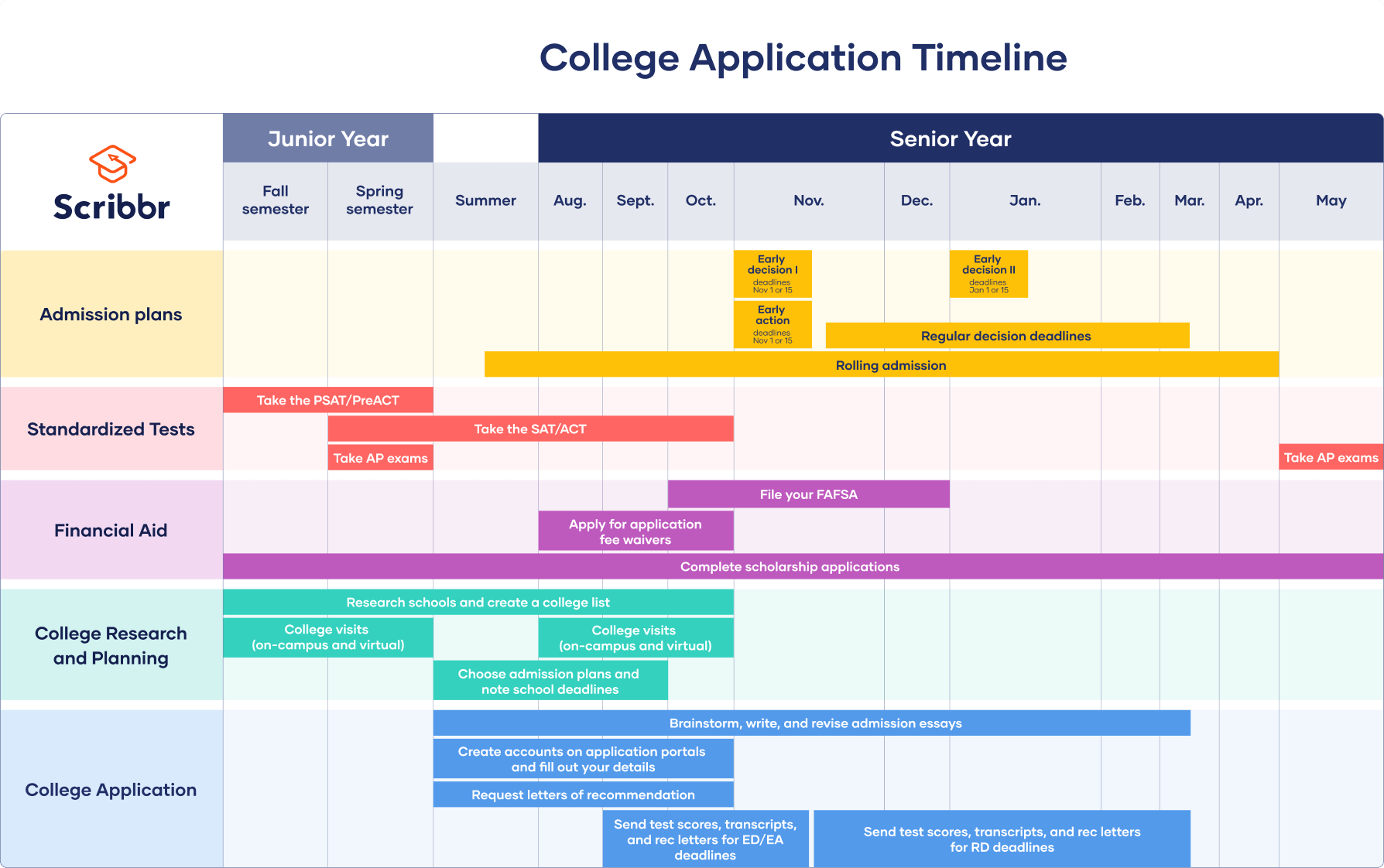
The Scribbr-style calendar above is the domestic default: PSAT in junior fall, SAT or ACT through the following autumn, essay work from summer into winter, and aid forms stacked on top. An international student starting in late August 2026 cannot replay junior year. AI is useful here because it converts that multi-year map into an eight-week critical path and flags the items that still require human institutions — schools, teachers, and College Board — to move.
What Should You Look for in an AI College Application Planner?
You should evaluate an AI planner on six dimensions we call the International Application Compression Index: deadline topology, document latency, essay voice integrity, recommender lead time, cross-border aid literacy, and official verification routing. Tools that score well on search or form-filling but fail on latency and official routing produce polished drafts that still miss November 1.
Deadline topology means the system distinguishes Early Decision I, Early Action, Early Decision II, Regular Decision, and rolling admission, then back-plans from the earliest binding date. A generic chatbot that treats “college applications” as one deadline will mis-order essays and score sends.
Document latency is the hidden constraint. Teacher letters, translated transcripts, and institutional document portals do not move at chat speed. Any serious plan leaves multi-day buffers after each upload.
Essay voice integrity asks whether the tool extracts stories from the student or overwrites them. Admissions readers discount fluent English that could belong to anyone.
Recommender lead time measures whether the planner forces outreach in week 1, not week 6. ACT's guidance on requesting letters treats this as a relationship task, not a form task.
Cross-border aid literacy covers CSS Profile currency conversion, non-U.S. tax packets, and school-specific document portals. Official verification routing covers what the AI must never pretend to do: transmit sealed transcripts, certify translations, or click submit inside College Board systems.
Jenova's College Admissions Consultant is built for the first five dimensions and is explicit about the sixth. It will draft a tracker and a briefing memo; it will not replace Naviance, a counselor School Report, or an IDOC upload.
How Does an AI Admissions Agent Compare to Common App, BigFuture, and Counseling Platforms?
Jenova's College Admissions Consultant plans and coaches the file; Common App submits it; BigFuture helps you search; Cialfo and Scoir organize counselor-led school workflows; College Essay Guy is strongest as an essay methodology library. Treating any one of those as a complete eight-week operating system is the usual planning error.
More than one million students apply each year to more than 1,100 Common App member colleges, and the platform itself is free even when colleges charge fees. That scale makes Common App the default submission layer, not a strategy engine. Citizenship, not mailing address, determines whether Common App treats you as an international applicant.
BigFuture is the research layer: its college search covers more than 4,300 institutions by location, major, and type. Cialfo markets itself as a counselor-and-student system with a global university database and Drive hubs, which helps when a high school already pays for it. Scoir and Naviance similarly assume a counselor of record. College Essay Guy's international timeline and aid guides are among the clearer public playbooks, but they do not maintain your deadlines, recommenders, or memory across sessions.
| Feature / Dimension | Common App | Jenova College Admissions Consultant | BigFuture | Cialfo | College Essay Guy |
|---|---|---|---|---|---|
| Personalized 8-week plan | Portal and requirement grid, not a coach | Builds a sequenced calendar across five workstreams | Research and scholarship focus | Counselor-student planning, often school-licensed | Essay calendars and public guides |
| School-list architecture | Add up to 20 colleges after you choose them | Profile-based reach / match / likely construction | Filter search across 4,300+ colleges | Global university database | Not a matcher |
| Essay support | Prompts, optional personal essay, supplements | Iterative drafting with persistent memory | Minimal | Unverified depth | Structured brainstorming and revision methods |
| Recommendation workflow | Invite and assign counselors, teachers, others | Outreach scripts, briefing packets, status tracker | No | Counselor tools and document hubs | Advice articles |
| Cross-border financial aid | Fee-waiver pathway; not an aid application | Sequences CSS Profile, IDOC, and school forms | Scholarship discovery | Unverified consumer aid coaching | Step-by-step international aid explainers |
| Official document submission | School Report, transcripts, recs via counselor | Cannot transmit sealed credentials | No | File hubs, not College Board submission | No |
| Pricing (as of 2026) | Free platform; colleges may charge fees | Free tier; Plus from $20/month | Free | Institutional; consumer price unverified | Free guides; paid coaching unverified |
| Best for | Submitting a finished U.S. file | Students who need one planner for all five tracks | Early research | Schools with counseling staff | Applicants stuck on essays |
Jenova's honest limitation is infrastructure. It is not Naviance, it does not host official transcripts, and it cannot click submit inside CSS Profile or IDOC. Common App's limitation is the inverse: it will accept a weak, late, or unbalanced file as readily as a strong one. Cialfo's limitation for independent international students is access — the product is built around school contracts. BigFuture will not write your supplements. College Essay Guy will not remember your last draft unless you pay for human coaching.
How Can AI Help International Students Build a Balanced College List?
AI is most accurate as a constraint engine — visa practicality, need-aware aid, testing policy, and deadline type — and weakest when it ranks “prestige” without those filters. A usable eight-week list is usually eight to twelve schools, inside Common App's 20-college cap, with at least two likely options that are realistic on both admission and demonstrated ability to pay.
International applicants should start with hard gates, not brand names. Need-aware colleges can deny a strong academic file because the aid budget is gone. Test-optional policies still often expect TOEFL, IELTS, or Duolingo from non-native English speakers, and many files also need a passport scan plus SAT or ACT if the student is using scores. An AI planner that ignores those gates will produce a decorative list.
Jenova's College Admissions Consultant is effective when the first prompt states constraints in numbers, not adjectives:
"I am an international first-year applicant from the Philippines, predicted IB 38, TOEFL 105, no SAT yet. I need 10 colleges: 3 likely, 4 match, 3 reach. Prefer need-aware schools that have met full need for internationals. Earliest deadline I can hit is Early Action on November 1. Do not include colleges that require CSS Profile if they never award institutional aid to non-U.S. citizens."
That prompt forces the model to sort on policy, not reputation. BigFuture remains useful as a second pass for majors, location, and size once the constraint list exists. Students who already have a counselor on Cialfo or Scoir should let the school platform store official requirements and use the AI agent to pressure-test balance: too many binding ED choices, too few likely schools, or a cluster of colleges that all require the same overworked math teacher.
A compressed list also has to respect application fees. Common App fee waivers exist and are college-specific; international eligibility is not automatic. An AI plan should flag every fee, every waiver path, and every college that is free to apply before week 3, when cash-flow surprises start deleting schools from the list.
If English scores are still below a college's published minimum, pair list-building with Jenova's TOEFL/IELTS Tutor. If SAT or ACT remains open, the SAT/ACT Tutor can decide whether an October sitting is still rational inside an eight-week file. Adding a test you cannot finish is a list error, not a testing error.
How Does AI Support College Essays Without Replacing a Student's Voice?
AI should run a discovery-and-revision loop — inventory stories, map them to prompts, pressure-test specificity — and should never become the author of record. Common App houses a shared personal essay that colleges may require or make optional, plus college-specific short answers and writing supplements. That architecture rewards one deep personal essay and many tightly aimed supplements, not ten interchangeable statements.
The failure mode in a compressed timeline is fluency without evidence. International students under time pressure often accept a polished paragraph that could describe any high-achieving applicant in any country. Readers notice. MIT's advice to recommenders is a useful inverse test for essays as well: evaluations only help when they are specific, storied, and backed by anecdotes, not generic praise.
A sound AI workflow in weeks 2 through 5 looks like this:
- Dump unedited scenes: a family responsibility, a classroom disagreement, a project that failed, a community obligation that cost something.
- Ask the agent to cluster those scenes against Common App prompts and the first three supplement themes on the list.
- Draft in the student's phrasing, then ask the model to mark every sentence that lacks a proper noun, a number, or a sensory detail.
- Run a voice check: read the draft aloud; if a classmate could claim the same sentences, rewrite.
A useful revision prompt:
"Here is my Common App draft. Do not rewrite it in a more impressive voice. Highlight sentences that could apply to any international STEM applicant. Ask me five questions that would force concrete detail from my last two years of school. Keep my syntax."
College Essay Guy's public methodology is still one of the better non-AI complements for structure. Jenova's advantage is persistence: the same agent can remember that the student already used the grandmother story in the personal essay and should not recycle it for a "Why us?" supplement. The limitation is the same as any language model. If the student feeds vague input, the output will be vague at higher speed.
Account rollover on Common App lets students save My Common Application answers across years. In an eight-week sprint that feature matters less than a daily revision cadence. Plan on one personal-essay lock by the end of week 4 and supplement locks rolling through week 7, with 48 hours of human rereading before any ED or EA submit.
How Can AI Coordinate Recommendation Letters and Official Verification?
AI can script the ask, the brag sheet, and the status tracker; only teachers, counselors, and official agencies can create the confidential documents colleges actually read. Common App lets students invite counselors, teachers, and other recommenders after completing the FERPA release, and each college sets its own recommendation rules. Some want two teachers; some want none; some allow a coach or employer.
MIT states the quality bar clearly. Because the pool is competitive, letters carry substantial weight, and staff report reading more than 30,000 applications. Their critiques of sample letters are a planning tool: a rec that only says “hardworking and honest” is treated as empty, while a rec that narrates a specific intellectual risk is usable. An AI briefing packet should therefore give the teacher facts they can quote — a paper title, a lab failure, a class rank context — not adjectives.
In an eight-week plan, recommender outreach belongs in days 1–4, not after essays. Teachers in many school systems need two to four weeks, and international calendars may include holidays that U.S. portals ignore. A practical sequence:
- Identify two academic teachers in different subjects plus the counselor of record.
- Generate a one-page brag sheet with the AI, then edit it so every claim is something the teacher witnessed.
- Send the ask with the exact colleges, deadline type, and portal (Common App, Coalition, or a school form).
- Log a check-in at day 10 and day 20. Do not nag daily.
A clean outreach prompt:
"Draft a 180-word email to my IB Chemistry teacher asking for a Common App recommendation for November 1 Early Action. Attach a bullet brag sheet from the notes below. Tone should be formal and specific. Do not write the letter itself."
Official verification is a separate track with longer latency. Transcripts, predicted grades, certified translations, and SAT, ACT, TOEFL, or IELTS score sends move through schools and testing agencies, not through chat. If the high school uses Naviance or another Common App partner, students do not invite counselors and teachers inside Common App — the school software does. AI that ignores that split will create duplicate requests and confused teachers.
Credential evaluation services, sealed envelopes, and ministry stamps cannot be hallucinated into existence. The planner's job is to list every official item, the sending party, and the latest date that still leaves a week of transit before the college's posted deadline.
How Should International Students Use AI for CSS Profile, IDOC, and Aid Deadlines?
AI should inventory which colleges require CSS Profile, institutional forms, or IDOC, then build a document locker and a submission calendar; the student still files on College Board systems. Many colleges use CSS Profile to award institutional aid to international students, and families can enter income, assets, and expenses in home currency while College Board handles conversion. Data submitted through that system is transferred to the United States.
Need-based international processes are school-specific. Washington University in St. Louis, for example, tells first-year international applicants that CSS Profile should be submitted by all need-based aid applicants. Public explainers put CSS Profile cost in the $16–$25 per school range, which adds up quickly on an eight-to-twelve college list. Confirm the current College Board fee schedule before paying; treat third-party figures as a planning estimate.
IDOC — College Board's Institutional Documentation Service — is the verification layer some colleges attach after CSS Profile. The sample portal below is typical of what families see: an institution code, a hard deadline, a list of tax returns, W-2 equivalents, and a dependent verification statement, plus a warning that processing can take several business days.
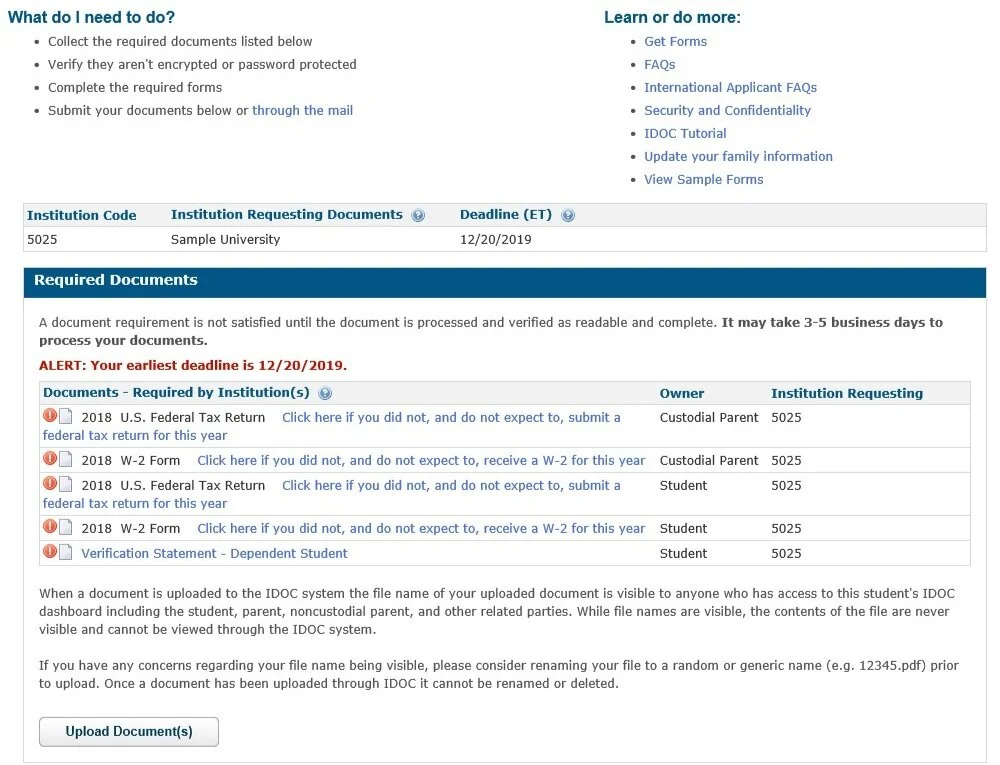
Two details on that screen matter for an eight-week plan. First, a requirement is not satisfied until the file is processed and readable, and the interface itself warns that review may take 3–5 business days. Uploading on deadline day is a miss. Second, file names are visible to anyone with dashboard access, while file contents are not, so families should rename documents to generic labels before upload.
International households often will not have U.S. Form 1040 or a W-2. The analog is usually a translated tax return, employer letter, or business statement the college names in its CSS or IDOC instructions. AI is useful for building that crosswalk:
"Here are five colleges on my list and their aid instructions. Make a table with columns for CSS Profile, IDOC, institutional form, non-U.S. tax documents, translations, and latest safe upload date assuming 5 business days of processing. Flag any college that does not give institutional aid to international students."
Jenova will not file CSS Profile or IDOC for you. That is a feature, not a gap: aid applications contain tax identifiers and should stay on official portals. The agent's limitation is the same as its value. It can prevent a missed document; it cannot certify one.
FAFSA, which appears on many U.S. senior-year calendars, is generally not the international student's primary form. Institutional aid runs through CSS Profile and campus forms. Scholarship search on BigFuture and dedicated engines can run in the background, but they should not displace the CSS/IDOC calendar in weeks 3 through 6.
How Do You Run an Eight-Week AI-Assisted Application Sprint?
You run the sprint by freezing the college list and recommender names in week 1, writing in weeks 2–5, moving money documents in weeks 3–6, and leaving week 8 as a submission-and-verification buffer. Starting from late August 2026, that cadence reaches a November 1 Early Action or Early Decision date; it is too late for a first SAT if scores are mandatory and no sitting remains.
Week 1 — Constraints and asks. Open Jenova's College Admissions Consultant at jenova.ai/a/college-admissions-consultant and state citizenship, curriculum, scores, budget, and the earliest deadline. Create the Common App account with a long-lived personal email, using the legal name on passports and score reports. Invite recommenders after FERPA. Send teacher emails within four days.
Week 2 — List lock and story inventory. Cut the list to 8–12 colleges. Pull every supplement prompt. Dictate 10 unedited stories into the agent. Begin CSS Profile data collection in home currency.
Weeks 3–4 — Personal essay and aid packet. Lock a personal-essay draft. Upload or request translations of tax documents. If a college uses IDOC, create the locker and rename files. Sit any last English-proficiency exam.
Week 5 — Supplements and score sends. Write "Why us?" essays with catalog-level specifics. Order official TOEFL, IELTS, SAT, or ACT sends. Confirm the counselor has the School Report path, especially if Naviance is required.
Week 6 — Forms and fees. Complete Common App activities, honors, and family sections. Pay or waive fees. Submit CSS Profile to every college that both requires it and awards international aid.
Week 7 — Human reread. Read every essay aloud. Confirm recommender green checks. Recheck testing policies one college at a time.
Week 8 — Submit and watch portals. Submit ED or EA at least 72 hours early. Track IDOC or institutional document status daily. Do not treat "uploaded" as "processed."
Common App submission is still review, pay if required, then submit. For the Common App side of the same sprint, start with their first-year checklist rather than inventing a second system. The free Jenova tier covers limited daily usage; Plus starts at $20/month with 30× the free allowance if the revision volume is high.
A week-1 kickoff prompt that keeps the five tracks visible:
"Build an eight-week Gantt-style plan with five swimlanes: list, essays, recommendations, finances, official verification. Earliest deadline 1 November. Assume two teacher recs, CSS Profile for six colleges, IDOC for two, TOEFL already sent, transcripts from a non-U.S. school that need certified translation. Put owner, dependency, and latest start date on every task."
If the student still needs score gains, insert the TOEFL/IELTS Tutor or SAT/ACT Tutor in weeks 1–3 only. After week 4, further testing usually endangers the file more than it helps it.
What Do Admissions Consultants Say About Compressed International Timelines?
Admissions practitioners treat eight weeks as an execution window for students who already have a transcript, a testing story, and teachers who know them — not as a substitute for two years of counseling.
"The international files that survive a two-month sprint share one property: the student already has relationships and records. AI can sequence a CSS Profile, a brag sheet, and nine supplements. It cannot manufacture a counselor who has never met the applicant or a four-year activity history that was never documented. We tell families to spend week 1 on people and portals, not on polishing the first sentence of the personal essay."
"The second pattern we see is aid-document lag. Colleges do not read an uploaded PDF the minute the progress bar finishes. Institutional portals routinely take several business days to verify that a file is complete and readable. An eight-week plan that submits IDOC or a translated tax packet on the deadline is, in practice, a late plan. Build a five-day buffer after every official upload, and treat 'processed' — not 'submitted' — as the true finish line."
"On essays, the useful role for a model is interrogation. The unused question is almost always more valuable than a rewritten paragraph. If an agent cannot point to a sentence that only this student could have written, the draft is not ready, regardless of how fluent the English has become."
— Jenova Product Team, undergraduate admissions tooling, working with international application workflows across multiple U.S. cycles
That view matches the comparison above. Use Jenova to keep five tracks honest. Use Common App to send the file. Use College Board systems for money documents. Use teachers for the letters no model should write.
References
- Common App — Application guide for first-year students
- ManageBac — University Admissions Timelines 2026–27
- Yocket — USA Universities Application Deadlines for 2026–27
- College Essay Guy — U.S. College Application Timeline for International Students
- Cialfo — Top 10 Tools to Simplify College Admissions Planning
- Common App Support — How is the Common App different for international applicants?
- College Board BigFuture — College Search
- Common App Support — What is a Common App fee waiver?
- All-Out Education — Common App Playbook for International Students
- MIT Admissions — How to write good letters of recommendation
- ACT — How to Ask for a Letter of Recommendation for College
- Common App — Recommender guide
- College Board — CSS Profile for International Applicants
- Washington University in St. Louis — International Applicant Financial Aid Process
- College Essay Guy — Financial Aid Guide for International Students