How Can AI Create a Stock Research Template With Invalidation Rules?
2026-08-24
What Five Fields Separate a Decision-Ready Thesis From a Recap?
A usable AI stock research template is not a company summary. It is a written contract that states what must be true to own the stock, what will change the price, what can break the idea, and when you will re-check the evidence. In 2026, tools such as Jenova’s Fundamental Stock Analyst, Fiscal.ai, Seeking Alpha, and AlphaSense can all accelerate the research, but only a structured template turns that output into a decision you can audit later.
The five fields that make a thesis decision-ready rather than merely informative:
✅ Entry assumptions — the 3–5 facts that must remain true for the position to exist ✅ Catalysts — dated events that can close the gap between price and value ✅ Risks — material threats drawn from filings, competition, and balance-sheet stress ✅ Invalidation conditions — pre-committed exit rules, not feelings after a drawdown ✅ Review dates — calendar checkpoints tied to earnings, filings, and thesis half-life
This article uses those five fields as an evaluation frame — call it the ACRIR contract (Assumptions, Catalysts, Risks, Invalidation, Review). The rest of the piece shows how to generate that contract with AI, where competing tools help or fall short, and how to keep the template honest after you buy.

Why Do Most Stock Research Notes Fail After the First Earnings Print?
Most notes fail because they describe the company instead of specifying what would prove the buyer wrong. After a few weeks, the original reason for owning the stock blurs into price action, social-media narratives, and recency bias. That is a process failure, not a forecasting failure.
FINRA’s stock-evaluation guidance starts with durable questions: how the company makes money, how it has performed, how much debt it carries, and what industry and macroeconomic risks it faces. Those questions are still the right ones. The problem is that unstructured notes do not force an answer that can be checked after the next 10-Q or 10-K.
The cost of that sloppiness shows up at scale. S&P Dow Jones Indices’ SPIVA U.S. Scorecard found that 79% of actively managed large-cap U.S. equity funds underperformed the S&P 500 in 2025. Individual investors do not have a research desk to absorb that error rate. A written invalidation rule is one of the few cheap ways to reduce thesis drift.
AI does not fix the incentive to rationalize a losing position. It does make it cheap to write the contract before you are emotionally invested, then reopen the same document on a scheduled review date.
What Should You Look for in an AI Stock Research Workflow?
You should look for a workflow that can ground claims in primary filings, force numbered assumptions, and produce an output you can reuse on the next ticker without rewriting the prompt from scratch. Speed without structure just produces longer, more confident recaps.
A practical checklist for 2026:
- Primary-source grounding. The model should work from 10-K risk factors, earnings transcripts, and consensus estimates, not from memory of last quarter’s headlines. Investor.gov treats public disclosure as the raw material investors use to make informed decisions.
- Assumption hygiene. Every bullish claim should be labeled as an assumption, an observed fact, or a forecast. Mixing those three is how templates become marketing copy.
- Catalyst specificity. “Margin expansion” is not a catalyst. “Gross margin +150 bps by Q2 FY27 on mix shift already visible in segment data” is.
- Pre-committed invalidation. Price stops can be part of the rule, but fundamental invalidation — a broken unit-economics assumption, a lost customer concentration, a failed trial — matters more for multi-quarter holds.
- Review cadence. Earnings dates, 10-K publication, and a 90-day thesis audit should be written into the template, not left to memory.
- Memory across sessions. A tool that forgets last month’s assumptions cannot tell you whether the thesis is intact.
AlphaSense’s 2026 research-tools survey frames the industry shift clearly: the bottleneck is no longer access to information, but extraction of a signal from filings, transcripts, broker notes, and news. That is the job a template is supposed to finish.
How Do Jenova, Fiscal.ai, Seeking Alpha, and AlphaSense Compare on Thesis Construction?
Jenova’s Fundamental Stock Analyst is strongest when you want a reusable, five-field thesis written in one conversation and remembered across later reviews. Fiscal.ai is stronger as a desktop data terminal with an AI copilot over deep financials. Seeking Alpha is stronger for reading other humans’ bull and bear cases. AlphaSense is stronger when you need licensed premium content at enterprise scale.
None of these tools replaces fundamental analysis of revenue, earnings, growth, return on equity, margins, and valuation multiples. They change how fast you can assemble the evidence and how consistently you can format it.
| Feature / Dimension | Jenova Fundamental Stock Analyst | Fiscal.ai | Seeking Alpha | AlphaSense |
|---|---|---|---|---|
| Thesis / template output | Structured ACRIR-style notes with persistent follow-ups | AI copilot over statements and KPIs; you still assemble the memo | Contributor theses plus quant ratings; format varies by author | Generative search, Deep Research, and workflow agents that draft profiles and decks |
| Source grounding | SEC filings, estimates, live web/search, user-uploaded documents | Institutional financials and segment KPIs in-platform | Transcripts, contributor research, quant scores | Licensed library of 500+ million premium documents plus internal content |
| Session memory / review tracking | Persistent cross-session memory; prior assumptions can be re-tested | Platform history and watchlists; less of a personal thesis ledger | Watchlists and saved articles; thesis tracking is manual | Persistent agent memory and scheduled workflow agents (enterprise) |
| Pricing (as of 2026) | Free tier; paid plans from $20/month | Free tier; Pro about $39/month billed annually | Free (limited); Premium about $299/year | Enterprise / sales-led; not a retail subscription |
| Best for | Individual investors who want a repeatable written contract per name | Desk-based fundamental work with KPI depth | Stress-testing a view against other investors | Institutional teams that need licensed content and compliance |
Sources for competitor capabilities and pricing: Barebone’s 2026 app comparison and AlphaSense’s 2026 tools guide.
Jenova Fundamental Stock Analyst
The agent is built for earnings analysis, relative valuation, business-model assessment, and current data across SEC filings, analyst estimates, and market sentiment. On the Jenova platform it can keep unlimited chat history, remember prior assumptions, and attach 10-Ks or your own models so later reviews start from the same contract.
The honest limitation is content scope. It does not license a broker-research universe on the scale AlphaSense describes, and it is not a 15-year KPI terminal in the Fiscal.ai sense. It is also not a brokerage. The output is a research artifact, not an execution ticket.
Fiscal.ai
Fiscal.ai (formerly FinChat) layers an AI copilot on institutional-grade statements and segment KPIs — subscriber counts, store counts, product-line revenue — that generic chatbots do not carry. The copilot is grounded in its own dataset, which reduces invented figures relative to an ungrounded model.
The limitation is workflow shape. It is web-first with no native mobile app in the 2026 comparison, and it will not automatically impose invalidation language unless you ask. It is a strong evidence engine, a weaker thesis-contract enforcer.
Seeking Alpha
Seeking Alpha remains the largest public library of long-form bull and bear cases, with quant ratings and transcripts around those narratives. Premium access was about $299 per year after its latest increase.
The limitation is variance. Contributor quality is uneven, conflicts are not always obvious, and FINRA warns that research outside broker-dealer rules may not carry the same conflict disclosures. Use it to pressure-test a template, not to outsource one.
AlphaSense
AlphaSense is built for teams that need licensed filings, expert transcripts, broker research, and agentic workflows over that corpus. Its 2026 write-up highlights generative search with citations, Deep Research, custom workflow agents, and an always-on agent with persistent memory.
The limitation is fit. It is an enterprise research platform, not a $20 personal template tool. If you do not need a 500-million-document library or internal-content ingestion, you will pay for infrastructure you will not use.
TIKR sits just outside this table as a pure data complement: Plus at $24.95/month and Pro at $54.95/month, deep global statements, no native app, and no thesis engine. Pair it with an AI writer if your bottleneck is history, not structure.
How Should AI Encode Entry Assumptions and Catalysts?
AI should encode entry assumptions as falsifiable statements with an owner, a source, and a review date — and encode catalysts as dated events with a transmission mechanism, not as slogans. If the model cannot name the filing, the segment, or the date, the field is unfinished.
Street of Walls frames catalysts as the specific drivers that cause a company to beat earnings: higher revenue, higher margins, lower interest expense, buybacks. Behavioural Investment is more skeptical, noting that naming a catalyst in advance is hard because you are specifying a driver of a change in the return profile, not just a news event. Both views belong in the template. Soft catalysts are allowed; unlabeled hopes are not.
A clean assumption block looks like this:
- Fact — FY25 services revenue was $X (10-K, p. Y).
- Assumption — services mix reaches Z% by FY27.
- Forecast — consensus EPS is $A; the thesis needs $B.
- Why the market disagrees — the gap the pitch must explain, as Mergers & Inquisitions requires in a stock pitch.
- What would change my mind this quarter — one number, not a paragraph.
Prompt the model to refuse vague catalysts. A useful instruction:
“List only catalysts with a date or date window, a filing or event source, and a one-sentence mechanism from the event to free cash flow or multiple expansion. If you cannot name those three, mark the item as a theme, not a catalyst.”
Consensus earnings estimates belong in this section as a baseline, not as the thesis. The template should state whether you are underwriting the consensus, a beat, or a multiple re-rating with unchanged earnings. Those are three different trades.
For timing and price structure, Jenova’s Technical Stock Analyst can add defined invalidation levels from market structure — prior swing lows, volume shelves, failed breakouts — so the fundamental contract and the chart contract do not contradict each other.
How Do You Write Invalidation Conditions That You Will Actually Follow?
You write invalidation as a short list of observable breaches, each tied to an action, written before you have a P&L. If the rule requires judgment you will not make under stress, it is decoration.
Trefis treats invalidation as discrete impending events — legislative risk, litigation outcomes, demand shocks — not as “the story feels worse.” That event-based style is what AI is good at extracting from Item 1A risk factors in a 10-K.
Three layers keep the field usable:
- Fundamental invalidation. The unit-economics assumption fails for two consecutive reports. A key customer, indication, or geography that was 20%+ of the thesis is lost. Net debt / EBITDA crosses a pre-set ceiling.
- Valuation invalidation. The multiple you underwrote is no longer available even if the operating case is intact — for example, the peer group de-rates and your “cheap vs. history” claim disappears.
- Process invalidation. You cannot explain the position in five sentences using the original assumptions. If the story has been rewritten twice, you no longer have the original trade.
Price can be a backstop. It should not be the only rule. A 15% drawdown with intact assumptions is volatility. Intact price with a broken assumption is a thesis that has already failed.
A prompt that produces better rules:
“From the 10-K risk factors and the last two earnings calls, propose five invalidation conditions. Each must be observable in public data within one reporting period. Pair each condition with: trim 50%, exit 100%, or re-underwrite. Do not use adjectives like ‘deteriorating sentiment.’”
ThesisLoop’s validation workflow makes the same point in research terms: map assumptions, evidence, counterevidence, catalysts, and decision checkpoints. Invalidation is just the checkpoint you agree to honor.
How Do You Generate a Full Stock Research Template With AI in One Session?
You generate it by forcing the model through a fixed sequence — screen, verify, read the latest print, map competition, value, extract risks, then write the thesis — and by refusing a finished memo until all five ACRIR fields are populated. A 75-minute pass is realistic if you do not wander.
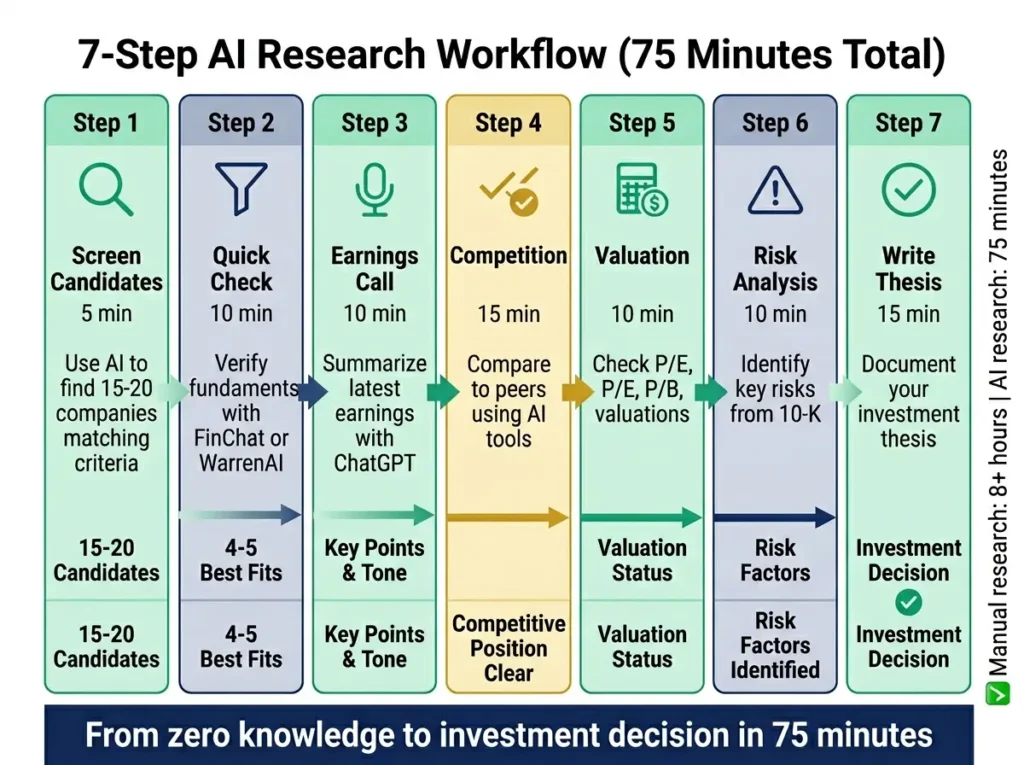
The sequence above compresses a manual day of work into timed blocks: screen 15–20 names, keep four or five, summarize the latest call, place the company versus peers, check valuation, pull 10-K risks, then write. FINRA still wants the same raw ingredients — business model, historical performance, leverage, industry position — so the AI step is compression, not substitution.
For Jenova’s Fundamental Stock Analyst, a single-session build looks like this:
- Open the agent and state the mandate, not just the ticker.
- Attach the latest 10-K, 10-Q, and earnings deck if you have them.
- Paste a template-forcing prompt:
“Build an ACRIR stock research template for [TICKER]. Mandate: [long-only / 12-month hold / max 3% position]. Fill these fields only: (1) business in five sentences, (2) five entry assumptions labeled Fact / Assumption / Forecast with sources, (3) three dated catalysts with transmission mechanisms, (4) five material risks from the 10-K with page references, (5) four invalidation conditions with actions, (6) review dates tied to the next earnings date and the next 10-K, (7) valuation using P/E, P/S, and D/E versus three named peers. If a field lacks a source, write Unverified.”
- Ask one adversarial pass:
“Now argue the bear case using only the risks and invalidation fields. Tell me which single assumption, if wrong, kills the thesis.”
- Save the output as the living document. On the review date, paste the same template back and ask what broke.
On Fiscal.ai, the same session starts in the financials and KPI library, then you export numbers into the ACRIR fields yourself. On Seeking Alpha, you read one high-quality bull and one high-quality bear, then write your invalidation rules — do not inherit the author’s. On AlphaSense, a workflow agent can draft the company profile; you still have to type the exit rules, because a generated deck will not feel the loss for you.
A compact template you can reuse:
| Field | What to write | Example prompt fragment |
|---|---|---|
| Entry assumptions | 3–5 numbered claims, each tagged Fact / Assumption / Forecast | “Cite the filing or estimate source beside each line.” |
| Catalysts | Date, event, mechanism | “No catalyst without a date window.” |
| Risks | Filing-backed, ranked by thesis damage | “Start from Item 1A, not from headlines.” |
| Invalidation | Observable breach + action | “Use numbers a third party could check.” |
| Review dates | Earnings, 10-K, 90-day audit | “Put ISO dates, not ‘next quarter.’” |
Kubera’s thesis guide treats a thesis as a discipline rather than a document. The AI’s job is to make that discipline cheap enough that you actually practice it on every name, including the ones you already own.
After the single-name template exists, Jenova’s Portfolio Management Strategist is the logical next pass: position size, factor overlap, and what happens to the book if two invalidation rules trip in the same month.
What Do Equity Analysts Say About AI-Generated Investment Theses?
Analysts who use AI well treat it as a clerk and a critic, not as a portfolio manager. The model is valuable when it makes assumptions visible and cheap to re-test; it is harmful when it produces a fluent memo that no one can falsify.
"The failure mode we see is not hallucination of a ticker. It is a beautifully written thesis with no owner for each assumption. If the model says 'management execution remains strong,' that sentence cannot be reviewed on a date. If it says 'gross margin stays above 42% in the next two prints or we exit,' a junior analyst — or the same investor three months later — knows exactly what to do."
"We also insist on a second pass that only looks for disconfirming evidence. The first draft of any AI memo is a confirmation machine. The useful draft is the one that ranks the two or three public facts that would retire the idea. That is the difference between a research assistant and a risk tool."
"Review dates are the unglamorous field that saves accounts. Most people will not re-read a 12-page note. They will re-read a half-page contract if the calendar throws it back at them the night before earnings. Build for that behavior."
— Jenova Product Team, equity-research workflow design, 8 years building analyst-facing AI tools
That view lines up with older process literature. Reasonable Deviations’ equity checklist already treated earnings reports as the default catalyst and asked investors to write the checklist before the print. AI does not change the checklist. It removes the excuse that writing it takes all afternoon.
How Should Review Dates and Position Monitoring Work After You Buy?
Review dates should be event-driven first and calendar-driven second: the next earnings release, the next 10-K, any catalyst window you underwrote, plus a 90-day full re-read whether or not news hit. Between those dates, you monitor only the assumptions you wrote down — not every headline.
A workable cadence:
- T+1 after earnings. Update Facts. Mark each Assumption as intact, weakened, or broken. Do not rewrite the thesis from scratch unless an invalidation rule tripped.
- Catalyst window. If the dated event passes and the mechanism did not show up in the numbers, retire that catalyst. Do not silently replace it with a new story.
- 90-day audit. Re-run valuation versus the same peers. If the cheapness claim depended on a multiple that no longer exists, that is valuation invalidation even if operations are fine.
- Annual 10-K pass. Re-extract Item 1A. New risk language is often the first honest admission that last year’s template is stale.
Persistent memory is the practical advantage here. A chat that still contains last quarter’s ACRIR fields can answer a narrow question — “Did assumption 3 survive this print?” — without regenerating a 2,000-word memo. Tools that start from a blank prompt every session quietly encourage thesis rewriting, which is how invalidation dies.
Two monitoring errors show up constantly. The first is checking the stock more often than the assumptions. The second is adding new bullish assumptions after a gain so the position can never be invalidated. The template’s job is to make both errors visible.
If you hold several names, keep one index of review dates rather than trusting each chat. The portfolio layer is where correlated invalidation appears — two retailers with the same consumer-credit assumption, two software names with the same net-new-ARR claim.
Which Investor Profiles Should Use Which AI Research Setup?
Use Jenova when you need a written, reusable contract and will actually reopen it; use Fiscal.ai when your bottleneck is statement and KPI depth at a desk; use Seeking Alpha when you need opposing human arguments; use AlphaSense when licensed content and team workflow are the product.
A more specific matching:
- Solo long-term investor, 8–20 names. Fundamental Stock Analyst plus a single ACRIR doc per ticker. Free or $20/month Plus is usually enough if you are not screening all day.
- Statement-heavy analyst who lives in browsers. Fiscal.ai or TIKR for history, then paste key lines into an AI template. Do not expect those terminals to remember your invalidation language.
- Investor who thinks by arguing. Seeking Alpha for the opposing memo, then your own four invalidation lines. Budget for Premium if you read more than a few names a month.
- Team with compliance and shared drives. AlphaSense, because internal notes, licensed research, and scheduled agents are the job. A personal chat tool will not clear that bar.
- Chart-first swing trader. Technical Stock Analyst for structure and stops, with a shorter ACRIR — two assumptions, one catalyst, one hard invalidation. A 12-month thesis template is the wrong artifact.
The common mistake is buying the most expensive research surface and still keeping assumptions in your head. The cheapest setup that writes invalidation down will beat the richest setup that does not.
AI can create a stock research template that holds up only if you make it complete the contract: entry assumptions, dated catalysts, filing-backed risks, observable invalidation, and review dates. Everything else is a briefing. Briefings feel like work. Contracts are what you can still use after the first earnings print.
References
- FINRA — Evaluating Stocks (10-K/10-Q, EPS, P/E, P/S, D/E, research conflicts)
- Investor.gov — Disclosure
- ETF Trends — SPIVA U.S. Scorecard: 79% of active large-cap funds underperformed the S&P 500 in 2025
- S&P Dow Jones Indices — SPIVA
- AlphaSense — Top Stock and Investment Research Tools for 2026
- Barebone AI — Best Stock Research Apps in 2026 (Fiscal.ai, Seeking Alpha, TIKR, Koyfin pricing and capabilities)
- Investopedia — Essential SEC Filings and Fundamental Analysis Inputs
- Investopedia — The Role of Earnings Forecasts in Stock Valuation
- Mergers & Inquisitions — Stock Pitch Guide
- Street of Walls — Building an Investment Thesis
- Behavioural Investment — The Curious Case of Catalysts
- Trefis — Events That Could Invalidate a Thesis
- ThesisLoop — Investment Thesis Validation Workflow
- Kubera — How to Build an Investment Thesis
- Reasonable Deviations — Equity Investing Checklist