How Can AI Calm You Down Before a Stressful Presentation?
2026-08-20
The fifteen minutes before you present are the hardest part. Your heart rate climbs, your thoughts spiral toward worst-case scenarios, and generic advice like "just breathe" collapses under the weight of an actual deadline. AI tools can now compress three distinct interventions — paced breathing, cognitive restructuring, and concrete coping planning — into a single five-to-ten-minute session you can run from your phone in a stairwell.
What Three Interventions Actually Reduce Pre-Presentation Anxiety, and Can AI Deliver Them?
Effective pre-presentation anxiety management combines three evidence-based components: a paced breathing protocol to lower physiological arousal, a structured cognitive restructuring exercise to test catastrophic predictions against evidence, and an if-then coping plan for the specific failure scenarios you fear. Conversational AI tools like Jenova's Public Speaking Coach, ChatGPT, and dedicated apps such as Orai can each deliver parts of this stack, but they differ substantially in which parts they handle well.
Key factors that separate a genuinely useful AI pre-presentation session from a generic pep talk:
✅ Real-time pacing, not instructions — the difference between being told "inhale for four seconds" and being counted through it turn by turn ✅ Structured cognitive restructuring — following an actual thought record protocol with evidence-for and evidence-against columns, not just reassurance ✅ Context capture — knowing your audience, stakes, and specific fear before generating coping steps ✅ Session memory — carrying your distortion patterns from last month's presentation into today's session ✅ Distortion labeling — naming the specific thinking pattern (catastrophizing, mind reading) rather than dismissing the thought
The three interventions map to different capability requirements, and no single tool leads on all three. Understanding which requirement matters most for your situation is the fastest route to picking the right one.
Why Does Breathing Before a Presentation Actually Work?
Slow, paced breathing reduces the physiological arousal that feeds anxious cognition — and the research is specific about what works. A systematic review of breathing practices for stress and anxiety reduction published in PMC found that effective breath practices "avoided fast-only breath paces and sessions <5 min, while including human-guided training, multiple sessions, and long-term practice." The five-minute threshold is not arbitrary.
A Stanford-affiliated study on brief structured respiration practices published in Cell Reports Medicine found that daily five-minute breathwork improved mood and reduced anxiety, with breathwork outperforming mindfulness meditation on both mood improvement and physiological arousal reduction. Greater Good Science Center at UC Berkeley reported the same finding for cyclic sighing specifically.
The mechanism matters for tool selection. Extended exhalation — where the out-breath is longer than the in-breath — is the common thread across the techniques the NHS recommends for stress. Any AI tool guiding you through breathwork should be pacing an asymmetric pattern, not just telling you to "breathe deeply."
Which Breathing Pattern Should AI Guide You Through Before Presenting?
For pre-presentation nerves specifically, box breathing is the strongest default — it improves focus while calming arousal, whereas 4-7-8 breathing is optimized for winding down and can leave you flatter than you want to be walking onstage.
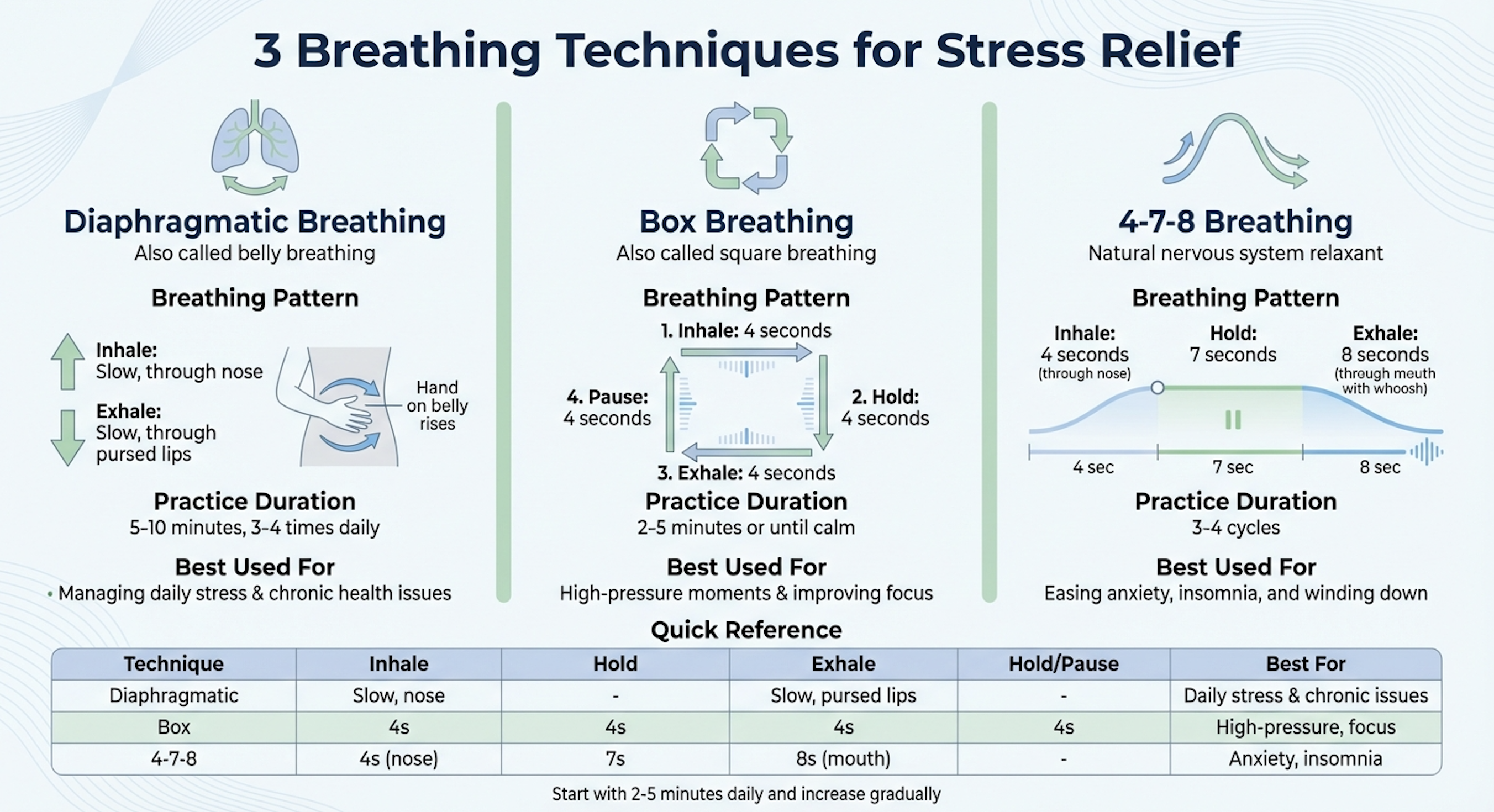
The three techniques serve different purposes:
- 📦 Box breathing (4-4-4-4) — Four seconds each for inhale, hold, exhale, and pause. Practice for 2-5 minutes or until calm. Best for high-pressure moments and improving focus. This is the pre-presentation choice.
- 🫁 Diaphragmatic breathing — Slow nasal inhale, slow exhale through pursed lips, hand on belly to confirm the belly rises. Practice 5-10 minutes, 3-4 times daily. Best for managing baseline daily stress rather than acute spikes.
- 🌙 4-7-8 breathing — Inhale 4 seconds through the nose, hold 7, exhale 8 through the mouth with a whoosh. Run 3-4 cycles. Best for easing anxiety, insomnia, and winding down — which is why it is a better night-before tool than a five-minutes-before tool.
The BBC's review of breathwork techniques covers cyclic sighing, box breathing, 4-7-8, and coherent breathing as the four with the strongest evidence base for rapid stress reduction.
Prompting an AI to actually pace you — the difference between instruction and guidance is entirely in how you ask. With Jenova's Public Speaking Coach:
"I present in 12 minutes. Walk me through five minutes of box breathing — count me through each cycle one message at a time, don't give me the instructions all at once. Then check my anxiety level before we move on."
The one-message-per-cycle constraint is what converts a text interface into a pacing device. Without it, most AI tools will hand you a paragraph of instructions and consider the job done.
How Can AI Identify Catastrophic Thoughts You Haven't Named Yet?
AI can surface catastrophic thoughts by running a structured Socratic sequence — asking what specifically you predict will happen, then what that would mean, then what that would mean — until the underlying prediction surfaces in a testable form. The value is not the AI's insight; it is that a conversational agent will ask the follow-up question a worksheet cannot.
The NHS thought record protocol uses seven prompts: the situation, initial feelings, unhelpful thoughts, evidence supporting them, evidence against them, alternative realistic thoughts, and how you feel afterward. Psychology Tools describes thought records as the mechanism by which patients "capture, evaluate, and restructure their negative automatic thoughts."
Research on the mechanism is encouraging but not unqualified. A study on the effects of completing a thought record on affect published in Psychiatry Research examined exactly this, and a PMC review of cognitive restructuring and psychotherapy outcome notes that therapists typically anchor the exercise with the question, "What is the evidence that the automatic thought is true or not true?"
The distortions that dominate presentation anxiety — worth knowing so you can spot them before the AI does:
| Distortion | What It Sounds Like | The Testable Claim Underneath |
|---|---|---|
| Catastrophizing | "I'm going to mess up" | A specific error will occur and will be unrecoverable |
| Mind reading | "Everyone will think I'm not smart" | Audience members will form and hold a specific negative judgment |
| All-or-nothing thinking | "I always make a fool of myself" | Any imperfection equals total failure |
| Fortune telling | "This will tank my promotion" | One presentation determines a multi-factor outcome |
| Emotional reasoning | "I feel unprepared, so I am unprepared" | Felt anxiety is evidence of actual inadequacy |
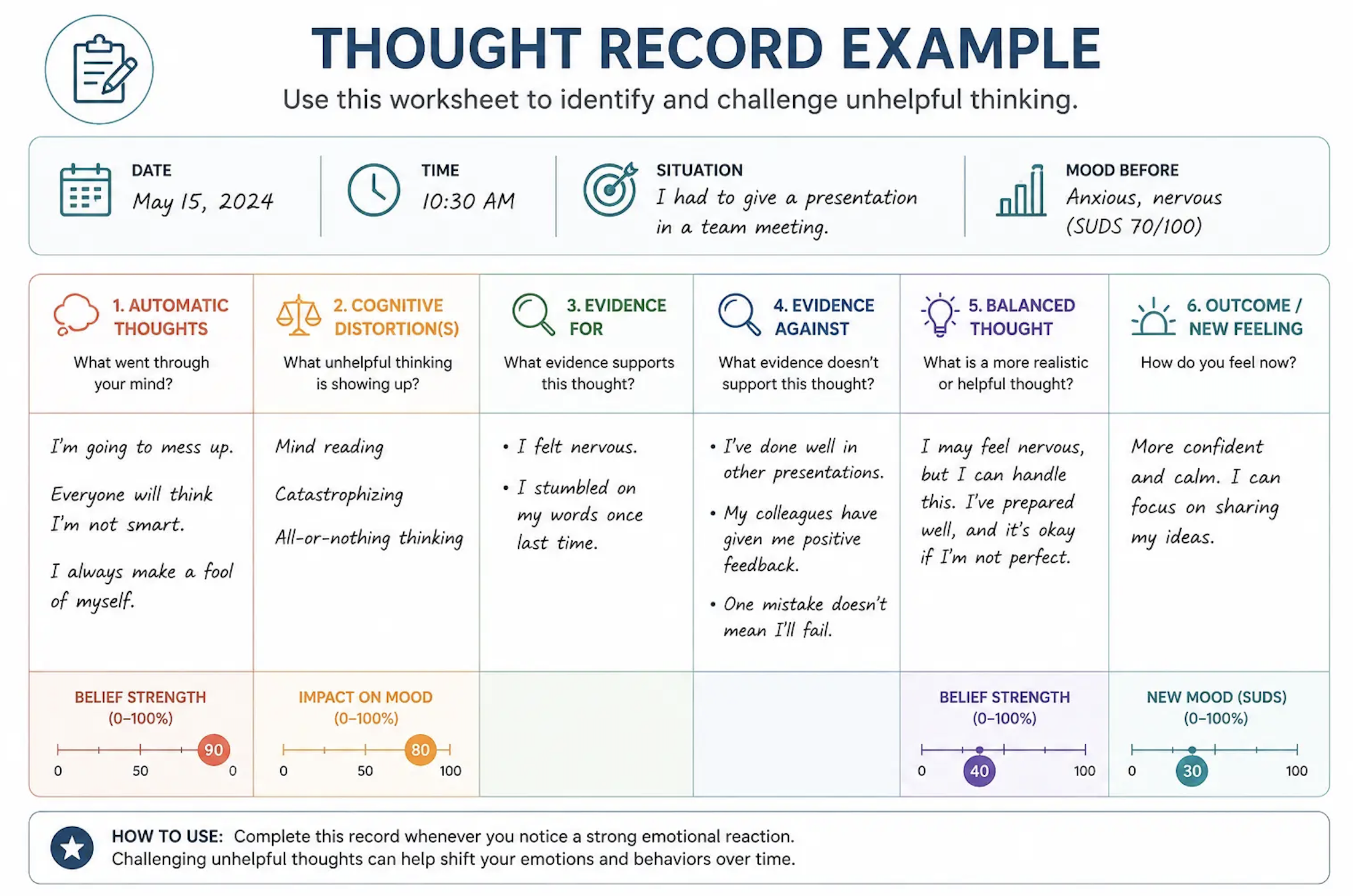
The thought record example above works through exactly this pattern. The automatic thoughts — "I'm going to mess up," "Everyone will think I'm not smart," "I always make a fool of myself" — get labeled as mind reading, catastrophizing, and all-or-nothing thinking. Belief strength starts at 90/100 and impact on mood at 80/100.
How Do You Run a Thought Record With an AI in Under Five Minutes?
The fastest route is to give the AI the full worksheet structure up front and ask it to walk you through one column at a time, so you are answering questions rather than filling in a form from memory.
A working prompt:
"Run me through a CBT thought record for presentation anxiety. Situation: I'm presenting Q3 numbers to my team in 20 minutes and the numbers are bad. Ask me one column at a time — automatic thoughts, then distortions you spot, then evidence for, then evidence against, then a balanced thought. Rate my belief strength 0-100 at the start and end."
What the AI should produce at each step, using the worksheet example as the model:
- Automatic thoughts — You supply these. The AI's job is to keep asking "and what else?" until you run out.
- Distortion labeling — The AI names the pattern. In the example: mind reading, catastrophizing, all-or-nothing thinking.
- Evidence for — Genuine supporting evidence, not dismissal. The example lists "I felt nervous" and "I stumbled on my words once last time." A good AI will not argue with these.
- Evidence against — "I've done well in other presentations," "My colleagues have given me positive feedback," "One mistake doesn't mean I'll fail."
- Balanced thought — Not a positive affirmation. The example produces: "I may feel nervous, but I can handle this. I've prepared well, and it's okay if I'm not perfect."
- Re-rating — In the example, belief strength drops from 90 to 40, and SUDS distress from 70/100 to 30/100.
The failure mode to watch for: most general-purpose AI assistants skip step 3 entirely and jump straight to reassurance. That short-circuits the mechanism — the exercise works because you generate evidence against a thought you have already taken seriously, not because someone tells you the thought is wrong. If your AI does this, prompt it explicitly: "Don't reassure me yet. First give me the strongest honest case FOR my thought being true."
What Makes an AI-Generated Coping Plan Actually Usable?
A usable coping plan is a short list of if-then statements tied to the specific failure scenarios you named in the thought record — not general advice about staying positive. The link between the two exercises is what makes the plan concrete.
Clinical sources treat this as standard practice. Pinnacle Therapy recommends spending "five minutes practising slow, deep breathing exercises to calm nerves before your presentation begins" as part of a broader CBT approach, and Dr. Julie Kolzet's overview of CBT for public speaking fear pairs breathing techniques with mindfulness practices aimed at "staying present instead of imagining worst-case" outcomes.
The evidence base for CBT itself is strong. A PMC review of cognitive-behavioral treatments for anxiety and stress-related disorders describes CBT as a family of techniques targeting the maladaptive thoughts and behaviors that maintain anxiety over time. Research from Northeastern University on automated interventions for public speaking anxiety notes that while CBT is effective for public speaking anxiety, few people seek it out — the access gap that AI tools are attempting to close.
A worked example. Feed the AI your thought record output:
"Based on the thought record we just did, give me five if-then coping statements. Each one should name a specific thing that could go wrong and what I'll do in the moment. Keep each under 20 words so I can memorize them."
Expected output shape:
- If I lose my place → I pause, look at my notes for three seconds, and continue. Silence reads as composure.
- If someone asks a question I can't answer → "Good question — let me get you an accurate number after this."
- If my voice shakes in the first minute → I slow down and lengthen my exhale. It resolves by slide two.
- If I see a bored face → One person's expression is not the room's verdict. I look at someone engaged.
- If I finish early → I open for questions rather than padding.
The 20-word constraint matters. A coping plan you cannot recall under arousal is not a coping plan.
How Do the Main AI Options Compare for Pre-Presentation Anxiety?
No tool covers all three interventions equally. Dedicated speech apps handle delivery feedback but not cognitive work; general assistants handle the cognitive work but lack context persistence; specialized coaching agents sit between them.
| Dimension | Jenova Public Speaking Coach | ChatGPT / Claude (general) | Orai | Yoodli | Microsoft Speaker Coach |
|---|---|---|---|---|---|
| Paced breathing guidance | Turn-by-turn on request; text-paced, not audio | Turn-by-turn on request; text-paced | Not offered | Not offered | Not offered |
| CBT thought record | Structured, with distortion labeling and re-rating | Capable but tends to skip evidence-for column unless prompted | Not offered | Not offered | Not offered |
| Coping-step generation | Tied to prior thought record in same session | Strong within a session | Not offered | Not offered | Not offered |
| Delivery feedback | Content and structure coaching; no audio analysis | Content only | Filler words, pace, clarity, energy scoring (per Orai) | Recording library, pacing, eye contact (reviewed by Duarte) | Timing, pace, pitch, fillers, repetition |
| Cross-session memory | Persistent across sessions | Varies by product tier and settings | Streaks and trend tracking | Recording library retained | None — reports vanish on close (per Duarte) |
| Pricing | Free tier available; Plus $20/mo | Free and paid tiers | Free with paid tiers | Free and paid tiers | Included with PowerPoint |
| Best for | Combined cognitive + delivery prep in one thread | Ad-hoc thought records with no setup | Filler-word and pace drilling | Recorded rehearsal review | Quick rehearsal metrics inside a deck |
Honest limitations across the category:
- Jenova's Public Speaking Coach is text-based. It cannot analyze your recorded audio for filler words or pace, and its "paced" breathing is turn-by-turn text rather than an audio metronome — less immersive than a dedicated breathing app. It also carries no clinical credentialing.
- General assistants default to reassurance over structured restructuring. They require explicit prompting to run a real thought record and typically lack persistent memory of your recurring distortion patterns.
- Orai scores delivery mechanics well but offers nothing for the cognitive side of anxiety.
- Yoodli's feedback can be generic — Duarte's tester noted it recommended pausing more without indicating where, and that its averaged pacing metric rated deliberately erratic speech as "conversational" and "relaxed."
- Microsoft Speaker Coach discards rehearsal reports permanently once closed, eliminating progress comparison.
- All AI tools share a context problem. Duarte's review found that most platforms "can't collect contextual details to inform their feedback," producing advice like "smile more" for a presentation about declining revenue. Conversational agents partially close this gap because you can state the context — but only if you actually do.
What Does a Complete Ten-Minute Pre-Presentation Session Look Like?
A full session runs roughly ten minutes: five for breathing, three for the thought record, two for coping steps. Here is the sequence with the prompts that make it work.
Minutes 0-5 — Paced breathing.
"I present in 15 minutes and my anxiety is about 75 out of 100. Count me through box breathing — four in, four hold, four out, four pause. One cycle per message. Stop after five minutes and ask me to re-rate."
Minutes 5-8 — Thought record.
"My anxiety is down to 55. Now run a thought record. Ask me for my automatic thoughts first, then label the distortions, then ask for evidence for AND against before you offer a balanced thought."
Minutes 8-10 — Coping steps.
"Convert that into five if-then coping statements under 20 words each, tied to the specific things I said I was afraid of."
A note on sequencing. Run breathing first. Cognitive restructuring under high arousal tends to produce arguments rather than genuine evidence review — you will find yourself defending the catastrophic thought instead of examining it. Lowering physiological activation first makes the second exercise substantially more productive.
For non-acute preparation, the same tools serve different roles. Jenova's Meditation Guide handles the daily practice side — the PMC breathing review found that multiple sessions and long-term practice, not one-off use, predicted the strongest outcomes. And Jenova's Interview Coach covers the adjacent case of high-stakes Q&A preparation, where the feared scenario is a question rather than a slide.
What Do Public Speaking and CBT Practitioners Say About AI Anxiety Tools?
Practitioners are broadly positive about access and consistently skeptical about depth — AI closes the availability gap for a well-documented intervention, but it does not replace clinical judgment for people with diagnosable social anxiety disorder.
"The thing we underrate about AI for pre-presentation anxiety is availability at the exact moment of need. Cognitive restructuring is a well-validated technique, but the research consistently notes that most people with public speaking anxiety never access it. A therapist is not in the stairwell with you eleven minutes before you go on. That access gap — not any theoretical advantage in technique — is where these tools earn their place."
"What we tell people to watch for is the reassurance trap. When we run thought records with people, the single most common self-sabotage is skipping the evidence-for column because it feels uncomfortable to argue for the thought that is frightening you. Most general-purpose AI assistants will happily collude with that instinct. They jump straight to 'that's not true, you'll do great.' That version of the exercise does nothing, because the belief re-rating at the end only moves when you have genuinely tested the thought rather than been told to drop it."
"The practical dividing line is acute situational nerves versus clinical social anxiety disorder. For the first — the quarterly presentation, the conference talk, the pitch — a structured ten-minute AI session is a reasonable, low-risk intervention. For the second, where avoidance is shaping career decisions and the fear generalizes across situations, AI is a supplement to treatment, not a substitute for it. Anyone whose presentation anxiety is limiting what jobs they apply for should be talking to a clinician."
— Jenova Product Team, 8 years building conversational coaching agents
Is AI Safe to Use for Presentation Anxiety, and When Should You See a Professional?
AI-guided breathing and thought records are low-risk for ordinary situational nerves, but they are not a treatment for social anxiety disorder and should not be treated as one.
Reasonable to handle with AI:
- Nerves that appear before specific high-stakes events and resolve afterward
- Anxiety that does not stop you from accepting speaking opportunities
- Physical symptoms — racing heart, shaky voice — that settle within minutes of starting
Warrants professional consultation:
- Avoidance that shapes career or academic decisions
- Anxiety that generalizes beyond presentations to meetings, phone calls, or social situations
- Panic attacks, or symptoms persisting for days before an event
- Anxiety that has not improved despite consistent self-help practice
Between Sessions notes that therapists themselves often feel uncertain working with public speaking anxiety, which is a reasonable signal that self-directed AI tools should stay in their lane on the clinical end. Research from ScienceDirect on real-time intervention for public speaking anxiety confirms CBT's effectiveness for overcoming avoidance behavior specifically — which is precisely the pattern that benefits from a clinician rather than a chatbot.
One further caution worth stating plainly: AI tools do not detect crisis states reliably, and conversational agents can produce confidently wrong health information. Use them for structure and pacing, not for diagnosis.
References
- PMC — Breathing Practices for Stress and Anxiety Reduction: Conceptual Framework of Implementation Guidelines
- Cell Reports Medicine (ScienceDirect) — Brief Structured Respiration Practices Enhance Mood and Reduce Physiological Arousal
- Greater Good Science Center, UC Berkeley — A Five-Minute Breathing Exercise for Anxiety and Mood
- NHS — Breathing Exercises for Stress
- BBC Future — These Breathing Techniques Could Reduce Your Stress in Minutes
- NHS Every Mind Matters — Thought Record CBT Exercise
- Psychology Tools — Thought Record Resources
- Psychiatry Research (ScienceDirect) — The Effects of Completing a Thought Record on Affect
- PMC — Cognitive Restructuring and Psychotherapy Outcome
- PMC — Cognitive-Behavioral Treatments for Anxiety and Stress-Related Disorders
- Northeastern University — Automated Interventions for Public Speaking Anxiety
- Pinnacle Therapy — Fear of Public Speaking: How CBT Can Help Professionals
- Julie Kolzet, PhD — Overcoming Fear of Public Speaking with Cognitive Behavioral Therapy
- Duarte — Can AI Help With Public Speaking? A Review of AI Platforms
- Orai — AI-Powered Public Speaking Coach
- ScienceDirect — Towards Real-Time Intervention for Public Speaking Anxiety
- Between Sessions — Understanding Public Speaking Anxiety: A Clinical Map for CBT Therapists