AI Home Safety Inspector: Photo-Based Hazard Checks for Every Room
2026-08-28
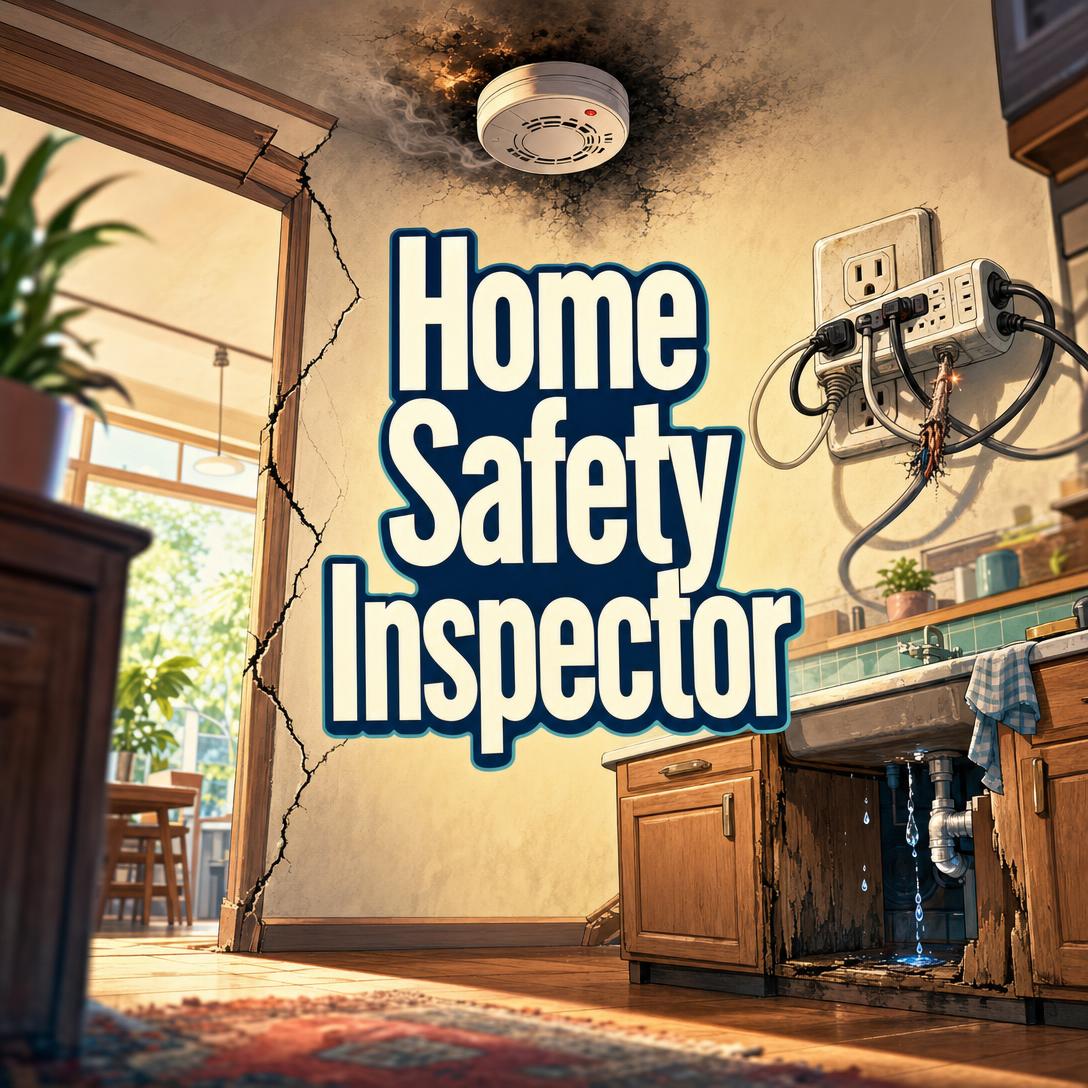
Home Safety Inspector helps you catch fire, electrical, structural, and fall hazards by scanning room photos and ranking what to fix first. While most people only notice a scorch mark, a drip, or a missing alarm after something has already gone wrong, this AI inspector looks for the risks you did not think to photograph.
✅ Photo-first scans that look for more than the problem you asked about ✅ Severity rankings from immediate danger down to routine maintenance ✅ Coverage across fire, electrical, moisture, falls, child safety, and aging-in-place ✅ Clear DIY-versus-professional guidance for every finding
A safer house is usually a series of small, visible conditions — an overloaded strip, a detector in the wrong place, a stair with no handrail — not a single dramatic failure. To understand why those conditions keep getting missed, it helps to look at how home harm actually happens.
Quick Answer: What Is Home Safety Inspector?
Home Safety Inspector is a photo-based home safety tool that identifies fire, electrical, structural, and fall hazards and ranks practical fixes by severity. Upload a room photo or walk the house area by area; it flags what a trained inspector would want you to handle first.
Key capabilities:
- Multi-hazard photo analysis, not a single-issue checklist
- Severity labels that separate life-safety problems from cosmetic wear
- Remediation steps with honest DIY limits and when to call a licensed pro
- Guided walkthroughs for kitchens, panels, stairs, water heaters, and more
- Context for childproofing, aging-in-place, rentals, and pre-purchase reviews
Why Home Hazards Go Unnoticed Until Something Fails
Home is supposed to be the safe place. The data says otherwise. Most fatal fires still start in ordinary rooms, during ordinary routines, in houses people believed were “fine.”
329,500 home structure fires in 2024 — NFPA reports those fires caused 2,920 civilian deaths and 8,920 civilian injuries
Cooking is not a rare edge case. It is the dominant ignition source in the rooms families use every day.
46.7% of residential building fires — Cooking was the leading cause of home fires in 2024, according to the U.S. Fire Administration
Electrical problems sit in the same blind spot: outlets, cords, and panels look static until they are not.
About 51,000 home electrical fires each year — ESFI estimates nearly 500 deaths, more than 1,400 injuries, and $1.3 billion in property damage
13% of home structure fires, 18% of home fire deaths — NFPA attributes that share to electrical failure or malfunction
The death rate inside those fires has not been drifting safely downward.
8.9 deaths per 1,000 reported home fires in 2024 — The National Safety Council notes that rate is higher than both 2023 and the longer-run average
Hazards that never announce themselves with smoke are just as easy to skip. Radon has no odor. Furniture tip-overs happen in seconds. Both still kill.
4 pCi/L — EPA’s radon action level; the agency estimates about 21,000 radon-related lung cancers a year
About 1 in 15 U.S. homes — EPA estimates high radon levels are present in roughly one in fifteen homes
Nearly 50% fewer tip-over injuries and deaths — CPSC credits a decade of anchoring education, while still urging families to secure TVs and clothing storage units
Knowing the numbers is not the same as seeing the hazard on your wall. But turning that knowledge into a room-by-room check is frustratingly difficult:
- You inspect what already bothers you — a stain, a trip, a buzzing outlet — and walk past the missing detector in the hallway.
- A licensed inspection is valuable, yet it is a scheduled event, not a Tuesday-night look at the dryer vent or the stair rail.
- Photos hide as much as they reveal unless someone is trained to read patterns: concentric water rings, warm-looking plates, horizontal foundation cracks, daisy-chained strips.
- Severity is easy to get backwards. A dramatic hairline crack can be settlement. A quiet Federal Pacific panel can be a fire problem.
This is exactly what a dedicated safety inspector was built for: a systematic pass over the rooms you already live in, ranked so the first fix is the one that actually reduces risk.
How to Inspect Your Home for Safety Hazards with AI
You do not need a clipboard or a code book to start. You need a clear photo, a specific room, and a willingness to hear about more than the one thing you noticed.
Step 1: Photograph the Area, Not Just the Symptom
Stand back far enough to show the room’s context — ceiling, outlets, floor, and adjacent water or heat sources. A close-up of a crack without the wall around it is harder to judge than a wider shot with the baseboard, window, and nearby plumbing in frame.
"This is the kitchen wall by the sink. The crack runs from the ceiling down, and the outlet on the right feels warm. What am I looking at?"
Step 2: Let the Inspector Scan Every Hazard Type
The AI inspector does not stop at your question. A kitchen photo can surface missing GFCI near water, a detector caked with grease, an overloaded strip, a dryer-adjacent lint path, and a cabinet leak in one pass. That extra scan is the point: the condition you did not think to ask about is often the more urgent one.
Step 3: Read Findings by Severity, Not by Drama
Results come back with a priority order — immediate danger, serious hazard, moderate risk, or maintenance. A sooty detector and exposed conductors outrank peeling caulk even if the caulk looks worse in the photo. You get a plain-language “why it matters,” what could happen if you wait, and whether the next move is DIY or a licensed electrician, plumber, or engineer.
"Walk this electrical panel with me. Cover is on. Tell me what you can see and what I should not attempt myself."
Step 4: Take the Fix That Matches the Finding
Each item includes a specific remediation path, not a vague “have that looked at.” That might mean replacing a 10-year-old smoke alarm, stopping use of a daisy-chained strip, or leaving a suspected FPE/Zinsco panel to a licensed electrician. If the punch list turns into carpentry, drainage, or a bathroom remodel, Home Renovation Advisor can help you sequence permits, materials, and contractor scope once the safety items are ranked.
Step 5: Continue Room by Room
A single photo is a start. A walkthrough is how you catch the water heater TPR discharge, the stair with four-plus risers and no handrail, the garage door that may not auto-reverse, and the bedroom with no detector. Ask for the next highest-priority area and keep going until the house has a running tally instead of a pile of unrelated worries.
Try a free photo check — no credit card required — and use the first room you already distrust as the test.
Home Safety Inspection Use Cases
🔥 Catching Kitchen Fire and Electrical Risks
Scenario: You notice a power strip hanging off a counter outlet, a detector on a greasy ceiling, and a slow drip under the sink. You are not sure which of those is actually dangerous tonight.
Traditional Approach: Search forums, buy a new detector, and ignore the strip because “it has always been like that.” A full electrician visit waits until something fails.
Home Safety Inspector: You upload one wide kitchen shot. The inspector flags the strip and any scorching as fire risk, checks whether a GFCI belongs near the sink, notes detector placement and condition, and treats the cabinet leak as a moisture path — not just a mop problem.
- Severity order so the warm outlet is not outranked by ugly caulk
- Honest limits on what a photo cannot prove (hidden splices, actual amp load)
- A clear line between a strip you can unplug now and wiring that needs a licensed electrician
If the finding is a damaged receptacle, double-tapped breaker, or a panel that should not stay in service, Electrician's Assistant can walk diagnostics, photo assessment, and repair-versus-replace decisions after the safety ranking is done.
🏡 Walking a House Before You Buy
Scenario: You are under contract on a 1970s ranch. The listing photos are flattering. You have twenty minutes in the house with your phone and a list of “things that looked off.”
Traditional Approach: Hope the general home inspection catches everything, then argue credits after the report. Cosmetic cracks and life-safety gaps get mixed together in a long PDF.
This AI inspector: You photograph the panel, the water heater, the stairs, the basement walls, and any ceiling stains. Findings separate deal-relevant safety (missing handrails, suspect panel brands, active leaks, no detectors in sleeping areas) from items that are ugly but not urgent. You still want a licensed inspector on site — this pass helps you know which photos to send them and which questions to ask.
- Pre-purchase framing: safety versus cosmetic, not a scare list
- Pattern notes, such as gutter failure outside lining up with basement staining inside
- A request for extra angles when a photo cannot settle a structural or environmental question
If you also need defect-focused building analysis — spalling, flashing, roof wear, or severity on construction defects — Property Inspection Analyst is the closer fit for those images while you keep life-safety questions with the safety inspector.
📱 Documenting Hazards from Your Phone
Scenario: You rent. The hallway smoke alarm is dead, the bathroom outlet is not GFCI, and the back stair has no graspable rail. Your landlord wants “proof,” and you are standing in the unit after work with only a phone.
Traditional Approach: A text that says “the stairs feel unsafe,” which is easy to dismiss. You lack code language, photos with context, and a written priority list.
A mobile safety check: Shoot the stair from mid-flight so risers, the missing rail, and the landing light are all visible. Add the hallway ceiling and the bathroom receptacle. You get documentation-style findings — what is visible, why it matters, and a ranked list you can send as a maintenance request rather than an argument.
- Works on iOS and Android with the same photo workflow as desktop
- Language you can reuse with a landlord or property manager
- Guidance on what still needs an on-site licensed tradesperson
Parents childproofing a first apartment can run the same mobile pass for furniture anchoring, blind cords, and window openings — the same CPSC anchoring message that accompanied a large drop in tip-over harm, applied to the actual dresser in the photo.
Home Safety Inspector FAQ
Is Home Safety Inspector free?
Yes. A Free plan includes the core photo-check workflow with limited monthly usage. Paid tiers raise usage — Plus starts at $20 per month — if you are walking an entire house, a rental portfolio, or repeated follow-up photos. There is no separate “inspection license” fee. You can start on the web or on iOS and Android with the same account.
How is Home Safety Inspector different from a professional home inspection?
A licensed inspector is on site, can test functions you cannot see in a still image, and can produce a certified report for a transaction or insurer. This AI inspector is a photo-and-description safety pass you can run tonight. It is built to catch visible life-safety issues and rank them. It does not replace a certified inspection, a load calculation, a gas-tightness test, or lab results for lead, asbestos, or radon.
Can this AI inspector find electrical hazards from a photo?
It can flag what a photo actually shows: damaged plates, overcrowded receptacles, extension-cord misuse, missing GFCI near water, scorch marks, clearance problems, and panel conditions that are visible with the cover on. It cannot measure load, confirm a connection behind the drywall, or declare a circuit safe. Warm devices, arcing, or water on electrical equipment are treated as stop-and-isolate problems, not DIY experiments.
Does Home Safety Inspector work on mobile?
Yes. Full feature parity across web, iOS, and Android means you can photograph a panel, a stair, or a rental defect on site and get the same severity-ranked readout. Speech-to-text helps if your hands are full on a ladder or in a crawlspace. Settings and history sync, so a walkthrough started on a phone can continue on a laptop.
How accurate is a photo-based home safety check?
Unambiguous evidence — no detector in a bedroom hallway, an open junction box, a stair with no handrail — supports a direct finding. Ambiguous evidence — possible mold versus staining, a crack that might be cosmetic — is labeled as a concern with a verification step. The inspector will say what the photo cannot prove. That honesty is the accuracy model: precise about what is visible, explicit about what still needs testing or a licensed specialist.
What home hazards can it identify?
Visible fire and CO-device issues, electrical red flags, structural and moisture patterns, fall and stair problems, child-safety conditions, aging-in-place barriers, garage and water-heater details, and pest or combustion clues that show up in a frame. Environmental hazards such as radon, lead, and asbestos are handled as “suspect and test,” not as diagnoses from pixels. Seasonal context — space heaters in winter, pool barriers in summer — changes what it looks for first.
Start Finding Home Hazards Before They Escalate
Home fires, electrical failures, unseen radon, and furniture tip-overs are not abstract risks. They concentrate in kitchens, sleeping areas, basements, and living rooms that look normal in listing photos and in the evening light. A systematic photo pass does not make a house new. It makes the next action obvious.
Home Safety Inspector gives you that pass: a multi-hazard read, a severity order, and a fix that matches the finding — including when the honest answer is to stop, get out, or call a licensed professional. Try it on the room that already bothers you, then keep walking.
Explore more at Jenova.
For Developers: Home Safety Inspector is available programmatically via the Jenova API — integrate photo-based home hazard assessment and severity-ranked remediation guidance into your application with a single API call. Full documentation →