Friends and Fables Alternative: AI RPGs, Custom GMs & Lasting Memory
2026-10-15
If you're looking for a Friends and Fables alternative as of October 2026, the usual reasons are memory that drifts over long campaigns, daily turn caps, or a 5e-only structure. Jenova is an AI agent platform built around these issues. It offers ready-to-play AI story games, lets you build your own AI Game Master with custom rules and lore, and keeps your campaign in persistent memory across sessions.
You aren't limited to one house GM in one ruleset. You can run a gothic horror mystery tonight and a homebrew sci-fi campaign tomorrow, and both will remember what happened last time.
- ✅ Persistent cross-session memory that tracks your characters, factions, and plot threads
- ✅ Custom AI Game Masters with your own instructions, house rules, and private lore documents
- ✅ Multiple model providers, including OpenAI, Anthropic, Google, DeepSeek, and xAI, with no lock-in
- ✅ Monthly usage with no daily caps, plus full feature parity on web, iOS, and Android
Switching platforms only makes sense if you know what's driving you away. The sections below look at where AI Game Master platforms struggle, where Friends and Fables still does well, and how to pick a tool that fits the way you play.
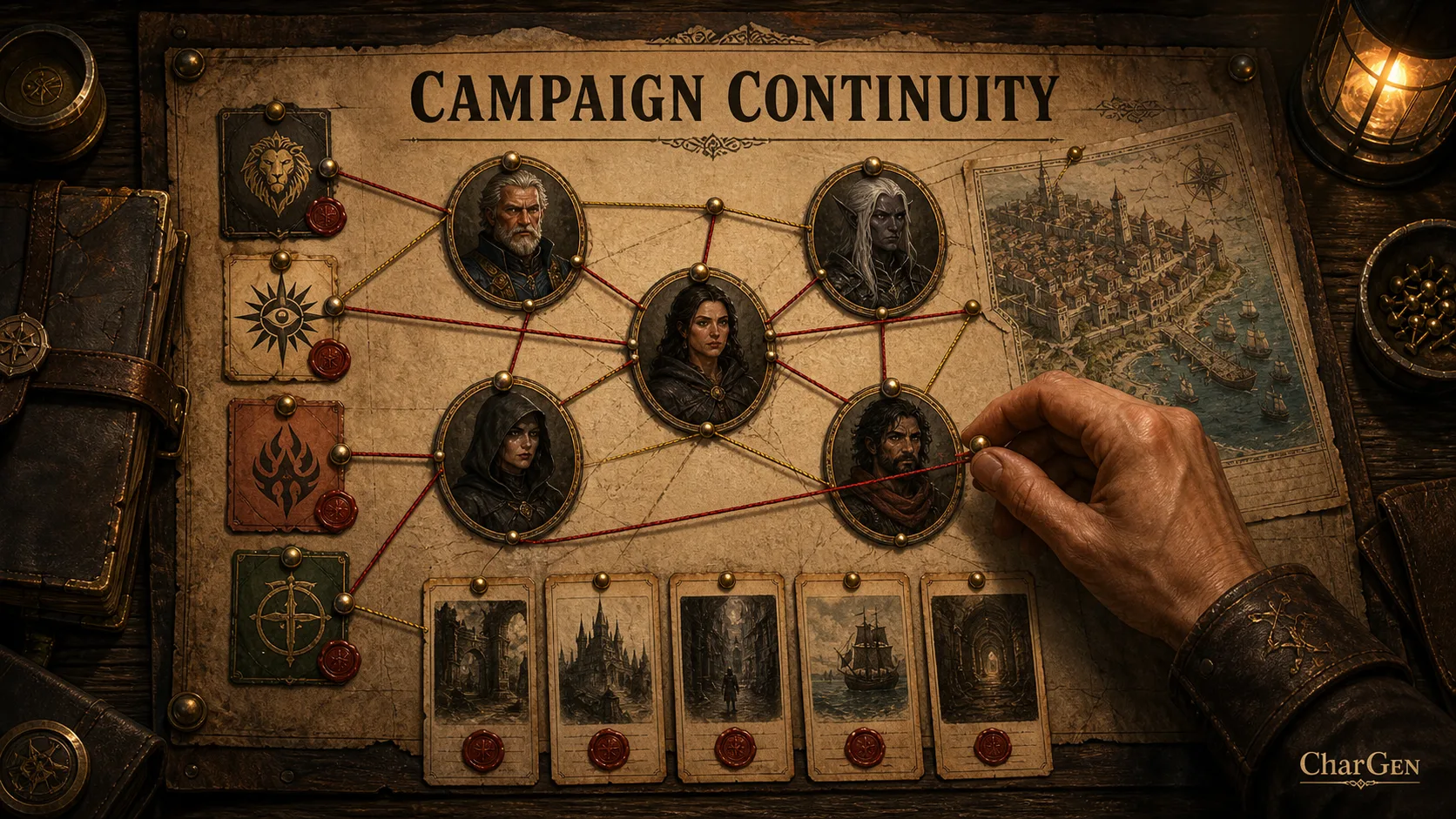
Quick Answer: What Is the Best Friends and Fables Alternative?
Jenova is an AI agent platform that works as a Friends and Fables alternative. It pairs ready-to-play AI story games with custom AI game masters, persistent cross-session memory, and access to leading AI models, without daily turn caps.
The best choice depends on why you're leaving. If live six-player tactical combat is your priority, a dedicated virtual tabletop may suit you better. If you care most about story, memory, and flexibility, Jenova is a strong fit.
Key capabilities:
- Ready-made AI story games in horror, mystery, gothic romance, and social drama
- Custom Game Master agents with your own setting, tone, rules, and knowledge base
- Character design, naming, and visual storytelling tools for building your party
- Persistent memory and unlimited chat history, so campaigns stay consistent from session to session
Why Players Look for a Friends and Fables Alternative
Friends and Fables has built a real audience. Its homepage describes an AI Game Master named Franz, worldbuilding tools, tactical 5e combat, and multiplayer parties.
100,000+ — Players and world builders on Friends & Fables, per its homepage
Up to 6 players — Maximum party size for multiplayer campaigns on Friends & Fables
25 turns per day — Free plan limit, with paid plans at $19.95, $29.95, and $39.95/month
Even so, long-running campaigns expose limits that are common to most AI RPG platforms:
- Memory drift across dozens of sessions
- Turn caps and credit costs that interrupt momentum
- Combat systems that are still being rebuilt
- 5e-style fantasy scaffolding when you want a different genre
- Campaign assets scattered across multiple tools
Memory Drift in Long Campaigns
Continuity is the hardest problem for any AI Game Master. A CharGen review of AI DM tools found that the recurring failure mode is continuity rather than prose. Over a long campaign, the model forgets who holds the amulet, contradicts an earlier ruling, or invents a faction that never existed.
A roundup from DungeonsDeep, itself a competing platform, notes that Friends and Fables' retrieval-based memory can lose track of details over a long campaign. AI Dungeon has a stricter version of the same limit:
~3,000 words — The total story AI Dungeon's free tier holds in its 4,000-token context, with older events compressed into 25 Memory Bank entries
Turn Limits and Credit Costs
The free plan's 25-turn daily cap can end a session just as a dungeon crawl gets interesting. Paid tiers advertise unlimited standard turns, but according to the same roundup, premium narration and image models still draw on credits. If you prefer higher-quality models, costs can climb quickly.
Combat Still Being Rebuilt
Tactical 5e combat on battlemaps is a headline feature on the Friends and Fables homepage. However, third-party reviewers report that combat is off by default while the team rebuilds it. Players who came specifically for crunchy fights have noticed.
Locked Into 5e-Style Fantasy
Friends and Fables is built around 5e-inspired fantasy. Competing tools now position themselves around the gap this leaves. aiga markets itself as an alternative without D&D 5e-style rules overhead, and Creation OS highlights support for a dozen genres, including noir, sci-fi, and horror. Demand for genre flexibility is clear.
Campaign Assets Scattered Across Tools
Even a good AI GM doesn't solve the prep problem. One reviewer describes how the wrong tool scatters your campaign across six tabs and two bad filenames. Character art, NPC notes, lore documents, and session recaps often end up in separate apps.
This is the set of problems Jenova was designed to address.
The Jenova Solution
Jenova approaches AI roleplay differently from a single-GM platform. Instead of one house narrator in one ruleset, you get a library of specialized agents and the ability to build your own. Every agent shares the same persistent memory, multi-model access, and tool integrations.
| Common AI RPG Friction | Jenova |
|---|---|
| Daily turn caps on free plans | Monthly usage allowance, no daily caps |
| One GM persona tied to one ruleset | Build any GM: your instructions, rules, genre, and tone |
| Memory that drifts across sessions | Persistent cross-session memory plus attached lore documents |
| Premium models gated behind credits | Switch between OpenAI, Anthropic, Google, DeepSeek, and xAI models |
| Lore and notes scattered across apps | Connect Notion, Google Drive, and other tools through MCP |
Ready-to-Play AI Story Games
If you want to start playing right away, Jenova's game agents run complete interactive narratives with consequences that build over time:
- The Mansion: You wake in a mansion with no memory of how you arrived. Every room hides secrets, and escape depends on piecing together the truth.
- The Asylum: You play an investigator inside a shuttered psychiatric institution, where each ward conceals part of a hidden story.
- Vesper Court: A dark gothic romance set in a hidden vampire court, full of blood intrigue and shifting alliances.
- Love Island: An open-world social drama in which relationships, alliances, and rejections emerge from your choices.
These aren't dice-heavy dungeon crawls. They are narrative-first experiences, closer to a one-shot run by a GM who never forgets a detail.
Build Your Own AI Game Master
For many Friends and Fables players, this is the main reason to switch. Jenova lets you create a custom agent in minutes. You write its instructions, choose your preferred model, attach a private knowledge base, and configure its tools.
In practice, you can upload your setting bible, faction histories, house rules, and SRD notes, and your GM will draw on them throughout the campaign. A noir detective campaign, a hard sci-fi survival game, and a Ravenloft-style horror run can each have their own Game Master with its own voice and tone.
"You are Mira, a dry-witted Game Master running a low-magic noir campaign in the city of Vessa. Use d20 checks, describe consequences honestly, and never let the party succeed without cost."
That last instruction addresses a well-documented weakness of AI GMs: an AI that never says no quietly removes the stakes.
Worldbuilding and Visual Storytelling
Supporting agents help with the rest of the setup. Name Generator brings cultural and linguistic depth to naming taverns, deities, and noble houses. Manga Creator can turn a memorable session into a visual story with a consistent art style.
Platform Capabilities That Matter for Campaigns
- Multi-model access: If one model writes combat well and another handles atmospheric prose better, you can switch between them freely.
- Persistent memory: Unlimited chat history and cross-session memory keep NPCs, grudges, and debts consistent.
- MCP tool integration: Pull lore from Notion or Google Drive, or run Google Search for real-world history references.
- Privacy: Your campaigns are never used to train public AI models.
Where Friends and Fables Still Leads
An honest comparison matters more than a sales pitch. Friends and Fables bundles a map maker, a virtual tabletop, and party play for up to six players. Players on Reddit also value how
in their worlds.Jenova doesn't have a dedicated rules engine or a grid battlemap. Dice outcomes are narrated by the model rather than resolved by code. If synchronous tactical combat with a full group is your main requirement, weigh that carefully before switching.
Specialized AI Agents for Tabletop and Story Fans
These agents cover the prep, design, and writing work that surrounds a campaign.
Character Creator
Character Creator is an expert character designer for roleplay, fiction, and original characters. You can generate a character quickly or build one step by step, and the agent researches source material and creates portraits across genres. It's well suited to assembling a full party before your first session.
- Quick-gen or guided character builds with backstory depth
- Portraits matched to genre and tone
- Research support for characters inspired by existing media
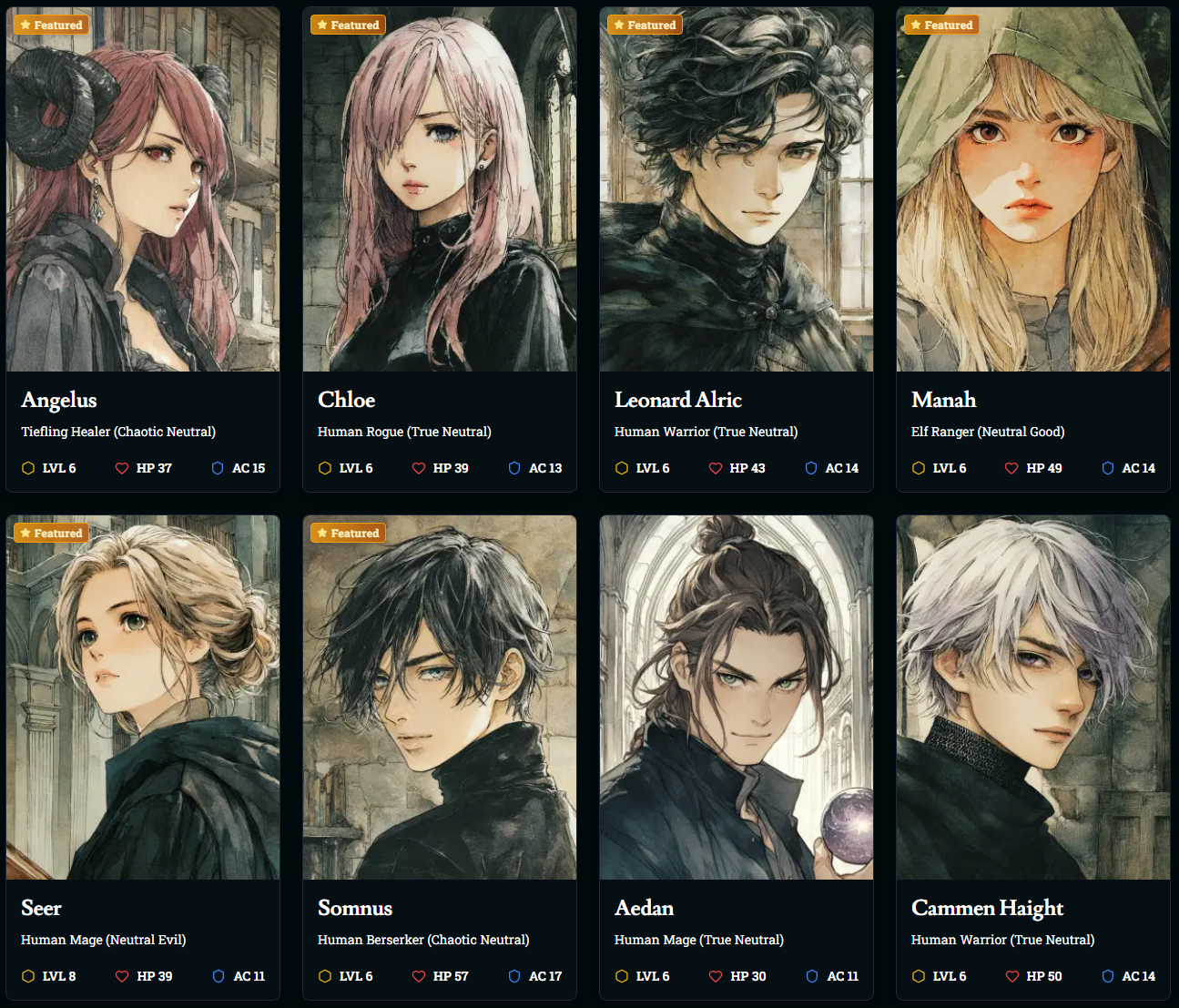
A party roster like this one, with classes, alignments, and stat lines, is the kind of reference worth keeping in a campaign so your AI GM can reference it consistently.
Game Designer Assistant
Game Designer Assistant is a design partner for brainstorming, systems analysis, and documentation. Use it to balance a homebrew magic system, design a faction reputation track, or stress-test a custom class before players get their hands on it.
- Systems analysis for mechanics and economies
- Design documentation you can attach to a custom GM
- Concept art generation for locations and creatures
Creative Fiction Writer
Creative Fiction Writer is a storytelling partner for original fiction in any genre. It researches to make settings feel authentic and can polish rough session notes into finished prose.
- Turns session logs into readable campaign chronicles
- Develops villain backstories and regional histories
- Offers editorial feedback on your own lore writing
Trading Card Game Creator
Trading Card Game Creator handles mechanics, lore, card art, and balance. Tabletop groups use it to make item cards, spell cards, or a custom card minigame for a tavern scene.
- Card mechanics and balance testing
- Lore text written to fit your setting
- Card art generation in a consistent style
You can try Jenova free, and no credit card is required.
How to Switch From Friends and Fables to Jenova
Step 1: Pick Your Play Style Decide whether you want a ready-made story or your own campaign. If you want to play right away, open The Mansion and start exploring within seconds.
"I check the portrait in the east hallway for anything hidden behind the frame."
Step 2: Build Your Party Use Character Creator to design your characters, including backstories, motivations, and portraits. Save the results so you can attach them to your campaign later.
"Create a tiefling healer with a secret debt to a devil, chaotic neutral, with a portrait in a watercolor fantasy style."
Step 3: Create a Custom Game Master Set up a custom agent, write your GM instructions, and attach your lore documents, house rules, and party sheets as its knowledge base. Choose the model whose writing style you prefer.
"Run my campaign in the Shattered Coast setting using the attached faction notes. Track party reputation with the Lion Guild and the Ember Cult."
Step 4: Play Across Sessions and Devices Start on desktop, continue on your phone during your commute, and come back days later. Persistent memory carries NPC relationships, inventory, and unresolved plot threads from one session to the next.
"Recap where we left off and remind me what the harbormaster owes us."
Step 5: Turn Sessions Into Stories Once an arc ends, export the highlights and turn them into a written chronicle, a comic, or a recap for players who missed the session.
Real Campaigns, Real Results
🌌 Homebrew Sci-Fi Campaign Beyond 5e
Scenario: A player wants a hard sci-fi survival campaign with oxygen tracking and corporate politics, which doesn't fit a 5e fantasy structure.
Traditional Approach: They would need to reshape a fantasy-first platform's tools or write prompts from scratch in a general chatbot that keeps nothing between sessions.
Jenova: A custom GM agent with an attached setting document and resource rules runs the campaign natively.
- Genre-specific tone and mechanics are written into the GM's instructions
- Lore documents ground every response
- No fantasy defaults leak into the story
🛠️ Prep Support for a Human-Run Table
Scenario: A DM runs a weekly in-person game but spends four hours prepping every Tuesday.
Traditional Approach: Manual NPC writing, rebalancing encounters by hand, and lore spread across scattered documents.
Jenova: Game Designer Assistant drafts faction mechanics and balances homebrew items, while a custom agent keeps the canon in one place.
- Prep time is concentrated on decisions instead of busywork
- Rulings stay consistent across sessions
- The human DM stays in charge at the table
📱 Commute-Length Story Sessions
Scenario: A player has 30 minutes on the train each day and wants an ongoing gothic story.
Traditional Approach: Daily turn caps cut sessions short, and switching devices loses the thread.
Jenova: Vesper Court continues on iOS or Android exactly where the desktop session ended, and speech-to-text supports hands-free input.
- Full feature parity on mobile
- No daily turn limits
- Memory syncs across devices
📖 Campaign Chronicle for the Group
Scenario: After 40 sessions, a group wants a written record of their campaign.
Traditional Approach: Someone spends weeks transcribing notes and writing chapters by hand.
Jenova: Creative Fiction Writer turns session recaps into polished chapters with a consistent voice.
- Chaptered prose based on what actually happened in play
- Editorial feedback on pacing and character arcs
- A finished keepsake for the whole table
Frequently Asked Questions
What is the best Friends and Fables alternative?
It depends on why you're switching. Jenova suits players who want persistent memory, custom AI Game Masters, genre flexibility, and model choice without daily turn caps. If you mainly want strict rules-engine combat or a grid battlemap, a dedicated virtual tabletop is a closer match. If you want open-ended text adventure without rules, AI Dungeon is an option, though its memory works through a context window.
Is there a free Friends and Fables alternative?
Yes. Jenova has a free tier with all core features and limited usage, and paid plans start at $20/month for 30× more usage. Usage resets monthly with no daily caps. For comparison, Friends and Fables' free plan allows [25 turns per day, with paid tiers from $19.95 to $39.95 per month](https://dungeonsdeep.ai/blog/best-friends-and-fables-alternatives-2026).
Can I build my own AI Dungeon Master?
Yes. On Jenova, you create a custom agent with your own GM instructions, a preferred AI model, and a private knowledge base containing your setting, house rules, and character sheets. Many players draft their mechanics first with a dedicated game design partner and then attach the finished document to the GM. Dice are narrated by the model rather than resolved by a code-based rules engine.
Does an AI Game Master remember my campaign between sessions?
On many platforms, memory fades as a campaign grows. Jenova provides unlimited chat history and persistent cross-session memory, so NPCs, debts, and plot threads carry forward. Attaching lore documents makes long-term recall more reliable. When an arc wraps up, the fiction-writing agent can turn your history into a written chronicle.
Is Friends and Fables shutting down?
No. Side Quest Labs has stated that Friends and Fables is not being sunset and will remain its easy, 5e-style option. Its separate product, Craft, is aimed at users who want deeper control over worlds, rules, and models. Players often explore alternatives because of specific limitations, such as turn caps or memory drift, rather than concerns about the platform closing.
Does Jenova work on mobile?
Yes. Jenova has full feature parity across web, iOS, and Android, and settings and chat history sync between devices. Speech-to-text supports hands-free play, which is useful for short sessions on a commute or narrating actions out loud.
Conclusion: Choose the Alternative That Fits How You Play
Players usually start looking for a Friends and Fables alternative because something specific gets in the way: memory that drifts after many sessions, turn caps that end a session early, or a fantasy-only structure that doesn't suit the story they want to tell.
Jenova addresses those issues with persistent memory, custom AI Game Masters built from your own rules and lore, access to leading AI models, and monthly usage with no daily limits. You can start with a haunted-house mystery tonight, build your party portraits this weekend, and run a homebrew campaign that still remembers session one when you reach session fifty.
Explore the full agent library at Jenova.
For Developers: Every agent in this article is available programmatically via the Jenova API, so you can build AI storytelling and roleplay features into your application with a single integration. Full documentation →