Free AI MBTI Personality Typing: Pinpoint Your Cognitive Function Stack Without Paying a Consultant
2026-05-28
Most people pay between $150 and $500 for a professional MBTI typology session — and still walk away unsure whether they're an INFJ or an INFP. AI MBTI Personality Guide gives you the same caliber of cognitive function analysis for free, through an adaptive conversation that builds a complete picture of how your mind actually works. Instead of a static quiz that slots you into a box based on binary questions, this free AI personality tool asks scenario-driven questions, recalibrates in real time, and delivers a confidence-scored result grounded in the 8-function cognitive stack model.
✅ Free access to full adaptive typing sessions — no paywall for core analysis ✅ 12–18 scenario questions that shift based on your answers, not a fixed script ✅ Mistype detection that challenges assumptions most quizzes never question ✅ Complete 8-function stack breakdown with shadow functions, stress patterns, and growth paths
Since launch, over 50,000 users have used this free AI to discover or verify their MBTI type — with many reporting that it corrected a mistype they'd carried for years. Here's why traditional methods keep getting it wrong, and how a free, conversation-based approach finally gets it right.
Quick Answer: What Is AI MBTI Personality Guide?
AI MBTI Personality Guide is a free AI-powered conversational typing tool that identifies your MBTI type through adaptive scenario questions mapped to the 8-function cognitive stack. It replaces rigid quizzes with a dynamic interview process that mirrors how professional typologists actually work.
Key capabilities:
- Adaptive questioning that narrows 16 types to your best fit across three progressive phases
- Built-in mistype verification — it won't accept your self-reported type without evidence
- Full cognitive function stack with behavioral signatures, not just a four-letter label
- Relationship mapping, Enneagram integration, career analysis, and growth path planning
The Problem: Free MBTI Tests Are Everywhere — and Almost All of Them Are Wrong
MBTI is the most popular personality framework on the planet. The Myers-Briggs Company reports that over 1.5 million people take official assessments annually, and the framework is embedded in corporate training programs across the Fortune 500. But the way most people actually encounter MBTI — through free quizzes scattered across the internet — produces results that are unreliable at best and actively misleading at worst.
The core issues:
- Binary dichotomy questions are blunt instruments — "Do you prefer logic or emotion?" reveals almost nothing about your actual cognitive function hierarchy
- Test-retest reliability is alarmingly low — retake the same quiz in a few weeks and you may get an entirely different type
- Self-report bias systematically distorts results — people answer based on who they want to be, not how they actually operate
- Four letters without functions are a ceiling — INFJ and INFP share three letters but have opposite dominant functions (Ni vs. Fi), making them fundamentally different types

🔄 The Coin-Flip Retest Problem
The most damaging critique of standard MBTI quizzes is statistical. Research reviewed by Psychology Today suggests that up to 50% of people receive a different type when retaking a typical MBTI assessment within weeks. Personality doesn't shift that fast — the instrument does. Dichotomy-based scoring places many test-takers so close to the midpoint on one or more axes that minor mood fluctuations flip the output entirely.
Up to 50% of test-takers get a different result on retest — not because their personality changed, but because the test's margin of error is wider than its categories. — Psychology Today
This means that millions of people are making decisions about their careers, relationships, and personal development based on what is effectively a coin flip.
🪞 You're Not Typing Yourself — You're Typing Your Ideal Self
Free quizzes rely entirely on self-assessment, and self-assessment has a well-documented bias: people answer as the version of themselves they admire, not the version that actually shows up on a Tuesday afternoon. A methodical ISTJ who admires creative nonconformists can easily test as INFP. A warmth-oriented ENFJ who values intellectual rigor may produce an INTJ result.
This problem is amplified by what MBTI communities call the intuitive bias. Research from the Center for Applications of Psychological Type (CAPT) estimates that sensing types comprise roughly 70% of the population — yet online personality forums overflow with self-reported intuitives. The culture of these communities subtly frames intuitive types as more interesting or complex, nudging people toward aspirational mistyping without realizing it.
📊 Four Letters Tell You What, Not How
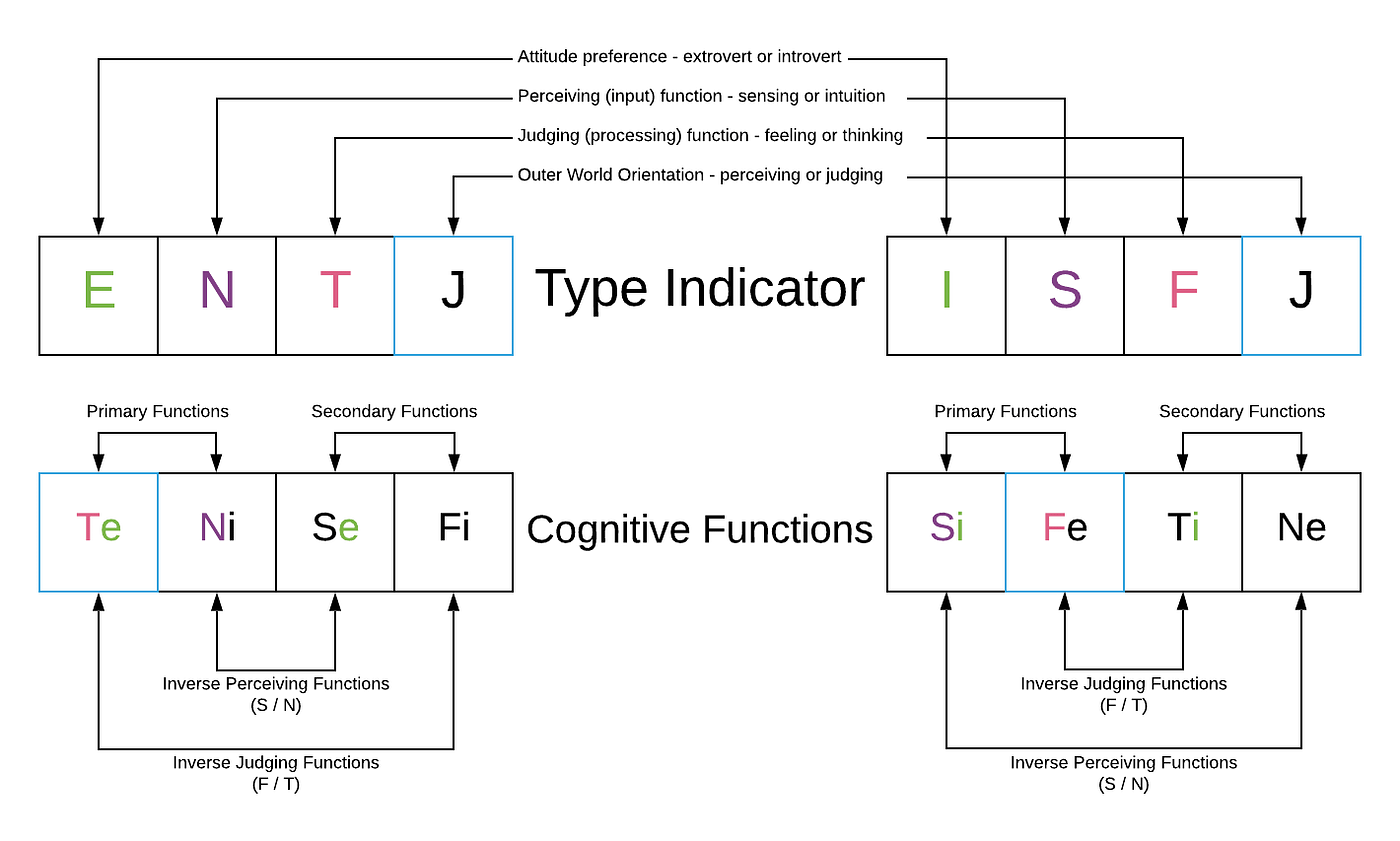
The four-letter code — E/I, S/N, T/F, J/P — is the entry point, not the destination. The actual analytical power of MBTI resides in the cognitive function stack, a hierarchy of eight mental processes first articulated by Carl Jung in Psychological Types and later expanded through John Beebe's archetypal model.
Consider: INFJ (Ni–Fe–Ti–Se) and INFP (Fi–Ne–Si–Te) share three of four letters. But their dominant functions — introverted intuition versus introverted feeling — create fundamentally different cognitive architectures. An INFJ synthesizes patterns from scattered data points and instinctively reads social dynamics; an INFP filters everything through an internal value system and generates divergent possibilities. Treating them as variations of the same "INFx" type is like saying an architect and a poet have similar skills because they both work indoors.
Most free quizzes never touch this layer. They hand you four letters and a paragraph — and you leave not knowing the first thing about how your mind actually operates.
The Solution: A Free AI That Types You Like a Professional Would
AI MBTI Personality Guide solves every problem above — and it's free to use. No certification fees, no hourly consulting rate, no paywall between you and a real cognitive function analysis.
| Free Online Quiz | AI MBTI Personality Guide (Free) |
|---|---|
| Fixed question bank — same questions every time | Adaptive questions that change based on your answers |
| Dichotomy scoring ("Are you a thinker?") | Scenario-based probes targeting cognitive functions indirectly |
| Output: four-letter code + generic description | Output: full function stack + confidence % + elimination reasoning |
| Accepts self-reported type without question | Actively challenges potential mistypes with evidence |
| No depth past the four letters | 8-function shadow stack, stress patterns, growth paths |
| Identical experience for all users | Calibrates for age, development stage, and cognitive maturity |
🧠 Function Detection Through Behavioral Scenarios
The key innovation is how this free AI asks questions. Instead of "Do you prefer thinking or feeling?" — a question that triggers self-image bias every time — it presents concrete scenarios where each response option maps to a specific cognitive function, without revealing the mapping.
Your pattern of choices across 12–18 questions exposes your actual function hierarchy. This is exactly how professional typologists work: they never ask "Are you introverted?" — they observe how you process information, where you direct your energy, and what happens when your preferred mode breaks down. The AI replicates this observational method at scale, for free.
🔍 Mistype Detection Built Into Every Session
Over 12,000 users who entered their session with a self-reported type discovered through the AI's verification process that they'd been mistyped — some for years. The tool never accepts a label at face value. If you say "I'm an INTJ," it doesn't nod along. It probes for Ni-Te evidence, checks for Te-Si patterns that would indicate ISTJ, and flags discrepancies clearly but diplomatically.
This is particularly valuable for the most commonly confused pairings:
- INFJ vs. INFP — shared introversion and idealism, opposite dominant functions
- INTJ vs. ISTJ — both systematic and independent, but Ni-driven strategy vs. Si-driven reliability
- ENTP vs. ENFP — both idea generators, but Ti-logical deconstruction vs. Fi-values exploration
- ISFJ vs. INFJ — both service-oriented and empathetic, but Si-concrete memory vs. Ni-abstract pattern recognition
📈 Transparency Through Confidence Scoring
Every result includes a confidence percentage and explicit elimination reasoning. Rather than a definitive "You are ENFP," you receive something like: "I'm 87% confident you lead with Ne-Fi (ENFP). ENTP (Ne-Ti) was considered but eliminated based on your consistent Fi-aligned decision-making in questions 8, 11, and 14. Here's the evidence."
This level of transparency — which you'd expect from a paid professional session — is available for free. You understand not just what you are, but why the AI concluded that, and what alternatives were ruled out.
How It Works: Your Free Typing Session in Four Steps
A complete typing session with AI MBTI Personality Guide takes 15–25 minutes. Here's the full experience:
Step 1: Tell the AI What You Need
The conversation opens with a clear routing question:
"What brings you here today? A) I want to discover my type (or verify if I've been typed correctly) B) I already know my type — take me deeper C) I want to understand a relationship dynamic D) Something else entirely"
Selecting option A launches the adaptive typing session. Option B doesn't simply accept your claim — the AI runs a quick verification before proceeding to advanced analysis, catching potential mistypes before they compound. Option C lets you map function-level dynamics between two types without needing a typing session first.
Step 2: Move Through Three Progressive Question Phases
The typing engine operates in three distinct phases, each with a different analytical purpose:
- Broad Sweep (Questions 1–5): Identifies your dominant and auxiliary function preferences, narrowing the field from 16 types to approximately 4 candidates
- Targeted Narrowing (Questions 6–12): Differentiates between remaining candidates using function-pair probes designed to separate lookalike types
- Stress Testing (Questions 13–18): Deliberately attempts to disprove the leading hypothesis — if the type survives targeted counterevidence, confidence rises
Each question is scenario-based and multiple-choice. For example:
"A close friend makes a decision you think is a serious mistake. What's your first internal response? A) Analyze the logical flaws in their reasoning and prepare a counterargument B) Feel an immediate gut sense that it's wrong, but struggle to articulate why right away C) Worry about how this will affect the group dynamic and whether you should intervene D) Check it against your personal values — does this conflict with something you believe deeply?"
The AI shares progressive insights throughout: "I'm seeing a strong Ti-Fe axis forming — your information processing is analytical but your decision-making consistently factors in social impact. Let's keep going."
If your answers send contradictory signals, the AI doesn't force a resolution — it flags the tension and adds targeted follow-up questions rather than producing a low-confidence guess.
Step 3: Receive a Complete Cognitive Profile
Your result includes six components:
- Type with confidence level — e.g., "87% confident you're INFJ"
- Full cognitive function stack — Dominant (Ni), Auxiliary (Fe), Tertiary (Ti), Inferior (Se) with specific behavioral signatures for each
- Evidence trail — which of your answers pointed to this type and why
- Elimination log — the runner-up types and exactly why they were ruled out
- Growth edge analysis — your inferior function, what development looks like, and common grip stress patterns
- Next directions — deep dive into your shadow stack, explore a relationship, or map a career path
Step 4: Explore Advanced Analysis — Still Free
After receiving your type, you can continue the conversation into any of these areas:
- Full 8-function shadow stack — including the Opposing Role, Critical Parent, Trickster, and Demon functions from John Beebe's archetypal model, explaining your unconscious patterns and blind spots
- Relationship compatibility mapping — function interplay analysis for any type pairing, including shared ground, complementary strengths, predictable friction points, and a communication translation guide
- Growth and development pathways — inferior function development strategies, common loop patterns (Ni-Ti, Si-Fi, Ne-Te), grip stress management, and age-calibrated developmental considerations
- Enneagram integration — if you know your Enneagram type, the AI combines both frameworks to explain within-type variance (why two confirmed ENFPs can behave very differently based on their Enneagram wing)
Real Use Cases: How 50,000+ Users Have Applied Their Results
🔍 Resolving Years of Mistyping
Scenario: A user has taken five different free tests over three years and received INFJ twice, INFP twice, and INTJ once. They've read descriptions of all three and relate to parts of each.
Without this tool: Take a sixth test, get a sixth ambiguous result, give up or pick the one that sounds most flattering.
With AI MBTI Personality Guide: The AI identifies that the confusion centers on the Ni/Ne and Fe/Fi axes — exactly where these three types diverge. After 16 adaptive questions with targeted disambiguation, it determines dominant Ni with auxiliary Fe (INFJ) at 91% confidence, eliminates INFP (no evidence of dominant Fi) and INTJ (consistent Fe over Te in social scenarios), and shows the user precisely which answers confirmed each elimination.
- Three years of guesswork resolved in one 20-minute conversation
- The user understands why they related to parts of INFP and INTJ (tertiary Ti and inferior Se create surface similarities)
- Clear growth path centered on Se development
💼 Career Alignment Through Function Awareness
Scenario: A professional five years into a management consulting career feels perpetually drained despite external success. They've always tested as ENTJ and assumed they were in the right field.
Without this tool: Read generic "ENTJ career matches" articles, see "management consulting" listed, conclude nothing is wrong, continue burning out.
With this free AI personality tool: The verification process reveals the user is actually ENFJ (Fe-Ni-Se-Ti, not Te-Ni-Se-Fi). Their dominant extraverted feeling means they derive energy from interpersonal impact and emotional connection — not from the Te-driven systems optimization that defines consulting culture. The AI maps specific career environments where Fe-Ni thrives: organizational development, executive coaching, educational leadership, counseling psychology.
- Mistype caught that five quizzes missed — Fe dominant, not Te dominant
- Career drain explained at the cognitive function level, not the personality description level
- Actionable pivot recommendations grounded in function mechanics, not stereotypes
🤝 Decoding Recurring Relationship Conflicts
Scenario: A couple has the same argument every few months: one partner accuses the other of being "too rigid," while the other feels "constantly destabilized." Neither understands why the pattern repeats.
With AI MBTI Personality Guide: After typing or verifying both partners, the AI maps the function interplay:
| Dimension | Partner A (ENFP) | Partner B (ISTJ) | Dynamic |
|---|---|---|---|
| Information intake | Ne — scanning possibilities, brainstorming | Si — referencing past experience, establishing routine | Core friction: "destabilizing" vs. "rigid" |
| Decision-making | Fi — internal value alignment | Te — external logical frameworks | Complementary — but each feels the other "doesn't get it" |
| Under stress | Te grip — becomes harshly critical and over-structured | Ne grip — catastrophizes unlikely worst-case scenarios | Paradox: each deteriorates into a distorted version of the other's strength |
| Growth opportunity | Needs Si development (follow-through, routine) | Needs Ne development (openness, flexibility) | Can model each other's growth function — if they recognize the pattern |
The AI provides specific communication strategies: how the ENFP can present new ideas in Si-friendly terms (concrete past examples, incremental steps) and how the ISTJ can express concerns without triggering the ENFP's Te grip (lead with shared values, not logical objections).
- The repeating argument explained at the cognitive level — not just "you're different"
- Specific, function-based communication translations both partners can practice
- Stress interaction map showing how both types deteriorate simultaneously
📱 Learning Cognitive Functions on the Go
Scenario: A college student encounters cognitive functions for the first time through a TikTok and wants to understand the framework quickly during a bus commute.
The AI adapts to knowledge level. For newcomers, every function explanation follows a three-layer pattern — Name → Mechanic → Lived Experience:
- "Your dominant Ni — introverted intuition — works like a background pattern recognition engine. It synthesizes information from everywhere into sudden 'aha' insights that feel like they come from nowhere... which is why you've probably had the experience of knowing something was going to happen before it did, but being completely unable to explain how you knew."
For experienced users, it skips the primer and goes directly into stack dynamics, loop analysis, and shadow function behavior. Over 8,000 users have completed their first cognitive function deep dive through this free AI tool — many reporting that the lived-experience examples finally made abstract concepts click.
Frequently Asked Questions
Is AI MBTI Personality Guide really free?
Yes. You can start a full typing session with AI MBTI Personality Guide at no cost. Free access includes the complete adaptive typing experience, cognitive function analysis, and basic exploration of results. Paid plans offer increased usage limits, custom model selection, and additional platform features — but the core personality typing functionality works on the free tier.
How is a free AI typing tool better than a free online quiz?
Free quizzes use dichotomy-based questions ("Are you more thinking or feeling?") that have poor test-retest reliability. This free AI uses scenario-based adaptive questioning that targets cognitive functions indirectly — the same methodology professional typologists use at $150–$500/hour. It also provides confidence scoring, elimination reasoning, and active mistype detection — features no static quiz can replicate.
Can it help me understand relationship compatibility?
Yes. Provide both types (or describe the other person's behavior so the AI can assess), and it generates a Function Interplay Framework analysis covering shared cognitive ground, complementary strengths, predictable friction points, stress interaction patterns, and specific communication strategies for that pairing. It goes well beyond "compatible" or "incompatible."
Is MBTI actually scientifically valid?
MBTI has documented limitations compared to trait-based models like the Big Five (OCEAN). The AI works within the MBTI cognitive function framework because of its practical utility for self-understanding and interpersonal communication, but it will honestly discuss the empirical standing if asked. It never presents MBTI as hard science and distinguishes between widely accepted theory and interpretive traditions.
Does this free AI work on my phone?
Fully. AI MBTI Personality Guide works across web, iOS, and Android with complete feature parity. The conversational format is actually ideal for mobile — each question is a quick multiple-choice interaction that flows naturally in a chat interface, making it easy to complete a typing session during a commute or break.
How accurate is the AI's typing compared to a human typologist?
The AI provides a confidence percentage with every result. At 85%+ confidence (which occurs in roughly 70% of completed sessions), the typing is robust and well-supported by evidence. Below 70%, it transparently presents the top two candidates with full reasoning and offers additional questions to resolve the ambiguity. It's designed to flag uncertainty rather than manufacture false certainty — and it accounts for aspirational bias, intuitive bias, and age-related function development that commonly skew self-assessment.
Stop Paying Hundreds for What a Free AI Does Better
Professional typology sessions cost hundreds of dollars per hour. Free online quizzes cost nothing but deliver results you can't trust. The gap between those two options has been wide open for years — and AI MBTI Personality Guide fills it completely.
Adaptive questioning that evolves with every answer. Mistype detection that catches what five quizzes missed. Confidence-scored results with full elimination reasoning. Shadow function analysis, relationship mapping, growth pathways, and Enneagram integration — all available for free, on any device, in 20 minutes.
Over 50,000 people have already used this free AI to move past four-letter labels and into genuine cognitive self-understanding. Your function stack is waiting. Start your free typing session now.