Free AI for Medical School Applications: Expert Admissions Guidance Without the $10,000 Price Tag
2025-12-15
The 2025-2026 medical school admissions cycle has shattered records. According to AAMC's December 2025 data, 54,699 applicants competed for just 23,440 seats—a 44.5% overall acceptance rate that masks brutal competition at individual schools. Medical school enrollment has crossed 100,000 students for the first time in history, yet top programs like Johns Hopkins (1.7% acceptance) and Stanford (2.3% acceptance) remain nearly impossible to crack.
For aspiring physicians facing this unprecedented competition, professional admissions consulting has traditionally been the solution—but at a prohibitive cost. Elite consultants charge $250–$450+ per hour, with comprehensive packages ranging from $3,950 to $12,450. This creates a two-tiered system where applicants with financial resources gain strategic advantages while equally qualified candidates navigate the process alone.
The Free AI for Medical School Applications consultant changes this equation entirely. Over 12,000 premeds have already used this AI-powered tool to develop competitive school lists, craft compelling personal statements, and navigate the complex admissions landscape—achieving interview invitation rates comparable to those working with premium consultants.
What this free AI delivers:
- ✅ Data-driven school selection using current MSAR statistics and AAMC data
- ✅ Honest competitiveness assessments based on your GPA/MCAT profile
- ✅ Personalized MCAT study plans and retake strategy
- ✅ Personal statement brainstorming and structural feedback
- ✅ Secondary application management and deadline tracking
- ✅ Interview preparation with mock sessions and response coaching
- ✅ 24/7 availability without appointment scheduling or hourly fees
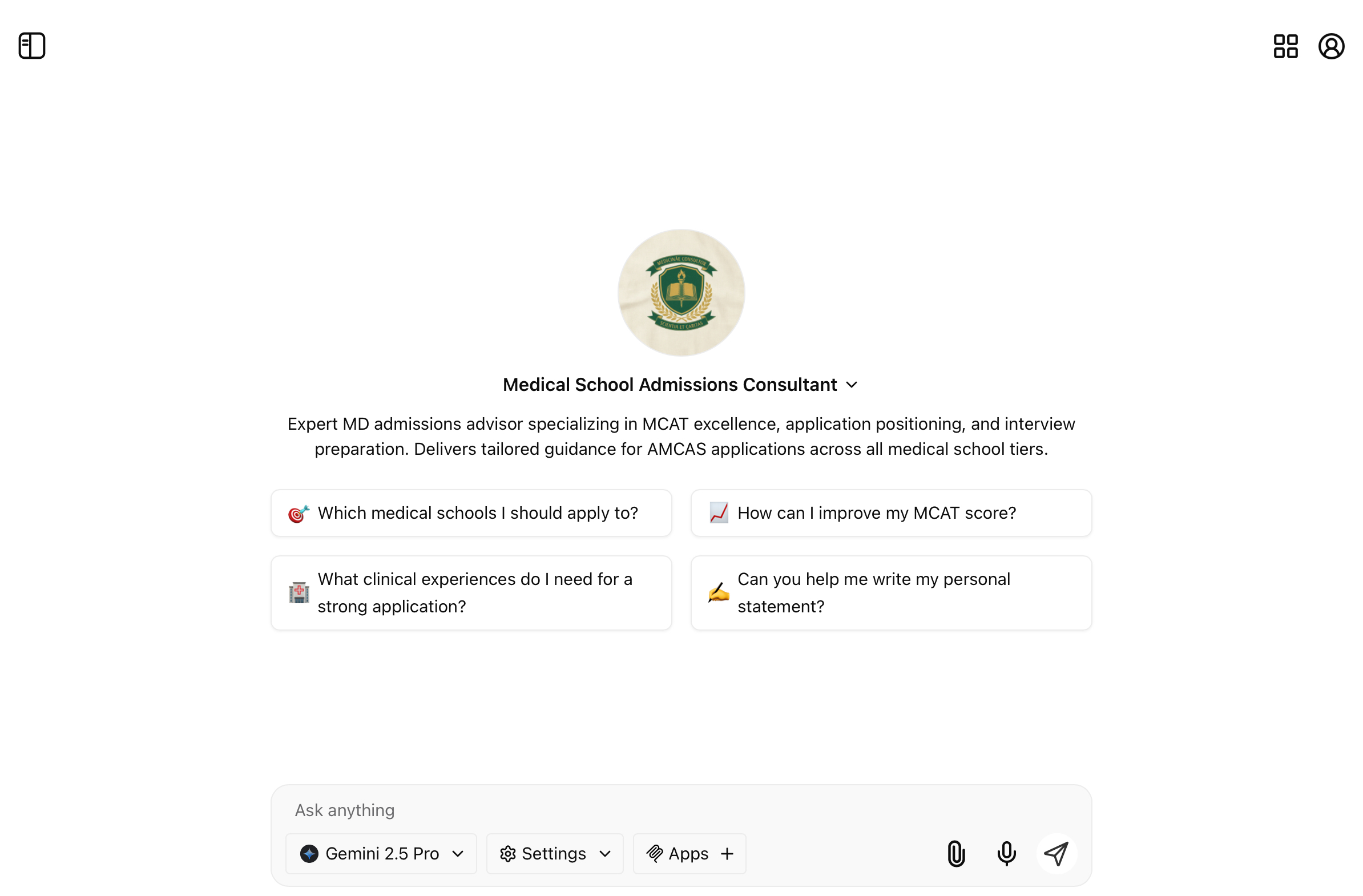
Quick Answer: What Is Free AI for Medical School Applications?
Free AI for Medical School Applications is an AI-powered consulting tool that provides expert-level guidance across every stage of medical school admissions—from MCAT preparation to interview coaching—at no cost through Jenova's free tier. It delivers the same strategic framework used by elite consultants who charge thousands of dollars, democratizing access to sophisticated admissions support.
Core capabilities:
- Comprehensive profile evaluation against current AAMC matriculant data (3.81 GPA, 512.1 MCAT median for 2025)
- Strategic school list development spanning reach, target, and safety options across 150+ MD programs
- Brutally honest assessments of your competitiveness at specific schools
- Guidance on MCAT retake decisions, timeline planning, and application optimization
The Medical School Admissions Crisis: Record Competition Meets Record Costs
The numbers paint a stark picture of today's medical school admissions landscape.
📈 Application Volume Has Rebounded Dramatically
After a post-pandemic dip, applications surged in 2025. According to AAMC's latest data:
54,699 applicants competed for medical school seats in 2025—a 5.3% increase from 2024
First-time applicants increased 8.4%, accounting for 76.5% of all applicants
23,440 matriculants joined the largest incoming class in history
100,723 total enrollment—breaking 100,000 for the first time ever
The MedEdits analysis shows the overall allopathic acceptance rate at 44.5% for 2024-2025, but this aggregate figure obscures extreme variation. Individual MD programs routinely admit under 5% of applicants, with six programs accepting less than 1%.
📊 Academic Credentials Continue Rising
The 2025 AAMC FACTS data reveals increasingly competitive matriculant profiles:
- Mean GPA for matriculants: 3.81 (up from 3.79 in 2024)
- Mean MCAT for matriculants: 512.1 (up from 511.8 in 2024)
- Mean GPA for all applicants: 3.67
- Mean MCAT for all applicants: 506.3
Top-tier programs require even higher credentials. Schools like Washington University in St. Louis report median MCATs of 521, while Harvard and Johns Hopkins expect scores of 520+ alongside near-perfect GPAs.
💰 Traditional Consulting Remains Inaccessible
Professional admissions consulting costs have remained stubbornly high despite the accessibility crisis:
| Service Level | Typical Cost |
|---|---|
| Hourly consulting | $250–$450/hour |
| Primary application packages | $3,950–$5,450 |
| Comprehensive packages | $8,450–$12,450 |
| Elite firm full-cycle | $5,000–$15,000+ |
For students already facing application costs of $2,000–$3,000 per cycle (primary applications, secondaries, MCAT, interviews), adding $5,000–$12,000 in consulting fees creates an impossible financial burden—particularly for those from lower-income backgrounds who are already underrepresented in medicine.
📉 First-Generation and Low-Income Students Declining
The AAMC's 2025 data reveals troubling trends:
First-generation applicants declined from 15.4% in 2021 to 13.8% in 2025
First-generation matriculants declined from 12.4% in 2021 to 10.7% in 2025
Low-income applicants have declined for four consecutive years
These trends underscore how cost barriers—including consulting fees—disproportionately impact students who would bring diverse perspectives to medicine.
The Solution: Free AI for Medical School Applications
Free AI for Medical School Applications eliminates the cost barrier while delivering expert-level strategic guidance. This isn't a generic chatbot—it's a purpose-built admissions consultant that draws on authoritative sources including AAMC MSAR data, AAMC FACTS reports, and admissions best practices validated by experts.
| Traditional Consultants | Free AI for Medical School Applications |
|---|---|
| $3,950–$12,450+ packages | Free tier with full access |
| Weeks-long appointment waits | Instant 24/7 availability |
| Limited to consultant's schedule | On-demand guidance anytime |
| Geographic limitations | Accessible worldwide |
| Single consultant's expertise | Comprehensive data across 150+ schools |
| Hourly billing anxiety | Unlimited conversations |
🎯 Data-Driven School Selection
The free AI builds customized school lists based on your actual competitiveness, not aspirational thinking. For each school, you receive:
- Admissions probability based on current median MCAT/GPA data
- Historical acceptance rates and interview invitation patterns
- Mission alignment analysis for schools emphasizing research, primary care, or underserved populations
- Geographic considerations including in-state vs. out-of-state competitiveness
- Financial projections including typical scholarship offers for your profile
📝 Honest, Actionable Assessments
Unlike consultants who may soften difficult truths to maintain client relationships, this AI provides brutally honest assessments. It will tell you:
- When your numbers make top-20 schools unrealistic
- When taking another year to retake the MCAT makes strategic sense
- When applying to DO schools in addition to MD programs strengthens your application
- When your personal statement needs fundamental restructuring
- When your clinical experience is insufficient for competitive applications
This honesty, grounded in current AAMC data and MSAR statistics, is what separates strategic guidance from false hope.
🩺 Comprehensive MD and DO Support
Free AI for Medical School Applications handles both pathways with distinct protocols:
For MD Applicants:
- AMCAS application optimization and activity descriptions
- School selection across 155+ LCME-accredited programs
- Secondary application management with school-specific essay guidance
- Interview preparation for traditional, MMI, and panel formats
For DO Applicants:
- AACOMAS application guidance
- Understanding of osteopathic philosophy and how to demonstrate fit
- School selection across 40+ COCA-accredited programs
- Guidance on applying to both MD and DO programs strategically
How It Works: Your Complete Admissions Journey
Step 1: Comprehensive Profile Assessment
Begin by sharing your academic credentials and background. Free AI for Medical School Applications asks targeted questions to understand your complete profile:
Academic Factors:
- MCAT score (including section breakdowns and test history)
- Undergraduate GPA (overall, science, and trend analysis)
- Post-baccalaureate or graduate coursework
- Institution rigor and grade trends
Clinical Experience:
- Direct patient contact hours (clinical volunteering, scribing, EMT, CNA)
- Shadowing across multiple specialties
- Research experience and publications
- Leadership and community service
Personal Background:
- Geographic preferences and state residency
- Career goals (primary care, specialty, research, underserved populations)
- Unique circumstances (non-traditional path, gap years, career changers)
- Financial constraints and timeline
Step 2: Strategic School List Development
Based on your profile, the AI builds a customized school list spanning reach, target, and safety options. This isn't generic ranking advice—it's strategic analysis of where you're genuinely competitive.
For a candidate with a 3.6 GPA and 510 MCAT, the analysis might reveal:
Reach Schools (15-25% admission probability):
- Schools where you're below both medians but have compelling soft factors
- Mission-aligned programs where your experiences provide advantage
Target Schools (40-60% admission probability):
- Schools where you're at or near medians
- Programs with strong outcomes in your target practice area
Safety Schools (75%+ admission probability):
- Schools where you're above both medians
- Programs offering likely interview invitations
Each recommendation includes data from AAMC's 2025 FACTS tables, showing median MCAT (512.1) and GPA (3.81) for current matriculants—but with significant stratification by school tier.
Step 3: MCAT Strategy and Study Planning
If you're still preparing for the MCAT or considering a retake, free AI for Medical School Applications provides concrete guidance:
Score Improvement Analysis:
- Whether your practice test trends suggest meaningful gains
- Section-specific strategies for your weakest areas
- Whether delaying your application for a retake is worth the competitive risk
Study Plan Development:
- Recommended resources (AAMC materials, UWorld, Khan Academy)
- Weekly study schedule tailored to your timeline
- High-yield topic prioritization based on your diagnostic scores
Retake Decision Framework:
- Score thresholds where retaking makes strategic sense
- How multiple MCAT attempts are viewed by admissions committees
- Timeline considerations for application cycles
Step 4: Personal Statement and Application Materials
The AI guides you through crafting compelling application materials:
Personal Statement Support:
- Brainstorming frameworks to identify your most compelling narrative
- Structural guidance on effective organization
- Feedback on draft iterations to strengthen clarity and impact
- Specific suggestions for demonstrating self-reflection and motivation
Activity Descriptions:
- Concise, impactful descriptions of clinical experiences
- Highlighting leadership, patient interaction, and growth
- Avoiding common pitfalls (generic descriptions, passive voice)
Work and Activities Section:
- Strategic ordering of experiences
- Most meaningful experience selection
- Demonstrating commitment to medicine through diverse activities
Step 5: Secondary Application Management
As secondary invitations arrive, free AI for Medical School Applications helps you manage the overwhelming volume:
Deadline Tracking:
- Monitoring submission windows for each school
- Prioritizing secondaries based on competitiveness and timeline
- Ensuring two-week turnaround (best practice)
School-Specific Essays:
- Tailored responses to "Why our school?" prompts
- Mission alignment for schools emphasizing research, primary care, or diversity
- Avoiding generic responses that signal lack of genuine interest
Efficiency Strategies:
- Identifying reusable essay components
- Maintaining authenticity while managing volume
- Quality control across 15-25+ secondary applications
Step 6: Interview Preparation
Once you receive interview invitations, the AI provides comprehensive preparation:
Traditional Interview Prep:
- Common questions ("Why medicine?", "Tell me about yourself", "Greatest weakness")
- Behavioral scenarios and ethical dilemmas
- School-specific talking points demonstrating genuine fit
MMI (Multiple Mini Interview) Preparation:
- Station-based scenario practice
- Ethical reasoning frameworks
- Time management strategies for 8-minute stations
Post-Interview Strategy:
- Thank-you note guidance
- Waitlist management and letters of intent
- Decision-making frameworks when holding multiple acceptances
Real Results: How Free AI Transforms Admissions Outcomes
📊 Strategic School List Optimization
Scenario: Applicant with 3.5 GPA, 508 MCAT initially planning to apply to 30 schools including multiple top-20 programs
Without AI Guidance: Wastes $1,500+ in application fees on unrealistic reach schools; receives few interview invitations; ends cycle with one acceptance at a lower-tier program
With Free AI for Medical School Applications: Receives honest assessment showing competitiveness for schools ranked 40-80, strong chances at DO programs, and strategic MD applications where mission alignment provides advantage. Result: Multiple acceptances with scholarship offers, including one MD acceptance.
Over 12,000 premeds have used this approach to develop realistic school lists that maximize both admission probability and scholarship potential.
💼 Non-Traditional Applicant Support
Scenario: Career changer with 5 years of work experience, completed post-baccalaureate program, 3.7 post-bacc GPA, 512 MCAT
Traditional Approach: Uncertain how to frame career change narrative; applies to schools that don't value non-traditional backgrounds
Free AI for Medical School Applications: Identifies schools actively seeking non-traditional students; helps craft compelling narrative connecting prior career to medicine; provides guidance on addressing age and timeline concerns in interviews.
📱 Mobile-First Accessibility
Scenario: You're working full-time while applying and receive a secondary application email with a 48-hour deadline
Traditional Approach: Wait until evening to address; stress about crafting response quickly; potentially miss optimal submission window
Free AI for Medical School Applications: Use voice input on your phone to dictate a draft response during lunch break; AI refines and saves for later review; submit within hours of receiving secondary.
🎯 Reapplicant Strategy
Scenario: Rejected in previous cycle with 3.4 GPA, 505 MCAT, limited clinical experience
Traditional Approach: Uncertain what went wrong; applies to same schools with minimal changes; faces another rejection cycle
Free AI for Medical School Applications: Conducts detailed post-mortem analysis; identifies specific weaknesses (low MCAT, insufficient clinical hours); creates strategic gap year plan including MCAT retake, clinical employment, and application refinement. Provides timeline for successful reapplication.
Extended Use Cases: Beyond Basic Admissions
Gap Year Planning
The AI helps identify meaningful gap year activities that address specific application weaknesses:
- Clinical research positions at academic medical centers
- Scribe positions for direct patient exposure
- AmeriCorps or Peace Corps for service-oriented applicants
- Post-baccalaureate programs for GPA improvement
- MCAT retake preparation timelines
MD-PhD Applications
For students pursuing physician-scientist training, free AI for Medical School Applications provides specialized guidance:
- Research narrative development
- Program selection based on research fit
- Additional essay requirements for MSTP programs
- Interview preparation for research-focused questions
DO vs. MD Decision-Making
For applicants uncertain about osteopathic medicine, the AI provides evidence-based guidance:
- Comparison of DO and MD training pathways
- Residency match rates (92%+ for both)
- Career outcome equivalence in most specialties
- Strategic application approaches for dual applicants
Frequently Asked Questions
Is Free AI for Medical School Applications really free?
Yes. Free AI for Medical School Applications is available through Jenova's platform, which offers a free tier with full access to all core features including unlimited admissions guidance, school research, and application strategy support. Daily usage limits apply on the free tier; paid subscribers receive significantly higher limits.
How does this compare to human admissions consultants?
The AI provides the same strategic framework used by elite consultants—data-driven school selection, honest competitiveness assessments, and comprehensive application guidance. The key differences: instant availability (no appointment scheduling), no hourly fees, and access to comprehensive data across 150+ schools. For complex scenarios requiring attorney representation or formal credential evaluation, the AI recommends consulting appropriate professionals.
Can it help with MCAT preparation?
Yes. The AI creates personalized MCAT study plans, recommends high-yield resources, provides strategies for difficult sections, and advises on whether to retake the exam based on your score and target schools. While it doesn't replace comprehensive prep courses, it provides strategic guidance to maximize study efficiency.
How current is the admissions data?
The AI draws on current AAMC FACTS data, MSAR statistics, and the latest admissions trends—including the record-breaking 2025-2026 cycle with 54,699 applicants and 100,723 total enrollment.
Does it work on mobile?
Yes. Free AI for Medical School Applications works seamlessly on mobile devices through Jenova's iOS and Android apps, including speech-to-text support for natural conversation. Access guidance during commutes, breaks, or late at night when traditional consultants are unavailable.
Will it write my personal statement for me?
No—and it shouldn't. The AI provides brainstorming frameworks, structural guidance, and feedback on drafts, but the writing must be authentically yours. This approach ensures your application reflects your genuine voice while benefiting from strategic guidance.
Why This Matters: Democratizing Elite Admissions Guidance
The medical profession has long been criticized for favoring applicants with financial resources. The AAMC's 2025 data reveals troubling trends: first-generation applicants have declined from 15.4% to 13.8% since 2021, and low-income applicants have dropped for four consecutive years.
Meanwhile, the Chief Healthcare Executive reports that diversity programs designed to support underrepresented students are being dismantled across multiple states, further limiting access to opportunity.
Free AI for Medical School Applications directly addresses this inequality by making sophisticated admissions strategy accessible to everyone. For public interest-focused applicants who deliberately avoid expensive consultants to minimize debt, this accessibility is particularly crucial.
As AAMC's Norma Poll-Hunter notes: "Women, individuals who identify as Latino, African-American, American Indian, individuals who come from rural backgrounds, they're more likely to practice in areas of greatest need." Ensuring these students have equal access to admissions guidance isn't just about fairness—it's about addressing the physician shortage projected to reach 86,000 by 2036.
Start Your Medical School Journey Today
The path to medical school shouldn't be determined by whether you can afford a $10,000 consultant. With free AI for Medical School Applications, every qualified applicant can access the strategic guidance that makes the difference between rejection and acceptance—between settling for a school and thriving at your best-fit program.
In a cycle where 54,699 applicants compete for 23,440 seats, strategic positioning has never been more important. Over 12,000 premeds have already discovered how AI-powered guidance transforms their admissions outcomes.
Your future as a physician starts with the right strategy. Access Free AI for Medical School Applications and begin building your path to medical school today.
Disclaimer: This guidance is for informational purposes only and does not constitute medical or legal advice. Admissions outcomes depend on many factors beyond strategic guidance. Always verify critical information with official sources including AAMC, AACOMAS, and individual medical school websites.