Escape Room Simulator AI: Adaptive Puzzle Rooms On Demand
2026-08-31
The Mansion helps you search rooms, solve puzzles, and escape a living mystery by turning every action you describe into a consequence. While physical venues still demand tickets, travel, and a hard 60-minute clock, this escape room simulator AI provides an on-demand house of secrets you can enter from a phone or laptop. As of August 2026, players who want the classic "search, solve, escape" loop no longer have to wait for a weekend booking or assemble a group of four. You investigate drawers, stereo knobs, locked doors, and half-remembered clues in natural language—and the story answers.
- ✅ Play instantly—no travel, tickets, or forced countdown
- ✅ Every room hides secrets that react to how you investigate
- ✅ Clues, mistakes, and theories carry forward as you explore
- ✅ Same mystery on web, iOS, and Android, including voice input
To understand why this matters, it helps to look at what escape fans actually face today. Demand for locked-room puzzles is real, the venues are not evenly distributed, and a single booking often costs as much as a night out. An AI simulator does not replace a great physical set. It removes the gate in front of the genre so you can practice observation, deduction, and calm under pressure whenever you have 20 minutes.
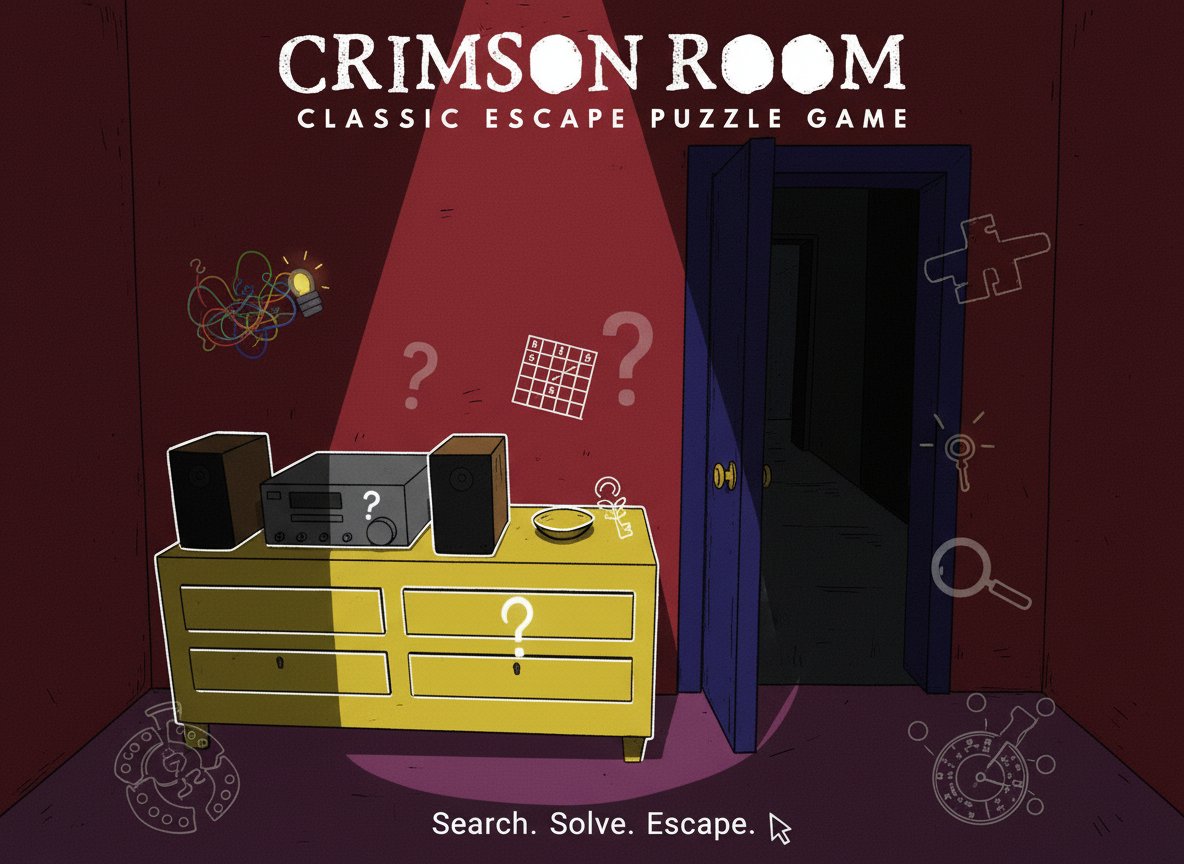
Quick Answer: What Is Escape Room Simulator AI?
The Mansion is an escape room simulator AI that drops you into a mystery house and lets you search rooms, solve puzzles, and escape through conversation. You describe what you examine, combine, or try; the room answers with consistent detail.
Key capabilities:
- Amnesia-start mystery: you wake in a mansion with no memory of how you arrived
- Room-by-room investigation—drawers, devices, doors, and shadows all hide information
- Natural-language actions instead of pixel-hunting a static screen
- A story that can continue across sessions instead of resetting when the hour is up
The Problem With Physical Escape Rooms
Escape rooms work because they force focused attention. You search a space, connect clues, and beat a lock before time runs out. That loop is so effective that educators now use it for problem solving and critical thinking, and universities have tested digital escape rooms as team-bonding activities. The hunger for the format is not a fad.
The U.S. scene is large and, after a boom-and-bust cycle, surprisingly stable:
Just over 2,000 — Escape room facilities operating in the United States
About 7,800 — Individual in-person games available across those facilities
$300 million — Estimated annual U.S. industry revenue, based on roughly 40,000 bookings per week
Globally, research firms still forecast expansion. One report values the escape room market at USD 1.22 billion in 2025, with a 14.2% CAGR through 2035.
But accessing that experience is frustratingly difficult:
- You have to live near a venue, or travel
- A private booking is now the norm, so solo players and odd-sized groups get priced out
- The clock is unforgiving, and you cannot pause mid-puzzle
- Most physical games are one-and-done; replay means another ticket
- The script cannot branch when you notice something the designer did not plan for
Those constraints are fine for a special occasion. They are a poor match for someone who wants to train observation skills on a Tuesday night, run a remote icebreaker, or replay a mystery from a different angle.
This is exactly what an AI mansion mystery was built for.
Why The Mansion
This AI escape room treats you as an investigator, not a tourist on a timed track. You wake in a mansion with no memory of how you arrived. Every room hides secrets. Every shadow could matter. You uncover the truth the same way a great physical game wants you to: by looking closely, testing ideas, and living with the results.
| Traditional Approach | The Mansion |
|---|---|
| Drive or ride to a venue, then wait for your slot | Start the mystery in the next message |
| About $150 per booking for a group hour | Free to try; play in short sessions or long ones |
| Fixed 60-minute clock; pause is not an option | Investigate at your pace; pick up later |
| One designed path; noticing “the wrong thing” wastes time | The room can respond to unusual searches and theories |
| Replay usually means buying another ticket | Return to the house and press on unfinished threads |
| Best with 4–8 people in the same city | Solo play, voice play on mobile, or a shared screen with friends |
Search like you are actually in the room
Physical games reward specificity. “I check the dresser” is weaker than “I pull the third drawer and feel along the back panel.” The simulator is built for that habit. Name the object. Name the action. Ask what you notice before you commit. The environment stays consistent: a stereo you already powered on should still be humming; a door you left ajar should still be ajar.
"I check the yellow dresser. Open the top drawer, then run my hand along the underside for a hidden latch."
Solve by connecting, not by guessing a walkthrough
Escape design is not trivia. Educational reviews of the format keep returning to the same point: the value is in sequencing clues, not memorizing facts. Say what you think a code refers to. Try the combination on the lock that actually matches. If you are wrong, you still learned how the house is organized.
"The stereo clicked three times, then twice. I try 3-2 on the drawer lock, then look for a four-digit pad that might want 3-2 plus the two numbers on the speaker grilles."
Escape without a gatekeeper
The end state is the same as the genre promise: get out, or learn why you cannot. Because the session is conversational, you can also ask for a lighter hint, a harder constraint, or a recap of items you already found—something a live game master can do, and a paused video game walkthrough cannot do without spoilers.
"I do not walk through the open doorway yet. From the threshold, what do I see, hear, and smell? I want one detail I could have missed."
Related Agents You'll Also Find Useful
If the mansion hooked you, these three extend the same itch—locked spaces, custom scenarios, and the craft of building puzzles.
The Asylum
The Asylum is the next locked building when you want a colder brief. You are an investigator sent into a shuttered psychiatric institution, and something has already gone wrong. Wards replace parlors; files replace jewelry boxes; the question is not only “how do I leave?” but “what happened here?”
- Ward-by-ward exploration with a hidden story
- Investigation tone rather than a pure parlor mystery
- The same search-and-deduce muscle, new architecture
Roleplay Game Master
When you want a heist penthouse, a submarine, or a cocktail lounge that is also a puzzle box, Roleplay Game Master runs the table. Unlimited memory and stable characters mean a custom escape you invent tonight can still remember the cipher you failed last week.
- Any theme, any difficulty, any cast of NPCs
- Character consistency across long campaigns
- Useful when your group wants a private room that no venue in town offers
Game Designer Assistant
If you finished a session and immediately started sketching your own locks, this design partner is the complementary step. It helps you turn a feeling (“search, solve, escape”) into systems, documentation, and genre-aware structure—whether you are prototyping a digital room or a physical one.
- Brainstorming and systems analysis across genres
- Documentation for puzzle logic and player flow
- Concept support before you spend money on props or code
Try the mansion mystery free—no credit card required.
How to Play an Escape Room Simulator AI
Step 1: Enter the house Open the simulator and read the opening beat. You have no memory of arriving. Note the first room: furniture, light, sound, and anything that feels out of place. Do not rush the door you have not earned yet.
"I stand still and take inventory. What furniture is in this room, what is powered on, and what is the first thing that does not belong?"
Step 2: Search in specific, physical language Name objects the way you would in a real room. Open, lift, look behind, listen, smell. One precise action beats five vague ones. If you find a key, say where you put it.
"I pull both speaker grilles, then check behind the stereo for a paper slip or a USB stick."
Step 3: Combine clues out loud Treat the chat as your scratch paper. Restate codes, counts, and symbols before you apply them. If a grid, a clock, or a question-mark prop showed up, say how you think it maps to a lock.
"I have a 3-by-3 number grid and a clock icon. I try reading the grid like a keypad, then I look for a lock that wants a time instead of a number."
Step 4: Test the exit, then decide how hard you want it When a door yields, check the next space before you sprint. Ask for a hint only after you have named what you already tried. That keeps the win yours.
"The blue door is open. I look down the hall without stepping through. If I am stuck after this, give me a hint that points at an object, not the answer."
Step 5: Leave and come back Close the session when life interrupts. On return, ask for a recap of rooms cleared, items held, and open puzzles. The house should not forget the drawer you already emptied.
Results & Use Cases
📊 Solo Friday mystery
Scenario: You want a 90-minute locked-room night, but the nearest venue is booked and a $150 group slot is wasteful for one person.
Traditional Approach: Skip it, watch someone else’s playthrough, or buy a one-shot video game that cannot hear your weird idea about the stereo.
The mansion mystery: You start in the parlor, empty the dresser, decode the audio, and reach the dark doorway on your own clock.
- No minimum player count
- Hints on your terms
- Replay the same house with a stricter “no hints” rule next time
💼 Remote team icebreaker
Scenario: A distributed squad has 45 minutes. You need collaboration, not a slideshow. Research on virtual rooms finds they can raise teamwork perceptions in online groups, and campus trials report digital rooms as engaging bonding activities.
Traditional Approach: Ship everyone to a city, or run a video-call “escape” that is really a shared Google Doc of riddles.
The simulator: One person shares the screen, the rest call out searches (“check behind the bowl,” “replay the stereo”). The room becomes a single object the team has to see together.
- Forces turn-taking and listening
- Works across time zones without a facility
- If the group wants a different set next week, Roleplay Game Master can host a custom office-heist room
📱 Commute or couch session on mobile
Scenario: You have a 25-minute train ride. A physical room is impossible. A console game is awkward to hold.
Traditional Approach: Idle on your phone until you can book a Saturday.
The AI room: Play on iOS or Android with the same story. Type, or use speech-to-text: “I open the bottom drawer.” Headphones on; the mansion in your pocket.
- Full play on phone, not a stripped-down demo
- Easy to pause at your stop
- Voice input keeps your hands free on a crowded commute
🎯 From player to designer
Scenario: You escaped, and now you want to build a room for friends—or for a real venue.
Traditional Approach: Guess at difficulty, copy a YouTube lock, and discover on game night that the second puzzle has no fair tell.
The path: Replay The Asylum to feel a different building’s rhythm, then take notes into Game Designer Assistant so flow, red herrings, and win conditions are written down before anyone buys a hasp.
- Study two distinct locked-building tones (mansion vs. institution)
- Capture puzzle logic while it is still fresh
- Prototype in chat before you spend on props

FAQ
What is an escape room simulator AI?
An escape room simulator AI is a conversational mystery that plays like a live room: you search a space, solve locks, and try to get out. Instead of clicking hotspots on a static illustration, you say what you do and the environment replies with consistent detail. This mansion is built for that loop—amnesia start, secret-filled rooms, and an exit you have to earn.
Is The Mansion free?
You can start without paying. A free tier covers core play with monthly usage limits; paid plans raise those limits if you run long campaigns or daily sessions. There is no per-room ticket and no required group size, which is the usual cost spike in physical venues.
How is an AI escape room different from a physical venue or a classic point-and-click game?
A physical venue gives you real props, and that irreplaceable. It also gives you geography, a typical booking cost around $150, and a script that cannot hear a novel idea. Classic point-and-click titles (the “search, solve, escape” desktop games) are hand-authored and finite. An AI room trades some of that authored set-piece precision for on-demand access, pause-and-resume play, and responses to searches the designer did not pre-record.
Can I play an escape room simulator AI on mobile?
Yes. Play in a browser or in the iOS and Android apps with the same story. Speech-to-text is useful when your hands are full. Settings sync, so a clue you found on the couch is still found when you continue on the train.
Can I build my own room instead of playing a set mansion?
Yes. Use Roleplay Game Master when you want a custom theme, cast, and difficulty with memory that lasts. Use Game Designer Assistant when you need systems, documentation, and genre structure for a room you might later build in the real world. The mansion remains the fastest way to play; the other two are how you author.
Is this useful for teams or only for solo puzzle fans?
Both. Solo play is the default and does not waste a group booking. For teams, put one player on the keyboard and let others call actions—the same collaboration virtual escape rooms are used to practice. Educators also use the format because it surfaces problem solving under a shared goal. Keep sessions short, assign a scribe for clues, and agree on a hint rule before you start.
Ready to Search, Solve, and Escape
Physical escape rooms are worth the trip when you can get a slot. They are also scarce, scheduled, and priced for groups. An escape room simulator AI removes those gates without removing the job: look harder, think cleaner, get out.
The Mansion is the house you can enter tonight—no booking, no countdown you did not choose, no unused chair you still paid for. Search the dresser. Replay the stereo. Decide whether that open door is an invitation or a trap.
Try the mansion now. Explore more at Jenova.
For Developers: The Mansion is available programmatically via the Jenova API — integrate adaptive escape-room play into your application with a single API call. Full documentation →