Dynamic NPC Conversations: AI Dialogue That Stays In Character
2026-09-10
Game Designer Assistant helps you design dynamic NPC conversations that react to what the player just did, remember what they said last week, and refuse to break character. While most worlds still fire the same three greets no matter who is holding the gun, this AI turns persona, memory, reaction rules, and dialogue locks into systems writers and engineers can actually ship. As of September 2026, players expect virtual people to talk like they live in the same world — not like they are reading from a clipboard.
✅ Specifies when a line fires from action, mood, memory, or relationship — not from a random bark table ✅ Keeps persona, lore, and quest facts inside hard knowledge boundaries ✅ Documents trees, generative constraints, and companion talk as one conversation system ✅ Works for open-world strangers, hub towns, CRPGs, and relationship-gated companions
To understand why this matters, let's examine why so many NPC conversations still feel canned — even in expensive games.
Quick Answer: What Are Dynamic NPC Conversations?
Dynamic NPC conversations are player-facing talks that change with action, memory, mood, and persona instead of replaying a fixed line. They are a design system, not a chatbot bolted onto a villager.
Key capabilities:
- Context reaction (threat, gift, location, weather, witnesses)
- Persistent conversational memory across sessions and maps
- Persona and lore locks so the blacksmith never explains the final boss
- Relationship- and quest-gated lines, not only branching menus
A bark that fires because you aimed a weapon is a start. A town that remembers the aim, the apology, and the rumor it caused is a conversation system.
The Problem With Scripted — and Ungoverned — NPC Talk
Players notice when a stranger begs for their life in one beat and forgets the gun in the next. They also notice when an “AI companion” rambles off-lore, invents a quest, or sounds like every other model-voiced extra. Studios feel that pressure: large language models are increasingly used to power NPC dialogue, quest logic, and world-building, while research on in-game contextual talk keeps treating conversation as a first-class gameplay problem, not flavor text (ChatNPC).
The production picture is mixed. Generative tools are in the building, but trust is not.
33% — Developers who report using generative AI in their work
Among those who do use it, 81% apply it to research and brainstorming — ideation, not a live innkeeper. That gap is the real design problem: teams want richer talk, and they do not want an ungoverned model improvising the plot.
But making conversations feel alive is frustratingly difficult:
- Handcrafted trees that cannot answer an unexpected question
- Open-ended chat that breaks persona, lore, and quest state
- No memory of prior talks, gifts, crimes, or companions
- Voice, localization, and QA costs that explode with every extra branch
Trees That Cannot Hear the Player
Academic work on NPC dialogue still starts from the same industry baseline: most commercial systems rely on handcrafted dialogue trees or rigid behavior scripts, which scale poorly and fail at long-term coherent interaction. A tree is excellent at a planned confession. It is helpless when the player aims a revolver at a man whose only authored beat was “good afternoon.”
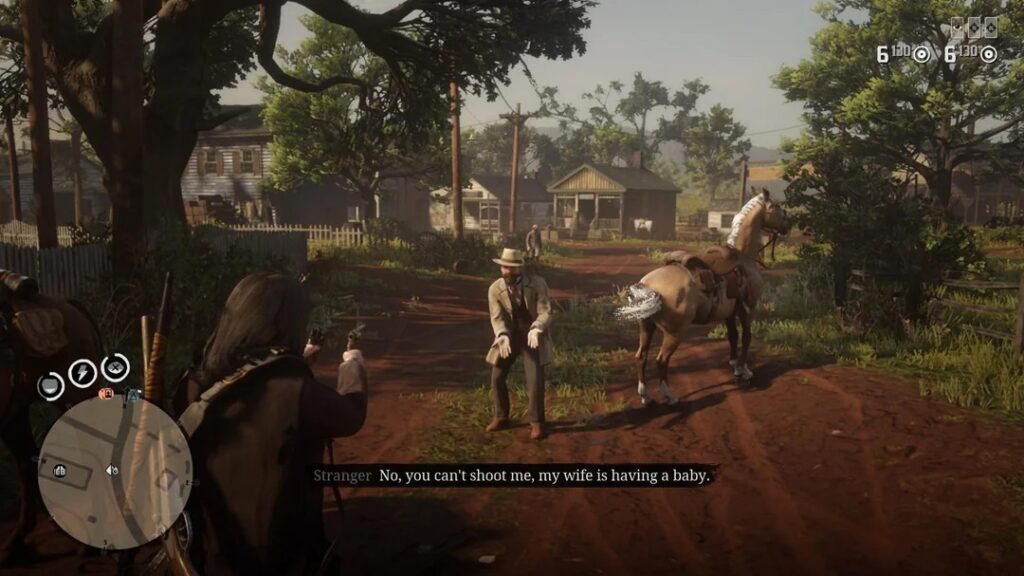
That plea is memorable because it is situated: weapon out, dirt road, a reason to live. It is still a trigger line. If the next sentence cannot change when the player holsters, follows him home, or mentions the baby in town, the conversation was never dynamic — it was a well-written interrupt.
Generative Talk Without Knowledge Boundaries
Dumping a general model into an NPC creates a different failure: fluency without a spine. Research on scalable NPC dialogue argues that personas should be fixed and knowledge bounded, with conversational memory and world knowledge retrieved at runtime rather than hoped for in a prompt. Without those rails, the companion invents a sister, spoils a dungeon, or agrees to a romance the relationship system never authorized.
Character consistency is now its own research problem. Work on balancing character consistency in game dialogue exists because “sounding human” is easy; sounding like this human, in this world, across sessions, is not.
Memory That Resets at the Loading Screen
Dynamic NPC conversations need two memories, not one meter: what this person already told the player, and what they are allowed to know about the world. Modular NPC architectures separate those stores so a guard and an innkeeper can share a model family without sharing a brain (fixed-persona SLMs with swappable memory). Most shipped design docs still store “met = true” and call it continuity.
This is exactly what this AI design partner was built for.
Why Game Designer Assistant
Game Designer Assistant treats dynamic NPC conversations as a standalone design problem — not a pile of disconnected bark files and a hope that “AI will fill the gaps.” You bring a cast, a genre, and a constraint (open-world strangers, a six-person party, a voiced companion with a relationship track). It returns systems: when talk starts, what the NPC may know, what they remember, what they refuse to say, and how that maps to trees, barks, or constrained generation.
| Traditional Approach | Game Designer Assistant |
|---|---|
| Fixed greets and a few interrupt barks | Reaction rules for threat, gift, location, witnesses, and mood |
| One branching tree per quest | Conversation physics plus lock lists writers can share |
| Ungoverned chatbot in a character model | Persona, lore, and quest boundaries specified before any model is chosen |
| “They should remember you” in a wiki | Conversational memory vs world knowledge, with what is public vs secret |
| Companion talk that ignores the relationship meter | Goals, optional topics, and affinity gates designed as one loop |
That table is the difference between a clever subtitle and a town that can talk. Production research already treats memory swap and retrieval as real-time problems — measured in fractions of a second on consumer hardware — but someone still has to decide what gets stored. This assistant specifies the what.
Reaction Rules Before Lines
Start with verbs, not quotes. Aimed weapon, holstered weapon, gifted item, overheard rumor, failed quest, rain, funeral, festival. Each verb gets a conversation outcome: plea, joke, freeze, call for guards, change of topic. The line comes last. If you cannot name the verb, you do not have dynamic NPC conversations — you have copy.
Persona Locks and Knowledge Boundaries
A blacksmith may know ore prices and the mayor’s temper. He may not know the demon’s true name. The assistant helps you write those fences as designer language: allowed topics, forbidden topics, refusal style, and what happens if the player pushes. That is how you keep generative or semi-generative talk from wrecking the plot while still letting players ask unexpected questions.
Two Memories, One Voice
Conversational memory is “you promised my wife you’d come.” World knowledge is “the mine collapsed last season.” Mixing them produces omniscient peasants. Splitting them produces people. Ask for both stores, plus which memories are shared when two NPCs gossip.
Companion Talk That Matches the UI
Relationship meters, optional “learn about their past” goals, and “make them happy” objectives are conversation gates. If the HUD says you are building a partnership and the spoken lines still sound like a first meeting, players feel the seam. The system has to read the same flags the UI does.
"Design dynamic NPC conversations for a 20-person frontier town: threat reactions, gift talk, rumor spread, and a hard ban on spoiling the mine collapse unless the NPC witnessed it."
"Convert this companion into a conversation system: relationship ranks 0–3, optional personal quests, refusal lines if I romance their rival, and memory of the last camp conversation."
"List every player verb that should change spoken lines in my CRPG hub — draw, steal, pray, bribe, dance — and map each to persona-safe responses."
Related Agents You'll Also Find Useful
If the system is ready and the lines still sound like design notes, Film Screenwriter pressure-tests scene craft: subtext, interruption, and the difference between a plea and a speech. Dynamic NPC conversations fail in the mouth as often as they fail in the graph.
- Scene outlines for first meetings, threats, and confessions
- Dialogue that carries character without dumping lore
- Revision passes when a lock list is correct but the voice is flat
If every NPC still talks like the same helpful extra, Personality Analyzer specifies attachment, conflict style, and trait stacks so a nervous clerk and a bored gunfighter do not share a sentence rhythm.
- Trait language you can drop into persona docs
- Stress behaviors that justify topic changes and refusals
- Compatibility notes when two companions argue in front of the player
If you need to hear whether memory and persona survive a long session, Roleplay Game Master runs the conversation as play: unlimited memory, character consistency, and the messy follow-up questions your tree never listed.
If you want a player-side reference for talk that actually changes with choices, College Life is an open-world campus story where friendships and heartbreak unfold from what you say — useful when you are tuning how fast a companion should stop sounding like a stranger.
Try this design partner free — no credit card required.
How It Works
Step 1: Name the Conversation Fantasy State genre, cast size, and what “dynamic” means in this game. A silent protagonist with bark replies is not a voiced detective with full interviews. Be concrete about input: button choices, free text, proximity barks, or mixed.
"Open-world story game, unvoiced player, 40 strangers plus 4 companions. I need dynamic NPC conversations for threats, jobs, and camp talk — not an open chatbot."
Step 2: Inventory Verbs and Context List every player action that should change spoken lines. Include location, weather, witnesses, weapons, time of day, and relationship rank. The deliverable is a verb × context matrix, not a script.
"Here are my player verbs. For each, tell me who notices, who talks, and who stays silent. Flag any verb that would break a voiced budget."
Step 3: Split Persona, Memory, and Lore For each major NPC, define voice, allowed knowledge, conversational memory, and world knowledge. Mark secrets the player can discover versus facts the NPC will never say. This is the spine that later trees or models must obey.
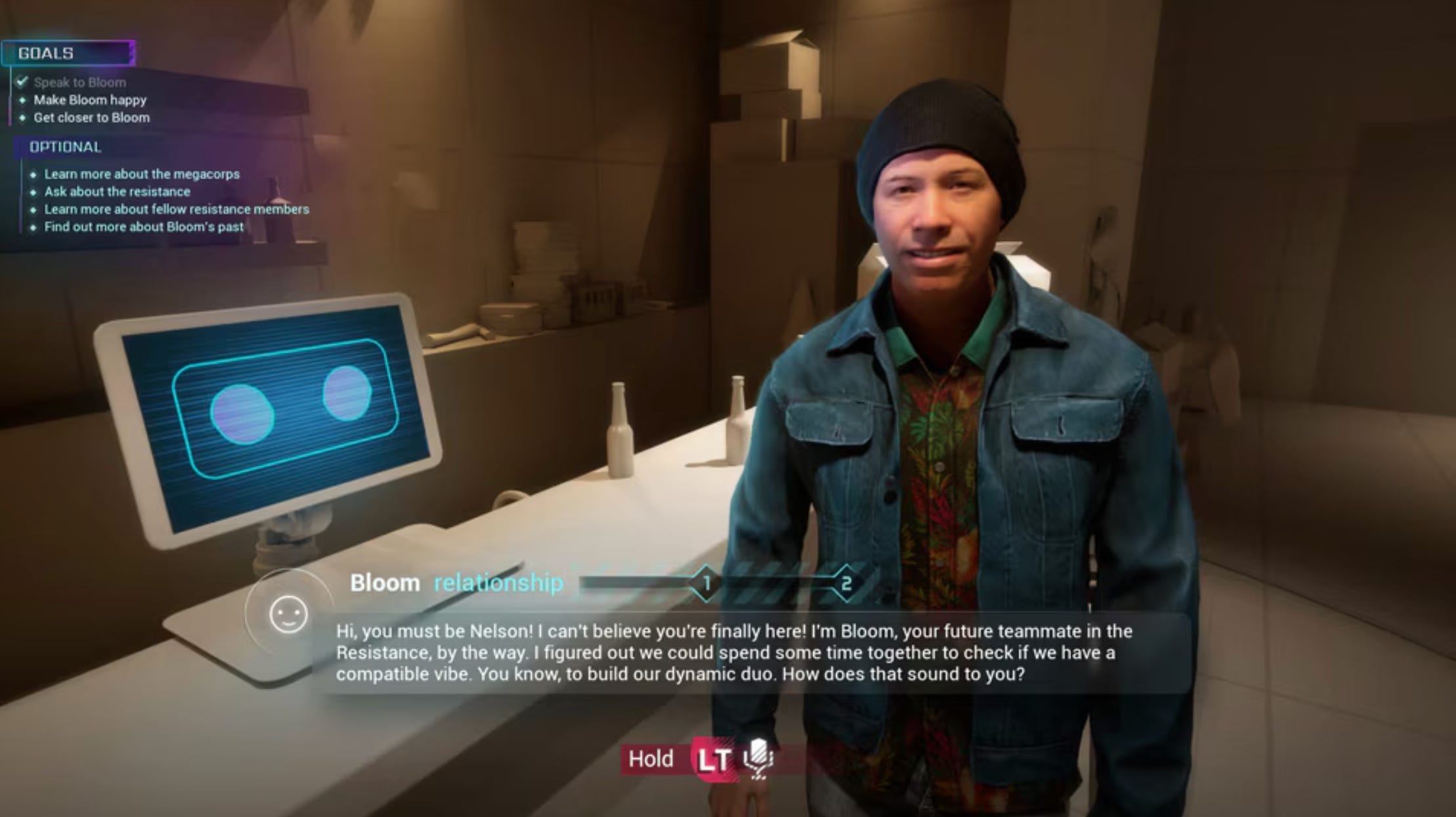
A “make them happy” goal and an optional “learn their past” beat are not menu chrome. They are conversation contracts: the NPC should offer personal topics, remember the last check-in, and stop introducing themselves like a stranger. If the system cannot explain why that meter moved, the talk will not match the HUD.
Step 4: Lock Lines, Then Choose a Delivery Tech Ask for lock lists: lines that require a witnessed crime, a saved child, a rival romance, or a failed promise. Only then decide tree, bark pool, or constrained generation. Technology last. Rules first.
"Write Mira’s lock list: camp lines if I drew on a civilian, if I missed her personal quest, and if I already know her brother’s secret."
Step 5: Playtest the Awkward Question Run the questions trees hate: “Who is your wife?” “Why shouldn’t I shoot you?” “What did we talk about yesterday?” If the assistant cannot tell you the in-character refusal, the memory callback, or the rumor that follows, the conversation system is not done.
Results & Use Cases
📊 Authoring Open-World Stranger Reactions
- Scenario: An action-story lead has beautiful world barks and one famous “don’t shoot” line. Players holster, follow, or joke — and the stranger goes mute.
- Traditional Approach: Add three more interrupts, then cut them in VO budget.
- Game Designer Assistant: A reaction matrix for draw, holster, chase, gift, and gossip, plus which NPCs are allowed to remember the incident tomorrow.
- Verb-first design so new lines have a reason to exist
- Rumor edges so the plea can become town talk
- Clear cuts for what must be voiced vs text-only
💼 Shipping Companion Conversations That Match the Meter
- Scenario: An RPG team has a relationship bar, optional personal goals, and a first-meeting speech that still plays at rank 2.
- Traditional Approach: Hide the intro behind a boolean and hope writers catch every flag.
- This design partner: Ranked topics, “learn their past” gates, happiness goals, and memory of the last scene — specified as one companion conversation system.
- HUD, journal, and spoken lines reading the same flags
- Refusal and cooldown rules when the player rushes intimacy
- Pair with Film Screenwriter when the locks are right and the scene still clunks
📱 Designing Talk Tables on a Phone Between Classes
- Scenario: A student designer has a cast list in notes and a vertical slice due Friday.
- Traditional Approach: A messy phone note that never becomes a matrix programmers can read.
- The AI systems partner: Voice or type a cast, get verb lists, persona fences, and lock lists before the commute ends. Web, iOS, and Android keep the same thread.
- Iterate on one NPC’s entire talk orbit in a sitting
- Screenshot-ready tables for the next standup
- No laptop wiki required to keep designing
🎯 Constraining Generative NPC Talk Without Killing Surprise
- Scenario: A studio wants players to ask unexpected questions without letting a model invent lore.
- Traditional Approach: A raw LLM behind the NPC, then a week of hotfixing spoilers.
- Game Designer Assistant: Allowed topics, forbidden facts, refusal style, and memory stores — the design layer research says you need before local or cloud models.
- Surprise inside fences, not instead of fences
- Playtest scripts for the questions trees never listed
- A spec engineers can implement in Unity, Unreal, or Godot without guessing tone
FAQ
What are dynamic NPC conversations in game design?
Dynamic NPC conversations are spoken or written exchanges that change with player action, world state, memory, and character persona. They can be fully authored, fully generated, or mixed. The test is simple: if the player does something the writer did not enumerate as a menu choice, does the NPC still respond in character, with the right knowledge, and with a consequence that can be remembered later?
Is Game Designer Assistant free to use?
Yes. Game Designer Assistant is available on Jenova’s free tier with core features and limited usage — no credit card required to start. Paid plans increase usage if you are iterating on large casts, companion routes, or daily design dumps. Usage resets monthly on your billing date, with the full allowance available from day one rather than a daily drip.
How are dynamic NPC conversations different from a chatbot in a game?
A chatbot answers text. A conversation system answers this person, in this world, under these quest and relationship flags. Chatbots optimize for helpfulness. NPCs must optimize for character: ignorance, bias, fear, and secrets. If your innkeeper can explain the final dungeon because the model is helpful, you do not have dynamic NPC conversations. You have a leak.
Can this AI help if we want generative dialogue?
Yes — by specifying the rails first. Persona, knowledge boundaries, conversational memory, world knowledge, and lock lists are what keep generation from breaking the game. For interior motivation, Personality Analyzer can add trait and attachment language so generated lines have a psychological spine, not just a banned-word list. You still choose the runtime model; the assistant writes the design the model must obey.
Does Game Designer Assistant work on mobile?
Yes. Jenova offers full feature parity across web, iOS, and Android, including speech-to-text if you want to dictate a verb list on the move. Conversation matrices and lock lists are text-first, so a phone session is enough to advance dynamic NPC conversations between classes or during a commute.
Will this work in my engine?
The assistant outputs design: verbs, fences, memories, thresholds, and scene outlines. You still implement in Unity, Unreal, Godot, Ren’Py, or a custom dialogue framework — tree, bark, or constrained generation. That split is useful. An engine plugin will not tell you whether the stranger should remember the baby. A documented conversation system will.
Conclusion
A clever subtitle is not a conversation system. Players stay when talk reacts to the gun, the gift, the meter, and the promise from last night — and when the NPC can refuse a question that would break the world. Game Designer Assistant is built to specify that system: reaction rules, persona locks, two kinds of memory, and the documents your writers and engineers can ship against.
If your next vertical slice still treats every line as either a frozen tree or an ungoverned chat window, start with the verbs and the fences. Design the talk, then pick the tech.
Try Game Designer Assistant now. Explore more at Jenova.
For Developers: Game Designer Assistant is available programmatically via the Jenova API — integrate dynamic NPC conversation design into your game-dev application with a single API call. Full documentation →