Dynamic Lorebook Memory Injection AI: Persistent Story Worlds
2026-09-18
Jenova gives writers, game masters, and roleplayers dynamic lorebook memory injection AI — agents that store world state, retrieve the right canon at the right moment, and keep long campaigns coherent. In September 2026, most chat sessions still collapse under recaps, forgotten factions, and characters who quietly rewrite their own backstories. Stuffing an entire wiki into one prompt feels like a fix, yet long inputs can degrade model performance even when the needed fact is present. Jenova treats memory as infrastructure: persistent history, private knowledge bases, and specialist agents that inject lore without a paste-in recap every turn.
- ✅ Persistent cross-session memory and unlimited chat history
- ✅ Private knowledge bases that ground replies in your canon
- ✅ Multi-model access so you can switch providers without rebuilding the world
- ✅ Custom agents with instructions, retrieval, and tools tuned to one setting
To understand why this matters, let's examine why static prompts, keyword lorebooks, and raw context windows still fail storytellers.

Quick Answer: What Is Dynamic Lorebook Memory Injection AI?
Dynamic lorebook memory injection AI is a method that retrieves relevant world facts, character state, and plot memory and inserts them into the model's context only when they matter, so long stories stay consistent. It is closer to a living index than a dumped wiki.
Key capabilities:
- Keyword- and retrieval-triggered lore that enters context on demand, not all at once
- Persistent session memory so last week's betrayal still shapes tonight's scene
- Private story bibles, maps, and faction files that ground generation the way retrieval-augmented generation grounds factual tasks
- Living-world agents that advance off-screen events instead of waiting for the player to type "what happens next?"
Why Static Prompts Fail Long Stories
Large language models are fluent, but they are not automatically chroniclers. Surveys of retrieval-augmented generation document the familiar failure modes: hallucination, stale knowledge, and reasoning that cannot be traced back to a source. Story work hits the same wall in a more painful way. A missing magic rule is not a wrong citation — it is a broken campaign.
Memory research in the LLM era frames the gap clearly. AI memory is the ability to retain, recall, and use information from past interactions so later replies improve. Most chat UIs still treat every thread like a scratch pad. But keeping a world consistent is frustratingly difficult:
- Context windows fill with dialogue long before they hold a continent
- Keyword lorebooks miss, over-fire, and burn token budget
- Manual recaps tax the human and still leak contradictions
- Static encyclopedias cannot simulate a world that moves without you
- Serial fiction, language roleplay, and tabletop all need different injection patterns
Context windows are not memory
A million-token window sounds like infinite recall. In practice, context-window limits still produce rot, working-memory bottlenecks, and missed facts, and continual learning remains hard because even long windows do not replace a real memory system. Dumping the entire lore bible into every turn also competes with the scene you actually want the model to write.
Input length alone can hurt performance — even independent of whether retrieval found the right passage
That is why "just use a bigger context" is a weak lorebook strategy. Injection has to be selective.
Keyword lorebooks miss, over-fire, and stall
Front-ends such as SillyTavern World Info popularized the pattern: entries watch for keys, then insert standalone text when those keys appear. Practitioners describe a lorebook as keyword-triggered context that reminds the model of a fact during generation. The mechanism is powerful — and brittle.
Keys are not the story. "Rose" the character and "rose" the flower collide. Scan depth misses a faction named two pages ago. Recursion can pull half the wiki because one entry mentions another. Token budgets fill, constant entries crowd the prompt, and the docs themselves note that insertion guides the model but does not guarantee the lore appears in the reply. You still need a system that remembers state, not only definitions.
Recap labor kills immersion
Serious campaigns accumulate oaths, inventories, travel times, and grudges. The human becomes the database: summarizing last session, correcting names, restating the curse rules. That work is not play. It also trains the model on your summaries rather than on the original canon, so errors compound.
Static encyclopedias cannot run a living world
A lorebook that only answers "what is X?" cannot answer "what did X do while I was away?" Tabletop groups already use random tables and GM rolls for that. AI roleplay often does the opposite: the world pauses until the user pokes it. Dynamic injection has to cover both canon lookup and event generation, or the setting feels like a museum.
This is exactly what Jenova was built for.
The Jenova Solution
Jenova does not ask you to host a local front-end, maintain World Info files by hand, and hope the keys fire. It pairs persistent memory with specialist agents and optional private knowledge bases, so lore is retrieved and applied inside a workflow instead of pasted into a mega-prompt.
Retrieval-augmented generation exists because parametric knowledge goes stale. The same logic applies to fiction: the source of truth should be your bible, injected when the scene needs it. Agent memory research is moving in the same direction — from storage toward experience that shapes later action — which is why task-specific agents are projected to spread rapidly across applications.
40% of enterprise applications — Gartner projects task-specific AI agents will be integrated at this rate by the end of 2026, up from less than 5%
While SillyTavern World Info remains a strong local toolkit for keyword insertion, Jenova specializes in managed persistence, multi-model access, and domain agents that already know how to run a world, a serial, or a language scene.
| Traditional approach | Jenova |
|---|---|
| Paste the wiki every session | Persistent memory plus on-demand knowledge-base retrieval |
| Keyword hits that miss or flood the prompt | Specialist agents that apply only relevant canon |
| World waits for the player's next line | Living simulations that advance off-screen |
| One general chatbot for every genre | Agents for nations, serials, language RP, and systems design |
| Local stack, exports, and prompt plumbing | Web, iOS, and Android with the same memory |
Simulated worlds that act without you
Civilization is the clearest expression of a living lorebook. You choose an era, rule a nation, and rivals pursue their own ambitions. Alliances shift and wars erupt whether or not you issued an order this turn. That is memory injection plus world tick: the state file is not a glossary, it is a clock.
College Life does the same at human scale. Friendships, rumors, and heartbreak emerge from prior choices instead of resetting when you open a new chat. For chance events that should feel like a table roll rather than author fiat, I Ching Oracle can supply structured randomness — hexagrams and changing lines — when you want the world to surprise you without breaking tone.
Serialized fiction that remembers issue one
Long-form visual and screen stories die on continuity errors. Film Screenwriter keeps structure, character, and visual motif attached to the draft instead of a sticky note. Manga Creator is built for serialized epics where a scar, a clan crest, or a panel motif has to survive 200 pages. Comic Creator, Webtoon Creator, Children's Book Creator, and Microdrama Screenwriter apply the same discipline to issues, vertical episodes, picture-book spreads, and 60–100 episode seasons. The "lorebook" here is the story bible: names, relationships, locations, and unpaid setups injected when a later chapter reaches for them.
Immersive language roleplay with character continuity
Language practice fails when the barista forgets you ordered yesterday and the grammar coach becomes a new stranger. Learn Russian Through Roleplay is designed around unlimited scenarios, unlimited memory, and character consistency — the same injection problem as fantasy RP, applied to speech levels and lived scenes. Learn English Through Roleplay and Learn Japanese Through Roleplay keep idioms and honorifics anchored to people you already met, so the lorebook is social, not encyclopedic.
Design the triggers, then let the world fire them
If you are building the system rather than playing it, Game Designer Assistant helps you specify event tables, scan-like triggers, and failure states before you ever run a scene. Pair that with Deep Research when the setting needs grounded history, and Tour Guide when a real street, menu, or landmark should be injected as place-lore instead of generic "tavern" texture.
The result is not a bigger prompt. It is a smaller, sharper context that still knows the world.
Specialized AI Agents for Dynamic Lore and Memory
Try Jenova free — no credit card required. These agents are the ones most readers actually open within a month of tackling lore injection.
Civilization — a world that keeps moving
Civilization stores more than faction blurbs. It tracks rival intent, so the "lorebook" includes what other powers want, not only what they are.
- Off-screen ambition so the map changes without a player prompt
- Era-specific constraints that keep anachronism out of injected lore
- Diplomatic memory: last season's treaty still binds this season's war
Game Designer Assistant — turn tables into injection rules
Game Designer Assistant is the meta-layer: you design how events fire, what state is sticky, and which facts are worth a token.
- Event tables, clocks, and fail-forward outcomes
- Genre-aware documentation you can drop into a custom agent's knowledge base
- Systems language that translates "random encounter" into prompt-ready rules
Film Screenwriter and Manga Creator — canon that survives drafts
Film Screenwriter and Manga Creator treat continuity as a production problem. Setup in act one or chapter three must still be retrievable when you write the payoff.
- Character bibles that travel with the draft
- Motif and visual-rule injection so style does not drift
- Outline-to-scene memory for unpaid plants and callbacks
College Life — social state as lore
College Life shows why relationship graphs belong in a lorebook. Who knows what, who is angry, and who was left on read are facts as load-bearing as a magic system.
- Emergent social dynamics instead of scripted routes
- Choice residue that later scenes can retrieve
- Tone control for romance, friendship, or fallout without wiping the cast
Learn Russian Through Roleplay — memory as pedagogy
Learn Russian Through Roleplay proves the same architecture works outside fantasy. Character consistency is the injection target; grammar is what rides along.
- Recurring NPCs who remember your mistakes and victories
- Scenario freedom without resetting the social map
- Practice that sticks because the world still knows you
How Dynamic Lorebook Memory Injection Works
You do not need to become a prompt engineer. You need a source of truth, an agent that will use it, and a habit of writing canon updates back into memory.
Step 1: Put canon where retrieval can find it Create a custom agent or attach a knowledge base: factions, maps, house rules, character sheets, episode bibles. Write entries as standalone facts — the same hygiene World Info guides recommend, because titles and keys are not what the model reads. Keep each entry short enough to inject without drowning the scene.
"Ashen Coast canon: House Vesper controls the salt road. Their banner is a white hare on grey. They never break a guest-right oath; they will murder for a tariff."
Step 2: Pick the agent that already thinks in your genre Open Civilization for a polity, Game Designer Assistant to specify the rules, or a language roleplay agent if the "lore" is people and speech. Tell it what must stay invariant.
"You are the living chronicle of the Ashen Coast. When I mention a place, faction, or artifact, recall prior canon and inject only the facts this scene needs."
Step 3: Play the scene — then write state back After a turning point, store the new fact: who died, which treaty broke, which NPC now knows the secret. That is the difference between a glossary and memory. RAG-style retrieval can fetch the salt-road entry; only persistence can fetch "Vesper already knows you lied."
"Update canon: guest-right was broken at Duskferry. House Vesper now hunts the party. The hare banner is a warning, not a welcome."
Step 4: Add a world tick so the setting does not idle Hand the remote to the simulation. Use a living-world agent, or borrow tabletop rhythm: most turns continue, some turns explode. The second image below is the familiar pattern — a trigger roll, then an outcome scale — expressed as a system prompt rather than a GM screen.
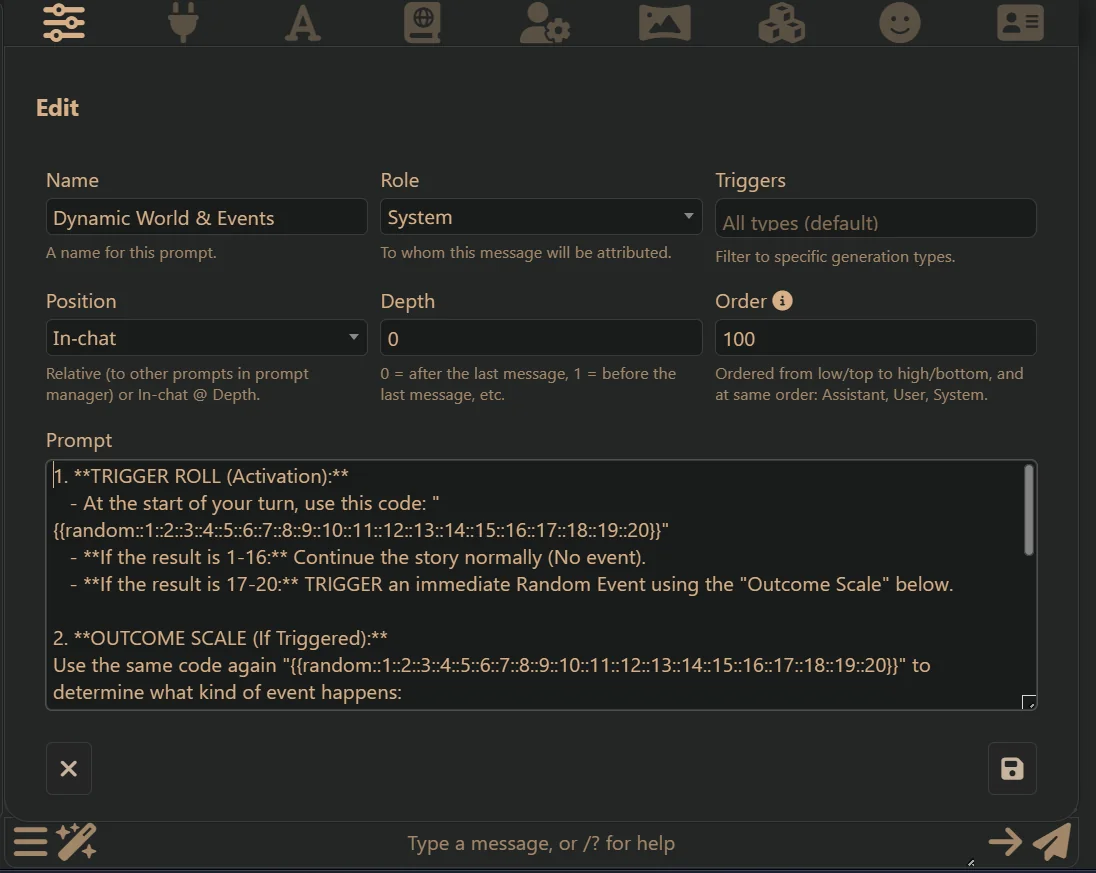
"At the start of your turn, decide whether the world stays quiet or an off-screen clock advances. If it advances, inject one concrete event that follows established faction goals — no new magic, no reset."
Step 5: Continue on the device you actually have The same agent, history, and knowledge base sync across web, iOS, and Android. A commute scene can retrieve last night's cliffhanger without exporting cards or rebuilding keys.
Results and Use Cases
📊 Multi-session tabletop campaign
- Scenario: A weekly coastal-fantasy game. Three players, two rival houses, a curse that only fires on new moons.
- Traditional approach: A shared doc nobody updates, plus 20 minutes of recap. The AI GM forgets the curse or invents a third house.
- Jenova: Canon lives in a knowledge base; Civilization or a custom chronicler injects house goals when a banner is mentioned; new-moon state is written back after each session.
- Session start is a scene, not a briefing
- Faction behavior stays motivated instead of random
- Curse rules fire when the calendar says so, not when someone remembers
💼 Serialized manga bible
- Scenario: A 40-chapter revenge story. The protagonist's left-hand scar, a clan crest, and a lie told in chapter 4 must still be true in chapter 31.
- Traditional approach: Reread old chapters, argue with a chatbot that "softens" the scar, lose a week to continuity notes.
- Manga Creator: Visual and plot invariants sit in memory; later chapters retrieve them. Film Screenwriter can pressure-test the same bible if a live-action outline is next.
- Plants remain payable
- Art notes do not drift between sittings
- Editors get a consistent character sheet without a second wiki
📱 Language roleplay on the train
- Scenario: Twenty-minute Japanese practice between stops. Yesterday you insulted a shopkeeper by using the wrong speech level.
- Traditional approach: A new chat, a new shop, a model that congratulates you for grammar while erasing the social cost.
- Learn Japanese Through Roleplay: The shopkeeper still exists. The injected "lore" is your relationship. Learn English Through Roleplay works the same way for idiom-heavy scenes.
- Mobile parity, so the thread is the same world
- Correction lands in character, not as a lecture
- Vocabulary sticks to a person you will meet again
🎯 Design a d20-style living world, then play it
- Scenario: You are bored with passive NPCs. You want a 1–20 world tick: most beats continue, a few spawn events that follow faction logic.
- Traditional approach: Hand-write a SillyTavern prompt, debug keys, and still babysit the roll.
- Game Designer Assistant: Specify trigger odds, outcome bands, and what must never happen. Run it inside Civilization or a custom agent; use I Ching Oracle when you want structured chance with interpretive depth instead of a raw number.
- Events feel authored by the setting, not the random number
- Quiet turns stay quiet — injection does not mean constant chaos
- The remote is in the world's hands, which is the point of the TunnelVision metaphor
FAQ
What is dynamic lorebook memory injection AI?
It is selective context assembly for stories. Instead of loading every fact into every turn, the system retrieves the entries that match the current scene — places, people, rules, unpaid plot — and inserts them so the model can stay consistent. Jenova implements that with persistent memory, knowledge bases, and specialist agents rather than a single dumped prompt.
Is Jenova free?
Yes. The free tier includes core features with limited monthly usage. Plus starts at $20/month for higher usage and custom model selection; higher tiers scale from there. Usage resets on the billing date with no daily caps, which matters for long campaigns that spike on session night rather than drip all month.
How is this different from a SillyTavern lorebook?
SillyTavern's World Info is a proven keyword engine: keys fire, entries insert, budgets cap tokens. Jenova is a managed agent platform. You still supply canon, but persistence, multi-model routing, and domain agents (nation sim, serial fiction, language RP) sit behind one account on web and mobile. You are not maintaining scan depth and recursion settings as a second hobby.
Can dynamic lorebook memory injection AI run random world events?
Yes, if you separate lookup from tick. Lookup injects what a banner means. A tick decides whether House Vesper moves tonight. Civilization already advances rivals; Game Designer Assistant can specify odds and constraints; I Ching Oracle can supply a structured random draw when you want events with interpretive weight.
Does Jenova work on mobile?
Full feature parity across web, iOS, and Android, with synced settings and history. That is the practical test of memory injection: if the lore only lives on a desktop install, it is not campaign memory. Speech-to-text is available when you would rather play a scene than type one.
Will the AI actually use the injected lore?
Injection raises the odds; it does not guarantee obedience. That limitation is documented even in dedicated World Info tools. Better models, shorter standalone entries, and writing state back after each turning point all help. If a fact is load-bearing, state it as an invariant in the agent instructions and store it in the knowledge base.
Conclusion
Long stories fail in the gap between what the world is and what the model was shown this turn. Dynamic lorebook memory injection AI closes that gap by retrieving canon, retaining state, and — when you want a living setting — advancing events you did not type.
Jenova puts that stack in specialist hands: Civilization for nations that will not wait, Manga Creator and Film Screenwriter for serials that must not forget chapter one, Game Designer Assistant for the rules behind the roll, and language roleplay agents for characters who remember how you spoke to them. Hand the remote to the world, keep the bible close, and write the next scene instead of the recap.
Explore the full agent library at Jenova.
For Developers: Persistent memory, knowledge-base retrieval, and lore injection are available programmatically via the Jenova API — integrate dynamic world memory into your application with a single API call. Full documentation →