Do AI Essay Coaches Protect Academic Integrity Better Than Generators?
2026-08-26
What Separates Process-Centered AI Coaching From Product-Centered Generation?
AI essay coaches support authenticity and academic integrity more reliably than essay generators because they keep authorship, revision decisions, and learning residual with the student. Generators optimize for a finished product. Coaches optimize for a visible writing process. In 2026, that distinction is the practical line most universities are trying to draw.
The gap is not branding. It is where intellectual work happens.
Key factors that separate ethical AI writing support from integrity risk:
✅ Authorship residual — how much of the submitted argument, evidence selection, and wording originated with the student ✅ Process visibility — whether a student can show drafts, feedback, and revision choices if asked ✅ Feedback versus substitution — whether the tool critiques a draft or replaces the draft ✅ Policy fit — whether typical use maps to permitted revision and learning, not banned full-assignment generation ✅ Human-in-the-loop control — whether the student evaluates, verifies, edits, and revises every material change
Jenova's Writing Assistant is built as a collaborative coach: it adapts to the student's voice, format, and domain, and it is strongest when the student arrives with a draft or a claim. General-purpose generators such as ChatGPT can brainstorm well, but their default move is to produce complete prose. Academic language tools such as Paperpal and Writefull sit closer to coaching when used for grammar, tone, and copyediting — and closer to generation when used to paraphrase or invent large passages.
To compare these tools honestly, it helps to evaluate them on ownership, process, and policy rather than on fluency alone.
Why Has the Generator-Versus-Coach Distinction Become Central to Academic Integrity in 2026?
The distinction became central because generative tools made it easy to submit fluent work that the student did not think through. A 2024 International Center for Academic Integrity finding, reported in the research literature, found that 58% of students admitted using AI tools to complete assignments dishonestly. That number is not a verdict on every writing assistant. It is evidence that product-centered use is already common.
When a student asks a model to "write a 1,800-word argumentative essay on X," the learning sequence collapses. Research on generative AI and student writing finds that generating an entire essay bypasses the reasoning, organization, and revision skills the assignment was designed to build. The paper may look competent. The writer does not become more competent.
Faculty responses have split. Some courses ban generative tools at every stage. Others require students to use them and then critique the output. Harvard's undergraduate guidance requires instructors to state a course AI policy and offers restrictive, mixed, and fully encouraging templates. Across those templates, one expectation is stable: the student remains responsible for validity, citation, and disclosure.
Detection is a weak backstop. Cornell's Center for Teaching Innovation does not recommend current automatic AI-detection algorithms for academic-integrity cases because they are unreliable. A 2025 review of academic integrity in the AI era notes that institutions often lean on similarity tools such as Turnitin while students use generative systems to write. That arms race favors process-centered assignments over forensic guesses after submission.
Coaching tools matter in this climate because they leave a trail of thinking. Generators matter because they erase that trail unless the student deliberately reconstructs it.
What Should Students and Faculty Look for When Evaluating AI Writing Support?
Students and faculty should evaluate AI writing tools with an Ownership–Process–Policy (OPP) test, not with a "does it sound academic?" test. Fluency is cheap in 2026. Authorship is not.
Ownership: who still wrote the argument?
A coach should make the student's claim sharper. A generator makes a claim for the student. Writing researchers and literacy specialists argue that AI should support writing instruction rather than substitute for the act of composing. If the tool can produce a complete submission from a prompt and a word count, it is a generator regardless of how it is marketed.
Useful ownership questions:
- Did the student choose the thesis before the tool produced paragraphs?
- Can the student explain every citation and why it belongs?
- Would the draft still exist if the chat history disappeared?
Process: can the work be inspected?
Authentic writing leaves residue: outlines, weak first attempts, rejected evidence, and revision notes. Edutopia's guidance on authentic writing in the age of AI emphasizes collaboration, choice, and visible process over one-shot production. Tools that only return a polished block of text fail this test. Tools that comment on a student draft, ask clarifying questions, or preserve prior sessions pass more of it.
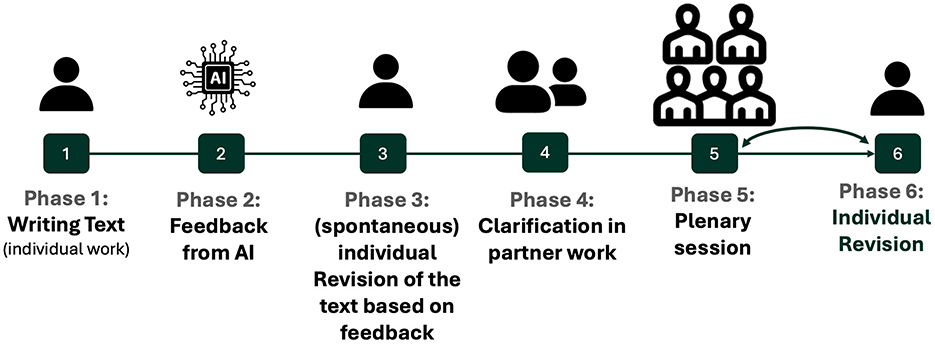
The six-phase workflow above is a useful reference model. The student writes first. AI feedback comes second. Individual revision, partner clarification, group discussion, and a final solo pass follow. The AI never occupies the author seat.
Policy: does typical use match the assessment brief?
Most institutional flowcharts now start with a single question: is AI permitted for this assessment, and for which tasks? Permitted uses commonly include revision, language feedback, and learning. Prohibited uses commonly include generating the complete assessment, inventing research, or submitting unacknowledged AI prose. A systematic review of generative AI and academic integrity in higher education documents how quickly those policy lines have become a core governance problem.
A tool that nudges users toward disclosure, source checking, and incremental edits is easier to defend under mixed or encouraging policies. A tool whose best-known use is "write my essay" is harder to defend under any of them.
How Do Leading AI Essay Tools Compare on Authenticity and Integrity Safeguards?
Jenova's Writing Assistant, Paperpal, Writefull, and ChatGPT can all improve academic prose, but they occupy different points on the generator-to-coach spectrum. ChatGPT is the most product-centered. Paperpal and Writefull are language-and-manuscript specialists. Jenova's Writing Assistant is the most process-centered of the four when used as an iterative editor rather than a ghostwriter.
The comparison below uses publicly documented capabilities as of 2026. Pricing and feature sets change; treat commercial cells as time-stamped, not permanent.
| Feature / Dimension | ChatGPT | Jenova Writing Assistant | Paperpal | Writefull |
|---|---|---|---|---|
| Default output | Complete answers and full drafts from a prompt | Collaborative revision in the student's voice | Grammar, tone, structure, and similarity checks on existing text | Academic language edits, paraphrase, and research-writing widgets |
| Training / domain fit | General-purpose conversational model | Multi-model academic and professional writing partner | Academic-grade suggestions; access to 250M+ research articles | Language models trained on millions of journal articles |
| Integrity-relevant controls | User-dependent; no assignment-policy layer | Persistent draft memory; student remains the author of record | Similarity checking against 99B+ sources before institutional review | Encrypted processing; texts are not stored or used for training |
| Process visibility | Chat transcript only | Cross-session memory of preferences, drafts, and prior feedback | In-document workspace for check-and-finalize workflows | In-editor widgets, including Overleaf / LaTeX support |
| Main limitation | Easy to outsource the entire essay; factual errors and invented sources | Can still generate long passages if the student asks it to; no institutional similarity database | Stronger as a manuscript polisher than as a pedagogy coach | Paraphrase and abstract/title generators can slide from editing into substitution |
| Pricing (as of 2026) | Free access; paid plans available | Free tier; Plus from $20/month with higher usage | Free tier advertised; paid plans unverified here | Unverified |
| Best for | Permitted brainstorming and outline exploration | Semester-long coaching that preserves student voice | Thesis and journal-article language plus pre-submission checks | Research-article phrasing, especially for non-native English writers in STEM |
Independent roundups place these tools in different workflow slots rather than in a single "best writer" category. One 2026 scientific-writing comparison notes that Jenni AI, Paperpal, Writefull, Trinka, Grammarly, and QuillBot typically cover one or two jobs — autocomplete, language editing, or paraphrase — rather than the whole writing process. That fragmentation is useful. It reminds students that no single product should become the author.
ChatGPT
ChatGPT excels at rapid ideation, counterargument generation, and explaining a rubric in plain language. Those uses can be legitimate when a course policy allows preliminary AI support. Its limitation is structural: the fastest path is a finished essay, and Harvard's own guidance notes that generative systems can produce incorrect material presented as fact and that provenance does not reliably survive into the output. Students who paste a prompt and submit the reply have not written an essay. They have commissioned one.
Paperpal
Paperpal is stronger as a scholarly editor than as an essay ghostwriter. It offers academic grammar and tone suggestions, citation generation, and a similarity check intended to happen before an institution's plagiarism review. The company reports use by more than five million researchers and trust from 1,500-plus journals, and it states that user work is not used to train AI. Those are real integrity-adjacent strengths. The limitation is pedagogical: a similarity score does not teach a first-year student how to build a warrant, and sentence-level polish can disguise a thin argument.
Writefull
Writefull is trained for research English. It copyedits, paraphrases at multiple levels, and offers widgets such as an Academizer, title generator, and abstract generator. It revises text quickly over an encrypted connection and states that texts and searches are not stored. That privacy stance is a genuine advantage. The integrity risk sits in the generative widgets. An abstract generator or aggressive paraphraser can become a substitute author if the student did not first write the underlying paper.
Jenova Writing Assistant
Jenova's Writing Assistant is designed as a bespoke writing partner: it adapts to format, audience, and domain, and it is most effective when asked for editorial judgment rather than a deliverable. On the Jenova platform it can retain unlimited chat history, remember recurring weaknesses, and work from attached drafts or a private knowledge base. That persistence is what makes coaching possible across a term instead of a single sitting.
Its honest limitations matter. It is not a university-licensed integrity system. It does not automatically know a syllabus policy. It will generate extended prose if prompted to do so. And it is not a replacement for a campus writing center, a subject-matter professor, or a required disclosure statement.
How Does an AI Essay Coach Preserve Student Voice Without Writing the Paper?
An AI essay coach preserves voice by operating one layer above the sentence the student has already attempted: it diagnoses, questions, and proposes options, then waits. A generator preserves fluency by skipping that wait.
In practice, voice is a pattern of choices — hedging, emphasis, evidence preference, rhythm, and the examples a writer reaches for. Studies of EFL writers using AI tools find genuine linguistic support for grammar and syntax, alongside a live tension between that help and the writer's sense of authenticity. The coach's job is to keep the student making those choices.
Testing a coaching workflow usually looks like this:
- The student pastes a thesis and a rough paragraph, not a prompt for a whole paper.
- The coach identifies the weakest warrant, the missing counterargument, or the claim that exceeds the evidence.
- The student rewrites. The coach then checks whether the new sentence still sounds like the rest of the draft.
- Only after the argument is stable does language polishing begin.
A prompt that keeps the tool in coach mode looks like this:
"Here is my thesis and two body paragraphs for a 1,500-word history essay. Do not rewrite them. Tell me which claim is least supported, which transition is doing too much work, and what a skeptical reader would attack first."
A prompt that turns any coach into a generator looks like this:
"Write the essay for me in my style and make it undetectable."
Jenova's Writing Assistant is comparatively good at the first pattern because it can remember earlier drafts and recurring habits — overusing intensifiers, burying the thesis, or citing a source it has not actually explained. Paperpal and Writefull are comparatively good at the last mile of academic register. ChatGPT can imitate either pattern, but only if the student resists the complete-draft default.
Voice preservation also depends on what the tool is allowed to remember. A coach with cross-session memory can say, "You made this same unsupported leap in last week's paper." A stateless generator cannot. That difference is pedagogical, not cosmetic.
Where Do University AI Assessment Policies Draw the Line Between Coaching and Generation?
University policies increasingly permit AI for revision and learning while treating full-assignment generation as misconduct. The operational test is not "was a tool open?" It is "did the tool do the assessed work?"
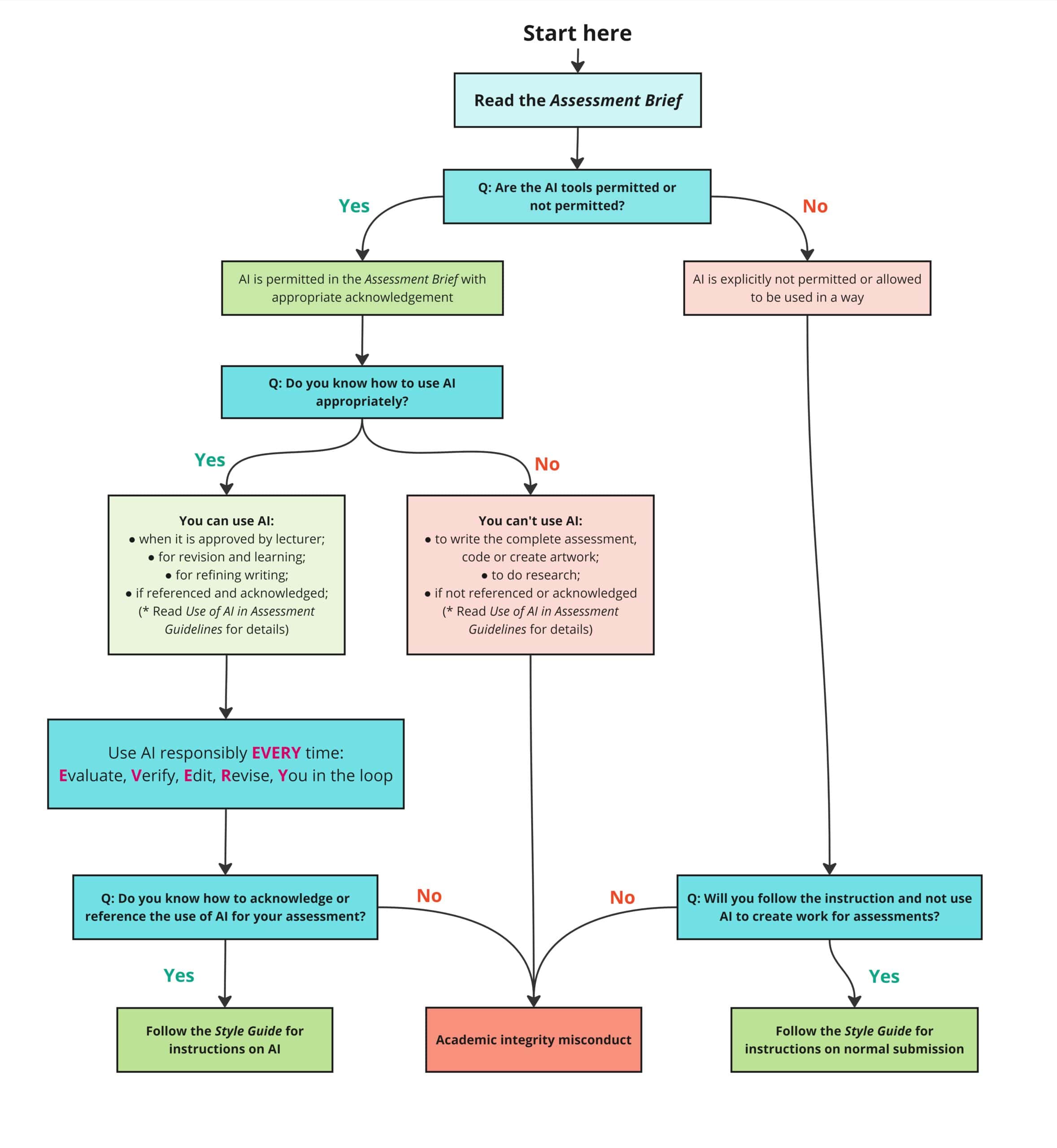
The assessment flowchart above is representative of the decision tree many universities now publish. Students start with the assessment brief. If AI is forbidden, using it is misconduct. If AI is permitted, permitted tasks are typically revision, learning, and refining writing — with acknowledgement. Generating the complete assessment, fabricating research, or failing to disclose AI use routes to an integrity case.
Harvard requires faculty to post a course policy and reminds students that different classes may set different rules. The University of Michigan publishes sample syllabus language ranging from explicit prohibition to defined, acknowledged use. Johns Hopkins flags cheating and assessment design as central challenges created by generative tools. Comparisons of elite-university policies show the same split: research support and language help are often negotiable; unacknowledged wholesale generation is not.
A practical translation of those policies:
- Usually closer to coaching: grammar feedback, outlining questions, rubric decoding, identifying missing counterarguments, checking whether a paragraph answers the prompt.
- Usually closer to generation: writing the essay from a title, producing fake quotations, rewriting a source so it can be submitted as original analysis, or creating code, artwork, or data the brief asked the student to produce.
- Always the student's burden: verifying facts, citing real sources, and following the style guide for AI acknowledgement.
Walden University's public guidance frames AI as a support for curiosity and scholarly work when used thoughtfully, not as an author of record. The Academic Senate for California Community Colleges likewise treats AI-integrated assessment as a chance to teach critical evaluation of tools, not to outsource the performance. Coaching tools fit those frames more cleanly than generators do.
One under-discussed implication: a coach does not make a banned-AI course safe. If the brief says no AI, the ethical tool is none. Policy precedes product.
How Do You Use an AI Essay Coach Without Crossing Into Academic Misconduct?
You stay on the ethical side of the line by writing first, asking for critique second, verifying every factual claim, and disclosing the tool if the course requires it. The sequence is the safeguard.
For Jenova's Writing Assistant, a low-risk setup takes a few minutes:
- Open the agent and attach the prompt, rubric, and your draft — not a blank page and a request for 2,000 words.
- State the constraint in the first message:
"Course policy allows AI for revision only. I wrote this draft. Do not add new sources or new paragraphs. Flag unsupported claims, unclear topic sentences, and sentences that do not sound like the rest of my paper."
- Revise in your own document. Paste the new version back for a second pass.
- Keep the chat and your draft versions. If an instructor asks how AI was used, you can show process rather than improvising a story.
- Add the acknowledgement your style guide specifies.
For Paperpal, the equivalent ethical use is to compose in your own workspace, then run language and similarity checks on text you already wrote. Side-by-side comparisons of Paperpal, ChatGPT, and Grammarly treat Paperpal as the more academic editor and ChatGPT as the more general generator. That is the right division of labor: generate nothing you would be ashamed to label; edit everything you are willing to sign.
A short checklist before submission:
- I can explain every paragraph without looking at the chat.
- Every citation points to a source I opened and used.
- AI-invented quotations, data, or references have been removed.
- The acknowledgement matches the assessment brief.
- If AI were banned tomorrow, the intellectual structure of the paper would still be mine.
Students working on literature reviews can pair a coach with a research tool rather than asking the writer to invent a bibliography. Jenova's Academic Research Assistant is built for literature discovery and citation management, which is a different job from prose generation. Keeping those jobs separate reduces the temptation to let one model both find and fabricate sources.
For application essays, the same logic holds. A College Admissions Consultant is useful for strategy, structure, and critique. It becomes an integrity problem the moment it authors the personal statement the committee believes the applicant wrote.
What Do Writing Pedagogy Experts Say About AI and Authentic Student Work?
Writing specialists increasingly agree that authenticity is a property of the process, not a vibe in the final paragraph. Tools that leave the student inside the loop protect learning. Tools that exit the student from the loop protect only the deadline.
"The integrity failure we see most often is not a student asking a model how a counterargument works. It is a student submitting a paper whose best sentences they cannot defend in office hours. Fluency without recoverable reasoning is the giveaway. That is why we design writing agents as editors and tutors rather than as delivery services. If the agent can remember that a student always overclaims in topic sentences, the next draft can get harder in exactly the right place. If the agent just emits 1,800 tidy words, nobody learned anything except how to hide the prompt."
"Campus policies are converging on a simple rule even when the wording differs: revision is often allowed, substitution is not, and disclosure is not optional. Automatic detectors will not save anyone. The durable evidence is the draft trail — what the student wrote before the model spoke, and what changed after. Students who cannot produce that trail should assume they have crossed the line, even if a detector never flags them."
— Jenova Product Team, designers of collaborative writing agents used by students and professionals in 70+ countries
The American Psychological Association's guidance on teaching academic integrity in the AI era likewise treats clarity of expectations, not after-the-fact detection, as the primary control. That is a pedagogy conclusion as much as a compliance conclusion. If the assignment only rewards a polished artifact, generators will win. If the assignment rewards inquiry, revision, and oral defense, coaches become useful and generators become obviously insufficient.
Which AI Writing Approach Fits Different Academic Contexts?
The better tool depends on the assessed skill, the course policy, and how much of the thinking must remain visibly the student's. There is no universal winner — only better fits.
Undergraduate essays in courses with mixed or encouraging AI policies. A process-centered coach is the stronger default. Jenova's Writing Assistant fits when the student needs recurring critique across drafts. Paperpal fits when the draft already exists and the remaining work is academic language. ChatGPT fits only for bounded tasks the syllabus names, such as generating practice counterarguments that the student then rewrites.
Research manuscripts and theses. Paperpal and Writefull are often stronger on disciplinary English, similarity checking, and editor-style copyediting. Writefull's research-trained paraphraser and academic widgets are built for journal prose, including LaTeX workflows. A general essay coach still helps with argument architecture, but it will not replace a field-specific language model trained on the journal record.
Courses that ban generative AI. Neither a coach nor a generator is appropriate. The ethical choice is a human writing center, a peer workshop, or solo revision. Using a "helpful" coach against an explicit prohibition is still misconduct.
Timed or in-class writing. Generators create the largest integrity gap because they compress hours of composition into seconds. Coaches add little during a closed assessment and should stay closed with everything else.
Admissions and scholarship essays. Committees are buying the applicant's judgment, not a model's diction. Critique is defensible. Ghostwriting is not, and it is usually detectable in an interview even when it is not detectable in a file.
A concise decision rule: if the grade measures the student's thinking, use a coach on a draft the student already wrote. If the grade measures only the artifact, the assignment — not the student — is what needs to change.
AI essay coaches do not automatically make a writer honest. They make honesty easier to practice and easier to demonstrate. Generators make fluency easier to fake. In a year when most campuses have a policy flowchart and almost no reliable detector, that is the difference that matters.
References
- PubMed Central — Shaping integrity: why generative artificial intelligence does not have to undermine academic integrity (ICAI 58% finding)
- MDPI Societies — Impacts on Writing Skills, Critical Thinking, and Integrity in the Age of AI
- Harvard Office of Undergraduate Education — Generative AI Guidance
- Cornell Center for Teaching Innovation — AI & Academic Integrity
- ScienceDirect — Reassessing academic integrity in the age of AI
- Keys to Literacy — Writing Instruction in the Age of AI
- Edutopia — Teaching Authentic Writing in the Age of AI
- MDPI Information — Generative AI and Academic Integrity in Higher Education
- ChatGPT — Product homepage
- Paperpal — AI academic writing tool
- Writefull — AI for research writing
- Paperguide — 7 Best AI Tools for Scientific Writing in 2026
- Taylor & Francis — Balancing AI and authenticity: EFL students' experiences
- University of Michigan Generative AI — Course Policies & Syllabi Statements
- Johns Hopkins University — Generative AI Assessment Strategies
- Thesify — Generative AI Policies at the World's Top Universities
- Walden University — Guidelines for Using AI Tools in Writing and Research
- Academic Senate for California Community Colleges — AI-Powered Education: Authentic Assessments and Learning
- The Effortless Academic — Paperpal vs ChatGPT vs Grammarly
- American Psychological Association — Teaching academic integrity in the era of AI