DnD Mystery Clue Generator AI: Three-Clue Webs, Suspects & Handouts
2026-10-20
Game Designer Assistant helps Dungeon Masters build solvable D&D mysteries by generating interlocking clues, suspects, red herrings, and backup leads in a single conversation. As of October 2026, it works as a full DnD mystery clue generator, not just a random table. It designs each clue around the conclusion it supports, so your players have multiple routes to the truth.
Most homebrew mysteries fail for one reason: the DM knows the answer, and the players are working from fragments. This AI gives you a structured investigation that still works after a failed roll or an unexpected detour.
- ✅ Redundant clue design — multiple independent clues for every conclusion players must reach
- ✅ Suspects with depth — motives, alibis, and secrets unrelated to the crime that mislead naturally
- ✅ Fail-forward backups — alternative routes when a skill check fails or a scene gets skipped
- ✅ Handout-ready output — letters, ledgers, and witness statements you can hand directly to players

Mystery adventures are among the most requested sessions at D&D tables and among the hardest to run well. Before looking at how AI-assisted clue design fixes this, it helps to understand why investigations collapse so often. The causes are structural, and they are predictable.
Quick Answer: What Is a DnD Mystery Clue Generator?
A DnD mystery clue generator is an AI tool that designs connected clues, suspects, and red herrings for tabletop investigations, so players can solve a Dungeons & Dragons mystery through multiple paths instead of a single fragile chain.
Key capabilities:
- Builds clue webs where each conclusion has at least three independent routes
- Generates suspects with motives, means, opportunity, and unrelated secrets
- Writes in-world handouts: letters, journal pages, ledgers, and witness testimony
- Stress-tests the mystery against party spells like speak with dead and zone of truth
Why D&D Mysteries Stall at the Table
Tabletop roleplaying continues to grow, and more tables are pushing past dungeon crawls into intrigue, noir, and investigation arcs.
$2.31 billion — Global tabletop role-playing game market size in 2025
**$3.66 billion by 2033** — [Projected tabletop RPG market size, up from $2.1 billion in 2025](https://dataintelo.com/report/tabletop-role-playing-games-market)
But 5e was not built for detective work. As Dungeon Matters notes, the game is built for combat, initiative, and hit points, and those same mechanics "gum up the works" during an investigation. The site identifies the single biggest mistake GMs make: not providing enough clues.
Building a mystery that survives real players is frustratingly difficult:
- Single-path clue chains break. According to Anvil N Ink's investigation guide, a mystery built on one chain collapses the moment a link is missed, and "in D&D, missed links are the default."
- Dice gate critical information. If the only route to the poisoned goblet is a DC 15 Medicine check and nobody has the proficiency, the investigation stalls.
- Divination short-circuits the plot. Speak with dead, zone of truth, and detect thoughts can end a mystery in minutes, which is why D&D Beyond recommends writing mysteries for 1st- to 3rd-level characters to limit this magic.
- The prep load is heavy. A convincing murder needs a timeline, NPC schedules, and consistent alibis. D&D Beyond advises building a minute-by-minute schedule so your NPCs "have their stories straight."
The fix, popularized by designer Justin Alexander, is well established:
3 clues per conclusion — The Three-Clue Rule for mystery adventure design
3–4 suspects — Recommended suspect pool to keep a D&D murder mystery from bogging down
Knowing the rule is easy. Applying it consistently across a timeline, multiple suspects, and a party's spell list is where the hours go. This is exactly the work Game Designer Assistant was built to take on.
Why Game Designer Assistant Works as a DnD Mystery Clue Generator
Game Designer Assistant is a dedicated game design partner with expertise in brainstorming, systems analysis, documentation, and concept art across every genre. For a DM, that means it treats your mystery as a system: every clue has a job, every suspect has a function, and every failure state has a fallback.
Random clue tables give you isolated objects like "a bloody glove" or "a torn letter." This AI designs clues backward from the solution, so each one points somewhere meaningful.
| Traditional Approach | Game Designer Assistant |
|---|---|
| Rolling on random clue tables that do not connect | Clues designed backward from the culprit, method, and motive |
| One clue per revelation, so a missed roll stalls the session | Three or more independent routes to every key conclusion |
| An evening of prep writing timelines and alibis by hand | Full timeline, suspect roster, and NPC schedules generated in minutes |
| Mysteries broken by a cleric's divination spell | Built-in countermeasures for the spells your party actually has |
| Verbal descriptions only | Written handouts and concept art for props |
Clue Webs Built on the Three-Clue Rule
Ask for a mystery and you get a clue map: each conclusion players need to reach, with three or more clues pointing to it from different scenes. This mirrors the pyramid structure D&D Beyond describes. There are many vague clues at the entry level and fewer, sharper clues near the solution.
It also diversifies clue types: testimony, physical evidence, documents, and environmental details. Hipsters & Dragons recommends exactly this mix, with clues that offer several diverse leads.
Suspects With Motives, Alibis, and Unrelated Secrets
Good red herrings are innocent suspects who are guilty of something else. The AI generates suspects in this pattern: the steward who did not poison the duke but has been embezzling from the estate. His nervousness misleads players without being a dead end.
Fail-Forward Backups for Every Check
For any clue hidden behind an Intelligence (Investigation) or Wisdom (Perception) check, it proposes an alternate route. A failed Medicine check means the tavern keeper mentions the victim complaining about the wine. The dice decide how information arrives, not whether it arrives.
Magic-Proofing Without Banning Spells
Share your party's spell lists and the AI designs around them. Examples include a culprit who genuinely believes they are innocent, a corpse whose literal answers mislead without context, or surface thoughts planted to deceive detect thoughts. Spells become additional clue sources instead of off switches.
Handouts, Props, and Campaign Memory
It drafts in-world documents such as coded letters, merchant ledgers, and torn diary pages, and it can produce concept art for prop sketches. It also remembers your campaign between sessions, so a multi-week investigation stays internally consistent.
Try prompts like these:
"Design a murder mystery for four level-2 characters at a noble's masquerade. Use three suspects, the Three-Clue Rule, and include one suspect with an unrelated secret."
"My party has a cleric with speak with dead and a bard with detect thoughts. Adjust my mystery so these spells give real information without solving it outright."
"Write three handouts for this case: a half-burned letter, a dockmaster's ledger entry, and a witness statement with one deliberate inconsistency."
A realistic caveat: the AI produces a strong first draft, but you know your table. Review clue clarity against your group's experience level. The common advice on
is that it is better for clues to be too obvious than too obscure.Related Agents You'll Also Find Useful
A complete mystery needs memorable names, polished handouts, and a sense of how good investigation pacing feels from the player's side. These agents cover the rest of your prep workflow.
Name Generator
If you are populating a suspect list, Name Generator crafts names with cultural and linguistic fluency. These are names that sound like they belong to a dwarven clan or a coastal merchant family.
- Character names tuned to culture, region, and tone
- Surnames and family names that hint at lineage or status
- Tavern, ship, and guild names for investigation locations
PDF Generator
Once your clues are written, PDF Generator turns them into professionally formatted documents ready to print or share in a virtual tabletop.
- Converts handout text into polished, printable PDFs
- Applies consistent formatting to case files and suspect dossiers
- Useful for a one-page DM reference sheet with the full clue web
The Asylum
If you want to study mystery pacing from the player's chair, The Asylum casts you as an investigator in a shuttered psychiatric institution where every ward hides secrets.
- Experience layered discovery and escalating tension firsthand
- Observe how environmental clues and hidden histories are revealed
- Bring pacing ideas back to your own table
All of these agents, including the clue generator, are available on the free tier. You can try the full workflow before committing to a paid plan.
How to Generate a D&D Mystery With AI
Step 1: Define the Crime Backward
Start with the culprit, the method, and the motive, then work backward. This is the approach D&D Beyond recommends to avoid missing crucial information. Open the AI game design partner and describe your setting, party level, and tone.
"The harbormaster was killed by his own first mate to cover up a smuggling ring. Party is level 3. Tone is noir. Build the timeline of the night of the murder."
Step 2: Generate the Suspect Roster
Ask for three or four suspects: one guilty, one innocent but suspicious, and one hiding an unrelated secret. Request motive, opportunity, alibi, and a single behavior that makes each suspect seem guilty.
"Give me four suspects with motives, alibis, and one secret each. Two should have alibis that only partly hold up."
Step 3: Build the Clue Web
Request a clue map with at least three clues per conclusion, spread across different scenes and clue types. Ask for a clear hierarchy: entry clues, connecting clues, and confirming clues.
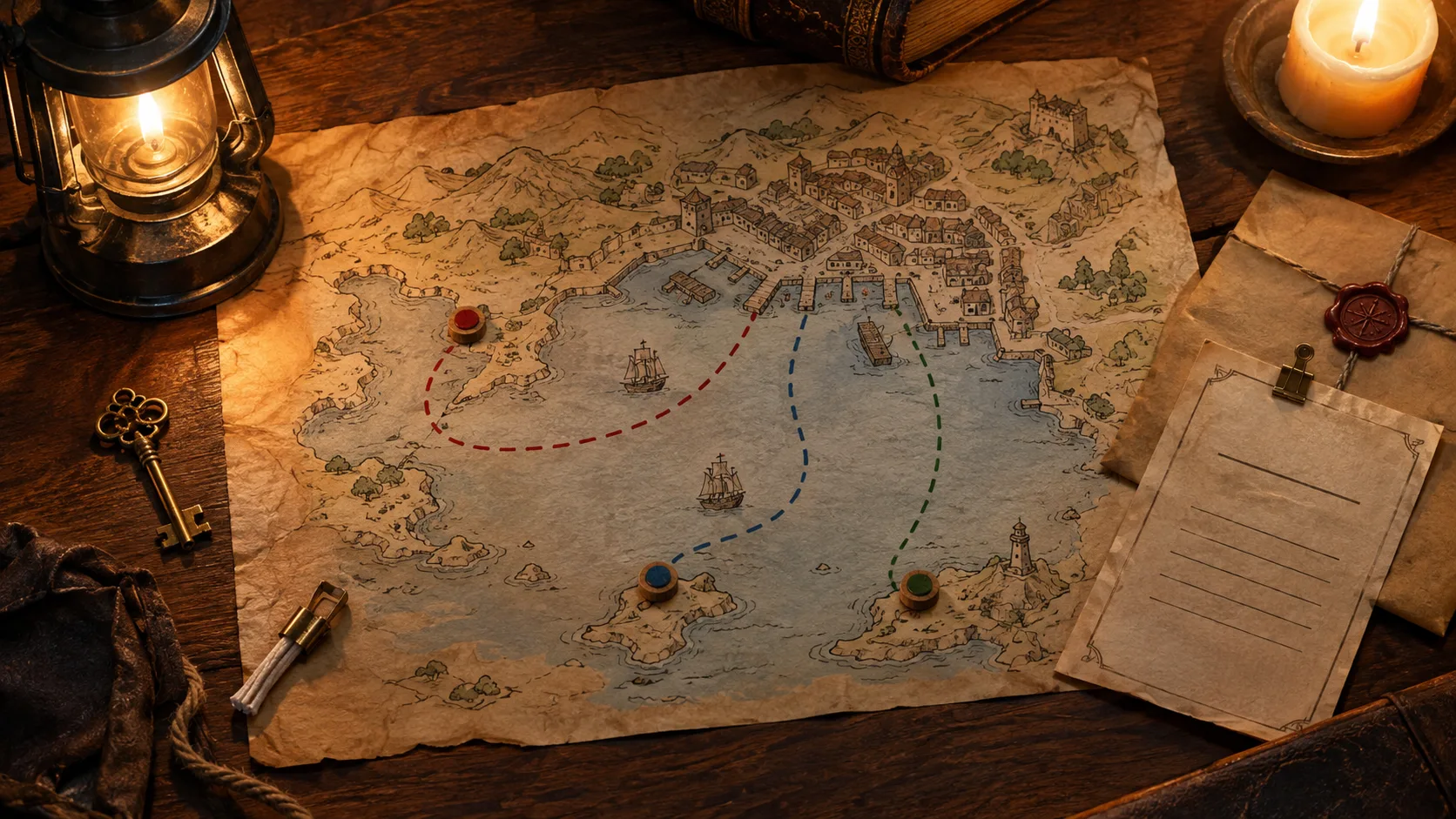
Think of it like the map above: three separate routes, each from a different starting point, all converging on the same harbor. Whichever path your players take, they arrive at the truth.
"Map the clues so players can reach 'the first mate is the smuggler' from the docks, the lighthouse, or the customs house. Mark which clues need ability checks and give each one a fail-forward alternative."
Step 4: Stress-Test Against Your Party
Share character sheets or spell lists and ask the AI to identify where spells or class features could break the case. Older EN World advice recommends reading through every divination spell available at your adventure's level. Here, the AI does that audit for you.
"Which spells or class features could solve this mystery too early? Give me a countermeasure for each that still rewards the player."
Step 5: Produce Handouts and a Session Tracker
Finish with in-world documents and a one-page DM tracker listing every conclusion and its clues. During play, check off what players have actually found. Dungeon Matters advises tracking what the players know, not what you have revealed.
"Write the smuggler's coded manifest as a player handout, then give me a checklist tracker of all clues grouped by conclusion."
Results & Use Cases
🏰 The Friday One-Shot at a Noble's Ball
Scenario: A DM has two evenings to prep a one-shot murder mystery for a new group of level-1 characters.
Traditional Approach: Building suspects, a timeline, and a redundant clue structure by hand typically takes several prep sessions. Even then, the DM may realize mid-game that a key clue sits behind a single check.
With the AI clue generator: One conversation produces the timeline, a four-suspect roster, a clue web, and three handouts. Suspect names come from Name Generator.
- Every conclusion reachable through multiple scenes
- Low-level framing that naturally limits divination magic
- Handouts ready to print before game night
⚓ A Multi-Session Smuggling Conspiracy
Scenario: A long-running campaign shifts into a harbor-town conspiracy spanning four sessions, with a party that includes a divination-heavy wizard.
Traditional Approach: Keeping clues, NPC statements, and red herrings consistent across weeks requires extensive notes. Players also often pursue leads the DM never planned for.
With the AI clue generator: The AI remembers the conspiracy's structure between sessions. When players chase an unplanned lead, it generates new clues consistent with the established truth.
- Branching clues with no "one true path," as The DM Lair recommends
- Spell countermeasures tailored to the wizard's actual spell list
- A running record of what the party has discovered
📱 Rescuing a Stalled Session From Your Phone
Scenario: Mid-session, players skip the lighthouse entirely and corner the wrong suspect. Momentum is dying.
Traditional Approach: The DM either railroads the party back or improvises a clue that may contradict earlier facts.
With the AI clue generator: The DM uses speech-to-text on the mobile app to describe the situation and gets three in-world ways to reintroduce the missing lead within seconds.
- A passerby rumor, an intercepted note, or a nervous witness approaching the party
- Consistency with the established timeline
- No pause long enough to break immersion
Frequently Asked Questions
Is there a free DnD mystery clue generator?
Yes. Jenova's free tier includes all core features with limited monthly usage, so you can generate clue webs, suspects, and handouts at no cost. For heavier prep, such as long campaigns or multiple one-shots, the Plus plan costs $20 per month and offers 30× the free usage. Usage resets on your billing date, with no daily caps.
How many clues should a D&D mystery have?
Follow the Three-Clue Rule: provide at least three independent clues for every conclusion players must reach. Players miss clues, fail rolls, and skip locations, so redundancy keeps the case solvable. As Dungeon Matters suggests, give away slightly more than feels comfortable. You hold the whole picture, and your players do not.
Can Game Designer Assistant handle spells like speak with dead and zone of truth?
Yes. Share your party's spell lists and this AI design partner will identify spells that could end the mystery early and propose countermeasures that still reward the caster. Examples include a culprit who believes they are innocent, a corpse whose literal answers mislead, or a planted false surface thought. The spells deliver information without solving the case.
How is an AI clue generator different from random clue tables?
Random tables produce isolated objects with no connection to your solution. An AI clue generator designs every clue backward from the culprit, method, and motive, so each one points to a specific conclusion. It also builds fail-forward alternatives for skill checks and adapts when players take an unplanned route.
Can I print clue handouts for my players?
Yes. Generate in-world documents such as letters, ledgers, and witness statements with the clue generator, then format them with PDF Generator for printing or sharing in a virtual tabletop. Physical handouts boost engagement because players can reread and compare evidence throughout the investigation.
Does the clue generator work on mobile?
Yes. It runs with full feature parity on web, iOS, and Android, with speech-to-text for hands-free input at the table. Your campaign details sync across devices, so you can prep at your desk and improvise from your phone mid-session.
Build Mysteries Your Players Can Actually Solve
D&D investigations stall for predictable reasons: single-path clue chains, dice-gated information, divination magic, and a heavy prep load. The solution is redundant, system-level clue design, and an AI DnD mystery clue generator applies it consistently in minutes instead of evenings.
Whether you are running a one-shot whodunit, a multi-session conspiracy, or rescuing a session that went off the rails, you get clue webs, layered suspects, and handouts that hold up at a real table. Your players get the satisfaction of solving the case themselves.
Try Game Designer Assistant now and build your next mystery. Explore more at Jenova.
For Developers: Game Designer Assistant is available programmatically via the Jenova API. You can integrate AI mystery and clue design into your virtual tabletop or campaign-management app with a single API call. Full documentation →