DnD Campaign Generator: AI Tools for Worlds, NPCs & Session Prep
2026-09-03
A DnD campaign generator used to mean a random dungeon table, a binder of NPCs, and a weekend of notes. In September 2026, Jenova gives Dungeon Masters a full AI workshop instead: specialized agents that build worlds, NPCs, plots, maps, and session recaps without replacing the person behind the screen.
You stay the DM. The platform handles the blank-page work.
✅ Generate homebrew settings, factions, and pantheons in a single sitting ✅ Name NPCs, towns, and magic items with linguistic consistency ✅ Structure adventures, villain schemes, and session-zero surveys ✅ Produce maps, handouts, recaps, and table-ready flavor text
Most “AI dungeon master” tools either try to run the game for you or dump unstructured prose into a chat window. A serious campaign generator should do the opposite: accelerate prep, remember canon, and get out of the way once dice hit the table.
To understand why that distinction matters, it helps to look at how Dungeon Masters actually prepare — and where the hours disappear.
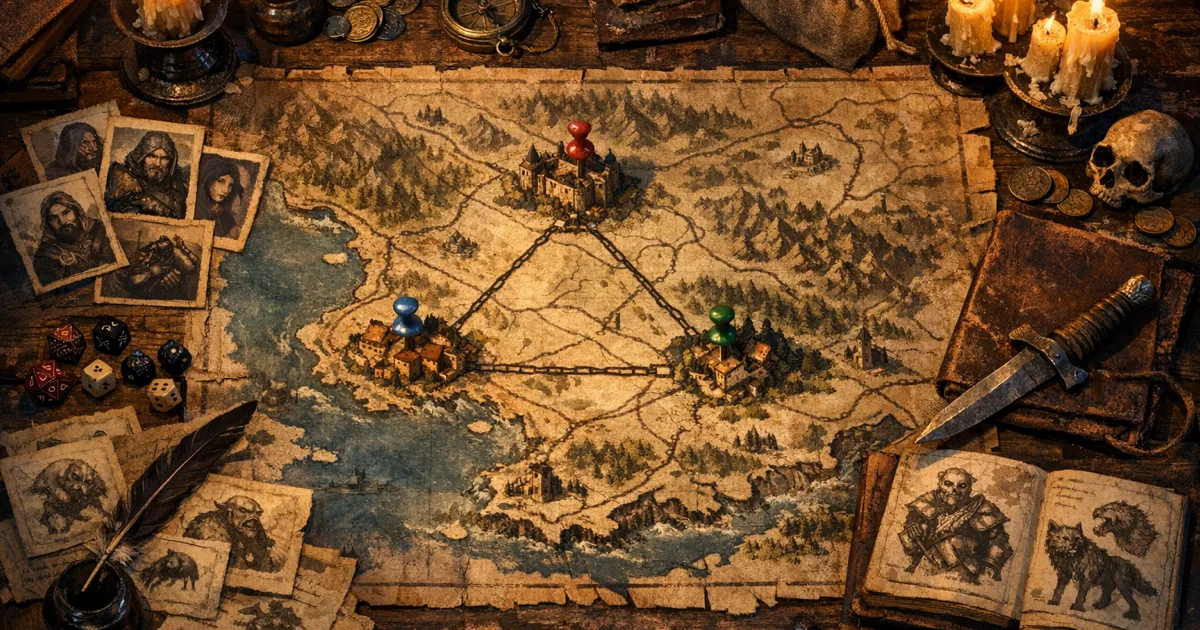
Quick Answer: What Is a DnD Campaign Generator?
Jenova is an AI platform that generates D&D campaigns — worlds, NPCs, plots, and session materials — so Dungeon Masters prep in minutes instead of hours. It is a prep assistant, not a robot in the DM chair.
Key capabilities:
- Worldbuilding and adventure structure with the Game Designer Assistant
- Lore, myths, and long-form setting prose via the Creative Fiction Writer
- Culturally fluent names for people, places, and relics through the Name Generator
- Persistent memory across sessions, multi-model access, and custom agents you can tune to your table’s tone
Why Campaign Prep Still Eats the Week
Running D&D means wearing a dozen hats at once: writer, cartographer, rules referee, voice actor, and accountant of every NPC the party has ever met. That observation is now standard among AI tools built specifically for the DM role — prep, session support, and continuity after the game.
The hobby’s own data shows why generators matter. In Sly Flourish’s survey of 6,600 fifth-edition Dungeon Masters, most tables were not running a published boxed set from cover to cover:
55% of Dungeon Masters — used a personal campaign setting rather than Forgotten Realms or another published world
Homebrew is the default. That is the fun part. It is also the workload.
Wizards of the Coast has leaned into community feedback with regular D&D Beyond surveys, and industry coverage has followed publisher experiments with AI-powered tools. The practical question for a Wednesday-night DM is narrower: what actually shortens prep without flattening the table?
But turning a cool premise into a playable campaign is still frustratingly difficult:
- Worldbuilding sprawls across docs, wikis, and half-finished maps
- NPCs blur together after session five
- Visuals (portraits, tokens, handouts) live in a different tool from the story
- General chatbots forget canon between conversations
- Solo “AI DMs” optimize for playing alone, not for running a human table
Homebrew Worlds Have No Ceiling
A published module hands you maps, stat blocks, and a plot spine. A personal setting asks you to invent geography, cultures, economies, and a reason the party cares — then keep all of it consistent when someone asks what the harbor smells like. Survey respondents overwhelmingly preferred home games and original adventures, which means the typical DM is also the typical worldbuilder. Generators that only spit out a five-room dungeon leave the real work untouched.
NPCs and Continuity Break First
The party will adopt the unnamed baker. They will ignore your lich. Continuity — who said what, who holds the amulet, which rumor was a lie — is the failure mode every long campaign hits. Prep-focused reviews in 2026 draw a hard line here: conversational memory degrades as the story grows, while structured campaign notes survive past session fifteen. If your generator cannot remember the baker’s name next month, it is not a campaign tool. It is a one-shot toy.
General Chatbots Are Unstructured on Purpose
ChatGPT and similar models are strong at riffs, dialogue, and “what if” prompts. They are weak at scannable NPC fields, encounter formats, and session-to-session canon. Comparisons of AI dungeon master tools keep repeating the same limits: no built-in campaign memory, prose walls instead of usable cards, and rules hallucinations when you need a CR that survives contact with a real party.
Solo AI DMs Solve a Different Problem
If your group cancelled, a solo engine can narrate a scene. If you already love DMing, that product is aimed at the wrong chair. Practitioners split the category in two: software that runs the game, and software that speeds up the game you still run. Free tiers on solo apps often cap play — one widely used engine advertises about 25 free turns per day before a paid plan. That is fine for midnight fiction. It does not prep next Saturday’s four-hour session.
Maps, Tokens, and Handouts Live in Another Tab
63% of DMs — preferred five-foot gridded combat with maps and miniatures
Most tables still want a map. Random dungeon crawlers and vibe-art generators rarely talk to your plot notes, rumor tables, or NPC portraits. The result is a beautiful image you cannot find, named final-final-use-this.png, disconnected from the cult that actually matters this week.
This is exactly what Jenova was built for: one place to generate the campaign, remember it, and carry it to the table.
The Jenova Solution
Jenova is not a single random table. It is a library of expert agents you can chain into a campaign pipeline — world first, names and faces second, structure third, handouts last — with persistent memory so last session’s baker still exists.
| Traditional Approach | Jenova |
|---|---|
| Four hours of notes scattered across docs and wikis | Specialized agents that output playable pieces, not chat filler |
| One general chatbot that forgets canon | Persistent memory across sessions and long-running campaigns |
| Separate tools for names, lore, maps, and recaps | One workspace; switch agents without losing context |
| Locked to a single model vendor | Models from OpenAI, Anthropic, Google, DeepSeek, xAI, and more |
| Solo AI that tries to replace the DM | Prep assistants that leave adjudication, pacing, and the room to you |
Guides to AI as a GM assistant make the same point: keep the human table; use AI for prep, notes, and recall. Jenova is built on that split.
Worldbuilding, Systems, and Table Reality
The Game Designer Assistant treats your campaign as a game, not only as a novel. Ask for dungeon flow, faction economies, travel times, or how a coastal city-state actually feeds itself. It brainstorms systems, documents them, and stress-tests whether an idea will survive a session rather than a mood board.
Pair that with Deep Research when you want a pantheon rooted in real myth cycles, a plague’s historical analog, or how medieval harbors were taxed. The agent searches widely, synthesizes with citations, and gives you raw material your table can steal without copying a published setting.
Characters, Psychology, and Dialogue
Names are not decoration. A culture that names every daughter after rivers feels different from one that numbers its soldiers. The Name Generator (detailed below) handles that layer. For motives and social texture, the Personality Analyzer builds NPCs who hold together under player interrogation — attachment patterns, status games, the lie they tell themselves.
When a scene needs to play like a scene, the Film Screenwriter is the right chair: three-act session outlines, dialogue that sounds spoken, and visual beats you can read aloud. You are not writing a movie. You are stealing film craft so the tavern confrontation has an entrance, a turn, and a reason to cut to combat — or not.
Maps, Crests, and Player-Facing Art
The Graphic Designer produces faction crests, wanted posters, rumor handouts, and illustration-ready briefs you can drop into a VTT or print. Describe the three-pin peninsula, the crypt door, or the cult’s sigil; iterate until it matches the notes, not a generic “fantasy map” aesthetic.
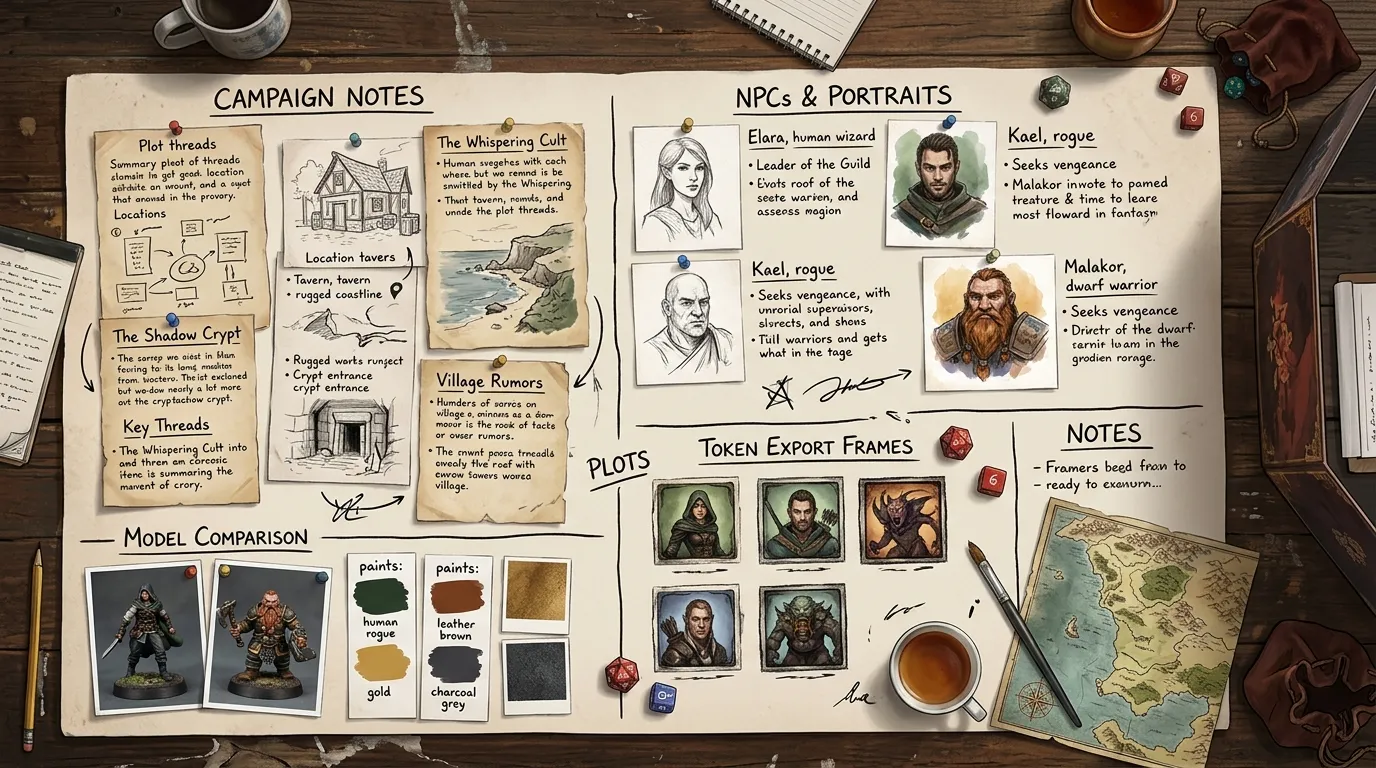
Custom agents let you lock tone (“grimdark low-magic,” “cozy hexcrawl,” “political intrigue only”) so every later prompt inherits the same world. Multi-model access means you can draft lore on one model and tighten boxed text on another without juggling accounts.
Specialized AI Agents for DnD Campaign Generation
These agents are the ones a working DM would plausibly open in the next month — not a tour of the whole library.
Creative Fiction Writer
Your setting bible needs myths people would actually believe. This storytelling partner writes origin cycles, in-world sermons, traveler’s journals, and the “what the peasants think is true” layer that makes a homebrew world feel inhabited. Deep research for authentic cultures sits underneath the prose, so your desert theocracy does not read like a reskinned generic kingdom.
- Long-form lore that stays internally consistent
- Multiple registers: epic, folkloric, bureaucratic, unreliable narrator
- Editorial passes when a region’s history contradicts last session
Name Generator
Random syllable soup breaks immersion. This naming consultant works from linguistic and cultural constraints — dwarven clan structures, colonial port towns, a language that avoids the letter R — and produces sets you can reuse for NPCs, ships, taverns, and cursed blades without colliding.
- Batch names with etymology notes you can turn into plot hooks
- Distinct phonology per culture so players hear the difference
- Titles, epithets, and place-names, not only first names
Machiavelli Mentor
Villains fail when they wait in a room. This strategist maps power, incentives, and multi-move campaigns: what the duke does if the party ignores the docks; which ally sells them out if the grain tariff passes. Use it to design factions that act off-screen, not a boss with extra hit points.
- Faction clocks and contingency trees
- Negotiation tables and leverage maps
- Schemes that still work if the players derail act one
Comic Creator
Big set pieces land harder when you can see them. Sequential art helps you storyboard a heist, a dragon reveal, or a city skyline, then crop panels into tokens and recap images. It is also the fastest way to give players a “this is the NPC you met” reference without commissioning a full portrait set on day one.
- Character reference sheets with consistent costumes
- Scene storyboards for climactic encounters
- Recap art that matches your campaign’s visual tone
Quiz Maker
Session zero is a campaign generator’s secret weapon. Build a player-preference survey (exploration vs. intrigue vs. combat), an in-world riddle the party finds on a standing stone, or a “what did your character believe about the Whispering Cult” questionnaire. Calibrated quizzes beat a vague “so what do you like?” conversation.
- Session-zero forms you can send before character creation
- In-world puzzles and rumor tests
- Print-ready output for physical tables
Try Jenova free — no credit card required.
How to Generate a D&D Campaign Step by Step
You do not need a twelve-tab stack. Four focused passes produce a first adventure you can actually run.
Step 1: Lock the Premise and Table Contract
State the pitch, tone, and what you will not prep. A tight brief saves every later agent from inventing a second world.
"We are running a coastal intrigue campaign, low magic, three players who like social deduction more than dungeon crawls. No world-ending threats. The hook is a missing grain fleet and a cult that leaves salt on doorways. Give me a one-paragraph pitch and three campaign promises I should say at session zero."
Use the Quiz Maker if you want that contract as a short player survey instead of a speech.
Step 2: Build Geography, Factions, and Names
Generate the map in words first: three settlements, the roads between them, who taxes whom. Then name everything inside one cultural system so the harbor town does not sound like it was copy-pasted from a different continent. The Name Generator should receive the same constraints as your lore pass.
"Create three linked settlements on a peninsula: a fortified grain port, a cliffside monastery, and a smuggler village. For each, give me a name with etymology, a ruling tension, and one secret that is not obvious from the docks."
Step 3: Write NPCs and the First Adventure Spine
Turn factions into people. Give each NPC a want, a lever, and a lie. Then ask the Writing Assistant for boxed text, rumor tables, and a recap template you will reuse after every session — same voice, same length, player-safe vs. DM-only notes.
"Write six NPCs for the grain port: harbormaster, debt-ridden shipwright, cult priest posing as a salt merchant, mercenary captain, lighthouse keeper, and a child who sells false charts. Each needs a want, a secret, and how they react if the party arrives armed."
Step 4: Make What Players Will See and Hear
Only generate art and music for things that will hit the table. A crest on a wax seal, a wanted sketch, a eight-bar tavern melody in text notation from the Music Composition Assistant. Skip the 40-portrait pack you will never print.
"Compose a simple tavern round in ABC notation: minor key, 6/8, lyrics about a fleet that never came back. Keep it singable for players who are not musicians."
Step 5: Prep the Clock, Then Stop
Ask for a three-session clock: what happens if the party does nothing. Pack a one-page cheat sheet. Stop prepping. The generator’s job is to make improvisation cheap, not to script the players’ lines.
Results & Use Cases
📊 Homebrew Peninsula in One Evening
Scenario: You promised a custom setting by Friday. You have a job, a map idea, and no lore bible.
Traditional Approach: A weekend of wiki pages, inconsistent names, and a first session that stalls in the tavern because nobody has a reason to leave.
Jenova: One premise pass, a three-settlement geography, a named cast, and a session-zero quiz. You arrive with rumors, not a novel.
- Playable secrets attached to places, not encyclopedia entries
- Names that share a language so the world sounds intentional
- A clock that advances even if the party goes fishing
💼 Expanding a Published Module Without Fighting It
Scenario: You are running a hardcover, but your table adopted a side NPC and you need three sessions of original material that still feeds the main plot.
Traditional Approach: Homebrew that tone-clashes with the book, or a railroad back to the next chapter.
Jenova: Use the Film Screenwriter to outline a side arc whose midpoint reveals a fact the module already assumes. Deep Research supplies period-accurate trade details so your dockside detour feels like the same world.
- Side quests that pay off published stakes
- Dialogue that matches the module’s register
- Notes you can drop without rewriting chapter seven
📱 Party Derails on Your Phone
Scenario: Mid-session, on the subway home from work or at a loud table, the players skip the crypt and sail to a town you have not named.
Traditional Approach: Panic stall, generic “small fishing village,” broken continuity next week.
Jenova: On iOS or Android — same agents, same memory — generate the town, two NPCs, and a rumor that still points at the crypt. Voice-to-text lets you capture the improvisation before you forget it.
- Full feature parity on mobile, not a stripped chatbot
- Persistent memory so the invented town still exists on Thursday
- Recap drafted before you reach your front door
🎯 Villain Who Acts Off-Screen
Scenario: You want a political antagonist, not a damage sponge. The party ignored the warning letter.
Traditional Approach: The villain waits in a lair until the final fight, then monologues.
Jenova: Machiavelli-style power mapping produces the next move: seize the granary, bribe the cleric, frame the rogue. You run consequences, not a cutscene.
- Factions with incentives, not alignment stickers
- Contingencies for “they never go to the castle”
- Intrigue that respects player agency
FAQ
What is a DnD campaign generator?
A DnD campaign generator is software that produces playable campaign pieces — setting, NPCs, plots, maps, and session notes — so a Dungeon Master can prep faster. On Jenova, that means specialized agents rather than one generic chat. It is a prep assistant. You still run the table, call rulings, and read the room.
Is Jenova free to use as a campaign generator?
Yes. Jenova has a free tier with core features and limited monthly usage. Paid plans increase usage and unlock custom model selection. You can generate a premise, a town, and a cast without a credit card, then decide whether a higher tier fits a weekly game.
Can AI replace a Dungeon Master?
Not for a real table that lasts months. Solo-play engines can run a scene, then wobble on continuity, stakes, and saying no. Practitioners who use AI at the table treat it as prep, notes, and recall. Jenova is built for that job: generate material, remember it, leave pacing and judgment to you.
How is this different from ChatGPT for D&D prep?
A general chatbot is a blank conversation. It will invent an NPC, then forget her, then contradict the map. Jenova gives you domain agents — game design, fiction, naming, personality, strategy — plus persistent memory and the option to attach your own notes as a knowledge base. You are not pasting the campaign into a new chat every Tuesday.
Does a Jenova campaign generator work on mobile?
Yes. Web, iOS, and Android share feature parity, including speech-to-text. That matters when you need a dockside NPC during a live session or want to dictate a recap on the commute. Generated notes stay attached to the same campaign memory across devices.
Can I generate maps, tokens, and NPC names in one workflow?
You can run the full pipeline in one account: names and lore first, then graphic handouts and comic-style reference sheets, then recaps. Jenova does not replace a dedicated VTT such as Foundry or Roll20; it feeds them. Generate the peninsula, the cult sigil, and the harbormaster’s portrait, then export what your virtual table actually needs.
Generate the Campaign. Run the Table.
Most Dungeon Masters are not looking to be replaced. They are looking to stop losing weeknights to blank pages, unnamed towns, and villains who sit still. A serious DnD campaign generator should output worlds, NPCs, plots, and session materials you can hold — then remember them when the party sails the wrong way.
Jenova puts that pipeline in one place: game design, fiction, naming, psychology, strategy, visuals, and recaps, with memory that survives session fifteen. Start with a peninsula and a salt-stained door. Leave with a campaign your table can play this week.
Explore the full agent library at Jenova and generate the next session before the group chat asks, “Are we still on for Friday?”
For Developers: Every agent in this article is available programmatically via the Jenova API — build AI-powered campaign generation into your application with a single integration. Full documentation →