Crush Decoder AI: Read Texts, Signals & Clear Next Moves
2026-08-28
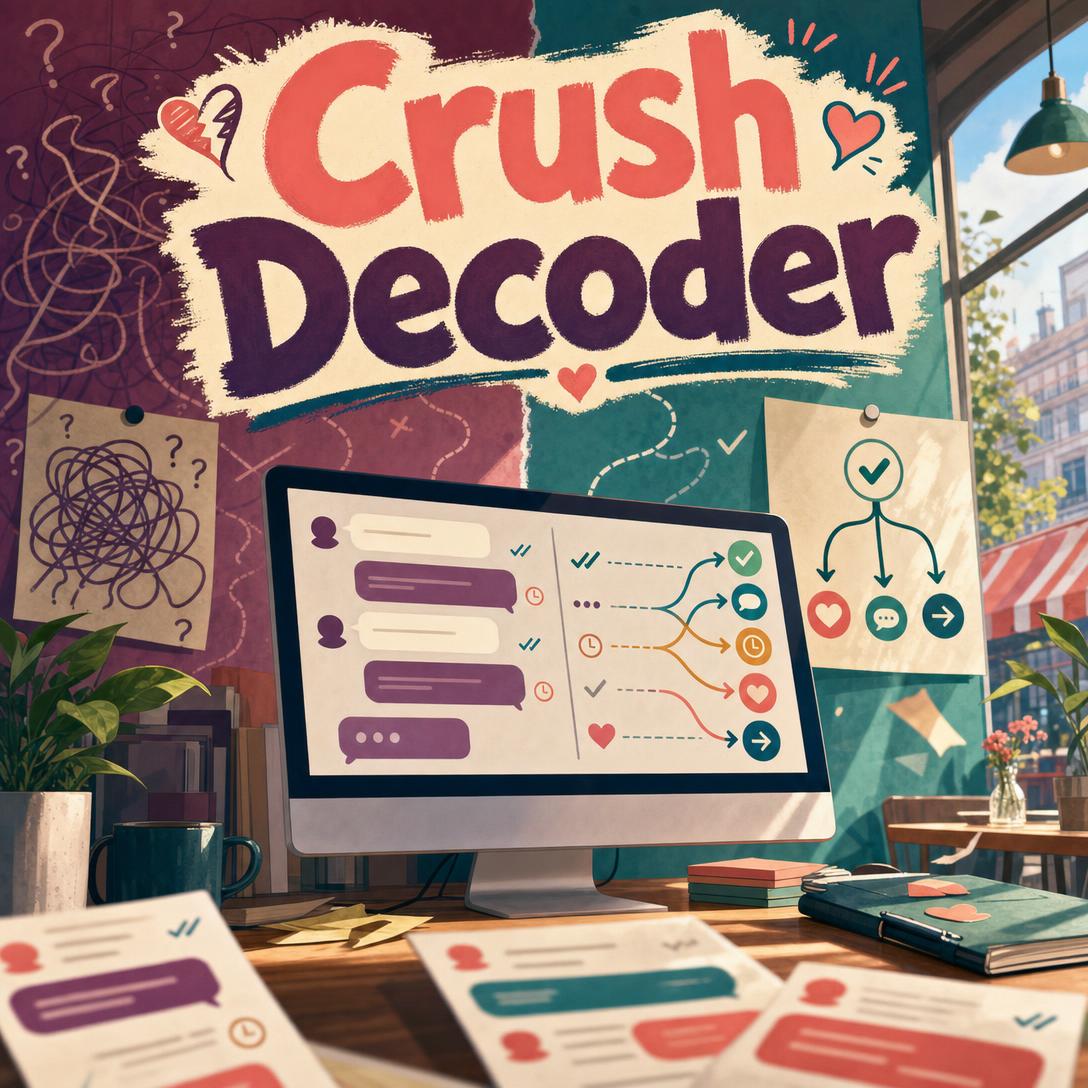
Crush Decoder helps you read a crush's texts, behavior, and mixed signals by tracking patterns — who initiates, how much effort they invest, and what they never do — then giving you an honest take and a specific next move. While a delayed reply or a vague "we should hang out" can send anyone into a spiral, this AI weighs consistency over intensity so you stop treating noise as data.
✅ Reads initiation, effort, and escalation — not emoji trivia ✅ Sorts mixed signals into types that actually change the advice ✅ Designs low-risk tests when the picture is genuinely unclear ✅ Tells you when to move forward — and when to stop chasing
Comfortable delusions waste months. Honest reads save them. To understand why that matters, it helps to look at how modern dating actually communicates — and why so many people get stuck decoding it alone.
Quick Answer: What Is Crush Decoder?
Crush Decoder is an AI signal-reading companion that interprets your crush's texts, behavior, and mixed signals to give an honest read and a clear next move. It favors patterns over one-off moments, so you can act instead of rereading the same thread.
Key capabilities:
- Decode texts for initiation, effort, tone, and whether the conversation is being kept alive or quietly closed
- Separate real mixed signals from wishful reading, breadcrumbing, and context-dependent friendliness
- Read in-person cues, social media habits, and the louder signal of what they don't do
- Suggest low-risk tests and send-ready next moves matched to the evidence — including when the honest answer is to walk away
Why Crush Texts Feel Impossible to Read
Dating did not get more confusing because people forgot how to flirt. It got more confusing because ambiguity now feels safer than clarity. Researchers at the Institute for Family Studies argue that vagueness is often motivated: if lasting love looks risky, staying undefined seems to protect you from loss. Communication is the actual antidote — but most people never get a clean read on what the other person is doing, so they never know what to communicate.
The channel does not help. SSRS polling in 2025 found that 39% of U.S. adults have used an online dating site or app, and 65% of adults aged 18–29 have done so. A large share of early attraction now lives in threads, story views, and "haha yeah" replies that were never designed to carry commitment.
39% of U.S. adults — have used an online dating site or app at some point
65% of adults 18–29 — have used online dating, the highest of any age group
84% of Gen Z Hinge daters — say they are seeking new ways to build emotional intimacy, even as hesitation and mixed expectations get in the way
Among people who have used these apps, SSRS also found that sharing family values outranked looks, income, and hobbies as a "very important" match factor. People want substance. The medium still rewards ambiguity.
That gap is where overthinking thrives:
- One slow reply becomes a story. Patterns matter; a single delay usually does not.
- "We should do something soon" gets filed as a plan. Vague future talk is often social lubrication, not a calendar hold.
- Warmth gets confused with interest. Some people are warm with everyone. The question is differentiated treatment.
- Your attachment style edits the footage. Anxious readers overweight tiny positives. Avoidant readers dismiss real effort. Both misread the same thread.
This is exactly what Crush Decoder was built for: a sharp, non-wishful second set of eyes when you cannot tell whether you are being pursued, parked, or politely managed.
How Crush Decoder Reads a Crush
Crush Decoder does not score a crush on a 1–10 "do they like you" meter and leave you there. It gives a read, shows the evidence, calibrates confidence, and hands you a next move. You can use it for one confusing text or an entire months-long slow burn.
Step 1: Share the actual evidence Paste the thread, describe the hangout, or walk through the last few weeks. Include context that changes the meaning: coworker vs. classmate, how they treat other people, whether this is new behavior or their baseline.
"We've been friends for eight months. He used to text first a few times a week. For the last three weeks I always initiate, replies are shorter, and he cancelled Friday without suggesting another day. What is this actually?"
Step 2: Get a direct read, not a menu of maybes You get an assessment first — clear, probable, or uncertain — then the evidence. Strong interest looks like consistent initiation, time made when it costs them something, and gradual escalation. Lukewarm interest looks like enjoyment without pursuit. Disinterest, even when polite, looks like obligatory replies and plans that never land.
"This is pretty clear — the effort slope is down, and cancelling without a replacement date is the tell. Busyness is temporary and named. A fade is a sustained downward line."
Step 3: Sort mixed signals into the type that changes the advice Most "mixed signals" are not mixed. They resolve into one of four buckets: one signal is real and the other is wishful; they are genuinely conflicted (interest plus friction); they are breadcrumbing (low-effort re-entry whenever you pull away); or the behavior is context-dependent (workplace niceness, cultural warmth, extrovert baseline). Naming the bucket matters because the next move is different in each case.
Step 4: Run a low-risk test when it is truly unclear If the read is uncertain, you get an experiment with predetermined criteria — stop initiating for a few days, suggest one specific plan, share something mildly vulnerable, or reference a future event — so either outcome is information. You are not performing for a reaction. You are checking investment.
Step 5: Leave with a next move you can actually send Matching energy, creating openings, and making specific plans beat paragraphs of proof. If the last move was met with enthusiasm, a slightly bigger step is reasonable. If it was lukewarm, hold position. If it was avoidance, you already have the answer.
When the read is "they are interested — now say something that does not kill the thread," Texting & Reply Coach can draft the actual message in your voice after the decoder has named the dynamic. Decode first, then write. Do not reverse that order while you are still arguing with the evidence.
Try Crush Decoder free — no credit card required.
Results & Use Cases
📊 The thread you have reread 40 times
-
Scenario: A classmate likes your stories, sends memes at midnight, and says "we should hang" — then goes quiet for four days. You are drafting a double text in the notes app.
-
Traditional Approach: Poll three friends who will tell you what you want to hear, then treat one slow reply as a verdict.
-
Crush Decoder: Separates "just because" texts (a real low-cost interest signal) from closure language and the slow fade. You get a pattern read and a rule: do not double text tonight; send one specific plan tomorrow, then stop.
-
Stops you from turning emoji length into a personality study
-
Names whether they keep conversations alive or let them die
-
Gives a send/don't-send call you can follow when you are spiraling
📱 Mixed signals from a dating-app match (on your phone)
- Scenario: You matched on the train, the chat is funny, they never suggest meeting, and every plan stays hypothetical. You are commuting, thumb hovering over another long message.
- Traditional Approach: Keep the chat alive for weeks because the banter feels like progress.
- The decoder: Endless texting without a move toward a real plan is usually entertainment, not pursuit. On mobile, you can paste the last 20 messages between stops and get a verdict before you invest another week.
If the read is "this match is real, the chat is the bottleneck," Dating App Advisor can help you tighten the profile, the opener, and the off-app transition so the next match does not stall in the same place.
- Flags matches who enjoy the attention but will not spend a Saturday
- Distinguishes fast app cycles from in-person friend-group pacing
- Works in a pocket-sized session — no desktop required
💼 The workplace crush you cannot afford to misread
-
Scenario: A teammate saves you a seat, remembers a throwaway comment from a meeting, and messages after hours about a non-work meme. You need to know whether this is differentiated interest or just a friendly colleague — because a wrong move has career cost.
-
Traditional Approach: Over-read professional warmth, or freeze and wait six months for a signal that never gets clearer.
-
The decoder: Workplace friendliness is the baseline. It looks for behavior beyond the role: after-hours contact, remembered details, plans that are not required, and whether they create proximity when they do not have to.
-
Treats career risk as part of the strategy, not an afterthought
-
Recommends tests that do not put either of you on the spot in the office
-
Will say "this is collegial, not romantic" if that is what the pattern shows
🎯 They said yes to coffee — now what?
- Scenario: The read came back positive, they accepted a specific Saturday plan, and you do not want a first hangout that feels like an interview.
- Traditional Approach: Pick a loud bar at random and hope chemistry covers the logistics.
- The decoder: Confirms the escalation is warranted, then you stop analyzing and start planning.
When signals support a real one-on-one, Date Planner can build the actual outing — venue psychology, timing, a backup if the place is slammed — so the next move is a good date, not another decoded screenshot.
- Ties the "ask" to evidence instead of a vibe
- Keeps the plan specific enough to get a real yes or no
- Hands off to logistics once the signal work is done
FAQ
Is Crush Decoder free?
Yes. You can use Crush Decoder on the free tier with no credit card. Usage is limited compared with paid plans; Plus starts at $20/month for substantially more room if you are working through an ongoing situation rather than a one-off text. Paid tiers raise monthly usage and add options like custom model selection. Start with a real thread on the free plan and upgrade only if you need the extra capacity.
Can Crush Decoder tell me if my crush likes me?
It can give a calibrated read — clear, probable, or uncertain — based on patterns you share. It will not pretend a single heart emoji is a confession, and it will not guarantee an outcome. Reciprocity is the master signal: genuine interest tends toward similar initiation and effort over time. Persistent asymmetry is information. If you only have one data point, it will say so and tell you what would confirm the leaning.
How is Crush Decoder different from asking ChatGPT or a friend?
Generic chatbots hedge. Friends pick a side. This AI is built to lead with an assessment, show the evidence, and counter the two failure modes that wreck crush-reading: overthinking a single delay, and rewriting disinterest as "they're just busy." It also accounts for your bias. Anxious readers need the zoom-out. Avoidant readers need help noticing what is actually being offered.
What if the signals are mixed on purpose?
Ambiguity is common because it feels emotionally safer than clarity, especially when attachment anxiety or avoidance is in the mix. Crush Decoder treats that as a diagnostic, not a personality quiz. Breadcrumbing gets named. Genuine conflict (interest plus bad timing or fear of losing the friendship) gets a different plan: space without disappearing, not a harder chase. Context-dependent warmth — office, friend group, culture — gets separated from pursuit before you act.
Does Crush Decoder work on mobile?
Yes. It runs with full feature parity on web, iOS, and Android, so you can paste a thread on the train, dictate what happened after a party, or check a read before you send. Speech-to-text is available when you would rather talk the situation out than type it. History persists across devices, which matters if you come back a week later with an update instead of starting from zero.
Can it help after a slow fade or a clear no?
Yes — and it will not coach you to keep pushing. A slow fade is a downward slope in effort, not one busy week. Clear disinterest is short replies as a pattern, cancelled plans with no reschedule, and physical or conversational distancing. In those cases the next move is dignity, not a better text. If the pattern starts to look like fixation after a no, it will say that plainly. Signal reading is for decisions, not for wearing someone down.
Know the Pattern, Then Make the Move
Mixed signals feel personal. A lot of them are structural: apps that reward chatting over choosing, a dating culture that treats ambiguity as safety, and brains that edit evidence to match hope or fear. Roughly 27% of couples who married in 2025 first connected through an app, which means a huge amount of real attachment now has to survive a medium that is terrible at showing intent.
You do not need another pep talk. You need a read you can act on — who is initiating, whether effort is rising or fading, and what to do this week. Crush Decoder was built for that job: honest, specific, and unwilling to let you spend another month chasing a pattern that already answered you.
Try Crush Decoder now. Explore more at Jenova.
For Developers: Crush Decoder is available programmatically via the Jenova API — integrate crush-signal decoding and next-move coaching into your application with a single API call. Full documentation →