CrewAI vs LangChain vs LangGraph: Best AI Agent Framework (July 2026)
2026-07-22
Choosing between CrewAI, LangChain, and LangGraph is one of the first architectural decisions every AI agent builder faces in 2026 — and one of the most consequential. Each framework brings a distinct philosophy to orchestration, state management, and multi-agent collaboration, but all three share the same fundamental requirement: you own the entire infrastructure stack.
The Jenova Agent API offers a fundamentally different approach — a fully-managed agent backend where orchestration, memory, model routing, storage, and tool integration come production-ready from day one.
✅ Any model from OpenAI, Anthropic, Google, xAI, and more — single integration ✅ Built-in memory, context management, and RAG — no external state stores ✅ MCP-native tool integration with zero configuration ✅ Build and launch custom production agents in minutes, not months
Whether you're evaluating these three frameworks head-to-head or looking to skip the infrastructure layer entirely, this guide breaks down what each option actually requires — and costs — in production.
Quick Answer: What Are CrewAI, LangChain, LangGraph, and the Managed Alternative?
CrewAI, LangChain, and LangGraph are open-source frameworks for building AI agent systems — each requiring developers to self-host, integrate, and maintain their own agent infrastructure.
Key differences:
- LangChain — Mid-level agent harness with chain-based abstractions; agents now built on top of LangGraph
- LangGraph — Low-level, graph-based state machine for stateful, multi-step agent orchestration with fine-grained conditional routing
- CrewAI — High-level, role-based framework for multi-agent team collaboration with hierarchical task delegation
- Jenova Agent API — Fully-managed agent backend: one API replacing the entire DIY stack (orchestration, models, memory, storage, tools, scaling)
The Problem: Building Production AI Agents Is Expensive and Fragile
The AI agents market reached $7.6 billion in 2025 and is projected to hit $10.9 billion in 2026, with 85% of organizations now deploying AI agents in some capacity. But the distance between a working prototype and a production deployment remains enormous — and expensive.
The cost of building a production AI agent ranges from $5,000 for a basic MVP to over $500,000 for enterprise-grade systems — and that's before ongoing maintenance. Organizations that budget only for model API costs consistently underestimate total spend by 5-10x, with teams projecting $50,000 in annual AI costs discovering they're actually spending $380,000 once integration overhead, human review, retry waste, and compliance infrastructure are included.
But cost is only half the story. Framework selection itself introduces significant engineering risk:
- Architecture lock-in — choosing the wrong framework means rewriting core infrastructure later
- Orchestration complexity — coordinating models, tools, memory, and retrieval across multi-step workflows
- Model vendor management — juggling separate API keys, rate limits, and pricing across providers
- Memory and state persistence — building and maintaining external stores for conversation continuity
- RAG pipeline engineering — provisioning vector databases, chunking strategies, and retrieval optimization
- Production scaling — handling traffic surges, reliability, monitoring, and incident response
CrewAI vs LangChain vs LangGraph: The Framework Landscape
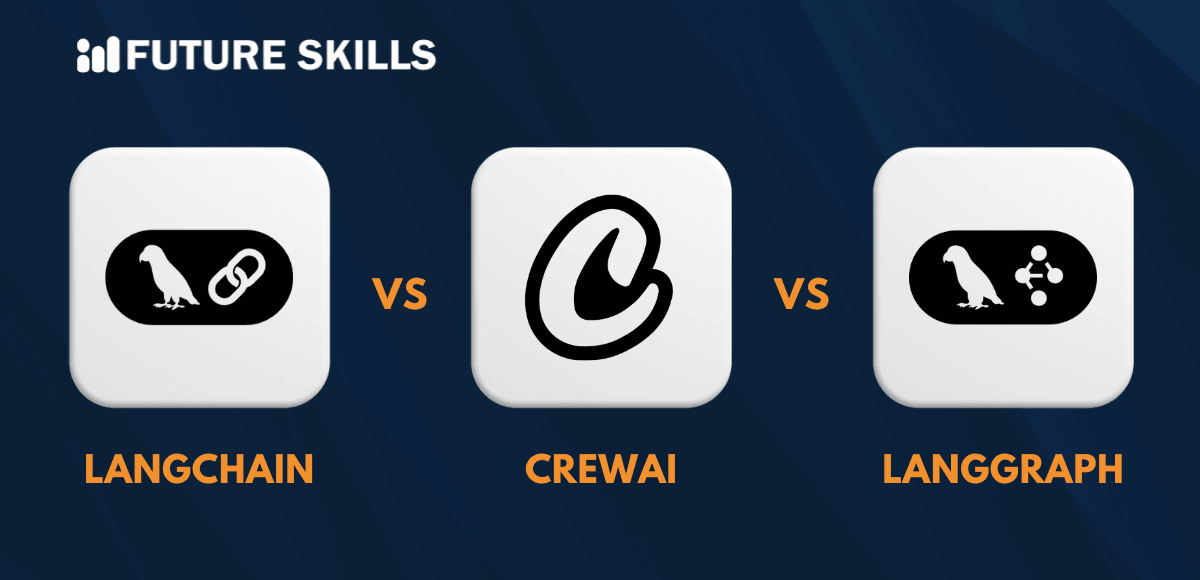
Each of these frameworks addresses agent-building differently, with distinct trade-offs in abstraction, control, and production readiness:
| Feature | LangChain | LangGraph | CrewAI |
|---|---|---|---|
| Architecture | Chain-based agent harness | Graph-based state machine | Role-based crew collaboration |
| Abstraction Level | Mid-level | Low-level (fine-grained) | High-level (declarative) |
| Multi-Agent Support | Via LangGraph integration | Native cyclic graphs, fan-out/fan-in | Native crews with hierarchical delegation |
| State Management | Defers to LangGraph | Central persistence layer with checkpointing | Event-driven flows with process orchestration |
| Memory | Via third-party integrations | Built-in persistence across sessions | Cognitive memory layer with contradiction resolution |
| Tool Integration | Full LangChain ecosystem | LangChain ecosystem + LangSmith | 100s of built-in tools, MCP, A2A protocol |
| Monthly PyPI Downloads | — | 6.17M | 1.38M |
| Production Adoption | Prototyping, RAG pipelines | LinkedIn, Uber, Klarna, GitLab | 63% of Fortune 500 |
| Learning Curve | Moderate | Steep (graph concepts, state schemas) | Gentle (YAML config, role descriptions) |
| Self-Hosting Required | Yes | Yes | Yes |
LangChain provides a mid-level agent harness with a standardized model interface across providers. Its agents are now built on top of LangGraph, making it an entry point for simpler agent use cases that can graduate to LangGraph's lower-level control when needed.
LangGraph delivers the most fine-grained control through a state graph programming model inspired by Pregel and Apache Beam. Developers define nodes, edges, conditional routing, and checkpointing explicitly — powerful for complex workflows, but with a steep learning curve and significant implementation overhead.
CrewAI takes the opposite approach with high-level role-based abstractions — define agent roles, goals, and backstories, and the framework handles delegation. Community benchmarks suggest CrewAI gets developers from idea to working prototype about 40% faster than LangGraph, but real-world deployment patterns show many organizations "prototype with CrewAI, productionize with LangGraph", suggesting neither framework alone covers the full lifecycle.
Orchestration: The Persistent Engineering Burden
Regardless of which framework you choose, the underlying engineering challenges remain remarkably consistent. An empirical study analyzing 64,098 GitHub issues and 3,191 Stack Overflow questions across major agent frameworks identified five recurring families of developer challenges:
- Environment, platforms, and dependency management
- Retrieval, embeddings, and agent memory
- Orchestration and execution control
- Interaction contracts between models and tools
- Runtime reliability and operational robustness
The study found that RAG Engineering, Document Embeddings & Vector Stores, and Orchestration are the most difficult challenges developers face — taking the longest to resolve and most frequently going unanswered, even though they attract less discussion than simpler setup issues. These are not framework-specific bugs. They are structural difficulties inherent to building agent systems from composable parts.
The Hidden Cost of "Free" Frameworks
All three frameworks are open source. None are free in production.
McKinsey benchmarks cited by industry analysis show that integrating an off-the-shelf coding assistant requires approximately $500,000 with a team of 6 engineers over 3-4 months, while building a customer service chatbot with custom integrations costs roughly $2 million with 8 engineers over 9 months. And these figures only cover the initial build. Ongoing maintenance typically runs 10% of initial development cost annually — for a $2 million build, that translates to $200,000 per year in engineering time just to keep the system running.
The framework is free. The orchestration, memory, retrieval, scaling, monitoring, and maintenance are not.
This is exactly the problem the Jenova Agent API was built to eliminate.
The Jenova Agent API
The Jenova Agent API is a fully-managed agent infrastructure service — a single integration that replaces the entire DIY stack of LLM APIs, orchestration frameworks, vector databases, memory stores, and tool servers. Instead of choosing between CrewAI, LangChain, and LangGraph and then building everything around them, developers define their agent's instructions, model, tools, and knowledge base. The API handles orchestration, persistence, retrieval, and scaling automatically.
| DIY Framework Stack | Jenova Agent API |
|---|---|
| Choose and learn CrewAI / LangChain / LangGraph | One API integration — no framework decision required |
| Build orchestration and workflow logic from scratch | Battle-tested orchestration built in |
| Manage separate API keys and rate limits per model provider | Any model through a single endpoint — no vendor lock-in |
| Implement external memory and state stores (Redis, Postgres, etc.) | Unlimited memory and context per session, built in |
| Provision and scale vector databases for RAG | Fully-managed storage with built-in RAG |
| Configure MCP servers, tool wrappers, and auth flows manually | Platform-native tools + any remote MCP server, ready out of the box |
| Handle scaling, uptime, monitoring, and incident response | Production-grade managed infrastructure |
Agent Orchestration
The API provides battle-tested orchestration coordinating models, tools, memory, and retrieval automatically for any workflow. Multi-step reasoning, tool invocation, and response synthesis happen within the platform — no custom graph definitions, state schemas, or workflow DAGs to maintain.
Where LangGraph requires defining nodes, edges, conditional routing, and state checkpointing explicitly, and CrewAI requires configuring agent roles, task sequences, and process types, the Jenova Agent API abstracts orchestration entirely. Define what the agent should accomplish. The infrastructure determines how.
Use Any Model
Power agents with models from OpenAI, Anthropic, Google, xAI, Qwen, and more through a single integration. No separate API keys per provider, no vendor lock-in, no migration effort when switching between models or providers.
This directly addresses one of the most common framework pain points. LangChain and LangGraph tie model access to provider-specific integrations that require individual setup. CrewAI's model flexibility still demands per-provider configuration. The managed API provides unified access across all supported providers through one credential.
Memory & Context
Unlimited conversation memory and context built into every session — no external state management, no Redis clusters, no custom serialization layers. Agents remember user preferences, past interactions, and long-running project context across sessions automatically.
For LangGraph developers, achieving comparable persistence means implementing checkpointing, configuring storage backends, and managing state serialization manually. CrewAI's cognitive memory layer, while powerful, requires deliberate configuration of memory types and storage. The managed API includes all of this natively.
Fully-Managed Storage
Managed relational and vector databases with built-in RAG. Upload documents and knowledge bases, and the API handles chunking, embedding, indexing, and retrieval — no infrastructure to provision, tune, or scale.
Given that the arXiv research found retrieval engineering among the most persistent and difficult challenges for agent developers across frameworks, eliminating this entire category of engineering work represents a significant reduction in both build time and ongoing maintenance burden.
Tools & MCP
Unlimited tool integrations with platform-native tools and any remote MCP server, production-ready without configuration. Gmail, Google Calendar, Drive, Search, Scholar, Maps, Notion, Dropbox, Reddit, YouTube, and more — no wrapper code, no auth flow plumbing.
Both CrewAI and LangGraph support MCP natively, but configuring tool servers, managing authentication, and handling tool invocation errors remains developer responsibility. The managed API provides these integrations ready to use immediately.
Production-Grade
Fully-managed infrastructure with stable APIs, built for production traffic. No servers to provision, no container orchestration to manage, no scaling policies to define. Production-tested with over 30,000 users across 70+ countries.
What You Can Build
The Jenova Agent API is designed for developers shipping production agents as features within their own products — not managing infrastructure. Here are concrete applications you can build and launch:
AI-Powered Customer Support for Your SaaS
Build a custom support agent trained on your product documentation, help articles, and past ticket data. Define your agent's instructions and brand voice, upload your knowledge base, and the API handles RAG, context management, and multi-turn conversation automatically. Resolve tickets 24/7 within your existing product interface.
Embedded Financial Advisor for Fintech Platforms
Launch a proprietary portfolio analysis agent on your fintech dashboard. Configure the agent with financial domain expertise, connect market data feeds via MCP tools, and deliver personalized investment insights directly within your branded experience — with session memory maintaining portfolio context across advisory conversations.
Personalized Tutor for EdTech Applications
Deploy an adaptive learning agent within your education platform. Customize instructions per curriculum, upload course materials as the agent's knowledge base, and the API manages session memory so each student receives a continuous, personalized learning experience across sessions — no external state management required.
AI Research Assistant for Enterprise Knowledge Management
Build an internal research agent connected to your organization's document repositories, Notion workspaces, and Google Drive. Employees ask questions in natural language. The agent retrieves, synthesizes, and cites relevant internal documents — powered by built-in RAG and managed vector storage.
Intelligent Content Generator for Marketing Platforms
Create a brand-aware content agent that produces marketing copy, social media posts, and email campaigns aligned with your style guidelines. Upload brand guides and past campaign materials as reference knowledge, and integrate the agent directly into your content management workflow via a single API call.
Custom Workflow Agent for Any Vertical
Build domain-specific agents for legal document review, real estate analysis, healthcare triage, recruitment screening, or any specialized use case. Define the agent's expertise through custom instructions, connect industry-specific tools via MCP, and deliver specialized AI capabilities within your existing product — without building the underlying AI infrastructure.
Get your API key and ship your first agent in minutes.
How It Works
Getting from zero to a production agent takes four steps:
Step 1: Get Your API Key
Create a developer account at jenova.ai/platform and generate your API key. This single key provides access to the entire managed infrastructure — every model provider, every tool integration, every platform capability through one credential.
Step 2: Build or Choose Your Agent
Create a custom agent by defining its system instructions, selecting a preferred model provider, uploading a private knowledge base, and configuring tool access. Alternatively, select from pre-built agents already optimized for specific domains. Agent configuration happens through the platform in minutes — no code required for setup.
Step 3: Add Credits
Add API credits to your account. Usage is metered per interaction based on the model and complexity involved. No fixed seats, no annual contracts, no minimum commitments — scale usage up or down as needed.
Step 4: Make Your First Call
Send a request to your agent. The API handles orchestration, model routing, tool invocation, memory management, and response generation end to end:
bashcurl -X POST https://api.jenova.ai/v1/chat \
  -H "Authorization: Bearer YOUR_API_KEY" \
  -H "Content-Type: application/json" \
  -d '{
    "agent_id": "your-custom-agent",
    "message": "Analyze Q2 revenue trends and flag anomalies against our forecast model",
    "session_id": "session-abc-123"
  }'
For complete endpoint specifications, request/response schemas, authentication details, and SDK documentation, see the full API docs.
Results & Use Cases
💼 Startup Shipping AI Customer Support in Days
Scenario: A B2B SaaS startup with 2,000 customers needs around-the-clock AI support but has a three-person engineering team.
DIY Framework Approach: Select between CrewAI or LangGraph. Set up orchestration logic, provision a vector database for product docs, implement conversation memory, configure model provider APIs, build escalation flows, handle scaling. Estimated timeline: 3-4 months with dedicated engineers and $500,000+ for a production-grade system.
Jenova Agent API: Define support agent instructions, upload product documentation, configure tool access for ticket management. Ship to production in days with built-in RAG, persistent session memory, and managed infrastructure.
- ✅ Weeks to production instead of months
- ✅ No vector database or memory infrastructure to build or maintain
- ✅ Scales automatically with customer growth — no infrastructure changes needed
📊 Fintech Platform Launching a Portfolio Advisor
Scenario: A fintech company wants to offer AI-powered portfolio analysis as a premium dashboard feature for retail investors.
DIY Framework Approach: Build a multi-agent system with LangGraph for stateful analysis workflows. Implement tool integrations for market data APIs, manage conversation persistence for ongoing advisory relationships, configure multi-model routing for cost optimization, and ensure compliance logging. Engineering investment: substantial, with ongoing maintenance budgeted at 10% of initial build cost annually.
Jenova Agent API: Configure a financial advisor agent with domain-specific instructions, connect market data feeds via MCP, and launch within the existing product. Session memory maintains portfolio context across conversations automatically.
- ✅ No orchestration framework to master, host, or maintain
- ✅ Switch between frontier models without code changes
- ✅ Built-in persistent memory for longitudinal advisory relationships
📱 EdTech Company Deploying Adaptive Tutoring at Scale
Scenario: An education platform serving 50,000 students needs personalized AI tutors across mathematics, science, and language arts.
DIY Framework Approach: Use CrewAI's role-based system to create subject-specific tutor agents. Build memory persistence for tracking individual student progress, implement RAG pipelines for curriculum materials, manage multi-model routing to balance quality and cost across varying question complexity. Each subject requires separate configuration and testing.
Jenova Agent API: Create custom tutor agents per subject with curriculum-specific instructions and materials. The API handles session memory (student progress persists automatically), RAG (curriculum materials are indexed on upload), and model routing — across all 50,000 concurrent student sessions.
- ✅ Each student receives persistent, personalized learning context
- ✅ Knowledge base updates deploy without re-engineering RAG pipelines
- ✅ Production-grade reliability meeting education SLA requirements
🎯 Enterprise Replacing a Brittle LangChain Stack
Scenario: A mid-size enterprise has been running a LangChain-based internal research agent for eight months. Maintenance costs have exceeded the initial build budget. Model provider updates routinely break integrations, and the two-person engineering team spends more time on infrastructure firefighting than building product features.
DIY Framework Reality: Maintaining production agent systems requires approximately 10% of initial development cost annually at minimum — but active agents with external integrations frequently exceed this. Model provider API changes, dependency version conflicts, and scaling incidents consume unpredictable engineering hours. For organizations running millions of queries, annual maintenance alone can reach $500,000 or more.
Jenova Agent API: Migrate agent logic to the managed API. Infrastructure updates, model compatibility, provider integrations, and scaling are handled entirely by the platform. The engineering team redirects fully to product features.
- ✅ Eliminate ongoing infrastructure maintenance burden
- ✅ Automatic compatibility with new model releases and provider changes
- ✅ Engineering resources permanently redirected from plumbing to product value
FAQ
How is the Jenova Agent API different from LangChain, LangGraph, or CrewAI?
LangChain, LangGraph, and CrewAI are open-source frameworks — they provide building blocks, but developers handle hosting, scaling, model management, memory persistence, RAG pipelines, and production hardening themselves. The Jenova Agent API is a fully-managed backend service: one integration that handles orchestration, multi-model routing, memory, storage, RAG, and tool integrations. You define what the agent does; the infrastructure handles how it runs.
How much does the Jenova Agent API cost?
The API uses a credit-based model — you pay per interaction based on the model and complexity involved. No fixed seats, no annual subscriptions, no minimum commitments. Add credits as needed and scale usage up or down. Visit the API platform for current pricing details and credit packages.
Which AI models are available through the API?
The API provides unified access to models from OpenAI, Anthropic, Google, xAI, Qwen, and more through a single integration. Select the model per agent or per request — no separate API keys, provider accounts, or integration work per model. The available model roster updates continuously as new models release.
How difficult is it to integrate the Jenova Agent API?
The integration follows four steps: get your API key, build or choose an agent, add credits, and make your first call. Custom agents are configured directly through the platform — define instructions, select a model, upload a knowledge base, configure tools. No infrastructure provisioning, no framework installation, no deployment pipeline. Full specifications are available at jenova.ai/platform/docs.
Is the Jenova Agent API production-ready?
Yes. The platform is production-tested with over 30,000 users across more than 70 countries. Infrastructure is fully managed with stable APIs built for production traffic — no servers to provision, no scaling policies to configure, no uptime monitoring to build. All data is encrypted in transit and at rest, and user data is never used to train public AI models.
Can I build custom agents or only use pre-built ones?
Both. Developers can create fully custom agents in minutes — define custom system instructions, choose a preferred model provider, upload private knowledge bases, and configure specific tool integrations via MCP. Pre-built agents are also available for common use cases. Custom agents receive the same production-grade infrastructure, memory, storage, and tool access as any pre-built option.
Conclusion
CrewAI, LangChain, and LangGraph each bring genuine strengths to AI agent development in 2026 — CrewAI's intuitive role-based collaboration for rapid prototyping, LangGraph's precise stateful orchestration for complex production workflows, and LangChain's broad ecosystem for getting started quickly. But all three require developers to build, host, scale, and maintain their own agent infrastructure — and the engineering cost of that infrastructure consistently dwarfs the framework itself.
For developers and teams who want to ship production AI agents as product features — not manage orchestration graphs, vector databases, model provider integrations, and memory stores — the Jenova Agent API provides the entire agent backend through a single integration. Define your agent, choose your model, and ship to production.
Start building at jenova.ai/platform/docs. Explore the full platform at Jenova. For questions, reach out at [email protected].