Create AI Agent: Build Custom AI Agents Without Code in 2026
2026-01-05
The ability to create AI agents has become a defining competitive advantage in 2026. With Gartner predicting that 40% of enterprise applications will embed task-specific AI agents this year, organizations that master agent creation are pulling ahead—while those stuck in pilot mode risk permanent disruption.
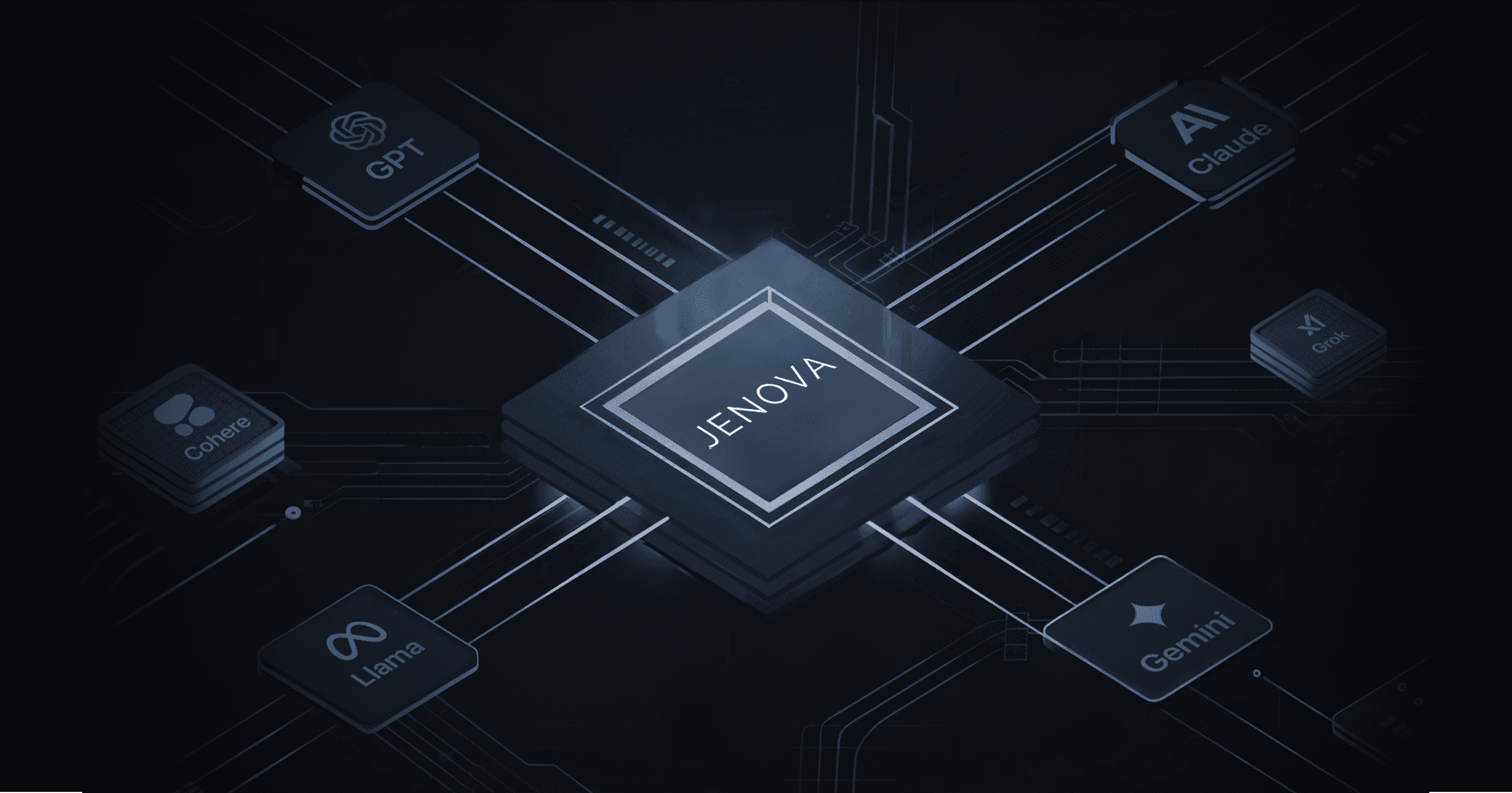
Jenova offers a comprehensive platform where anyone can create AI agents in minutes—no coding required. With access to the latest models including GPT-5.2, Claude Opus 4.5, Gemini 3 Pro, and Grok 4.1, plus seamless app integrations via the Model Context Protocol (MCP), Jenova transforms the complex process of agent development into an intuitive experience.
What you'll learn in this guide:
- How to create AI agents that actually deliver ROI
- The critical infrastructure decisions that separate successful deployments from failures
- Step-by-step workflows for building specialized agents
- Real-world use cases across industries
Quick Answer: What Does It Mean to Create an AI Agent?
Creating an AI agent means building an autonomous system that can perceive, reason, and take actions to achieve specific goals—without constant human oversight. Unlike simple chatbots that respond to prompts, AI agents can:
- Execute multi-step workflows autonomously
- Connect to external tools and APIs (email, calendars, databases, search)
- Maintain persistent memory across sessions
- Make decisions based on context and learned preferences
On Jenova, you can create custom AI agents by defining their role, selecting their AI model, writing custom instructions, attaching knowledge bases, and connecting apps—all through an intuitive interface that requires zero technical expertise.
The Problem: Why Most AI Agent Projects Fail
Despite massive investment in AI, the path from concept to production remains treacherous. McKinsey's 2025 State of AI report reveals that while 88% of organizations now use AI in at least one business function, nearly two-thirds have not yet begun scaling AI across the enterprise.
The disconnect is stark: everyone wants AI agents, but few know how to build them effectively.
The Technical Complexity Barrier
Traditional AI agent development requires:
- Deep expertise in multiple AI models — understanding the strengths, limitations, and optimal use cases for GPT, Claude, Gemini, and others
- Complex orchestration infrastructure — managing multi-step workflows, error handling, and state persistence
- API integration knowledge — connecting agents to Gmail, calendars, databases, and business applications
- Prompt engineering mastery — crafting instructions that produce reliable, consistent outputs
- Memory and context management — ensuring agents remember relevant information across sessions
According to Second Talent's AI Agents Statistics report, 62% of businesses exploring AI agent solutions lack a clear starting point, while 32% stall after pilot and never reach production.
The Vendor Lock-In Problem
Most agent-building platforms force you into a single AI model ecosystem. When a better model emerges—or when your use case demands specific capabilities—you're stuck rebuilding from scratch.
The Integration Nightmare
AI agents are only as powerful as the tools they can access. But connecting agents to business applications traditionally requires:
- Custom API development
- Security and authentication management
- Ongoing maintenance as APIs evolve
- Separate integrations for each application
The Memory Gap
Standard AI chatbots suffer from "amnesia"—they forget everything between sessions. Building persistent memory systems requires database infrastructure, retrieval mechanisms, and careful context management.
The Governance Vacuum
Gartner predicts that over 40% of agentic AI projects will be canceled by end of 2027 due to escalating costs, unclear business value, or inadequate risk controls. Without proper governance frameworks, agent deployments create more problems than they solve.
The Jenova Solution: Create AI Agents in Minutes
Jenova eliminates these barriers by providing a complete platform for creating, deploying, and managing AI agents—without writing a single line of code.
| Traditional Approach | Jenova AI Platform |
|---|---|
| Months of development | Minutes to deploy |
| Single model lock-in | Access to GPT-5.2, Claude Opus 4.5, Gemini 3 Pro, Grok 4.1 |
| Custom API integrations | Pre-built MCP connections to Gmail, Calendar, Drive, Notion, and more |
| Session-based memory only | Unlimited persistent memory across all sessions |
| Requires engineering team | No-code agent builder for anyone |
| Fragmented tools | Unified platform with 30,000+ users |
Multi-Model Architecture
Jenova's intelligent model router automatically selects the optimal AI model for each task—or you can manually choose based on your specific needs:
- GPT-5.2 — OpenAI's most capable model for complex reasoning
- Claude Opus 4.5 — Anthropic's flagship for nuanced analysis and long-form content
- Gemini 3 Pro — Google's multimodal powerhouse
- Grok 4.1 — xAI's model optimized for real-time information
This multi-model approach means your agents always have access to the best available AI capabilities, without vendor lock-in.
Model Context Protocol (MCP) Integration
The Model Context Protocol is an open-source standard that enables AI agents to securely interact with external applications. Jenova supports MCP connections to:
- Productivity: Gmail, Google Calendar, Google Drive, Notion, Dropbox
- Search: Google Search, Google Scholar, Google Maps
- Social: Reddit, YouTube
- Commerce: Amazon, eBay, App Stores
- Travel: Google Flights, Google Hotels
- Custom: Any MCP-compliant server
This means your agents can actually do things—send emails, schedule meetings, search the web, manage files—not just talk about doing them.
Unlimited Memory & Knowledge Bases
Every Jenova agent maintains:
- Unlimited chat history — full context from every conversation
- Persistent cross-session memory — agents remember user preferences, past interactions, and learned information
- Custom knowledge bases — attach documents, PDFs, and data sources for domain-specific expertise
Specialized AI Agents for Every Use Case
Jenova offers a comprehensive library of pre-built expert AI agents, each designed for specific domains. You can use these directly or as templates for creating your own custom agents.
Education & Test Prep
| Agent | Description |
|---|---|
| SAT/ACT Tutor | Personal prep coach with adaptive teaching and strategic guidance |
| GRE Tutor | Strategic coaching for Verbal, Quant, and AWA sections |
| GMAT Tutor | Elite preparation across all GMAT sections |
| LSAT Tutor | Dedicated prep for Logical Reasoning, Logic Games, and Reading Comprehension |
| MCAT Tutor | Comprehensive preparation across all four MCAT sections |
Business & Finance
For organizations looking to create AI agents for financial analysis and business operations, Jenova provides specialized solutions:
- Business Co-Pilot — Strategic partner for founders handling business planning, financial modeling, and operations
- Fundamental Stock Analyst — Deep equity research including earnings analysis, valuation, and SEC filings
- Technical Stock Analyst — Price action analysis, market structure, volume, and momentum indicators
- E-Commerce Business Partner — Product research, listing optimization, and PPC management
Research & Productivity
- Academic Research Assistant — Literature discovery, citation management, and manuscript preparation
- Personal Secretary — Calendar management, email handling, travel coordination, and daily logistics
- YouTube Search — Natural language video and channel discovery
- Reddit Search — Find discussions, insights, and community knowledge
Creative & Writing
- Creative Fiction Writer — Collaborative storytelling with deep research and editorial insight
- Marketing Visual Designer — Logos, campaign imagery, and social media assets
- UI/UX Prototype Generator — Polished screen prototypes for product design
Document Generation
When you need to create AI agents that produce professional documents:
- PDF Doc Generator — Professional PDF creation with adaptive design
- Word Doc Generator — Formatted Word documents for business use
- CSV Generator — Structured spreadsheet generation for data analysis
How to Create AI Agents on Jenova: Step-by-Step
Creating a custom AI agent on Jenova takes minutes, not months. Here's the complete workflow:
Step 1: Define Your Agent's Purpose
Start by clearly articulating what your agent should accomplish:
- What specific tasks will it perform?
- Who is the target user?
- What apps and data sources does it need access to?
- What tone and personality should it have?
Step 2: Access the Agent Builder
Click the "Agents" button in the top-right corner of the Jenova interface. Select "Create New Agent" to open the no-code builder.
Step 3: Configure Core Settings
Name your agent — Choose a descriptive name that reflects its function (e.g., "Sales Outreach Assistant" or "Legal Document Reviewer")
Select your AI model — Choose from:
- GPT-5.2 for complex reasoning tasks
- Claude Opus 4.5 for nuanced analysis
- Gemini 3 Pro for multimodal capabilities
- Or enable intelligent routing to automatically select the best model per task
Step 4: Write Custom Instructions
This is where you define your agent's behavior. Effective instructions include:
- Role definition — "You are a senior financial analyst specializing in..."
- Task boundaries — What the agent should and shouldn't do
- Output format — How responses should be structured
- Tone and style — Professional, casual, technical, etc.
- Decision frameworks — How the agent should prioritize and reason
Step 5: Attach Knowledge Bases
Upload documents, PDFs, or data files that your agent needs to reference:
- Product documentation
- Company policies
- Research papers
- Historical data
- FAQs and support materials
Jenova's RAG (Retrieval-Augmented Generation) system ensures your agent can access and cite this information accurately.
Step 6: Connect Apps via MCP
Click the "Apps" button to connect your agent to external tools:
- Gmail — Send and receive emails
- Google Calendar — Schedule and manage events
- Google Drive — Access and create documents
- Notion — Manage databases and notes
- Custom MCP servers — Connect proprietary systems
Step 7: Enable Memory Settings
Configure how your agent retains information:
- Global Memory ON — Agent remembers information across all sessions
- Global Memory OFF — Each session starts fresh (useful for privacy-sensitive applications)
Step 8: Test and Iterate
Run test conversations to validate your agent's behavior:
- Does it understand its role correctly?
- Are responses accurate and well-formatted?
- Does it use connected apps appropriately?
- Does it maintain context across turns?
Refine your instructions based on testing results until the agent performs reliably.
📊 Enterprise Use Cases: AI Agents in Action
Customer Support Automation
Traditional Approach: Support teams manually handle thousands of tickets, leading to long response times and inconsistent quality.
Jenova Solution: Create AI agents that:
- Automatically triage and categorize incoming tickets
- Provide instant responses to common questions using your knowledge base
- Escalate complex issues to human agents with full context
- Send follow-up emails via Gmail integration
- Log interactions in your CRM
According to Master of Code Global's statistics, organizations report an average 6.7% boost in CSAT scores in areas where AI agents have been deployed.
💼 Sales Development
Traditional Approach: SDRs spend hours researching prospects, crafting personalized outreach, and managing follow-ups.
Jenova Solution: Build agents that:
- Research prospects using web search integration
- Generate personalized email sequences
- Schedule meetings via calendar integration
- Track engagement and optimize messaging
- Maintain persistent memory of all prospect interactions
📱 Research & Analysis
Traditional Approach: Analysts manually gather data from multiple sources, synthesize findings, and produce reports.
Jenova Solution: Deploy the Academic Research Assistant or create custom research agents that:
- Search academic databases and web sources
- Synthesize findings across multiple documents
- Generate structured reports with citations
- Track research progress across sessions
- Export findings to Google Drive or Notion
🎯 Personal Productivity
Traditional Approach: Professionals juggle multiple apps, manually transferring information and managing schedules.
Jenova Solution: The Personal Secretary agent:
- Manages your calendar and schedules meetings
- Drafts and sends emails on your behalf
- Coordinates travel arrangements
- Maintains to-do lists and reminders
- Remembers your preferences and communication style
Frequently Asked Questions
How much does it cost to create AI agents on Jenova?
Jenova offers tiered pricing to match different usage levels:
- Free tier — Core features with limited daily usage
- Plus ($20/month) — 20× usage, custom model selection
- Pro ($100/month) — 100× usage, dedicated support
- Max ($200/month) — 200× usage, priority support
Usage limits are calculated on a rolling 24-hour basis and shared across all agents on the platform. Visit www.jenova.ai for current pricing details.
Do I need coding skills to create AI agents?
No. Jenova's agent builder is entirely no-code. You define your agent's behavior through natural language instructions, select models from a dropdown, and connect apps with a few clicks. Technical users can add custom MCP servers for advanced integrations, but it's not required.
How do Jenova agents compare to building with frameworks like LangChain or AutoGen?
Traditional frameworks like LangChain, AutoGen, or CrewAI require significant development expertise—you're writing code, managing infrastructure, and handling integrations manually. Jenova abstracts this complexity:
| Framework Approach | Jenova Approach |
|---|---|
| Write Python/JavaScript code | No-code configuration |
| Manage your own infrastructure | Fully managed platform |
| Build integrations from scratch | Pre-built MCP connections |
| Handle memory management | Automatic persistent memory |
| Single model typically | Multi-model access with intelligent routing |
Can I use my own AI models or only Jenova's supported models?
Jenova currently supports models from OpenAI (GPT-5.2, GPT-5 series, GPT-4o), Anthropic (Claude 4.5 series, Claude Opus 4.5), Google (Gemini 3 Pro, Gemini 3 and 2.5 series), xAI (Grok 4.1, Grok 4), and select Chinese providers. Custom model integration is on the roadmap.
Is my data secure when I create AI agents on Jenova?
Yes. Jenova maintains enterprise-grade security:
- Data is encrypted in transit and at rest
- Your data is never used for model training
- Data is not sold to advertisers
- Full compliance with privacy regulations
Can agents created on Jenova work on mobile devices?
Absolutely. Jenova offers full feature parity between desktop and mobile apps (iOS and Android). Agents you create work identically across all devices, with the same memory, integrations, and capabilities.
Conclusion: The Future Belongs to Agent Builders
The ability to create AI agents is no longer a nice-to-have—it's becoming essential infrastructure for competitive organizations. IBM's 2026 predictions emphasize that AI agents will fundamentally reshape business operations, while Google Cloud's AI Agent Trends Report forecasts that 2026 will be the year agents transform from pilots to production-ready systems.
The organizations pulling ahead aren't waiting for perfect solutions—they're building agents today, learning from deployment, and iterating rapidly. With platforms like Jenova, the barriers that once required engineering teams and months of development have collapsed.
Key takeaways:
- AI agent adoption is accelerating—40% of enterprise apps will embed agents by 2026
- Traditional development approaches are too slow and complex for most organizations
- No-code platforms with multi-model access and pre-built integrations democratize agent creation
- Persistent memory and MCP connections transform agents from chatbots into autonomous workers
Ready to create your first AI agent? Visit Jenova to start building in minutes—with access to GPT-5.2, Claude Opus 4.5, Gemini 3 Pro, and the complete suite of tools you need to deploy agents that actually deliver results.