Civilization Simulator AI: Rule Nations Against Living Rivals
2026-08-30
Civilization helps you rule a nation and reshape history by putting you across the table from rivals who pursue their own ambitions. While most strategy games still rely on scripted opponents and difficulty bonuses, this AI civilization simulator treats every alliance, war, and era as a living contest that does not wait for you.
In August 2026, that distinction matters more than ever. Players want a civilization simulator AI that thinks in decades, not in scripted turns.
✅ Choose an era and take the throne of a nation ✅ Face rivals whose goals shift as alliances form and collapse ✅ Wage war, negotiate, and reshape history in one continuous campaign ✅ Play on web, iOS, or Android with full campaign memory
To understand why a dedicated civilization simulator AI is different from bolting a language model onto an existing 4X game, it helps to look at what happens when generic agents try to run a civilization — and how often they fail.
Quick Answer: What Is Civilization Simulator AI?
Civilization is an AI civilization simulator that lets you choose an era, rule a nation, and reshape history against rivals who pursue their own ambitions. The world keeps moving whether you are ready or not.
Key capabilities:
- Era selection and nation-scale rule, from founding a people to steering a mature state
- Rivals with independent goals — alliances shift, wars erupt, and no opponent sits idle
- Persistent campaign memory so prior treaties, grudges, and strategies carry forward
- Play anywhere: the same campaign continues across web, iPhone, and Android
Why Most Civilization Simulator AI Still Falls Short
Civilization games are one of the hardest tests in game AI. A single match can last hours or days, and the action space explodes as cities, units, technologies, and diplomatic ties multiply. Researchers building CivRealm, a Civilization-inspired benchmark, found that human players typically learn the game reasonably well within 23 hours — often in no more than four full matches. Reinforcement-learning and large-language-model agents, by contrast, still struggle to make substantial progress in the full game.
That gap is not academic. It is the reason a civilization simulator AI either feels alive or feels like a spreadsheet with flags.
But getting a true civilization simulator AI experience is frustratingly difficult:
- Packaged 4X AI often “cheats” with production and combat bonuses instead of playing smarter
- Research agents optimize the threat they can see and miss the victory condition that actually wins
- Computer-use setups that drive Civilization VI from a terminal are brittle, technical, and slow
- Long campaigns demand memory across sessions — something most chat tools simply do not keep
23 hours — typical time for a human to learn Civilization well, usually across at most four full games (CivRealm / arXiv)
A frontier-model agent in the CivBench evaluation spent fifty turns researching Nuclear Fission, ran a virtual Manhattan Project, and launched two nuclear strikes at France — then lost anyway, because a diplomatic victory had already been sitting in reach. It answered the threat it could see and ignored the one that decided the game.
Two nuclear strikes — an AI agent playing Civilization VI bombed Toulouse to halt cultural expansion, then lost on a diplomatic victory it never contested (Decrypt / CivBench)
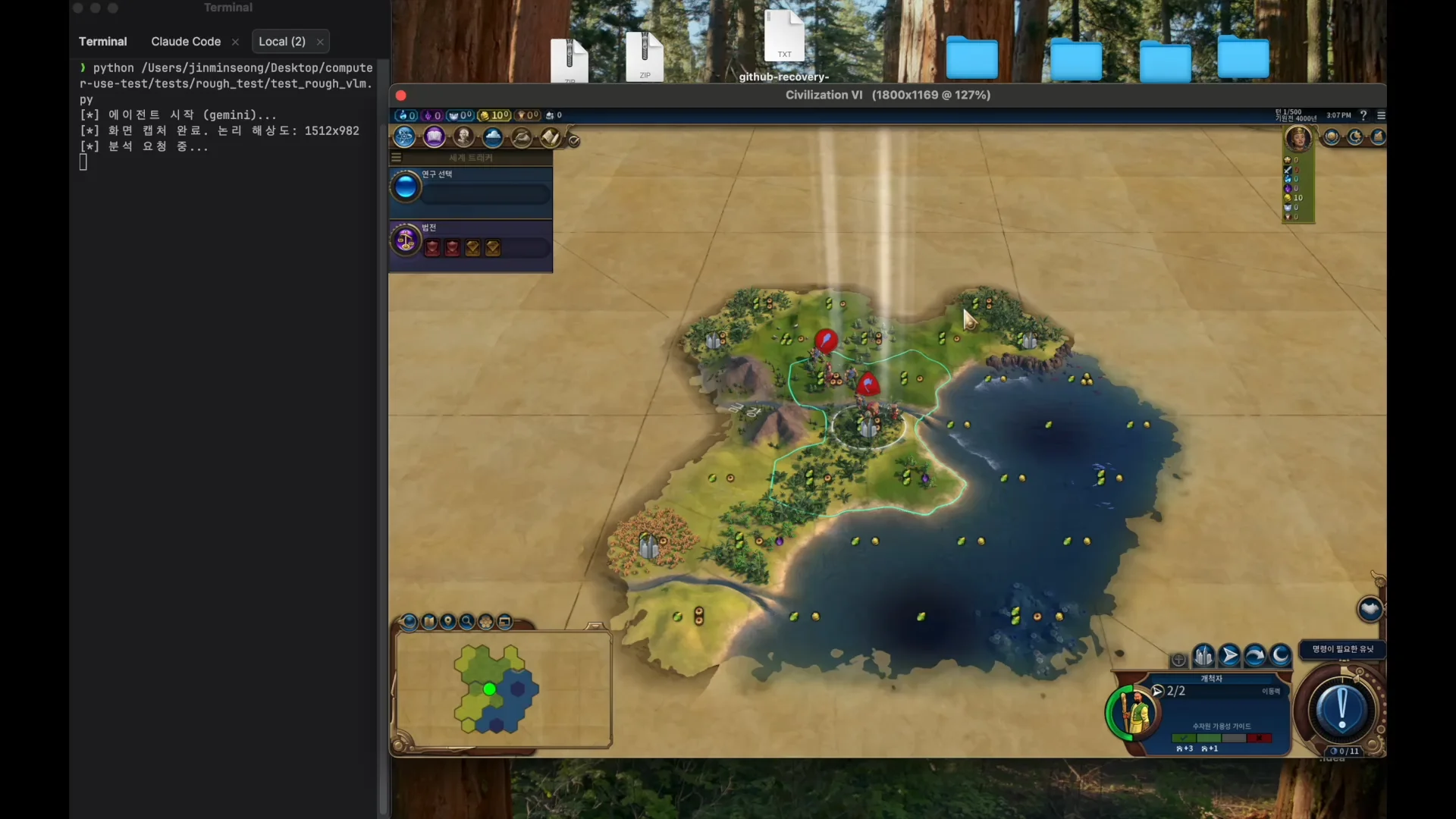
That screenshot is the research path in miniature: a language model staring at pixels, issuing clicks, and hoping long-horizon strategy emerges. CivRealm reports the same pattern in language-based agents — strong at economic expansion, weak at noticing the invasion that ends the game.
RAND analysis of agentic strategy adds a further warning. Even models that can recite escalation risks still get pulled into move-and-countermove spirals when they are asked to act as strategists, not quiz-takers. A civilization simulator AI that only maximizes the current crisis will burn the map and still lose.
The market around this problem is growing fast. Generative AI in gaming is projected to expand from $1.79 billion in 2025 to $2.21 billion in 2026. Broader AI in gaming was valued at USD 4.54 billion in 2025. GDC’s 2025 trend briefing put generative AI among the defining forces in game development. More models in games does not automatically mean better rulers, diplomats, or generals.
This is exactly what Civilization was built for.
Why Civilization
Civilization is a standalone AI civilization simulator: you pick an era, take a nation, and play against rivals who want things you do not. Alliances shift. Wars erupt. The world does not pause while you think.
That is a different product from a chatbot that roleplays a king, and a different product from a computer-use agent grinding Civilization VI through a terminal.
| Traditional Approach | Civilization |
|---|---|
| Scripted 4X AI that wins with hidden bonuses, not better strategy | Rivals pursue independent ambitions — diplomacy and war emerge from goals |
| Generic LLM agents that nuke the visible threat and miss the actual victory | Campaign play built around era, nation, and a world that keeps moving |
| Multi-hour or multi-day matches that reset when the session ends | Persistent memory of treaties, wars, and prior decisions |
| Technical computer-use stacks (Python + screen capture + game client) | Open a campaign in a message — no engine, no mods, no API wrangling |
Era, nation, and a world that does not wait
You are not filling out a form. You choose when in history you take power and which people you lead. From that point, every rival is a player with its own trajectory. If you stall, they do not.
Rivals with ambitions, not difficulty sliders
The core loop is political, not mechanical. A neighbor may want your coastline, your faith, or a seat at a future peace table. Because those goals conflict, alliances are temporary and wars have causes. That is closer to how strategic agents actually behave in long-horizon tests than a production bonus on Deity.
Memory that makes history feel like history
A civilization simulator AI is only as good as what it remembers. Prior campaigns, broken treaties, and the last war’s terms should shape the next conversation. This AI keeps that thread so a late-game crisis is not a fresh chat with amnesia.
Prompts that start a campaign, not a tutorial
You do not need a 400-page civilopedia. You need a throne and a problem.
"Start a Bronze Age campaign. I rule a river-valley kingdom with two copper mines and one hostile steppe neighbor. Open with diplomacy, but prepare a levy if they refuse tribute."
"I am a maritime republic in a Renaissance-era archipelago. Rival city-states are forming a trade league without me. Split them without open war."
"Take my current save: I am three eras behind in science, ahead in faith, and my northern rival just denounced me. Give me a ten-turn plan that does not concede the coast."
Related Agents You'll Also Find Useful
If you are already thinking in centuries, these agents sit next to a civilization simulator AI in a natural workflow.
Roleplay Game Master
When you want the same world at street level — a court intrigue, a frontier garrison, a merchant convoy — Roleplay Game Master runs immersive scenes with consistent characters and unlimited memory.
- Any scenario, any tone, without breaking character
- Long-running casts that remember prior sessions
- A natural follow-on when a campaign beat deserves a scene, not a map
Alternate Historian
Before you found a nation, stress-test the timeline. Alternate Historian turns “what if” into causal chains — useful for setting victory conditions, casus belli, and the political weather of your era.
- Bold counterfactuals instead of textbook summaries
- Cause-and-effect reasoning across wars, trade, and institutions
- World-systems framing that maps cleanly onto campaign goals
Military & Defense Analyst
When a campaign turns on force design rather than flavor, this analyst brings doctrine, wargaming, and force assessment at a serious standard — the kind of thinking a late-game war actually requires.
- Strategy and doctrine, not just unit lists
- Wargaming and force-on-force assessment
- Defense-industry and capability context when your “tech tree” needs realism
Try Civilization free — no credit card required.
How It Works
Step 1: Claim an era and a nation Open Civilization and state when you rule and who you are. Specificity is leverage: geography, resources, and neighbors give the AI something to push against.
"Classical Mediterranean. I lead a hill-fort people with excellent iron, no navy, and a richer coastal empire to the south. I want survival first, hegemony later."
Step 2: Declare what winning means Civilization games have many victory paths. Say whether you care about faith, trade, conquest, or prestige so rivals can oppose the plan you actually have — not a generic score race.
"I will not pursue domination. I want a cultural and diplomatic settlement by the Industrial era. Punish anyone who blockades my ports."
Step 3: Play the turn as a decision, not a menu Ask for the crisis, the hidden risk, and the move. This is where generic agents fail: they fixate on one threat. Demand the second-order problem — the diplomatic clock, the famine, the rival you are not looking at.
"End of turn 40. Summarize each rival’s likely victory path, then recommend one military move and one diplomatic move. Flag the threat I am probably ignoring."
Step 4: Let consequences compound Bring the last war, the last treaty, and the last insult back into the next session. The simulator should treat history as state, not as flavor text.
"Resume yesterday’s campaign. They broke the grain embargo. I want options that hurt their coalition without giving the inland empire a pretext to intervene."
Step 5: Continue on the device you have A campaign that only lives on a desktop is a campaign you will abandon. Pick the thread up on your phone between meetings; the rivals will not pause out of courtesy.
Results & Use Cases
📊 Counterfactual empire: what if your coast never fell
Scenario: You want to replay a historical collapse — a Bronze Age palace economy, a steppe confederation, a colonial periphery — and test a different first century of decisions.
Traditional Approach: Load a historical scenario in a 4X title, fight the scripted AI, and hope the difficulty slider substitutes for politics. Or spend an evening prompting a general chatbot that forgets the treaty you signed yesterday.
Civilization: You name the era, the nation, and the wound in the timeline. Rivals pursue their own recovery. Pair the setup with Alternate Historian if you want the causal chain before you take the throne.
- Era-true constraints instead of a generic map
- Opposition that has goals, not just bonuses
- A campaign you can resume without re-explaining the century
💼 Staff-level wargame for a messy coalition war
Scenario: You are practicing multi-front thinking — two allies you do not trust, a navy you cannot afford, and a rival racing a different victory condition.
Traditional Approach: Tabletop hours, or a Civ VI match where the AI still leans on combat and economic padding at higher difficulties rather than true coalition play. Research agents, as CivBench showed, may spend fifty turns on the wrong instrument of power.
Civilization: You brief the situation in plain language and get pressure from every direction. When the order of battle matters, bring in Military & Defense Analyst for doctrine and force design, then return to the throne.
- Multiple victory clocks visible at once
- Diplomacy as a weapon, not a menu of gold trades
- After-action memory so the next war inherits the last one
📱 Ten-minute mobile session on a live campaign
Scenario: You are on a train. Your northern rival denounced you six hours ago. You have time for one decision, not a two-hour turn.
Traditional Approach: A laptop, a loaded save, and a UI built for a desk. Or a computer-use agent that needs a running game client, a Python process, and a captured framebuffer — the workflow in the screenshot above.
Civilization: You open the campaign on your phone, ask for the one move that changes the next decade, and close it. The world is still there after dinner.
- Full campaign continuity on iOS and Android
- Decision-sized sessions instead of evening-sized matches
- No mods, overlays, or screen-control agents required
🎯 Design a living court, then zoom in
Scenario: The map is not enough. You want the treaty signing, the succession crisis, the general who might not obey.
Traditional Approach: Switch tools, lose continuity, and rebuild the cast.
Civilization + Roleplay Game Master: Resolve the strategic beat in the simulator, then drop into the room where it happens. Characters stay consistent; the campaign remains the source of truth.
- Strategy layer and scene layer without a new universe
- Memory across both the map and the court
- Useful for writers, GMs, and players who think in both scales
FAQ
What is a civilization simulator AI?
A civilization simulator AI is software that lets you rule a people through time against opponents who plan, bargain, and fight with their own objectives. Civilization is built for that loop: era, nation, rivals, and a world that continues when you look away. It is not a pixel-driver for an existing 4X client, and it is not a trivia bot about historical dates.
Is Civilization free to try?
Yes. You can start a campaign without a credit card. Usage scales with optional paid tiers if you run long, frequent sessions. The important part for a civilization simulator AI is continuity — you should be able to found a nation on the free tier and learn whether the rivals feel alive before you commit.
How is this different from Civilization VI or a computer-use agent?
Civilization VI is a brilliant board. Most of its AI still leans on bonuses, and research agents that play it through APIs or screen control — Civ6 tool servers, CivAgent, CivRealm — remain experimental. They can misread victory conditions, as CivBench’s nuclear episode showed. This product is the campaign itself: you rule, rivals scheme, history moves.
Does a civilization simulator AI work on mobile?
Yes. Play on the web, iPhone, or Android with the same campaign thread. That matters because civilization play is a long game; if it only fits a desktop evening, most campaigns die at turn twenty. A mobile session should be a real decision, not a stripped-down demo.
Can I play a specific historical era?
That is the intended starting move. Name the era, the geography, and the political problem. The more concrete the brief, the more the rivals have to work with. If you need a sharper counterfactual first, sketch it with Alternate Historian, then take the throne.
Will the AI actually play strategically?
Dedicated campaign design beats a general model dropped into a hex grid. Benchmarks keep showing the failure mode: language agents expand the economy and miss the raid; strategy agents escalate past the win they already had. Civilization is scoped to era-scale rule and rival ambition so those second-order threats stay in the room. It is still a simulation — demand the hidden risk every few turns.
Rule a Nation That Pushes Back
A civilization simulator AI is only worth launching if the other players want something. Scripted 4X opponents pad their yields. Computer-use agents click through Civilization VI and still lose the victory they never noticed. CivRealm and CivBench are clear on the research record: long-horizon civilization play is still hard.
Civilization is the other path. Choose an era. Rule a nation. Meet rivals who do not wait. Alliances will shift, wars will erupt, and the map will remember what you did.
Try Civilization now. Explore more at Jenova.
For Developers: Civilization is available programmatically via the Jenova API — integrate era-scale nation play and rival-driven campaigns into your application with a single API call. Full documentation →