AI Civilization Game: Command Empires and Rewrite History
2026-08-28
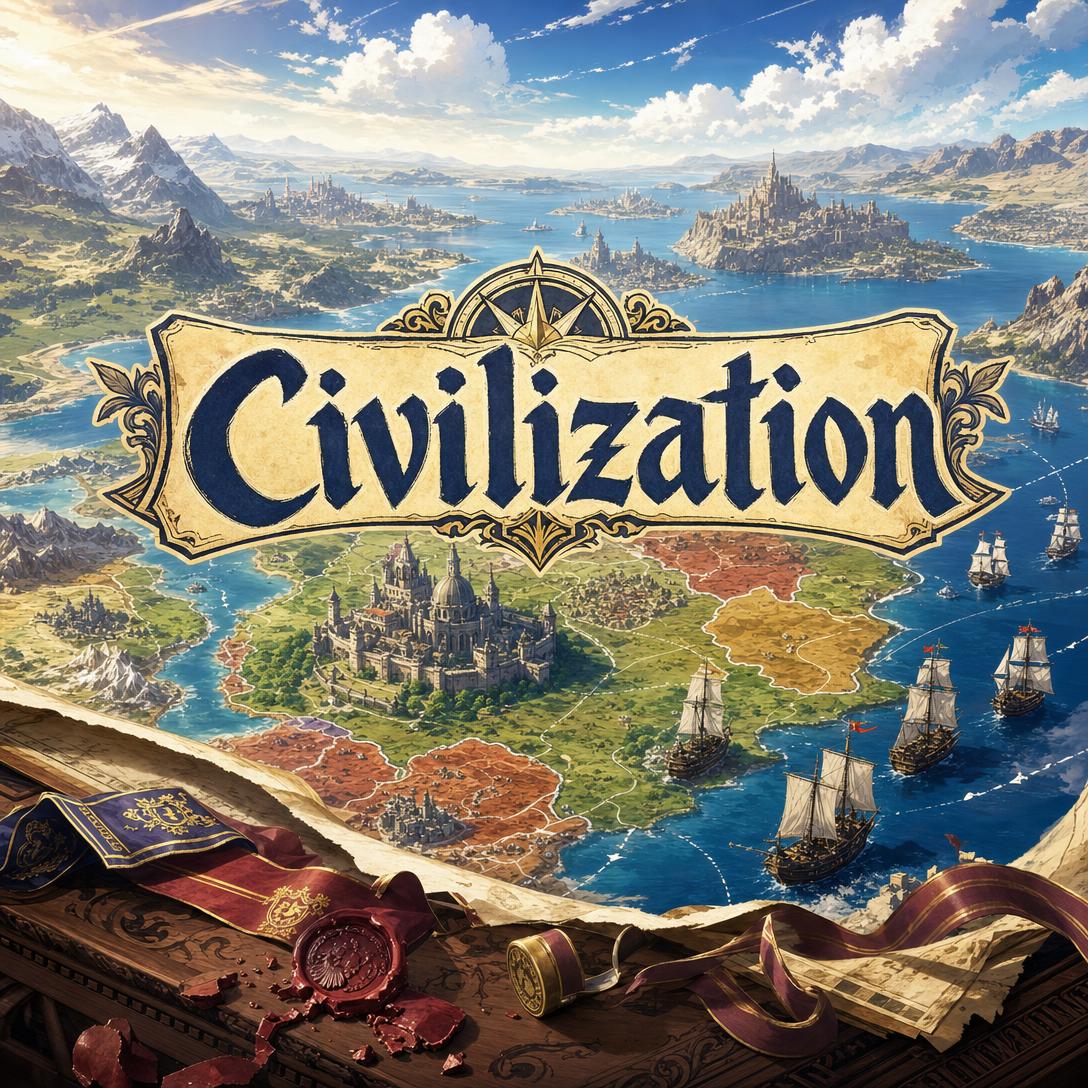
Civilization puts you on a real throne, in a real historical era, then lets the timeline split. You rule one month at a time through a living court: generals argue over winter campaigns, chancellors stall for better terms, and rival empires march whether you are watching or not. There is no scripted campaign and no guaranteed victory. You can conquer, trade, ally, or simply survive — and you can lose the country to invasion, revolution, or coup.
✅ Alternate-history grand strategy that starts from real conditions and diverges from the first month ✅ A world that acts every turn — every rival nation pursues its own agenda ✅ Fog of war through advisors, spies, merchants, and rumors, never a god’s-eye map ✅ Full play on web, iOS, and Android, with a free tier to begin a first reign
To see why that design matters, it helps to look at how strategy players actually spend their time — and why so many historical simulations still pause the planet until the next click.
Quick Answer: What Is Civilization?
Civilization is an AI grand strategy game that simulates alternate history one month at a time, with rival nations acting on their own while you rule. You issue orders; the world decides what actually happens.
Key capabilities:
- Era, nation, and ruler selection, then an emergent world built from real starting conditions
- Monthly turns covering war, diplomacy, trade, espionage, technology, and internal unrest
- Independent AI nations that ally, betray, overextend, and blunder
- Real loss conditions: conquest of the capital, coup, revolution, or forced abdication
Gameplay & Features
Demand for deep strategy is not a niche hobby. The online strategy games market reached USD 23.45 billion in 2026 and is forecast to grow at a 9.39% CAGR through 2031. Inside that market, MMO and 4X modes held 40.20% of 2025 revenue — the slice most associated with persistent maps, long campaigns, and territorial competition.
USD 23.45 billion — Online strategy games market size in 2026
Most of those games still treat other countries as waiting rooms. Civilization is built on the opposite premise: history is already in motion when you enter the chamber, and it keeps moving after you leave.
A Map That Does Not Wait
Every month, every participating nation executes its own agenda — campaigns, treaties, industrial programs, spy rings, succession crises. Quiet powers still generate intelligence: a missing dispatch, an unusual grain purchase, a fleet that should not be where merchants swear it is. Two countries you have never spoken to can go to war over a border province and redraw your entire neighborhood.
That independence is the core loop. Your orders are commands, not cheat codes. An army can be ordered into the Alps in January and still die in the snow. An envoy can be told to extract total surrender and return with a ceasefire and a bruised reputation.
"Napoleonic Europe, 1805. I rule Prussia. Include France, Russia, Austria, Britain, and the Ottoman Empire."
Fog of War, Delivered by a Court
You never receive a spreadsheet of the true world. Information arrives as people: a methodical general at the war map, a chancellor late with a letter, a spymaster who speaks after the others have gone. Advisors disagree in front of you, carry biases, remember past arguments, and can be wrong. They can also resign, die, or be replaced — and the next voice in that chair will not sound like the last.
Reliability scales with what you invest. Border patrols see nearby forts. Trade networks reveal odd shipments. Espionage, built over months, can uncover a secret negotiation — or feed you a lie planted by someone else’s counter-spies. Neglect a direction long enough and a nation’s stance decays into rumor.
"Send an envoy to Britain, reinforce the southern border, and raise a modest war tax. I want the chancellor and the treasurer in the same room when they object."
War, Bread, and the Possibility of Defeat
Military campaigns play out across seasons, not combat rounds. Quality, supply, terrain, weather, leadership, and luck all matter, and front-line reports are estimates dressed as certainty. A “glorious victory” can arrive two months before the casualty lists. Navies blockade, raid, and decide wars as surely as field armies when the era allows it.
The economy is qualitative and unforgiving. Prolonged war strains treasuries, inflates prices, and starves reform. Roads, ports, canals, and later railways take months or years and then change what an army can even attempt. Occupied provinces do not become loyal because a color flipped on a map.
Stability is the internal health of the reign. Unpopular conscription, famine, religious shock, and a string of defeats can move a supportive populace toward protests, draft resistance, coup whispers, and open revolt. Decline is fast. Recovery is slow. Collapse is a multi-month fight for survival, not an instant game-over screen — until it is.
You can lose. Occupation of the capital, a generals’ coup, a popular revolution, or a court that demands abdication will end the reign. Afterward, the record of the age is laid out: hidden objectives, missed warnings, and the month the timeline actually broke.
Alternate History With Cause, Not Magic
The opening month is historical. After that, Germany can win in the east, a minor power can industrialize, a dynasty can fall decades early. Divergences have to be physically and technologically plausible for the era, and they announce themselves in fragments — iron shipments, evasive envoys, a rifle that outranges yours by three hundred yards — before the map looks unrecognizable.
If you want to pressure-test the “what if” before you sit the throne, Alternate Historian is the natural companion: causal chains, world-systems thinking, and opinionated timelines you can then attempt to live through in play.
"I am a custom ruler: Empress Meihua of a reforming Qing court, committed to naval yards over new banner armies."
How to Play
Step 1: Choose an Era, a Nation, and Your Rivals
A new campaign opens like the first page of a chronicle, not a settings menu. You pick a period, the country you will rule, and the other powers that will inhabit the board. Four to seven rivals usually produce the richest diplomacy; fewer keeps the age intimate; more turns the month into a crowded congress.
Name the region when the era is ambiguous — an Age of Exploration can be Atlantic, Pacific, or planetary. The simulation will not start until era, your nation, and at least one other country are set.
"Late Warring States, 260 BCE. I rule Qin. The others are Zhao, Chu, Qi, Yan, Han, and Wei."
Step 2: Take the Throne
Once the cast of nations is fixed, you become someone. Historical rulers from that country and year are offered with a line of reputation — reformer, martinet, diplomat, zealot — or you define a custom name, title, and governing philosophy. This is not flavor text. It shapes how foreign courts address you and how your own advisors first judge your nerve.
The opening audience is long on purpose. You meet the capital in a specific season, hear advisors as characters rather than tooltips, and inherit at least one problem already on fire. Someone will disagree about what to do with it.
Step 3: Issue Orders, Then Live With the Month
Each turn is one month. You may give a single decisive command or a bundle of administrative orders — raise a levy, open a grain corridor, instruct a spy ring, refuse a marriage, start a foundry. Work that cannot finish in thirty days is begun, with progress reported and a completion you can plan around.
You cannot skip seasons. “Fast-forward to the peace treaty” is not a royal prerogative. What has been narrated — a lost battle, a signed clause, a betrayal — stands.
"March the Army of Silesia toward Dresden, but do not cross the Saxon frontier until we know where the French magazines actually are."
Step 4: Read the World, Not a Score
A month returns as a court day: how your orders played out, what happened at home, then a world report in which every other nation appears. Belligerents get dispatches and conflicting casualty claims. Distant neutrals arrive as merchant talk or an unsettling silence.
End-of-month tension is the hook. Something unresolved is already moving toward you. Issue the next orders, or watch the window close.
Try the simulation free — no credit card required.
Scenarios & Modes
🏰 The Coalition Winter
Scenario: You rule Prussia in 1806. France is hostile, the Ottoman fleet is a rumor with too many sails, and Britain has offered mediation that your general calls a stalling tactic.
On a paused 4X map: You would optimize a tech queue, park stacks on a front, and wait. Other countries would largely wait with you.
In this grand strategy game: The month advances whether your answer is brilliant or late. Advisors split in the chamber — concentrate in Saxony, buy time with London, or strip the eastern border to feed a single army. A “friendly” partner may already be talking to your enemy. Two or three turns of evasive envoys and odd naval traffic are all the warning you may get.
- Wars last seasons, not clicks
- Reputation for broken treaties follows you into every other capital
- Overextension creates rebellions in the provinces you just dyed your color
⚔️ River Kingdoms, Shared Knives
Scenario: Shu Han in winter, 208 CE. A massive northern army is months from Jing Province. An alliance with a wary river power is the only math that works, and your most loyal general despises the idea.
What you play: Court argument as strategy. One advisor treats the alliance as survival; another would rather fortify and dare the north to drown. The northern warlord is building a fleet you cannot see. A western neighbor has gone quiet long enough to become unknown in all but name.
This is the pleasure of incomplete information. You are not solving a puzzle with a published solution. You are choosing whom to trust while the rivers freeze.
If the political knife-work is what you came for — mapping incentives, reading a weak coalition, designing a campaign of favors and threats — Machiavelli Mentor is a sharp companion between sessions, then you return to the throne and test whether the theory survives contact.
📱 A Reign on the Train Home
Scenario: You have twelve minutes on a phone. Last month you ordered a canal and a cautious levy. This month a merchant swears a rival is buying twice the usual iron, and your spymaster wants money for a network that will not mature until spring.
Traditional long-session grand strategy: A desktop evening, a UI of ledgers, a save file you are afraid to abandon.
Civilization: One month is a complete dramatic unit. Issue two or three orders in a sitting, read the court, stop. Mobile already accounted for 47.10% of online strategy revenue in 2025, and this design fits that habit: deep play without a three-hour map trance. Web, iOS, and Android stay in sync, so the same reign continues at a desk later.
- Monthly turns match stolen time
- Memory of the campaign persists — advisors remember who ignored them
- Quiet months still matter: a finished road, an offhand rumor, a chancellor who was right
📜 Classroom Curiosity, After Hours
Historical games are not only entertainment. Educators have argued for years that well-framed play can raise interest in history and support historical thinking, and European history-teaching networks have made the same case for video games as a serious learning medium. Projects such as Feather River College’s Games in History Education exist specifically to put eras into playable form.
This simulation is not a textbook and does not pretend to be one. It is a pressure chamber for decisions: Why did coalitions form? What did logistics actually forbid? Where did legitimacy come from when the harvest failed?
When a campaign makes you hungry for the real record — the documents, the historiography, the argument about causes — History Tutor is the place to unpack the era you just bent, from first questions through graduate-level debate.
FAQ
What is the Civilization AI game?
Civilization is a narrative grand strategy game of alternate history. You select an era, a nation, and a ruler, then govern month by month through a court of biased advisors while every other country pursues its own strategy. The opening conditions are historical. The rest is earned — or lost — in play, including the genuine possibility that your reign ends.
Is Civilization free to play?
Yes. You can start a reign on the free tier with no credit card. Higher plans expand monthly usage if a long campaign, a crowded board of nations, or frequent replay is your habit. Pricing is subscription-based rather than a box copy: Free, Plus at $20/month, and further tiers above that, with usage resetting each billing cycle.
How is this different from classic 4X or map-based grand strategy?
Map 4X and many grand strategy titles center production queues, visible stats, and a world that largely waits on the player. This game centers a court briefing, fog of war, and rival nations that act first. There is no victory score. Dominance creates rebellions, overextension, and new enemies. Combat is a campaign narrative constrained by supply and season, not a resolved equation. If you want ledgers and moddable maps, those remain a different genre; if you want to be the ruler who might be wrong, this is the brief.
Can you actually lose?
Yes. Loss is a slow tightening over several months, not a single unlucky roll. Paths include military occupation of your core, a coup after stability collapses, a popular revolution, or a court that demands you step down. After the reign ends, a debrief reveals hidden alliances, planted intelligence, and the turning point you missed.
Does Civilization work on mobile?
Yes. Play on the web, iPhone, and Android with the same reign, the same memory of past months, and the same speech-to-text if you prefer to dictate orders. A month of court business is a natural mobile session; a crisis month is still readable without a mouse and a twenty-inch map.
How historically accurate is the simulation?
The first month is anchored in real relationships, forces, and constraints for the era you chose. After that, accuracy means internal consistency and technological plausibility, not a railroad back to the textbook ending. Advisors can misread the room. Your intelligence can be incomplete. Treat it as serious historical fiction you inhabit, then verify the real past with a tutor or a library when the divergence makes you curious.
Conclusion
Most strategy games give you a map and wait. Civilization gives you a court, a month, and a planet that does not care whether you are ready. You pick an era and a crown. Rival nations scheme in the next room. Fog of war turns every alliance into a bet, and a bad winter can end a dynasty as surely as a lost battle.
If you want grand strategy as alternate history — not a puzzle with a wiki solution — sit the throne, issue the orders you can afford, and read what the world did anyway.
Try Civilization now. Explore more at Jenova.
For Developers: Civilization is available programmatically via the Jenova API — integrate alternate-history grand strategy simulation into your application with a single API call. Full documentation →