Choose Your Own Adventure Creator: AI Branching Story Builder
2026-09-08
Game Designer Assistant helps you ship a complete choose-your-own-adventure story by turning a premise into mapped branches, documented consequences, and scene-ready copy. While most interactive stories stall in tangled flowcharts and untested endings, this AI gives you a working design system you can actually write against. In September 2026, writers, teachers, and indie designers want branching fiction without learning a game engine first.
✅ Maps choice nodes, flags, fail states, and endings before you draft prose ✅ Audits orphaned paths, false choices, and unwinnable loops ✅ Writes scene text and choice labels that match a defined player fantasy ✅ Packages documentation you can take into Twine, Book Creator, print, or the web
To understand why a dedicated choose your own adventure creator matters, it helps to look at how branching stories actually break — and why a generic chatbot is a poor substitute for a game-design partner.
Quick Answer: What Is a Choose Your Own Adventure Creator?
A choose your own adventure creator is a design tool that maps branching plots, player choices, and multiple endings so you can build playable interactive fiction without assembling the story architecture by hand. Game Designer Assistant fills that role for writers who need systems thinking, not just more paragraphs.
Key capabilities:
- Branch maps with decision points, consequences, and replay paths
- Scene copy and choice text that keep agency real, not cosmetic
- Systems notes for inventory, flags, timed events, and fail states
- Genre-aware structure for mystery, horror, romance, classroom stories, and training scenarios
- Documentation you can hand to an illustrator, a class, or an engine
Why Most Branching Stories Never Get Finished
Interactive fiction is not a linear novel with extra buttons. Research on classic CYOA-style books isolates the mechanics that make the form work: decision points, reader agency, consequences of choices, multiple storylines, and replay-ability. Miss any one of those, and the “adventure” collapses into a slideshow.
The form is also older — and harder — than it looks. Interactive fiction dominated the 1980s game industry as text adventures, then evolved through hypertext, Twine, and web-based storygames. Digital fiction scholars describe the current landscape as multimodal, collaborative, and participatory — which is exciting for readers and punishing for a solo author staring at a blank passage list.
But getting from a cool premise to a playable branch map is frustratingly difficult:
- Combinatorial explosion — two choices per scene become dozens of endings you never wrote
- False agency — options that sound different and lead to the same paragraph
- State tracking — keys, alliances, injuries, and timers that the draft forgets
- Implementation tax — learning Twine, Ink, ChoiceScript, or a classroom app before the story is even stable
- Playtest blindness — authors cannot hold every path in working memory
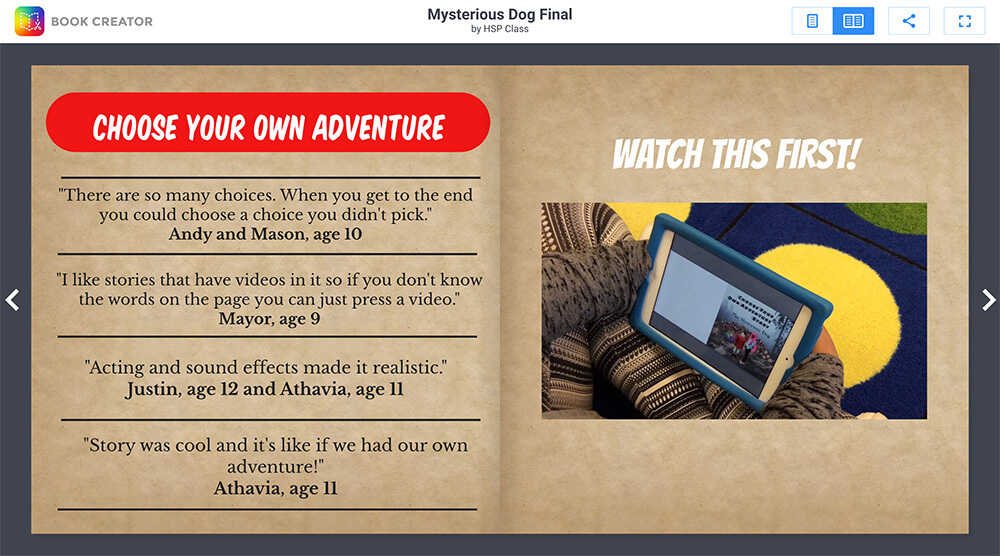
Classroom CYOA projects make the gap obvious. Students praise choice, embedded video, and sound effects — then the teacher still has to design every fork so those features serve the plot instead of decorating a linear tale.
The outline dies in the flowchart
A branching story is a system. You need nodes, edges, endings, and the flags that connect them. Paper charts go stale the moment you add a third ending. Spreadsheet maps help until a late twist rewires chapter two. Interactive storytelling research treats computer systems as a narrative medium, not a place to paste a novel. If the map is wrong, prettier prose will not save it.
Tools that play the story do not design it
Twine, Book Creator, and web templates are excellent players and publishers. They are weaker designers. You still invent the topology: how many endings, which choices are traps, when to gate a scene, how to make rereads worth it. Indie experiments like command-line CYOA engines show the same split —
.Education and training raised the stakes
Branching narrative is no longer only a bookstore gimmick. Digital-fiction workshops report that students working in digital media show significantly increased engagement — and also that technical know-how and weak institutional support still block production. Workplace learning teams use branching scenario tools so choices have consequences in a safe space, because a slide deck does not build procedural memory. Teachers and L&D designers need a choose your own adventure creator that thinks in outcomes, not just chapters.
This is exactly what Game Designer Assistant was built for.
Why Game Designer Assistant Works as a Choose Your Own Adventure Creator
Game Designer Assistant is a standalone game-design partner. You bring a premise, a player fantasy, and constraints (length, age range, platform, number of endings). It returns structure: systems analysis, branch documentation, scene lists, and concept direction you can implement anywhere.
That order matters. Most people open a passage editor and start writing “You stand in a hallway.” A CYOA creator should first ask what the player is deciding about, what can be lost, and which endings are actually distinct.
| Traditional Approach | Game Designer Assistant |
|---|---|
| Draw a flowchart, then discover a missing ending on page 40 | Specify endings and fail states first, then fill nodes |
| Write passages before flags exist | Document inventory, relationships, and timers as a system |
| Cosmetic choices that reconverge immediately | Choice audits that flag agency that does not change state |
| Learn an engine in order to outline | Engine-agnostic design docs for Twine, print, web, or class apps |
| Playtest every path yourself | Structured path reviews for orphans, softlocks, and dead humor |
| Art and UI as an afterthought | Concept-art notes tied to scenes and set pieces |
Branch architecture before prose
Ask for a node map with a hard budget: 12 passages, 3 endings, 1 timed gate, no false choices. The assistant treats that like a systems problem — fan-out, reconvergence, and replay hooks — instead of a request for more atmosphere. You get a skeleton you can argue with, which is the only way a branching plot stays small enough to finish.
Choice text that carries consequences
CYOA fails when option A is “be brave” and option B is “be smart” and both dump the reader into the same room. Here the work is mechanical: each option must change a flag, spend a resource, close a path, or reveal information the other option withholds. Classic interactive storytelling depends on consequences, not decoration.
"Design a lighthouse mystery CYOA. Player is the night clerk. Three mutually exclusive endings: escape with the logbook, become the new keeper, or vanish. No cosmetic choices. List every node, flag, and fail state."
Documentation you can hand to a class, artist, or engine
Teachers building multimedia books, writers targeting the web, and designers packing a jam game all need the same artifact: a readable design bible. Passage IDs, choice labels, trigger conditions, and ending criteria travel into Book Creator, Twine, or a custom page. Digital fiction loses aesthetic function if you strip it from its medium — so the output names the medium (tablet classroom book, browser ordeal, print maze) instead of pretending every CYOA is the same object.
"Turn this premise into a teacher-facing branch map for ages 9–12: a missing dog, two red herrings, embedded ‘watch this first’ video beats, and a fair ending if the reader rereads once."
Genre literacy across platforms
Interactive fiction now sits inside a wider set of digital narrative genres — hypertext, web stories, transmedia, and playable fiction. Horror CYOA needs unfair-feeling-but-fair information. Romance CYOA needs relationship flags that cannot be maxed by grinding “be nice.” Training CYOA needs the wrong procedure to look tempting. The assistant is a game designer, so those constraints show up as rules, not vibes.
"Audit this 8-node office fire-response adventure. Every wrong choice must teach a procedure. No instant-death gotchas. Mark where a reread should feel smarter, not longer."
Related Agents You'll Also Find Useful
If you are building a CYOA, you rarely need only a branch map. Dialogue, names, playtesting, and panels are the next bottlenecks. These agents sit on the same desk.
Film Screenwriter
If the map is solid but scenes thud, Film Screenwriter turns nodes into dramatic beats: objective, obstacle, button, visual business. CYOA choice lines are just dialogue with a UI. Use it when a passage needs conflict you can film in your head, not a paragraph of inventory.
- Scene objectives tied to a single player decision
- Dialogue that makes both options feel in-character
- Revision passes that cut explanation the branch map already covers
Name Generator
Branching worlds multiply proper nouns. A coastal mystery cannot reuse “Old Man” across four endings. Name Generator produces culturally grounded names for people, vessels, streets, and artifacts so each path feels like it belongs to one setting.
- Character and place names with linguistic consistency
- Item and faction labels that stay readable in choice buttons
- Avoids the “Generic Innkeeper #3” problem that breaks immersion on reread
Roleplay Game Master
Design is not playtest. Roleplay Game Master runs the adventure as a player with memory, so you can walk Ending B without holding the whole tree in your head. Inconsistencies in voice, rewards, and “I thought I had the key” moments surface immediately.
- Full-path playthroughs with persistent state
- Stress tests for unfair difficulty and joke endings
- Notes on where a reader would rage-quit versus reread
Comic Creator
Illustrated CYOA — classroom books, webtoon-style forks, print maze comics — needs panels that still make sense when the reader skipped a scene. Comic Creator plans sequential art around optional pages so a missed branch does not orphan a visual continuity.
- Page plans that survive skipped nodes
- Choice UI treated as part of the layout, not a caption afterthought
- Style bibles so Ending A and Ending C look like one book
Try Game Designer Assistant free — no credit card required.
How to Build a CYOA With an AI Design Partner
Each step below is a complete action. Do them in order. Skip the engine until step 4.
Step 1: Lock the player fantasy and the ending set State who the reader is, what they want, and how many endings you will actually write. A CYOA with “lots of choices” and one real climax is a linear story. Give a numeric budget.
"Player is a junior ranger in a flooded visitor center. Fantasy: competent under pressure. Exactly three endings — evacuate the group, save the archive, or stay with the injured fox — and one joke fail. Age 10+. 15 minutes to play."
Step 2: Map nodes, flags, and reconvergence Ask for a passage list with IDs, incoming links, outgoing choices, and the state each choice writes. Force reconvergence so you are not drafting 40 unique rooms. This is the choose your own adventure creator job: topology, not adjectives.
"Produce a 14-passage map. Max two choices per node. Two flags:
has_radioandtrusts_guide. Reconvergence after the boathouse. Call out any cosmetic choice."
Step 3: Write passages and choice labels against the map Draft only after IDs exist. Choice text should preview cost (“Leave the radio”, “Spend the last flare”), not moral slogans. If a line needs subtext, pull in scene craft from a screenwriter pass, then paste it back onto the node.
"Write passage L4 (boathouse) at 80–100 words. Choice A spends
has_radio. Choice B spends time and setsflood_rising. No recap of things the player already clicked."
Step 4: Playtest every ending, then pick a publisher Run each ending as a player. Log softlocks, unwinnable items, and jokes that undercut a serious path. Only then choose Book Creator, Twine, print, or a web title screen. Works like Inanimate Alice show how text, sound, images, and small games can share one story — but multimedia on a broken map is still a broken map.
"Play Ending C only, from start to vanish. List every flag you needed. If a required item was missable without warning, patch the map, do not patch the prose."
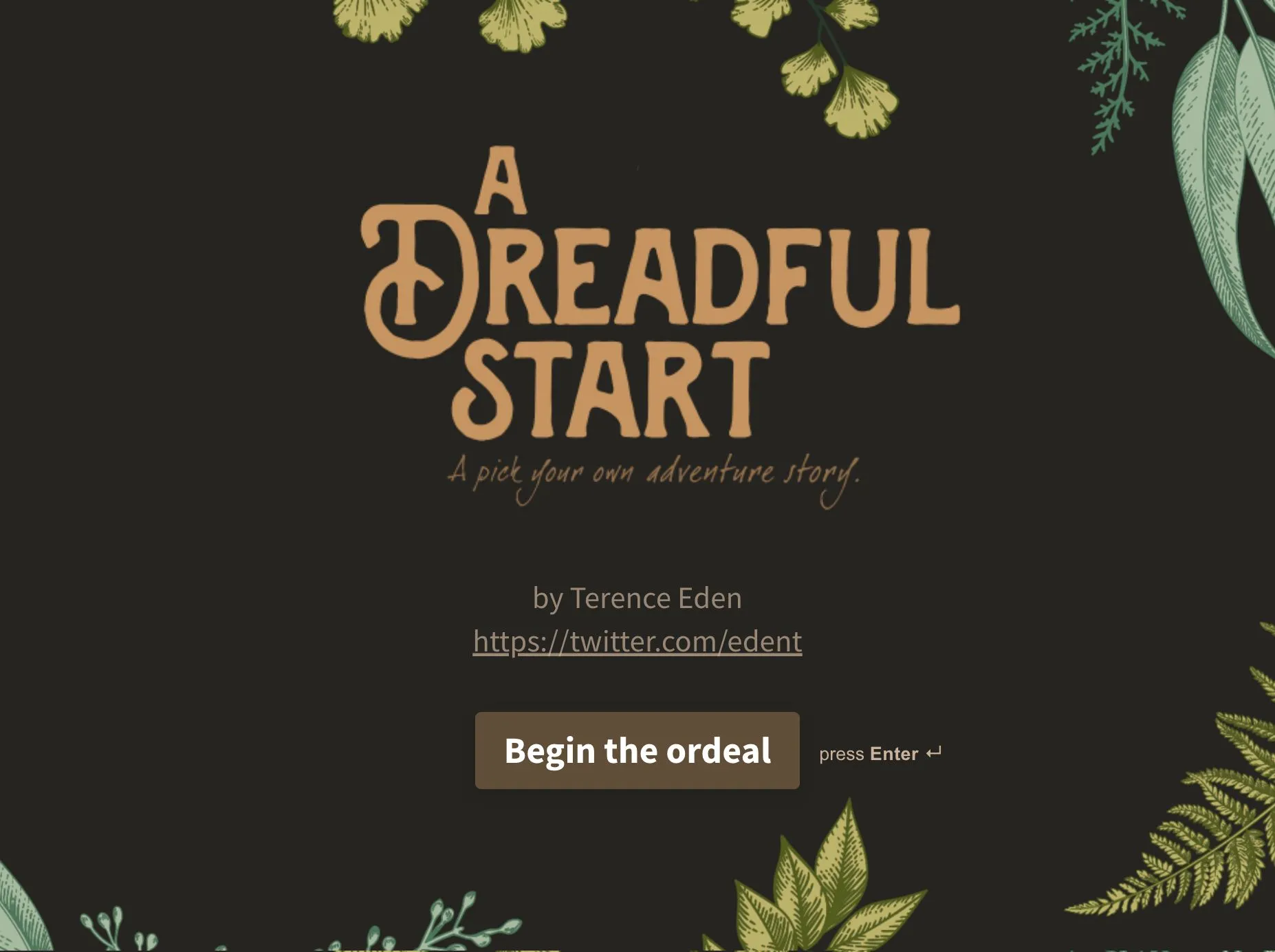
A browser ordeal with a single “begin” beat still hides a branch map. Design the ordeal first; the title screen is the last mile.
Results and Use Cases
📊 Classroom mystery book with media beats
- Scenario: A grade 4–6 class wants a “Mysterious Dog” style CYOA with a “watch this first” video, sound effects, and two honest endings.
- Traditional Approach: A teacher storyboards in slides, then rebuilds every fork inside Book Creator after students change the plot in workshop.
- Game Designer Assistant: A 12-node map with video beats marked as gated scenes, plus choice labels kids can act out.
- Fair reread path if the class missed a clue
- Accessibility notes (video as support, not the only way to know a word)
- Exportable passage list for the actual book tool
💼 Safety or onboarding scenario for a team
- Scenario: A warehouse lead needs a 10-minute branching drill: spill, alarm, or injured coworker.
- Traditional Approach: Linear video plus a quiz that never shows why the wrong click was tempting.
- The AI design partner: A decision tree where choices have consequences and the team sees outcomes without real-world risk.
- Wrong answers teach procedure instead of instant-fail humiliation
- Flag tracking for PPE, radio, and evacuation order
- Debrief sheet listing the intended lesson per node
📱 Commute draft of a web horror CYOA
- Scenario: A writer wants a short browser horror — title card, one ordeal, three deaths — drafted on a phone between stops.
- Traditional Approach: Notes app fragments that never become a graph; Twine only happens at a desk.
- Your CYOA design partner: Voice or short typed prompts produce a node list small enough to finish that night.
- 8–10 passages, mobile-readable choice lines
- Ending uniqueness check so Death A ≠ Death B with different adjectives
- Next-day handoff into a web template or Twine
🎯 Tabletop one-shot with real forks
- Scenario: A GM needs a 3-hour mystery that is not a railroad, with two clues that can be missed.
- Traditional Approach: A linear module with “if the party goes left, improvise.”
- Game Designer Assistant + Roleplay Game Master: A branch bible, then a live playtest that holds NPC voices and inventory across paths.
- Missable clues that still allow a harder ending
- NPC agendas that stay consistent when scenes are skipped
- Cut list so the session actually fits three hours
FAQ
What is a choose your own adventure creator?
A choose your own adventure creator is software or a specialist that helps you design branching stories: decision points, consequences, multiple endings, and reread value. Game Designer Assistant focuses on the design layer — maps, flags, choice audits, and scene lists — so you can publish in Twine, a classroom book app, print, or the browser without discovering a missing ending after you have already written 8,000 words.
Is Game Designer Assistant free?
Yes. You can use it on the free tier with core features and limited monthly usage. Paid plans increase usage if you are iterating long maps, generating concept direction, or running many playtest passes. You do not need a credit card to try a first branch map. For most writers, the first useful output is a constrained node list, not a finished commercial game.
How is this different from Twine, Ink, or ChatGPT?
Twine and Ink run interactive fiction; they do not decide whether your graph is fair. A general chatbot will happily write atmospheric passages while losing track of flags. This assistant is a game-design partner: systems analysis, documentation, and genre structure first, prose second. You still pick the engine. The difference is that the story is finishable when you open that engine.
Can I build educational or training CYOA, not just games?
Yes. Branching narrative is used in classrooms and in scenario-based workplace training. Specify age, learning objective, and whether failure should teach or lock. Ask for debrief notes per node. Multimedia — video, audio, images — should be marked as optional supports so a reader who cannot play a clip can still choose well, which is how strong classroom books are designed.
Does a choose your own adventure creator work on mobile?
Yes. You can dictate a premise, receive a passage map, and revise choice labels on a phone or tablet with the same workspace as desktop. That matters because CYOA design is a series of small structural decisions, not one long writing session. Finish the graph on the commute; implement passages later at a keyboard.
Will it output a file I can publish immediately?
It outputs design: maps, flags, passage copy, and production notes. You still place that material into Book Creator, Twine, a web template, or print. That split is intentional. Interactive digital narrative covers hypertext, storygames, and other born-digital forms, and each form has its own compiler. A honest choose your own adventure creator gets the story system right, then lets you publish in the medium you already use.
Finish the Map, Then Write the Adventure
Choose-your-own-adventure stories fail in the graph, not in the adjectives. If choices do not change state, if endings are paletteswaps, if a classroom video is the only way to learn a clue, the reader feels it. A dedicated choose your own adventure creator — Game Designer Assistant — puts systems, flags, and fair agency in place before you spend a weekend on passage 1.
Write the three endings. Cap the node count. Audit the false choices. Then implement wherever your audience already reads: a tablet book, a browser ordeal, a training scenario, a jam game.
Try Game Designer Assistant now. Explore more at Jenova.
For Developers: Game Designer Assistant is available programmatically via the Jenova API — integrate branching-narrative design, choice maps, and interactive-fiction systems into your application with a single API call. Full documentation →