Character Profile Generator: AI Sheets for Stories & Games
2026-09-06
Writing Assistant is an AI character profile generator that turns a role, a look, and one sharp contradiction into a complete sheet — appearance, history, motives, voice, and the facts a novel bible or RPG table actually uses. Random tools dump hair color next to a hobby and call it a person. This AI builds a profile whose class, faction, and backstory agree with each other. In September 2026, writers and game masters still lose hours to empty NPCs and leads who change eye color between chapters.
✅ Interlocking bios instead of disconnected form fields ✅ Appearance, occupation, faction, languages, and voice in one pass ✅ Sheets you can drop into a novel bible, comic OC, or TTRPG session ✅ Fast enough for a shopkeeper you need before the party walks in
A usable character profile is not a pile of labels. It is a person whose numbers, history, and speech all point the same way. To see why that is hard to fake, it helps to look at what most generators still produce.
Quick Answer: What Is a Character Profile Generator?
A character profile generator is an AI writing tool that builds a complete fictional person — appearance, backstory, motives, voice, and sheet details — so the profile stays consistent on the page or at the table. It is more than a random name plus a hair color.
Key capabilities:
- Assemble a full profile from role, look, and one contradiction
- Align occupation, faction, languages, and stats with the story
- Produce voice, tells, and a sample scene, not just a bio block
- Keep a cast from sharing the same face, diction, and moral line
The Problem With Random Character Profile Generators
Storytellers do not lack forms. Detailed generators promise biographies, important people, and timelines for protagonists in long novels or film series. OC profile tools spit out age, career, MBTI, hobbies, and a paragraph of origin in a single click. Tabletop design still often starts with core stats and skills because those numbers are what the table can grab.
Nearly 40% — Productivity gain generative AI can give highly skilled workers
Ideation help is real. A coherent person is still rare.
But turning a filled form into someone you can write or play is frustratingly difficult:
- Random fields do not constrain each other
- Stats, class, and backstory often describe three different people
- Large casts reuse one face, one diction, and one moral line
- Game masters need a playable NPC now, not after a wiki page
A click-to-generate OC can list blood type, a Capricorn sun, model-train collecting, and “unreasonable skeptical judgmental” in the same breath. That is a mood board, not a profile. Nothing in it tells you how the person stands in a doorway, who they protect, or what they do when money and loyalty collide.
Writers already know the next trap. Duke’s creative writing faculty argue that offloading images and language to a model cedes the work that actually builds skill — which is why a generator that only pastes adjectives is worse than no generator. On the table, archetypal roles get the game started while players are still finding their characters, but they freeze if no second layer exists when the scene turns. Advice for play has long been not to let a character stay static.
Lists cannot hold a portrait, a faction, and a fear in the same place. Dice cannot remember that your elf rogue cooks for the crew and lies to everyone else. That is the job of a character profile generator that writes the connections.
This is exactly what a dedicated AI writing partner is built for.
Why Writing Assistant Builds a Real Character Profile
Writing Assistant treats a profile as one system. You give it a function in the story, a body and social world, and at least one friction point. It returns a sheet you can drop into a chapter, a character bible, or a session — appearance, history, voice, and the mechanical facts if you need them.
It is a writing partner for this job, not a form that shuffles hair color and alignment.
| Traditional Approach | Writing Assistant |
|---|---|
| Random name, job, and hobby on one page | Interlocking look, history, faction, and voice |
| Hours of wiki templates and questionnaires | A usable profile in a single conversation |
| Stats that ignore the backstory | Numbers and skills that follow from the life |
| Every NPC shares the author's default face | Distinct diction, posture, and visual tells |
| A bio that never changes a scene | Stress behavior you can write or play immediately |
From fields to a living sheet
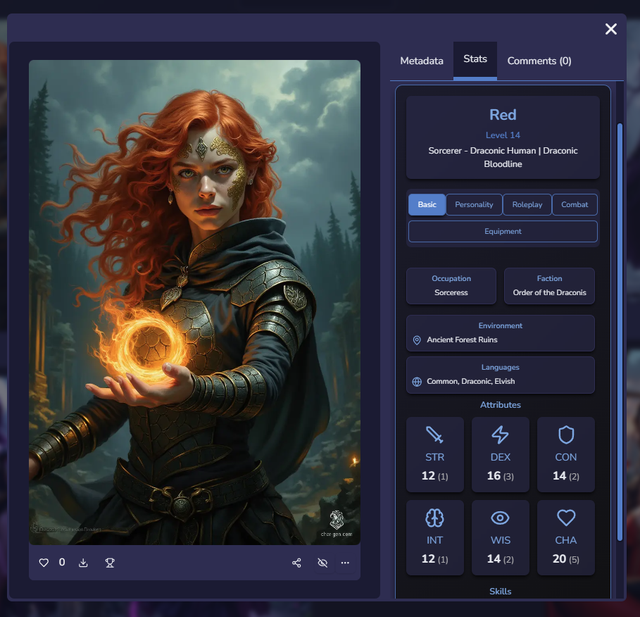
Ask for more than “red hair, sorcerer, chaotic good.” Request how the body, the class, and the faction show up in money, manners, and fear. A Level 14 draconic sorcerer with Charisma 20 and a seat in the Order of the Draconis should not talk like a tavern drunk, and her languages should match the rooms she actually enters. The useful output is the collision: the court mage who still flinches at kitchen fires because that is how the bloodline first showed.
Appearance that earns the stats
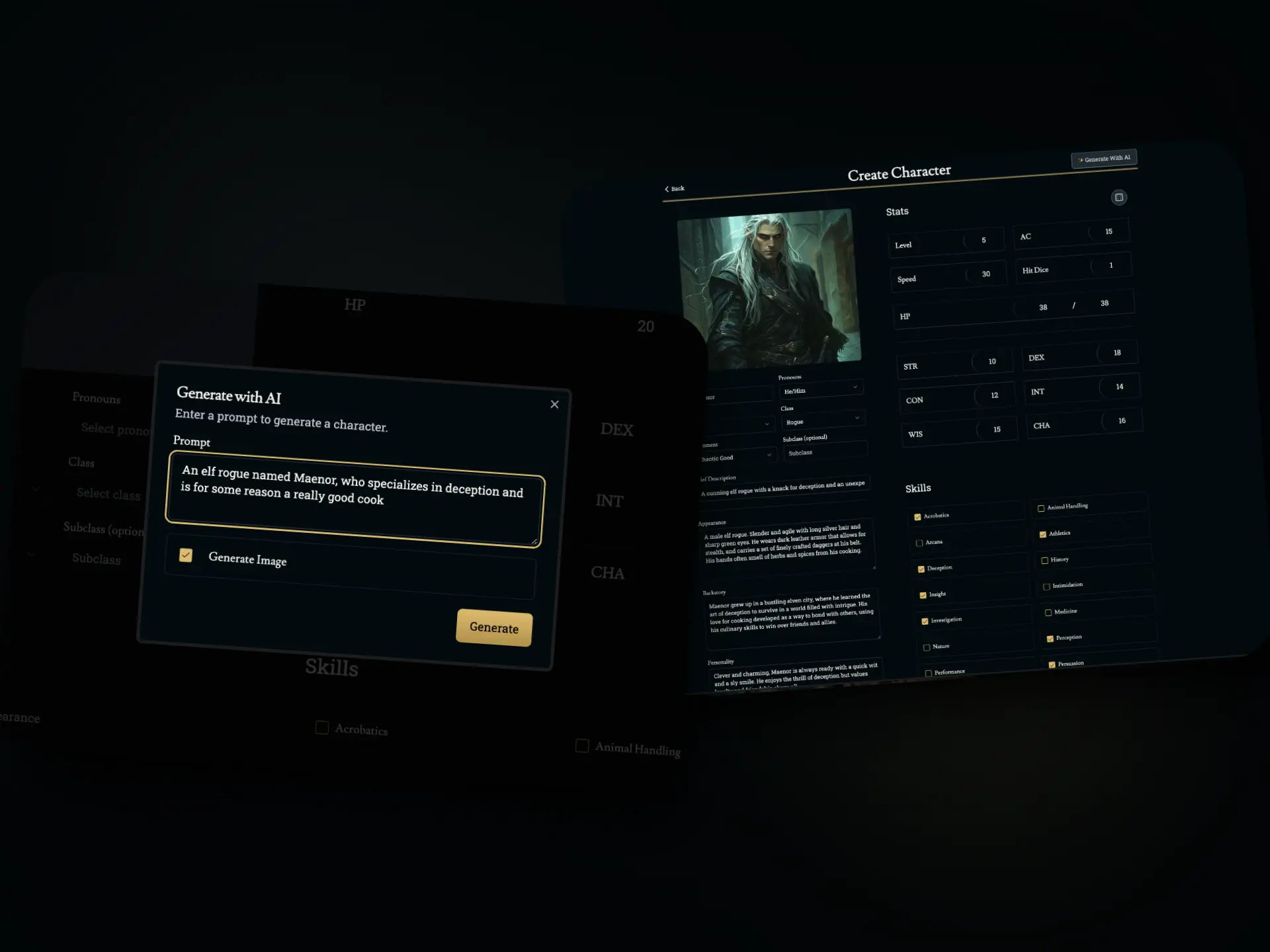
A portrait is wasted if the sheet contradicts it. Long white hair and a cook’s scar on the knuckles should show up in the deception kit and in how the rogue stands at a stove. Ask the generator to justify Strength, Dexterity, and Charisma from biography, not from a wish list. If the numbers and the face disagree, push until they do not.
Voice, faction, and languages in one pass
Personality that never reaches diction will vanish in draft two. Faction that never reaches who they will not betray is flavor text. Ask for oaths, banned words, who taught them Elvish, and the joke they use when they are lying. Supporting casts need this more than protagonists. Readers forgive a slightly generic hero. They will not forgive five side characters who all hedge in the same way.
Cast-scale memory
A novel, a season, or a campaign lives or dies on whether the harbormaster in chapter three still has the same tell in chapter twenty. Because this AI keeps conversation context, you can generate a lead, then a rival, then a parent, and demand that none of them share a verbal fingerprint, a silhouette, or a moral line.
Try prompts like these:
"Generate a full character profile for an elf rogue named Maenor who specializes in deception and is, for some reason, a really good cook. Include appearance, ability scores that follow from that life, skills, a private superstition, speech patterns, and how he behaves when a job goes bad in a kitchen."
"Build a Level 14 draconic-bloodline sorcerer: red hair, gold facial markings, Order of the Draconis, languages Common/Draconic/Elvish. Give me occupation, faction politics, a bond, a flaw, equipment that matches Charisma 20, and a 150-word scene where she refuses to burn a village."
"Create four distinct profiles for a heist crew: planner, face, muscle, insider. No two may share silhouette, diction, or moral line. Show each one reacting to the same failed lock."
Related Agents You'll Also Find Useful
If you are also naming the person you just built, Name Generator can produce culturally grounded names for characters, houses, crews, and pets that match the profile instead of fighting it.
- Linguistic and cultural fluency for fictional and real-world naming
- Options that fit grimdark, courtly, comic, or contemporary tone
- Fast iteration when a name is close but not quite right
If the profile has to survive a ruleset, economy, or faction map, Game Designer Assistant turns that inner life into systems, documentation, and playable roles.
- Brainstorming that respects genre, platform, and audience
- Help converting motives into mechanics, factions, and adventure hooks
- Support for bibles, pitch docs, and encounter design
If you want to play the person rather than only describe them, Roleplay Game Master keeps character consistency across long, improvised scenes.
- Persistent memory so NPCs do not reset every session
- Room to test a profile in conversation before it hits the table
- Useful for solo rehearsal and group play
If the sheet has to survive a script, Film Screenwriter takes the same profile into structure, dialogue, and visual storytelling from outline through revision.
- Character development tied to scenes, not orphan bios
- Dialogue craft that preserves the voice you just locked
- Useful when a novel bible has to become a shooting draft
Try Writing Assistant free — no credit card required.
How to Use an AI Character Profile Generator
Step 1: Name the job in the story
State who they are to the plot, not just class or job title. “Rogue” is a stat block. “The only lockpicker who still cooks for the crew the night before a job” is a person. Include age band, social position, and the problem they create.
"Create a profile for the bailiff who must arrest the player's mentor. He respects the mentor, fears his own lord, and has a sick child at home. Include look, voice, and what his sheet would show if this were 5e."
Step 2: Lock the body and the world
Give Writing Assistant a silhouette, a culture, and the rooms they enter. “Tall with red hair” is weak. “Draconic markings she does not hide, a forest ruin she will not leave, Elvish from a tutor she betrayed” will generate behavior, wardrobe, and languages that match.
"She is a Level 14 sorcerer of the Order of the Draconis. She holds a fire orb in both hands and will not wear a crown. Show how that choice shapes posture, faction standing, and the way she greets a paladin."
Step 3: Add one contradiction and one fear
A profile without a cost drifts. Give a value that will hurt them, plus a fear that is specific. “Afraid of failure” is weak. “Afraid the guild will learn she cannot read a recipe she is famous for” will generate humor, pride, and violence.
"He is the best cook in the thieves’ kitchen and has hidden that he cannot taste salt. Show how that fear shapes deception, generosity, and what he does when a client complains."
Step 4: Demand a sheet, not a paragraph
Ask for appearance, core stats or attributes, occupation, faction, languages, tells, a taboo, and a sample scene. If the result is still a list of adjectives, push once: “Prove this in a three-beat scene at a funeral.”
"Rewrite this as: look, 6 attributes with brief justification, occupation, faction, 3 languages, 5 skills, 2 flaws, 1 bond, typical oaths, and a 150-word tavern scene that proves all of them."
Step 5: Stress-test, then freeze the voice
Run the same person through praise, humiliation, and a bad deal. Keep the version whose choices surprise you without feeling random. Save that snapshot and reuse it as the source of truth when you add siblings, rivals, or a second adventure. Generate the next character against the first: “Do not reuse her silhouette, diction, or coping style.”
Results and Use Cases
📊 Novelist locking a lead and a foil
Scenario: You have a premise — a cartographer who falsifies coastlines — and a blank second lead who keeps stealing the first woman’s syntax.
Traditional Approach: A weekend of wiki templates, a Pinterest board, and two chapters where both women hedge in your own rhythm and share the same green eyes.
This generator: One conversation produces opposing relationships to truth: the cartographer who lies to keep sailors alive, and the admiralty clerk who tells the truth to keep her pension. Their argument writes itself, and neither profile can be swapped.
- Clear moral friction without cartoon evil
- Distinct sentence rhythm and silhouette for each woman
- A reusable bible entry for later chapters
💼 Game master stocking a town before session
Scenario: The party hits a port at 7 p.m. You need a harbormaster, a fence, and a priest who all want different things from the same crate.
Traditional Approach: Three hastily named NPCs who all say “I don’t know anything about that,” with identical hit points and no tell you can remember.
The AI character profile generator: Three motives, three silhouettes, three ways to fold under a bribe. You walk in with playable people instead of hats. If a profile has to become an encounter, Game Designer Assistant can turn those motives into hooks.
- Faster prep without a full backstory novel
- Traits and stats that create hooks the table can grab
- Easy to extend if the party adopts an NPC
📱 Mobile: a profile in the parking lot
Scenario: Your group is already at the store. You need the shopkeeper to matter in one scene.
Traditional Approach: You improvise “gruff but fair” for the fifth time this campaign and forget the name by dessert.
On your phone: Open a session, dictate the prompt, and walk in with a man who undercharges veterans, overcharges wizards, and will not look at anyone’s left hand. Full web, iOS, and Android parity means the sheet is in your pocket.
- Voice-to-text for prompts while you walk in
- A single visual tell you can actually remember at the table
- Room to generate a second NPC if the party splits
🎯 Screenplay: five voices in one room
Scenario: A pilot scene traps five people in a negotiation. On the page they all sound like the writer, and two of them share the same “tired detective” look.
Traditional Approach: A table read where every line could be swapped without damage.
The same workflow: Generate five profiles with banned words, different sentence lengths, different ways of interrupting, and five silhouettes that a costume department could actually distinguish. Then write the scene against those constraints.
- Dialogue that survives a table read
- Status and class readable in speech and posture
- Fewer “who said that?” notes from collaborators
FAQ
What is a character profile generator used for?
A character profile generator is used to invent a complete fictional person — look, history, motives, voice, and sheet details — so they can carry a scene in a novel, comic, script, or tabletop game. It is a drafting tool for characterization, not a medical or psychological assessment of real people.
How is an AI generator different from a random OC or RPG form?
A form gives you disconnected fields: hair color, job, MBTI, a hobby. An AI generator connects those fields into behavior, diction, and conflict, and can justify stats from biography. You still choose the interesting contradiction. The tool’s job is to show how that contradiction plays when money, love, or danger enters the room.
Can I use this for D&D NPCs and player characters?
Yes. It is a strong fit for appearance, class, faction, languages, Ideals, Bonds, Flaws, and the extra layer those prompts do not cover — how the person talks, what they will not do, and what they do when two values collide. After you lock a profile, Roleplay Game Master is useful if you want to rehearse the NPC in conversation before the session.
Is this character profile generator free?
You can start on a free tier with no credit card. That is enough to test leads, supporting casts, and a handful of NPCs. Long novels, weekly campaigns, and heavy revision may need a paid plan for more usage. There is no separate fee per character.
Does it work on mobile?
Yes. Sessions work across web, iOS, and Android with the same core writing features, so you can generate a profile on a laptop and check it on your phone at the table. Speech-to-text helps when you would rather dictate a prompt than type it.
How do I keep generated profiles from feeling generic?
Give the tool a specific social world, a cost, and a ban list. “Make them not the brooding loner” is weak. “No orphan backstory, no dead spouse, must care more about reputation than money, must not have green eyes” will force a shape. Then run the result through Name Generator so the name matches the culture and tone you actually built.
Conclusion
A character profile generator is only as good as the person it produces. Random OC forms and blank RPG sheets still matter as sparks. They do not hold a face, a faction, a fear, and a voice in the same place.
Writing Assistant does that job: it turns a role and a friction point into a sheet you can write, cast, or play, then keeps the next person from looking or sounding like the last. Use it for leads, foils, and the shopkeeper who has to last more than one line.
Try it on the next character who would otherwise get a single adjective and a random hair color. Then keep going until the whole cast can argue without sharing a throat.
Explore more at Jenova.
For Developers: Writing Assistant is available programmatically via the Jenova API — integrate character profile generation into your application with a single API call. Full documentation →