Character Personality Generator: AI Traits for Fiction & RPGs
2026-09-06
Writing Assistant is an AI character personality generator that turns a role, a contradiction, and a goal into traits, flaws, motives, and a voice you can actually write or play. Random tables stop at a single adjective. This AI builds people who argue with themselves and still feel consistent. In September 2026, writers and game masters still lose hours to same-voice casts and forgettable NPCs.
✅ Distinct trait clusters instead of isolated labels ✅ Flaws, tells, and speech patterns that stay consistent ✅ Fast profiles for leads, side characters, and tabletop NPCs ✅ Usable output for novels, scripts, and RPG sessions
A memorable character is not a pile of virtues. Traits drive conflict, shape relationships, and decide what a person will risk. To see why generators matter, it helps to look at where trait lists and dice tables fall short.
Quick Answer: What Is a Character Personality Generator?
A character personality generator is an AI writing tool that produces distinct traits, flaws, motives, and speech patterns so fictional people feel consistent and alive. It goes further than a one-word roll on a d20 or d100.
Key capabilities:
- Build a full profile from role, background, and one sharp contradiction
- Generate tells, taboos, and diction that survive a whole chapter or session
- Stress-test the person with a scene so the traits produce behavior, not flavor text
- Keep a large cast from collapsing into the same voice
The Problem With Trait Lists and Random Tables
Storytellers do not lack adjectives. ProWritingAid catalogs more than 1,200 character traits. Writers Write maintains 350 essential traits for well-rounded casts. TeacherVision publishes 465 examples for classroom and craft use. Tabletop games add another layer: Dungeons & Dragons gives players Personality Traits, Ideals, Bonds, and Flaws as a starting kit.
1,200+ character traits — ProWritingAid's reference list for storytellers
350 essential traits — Writers Write's guide to positive and negative characterization
465 character traits — TeacherVision's list of personality examples
Quantity is not the bottleneck. Turning a label into a person is.
But getting from "ambitious" or "loyal" to someone who can carry a scene is frustratingly difficult:
- Random rolls produce a sticker, not a system
- Archetypes flatten into copies of characters readers already know
- Large casts start speaking in the author's default rhythm
- Game masters need a shopkeeper, rival, or witness now, not after a worksheet
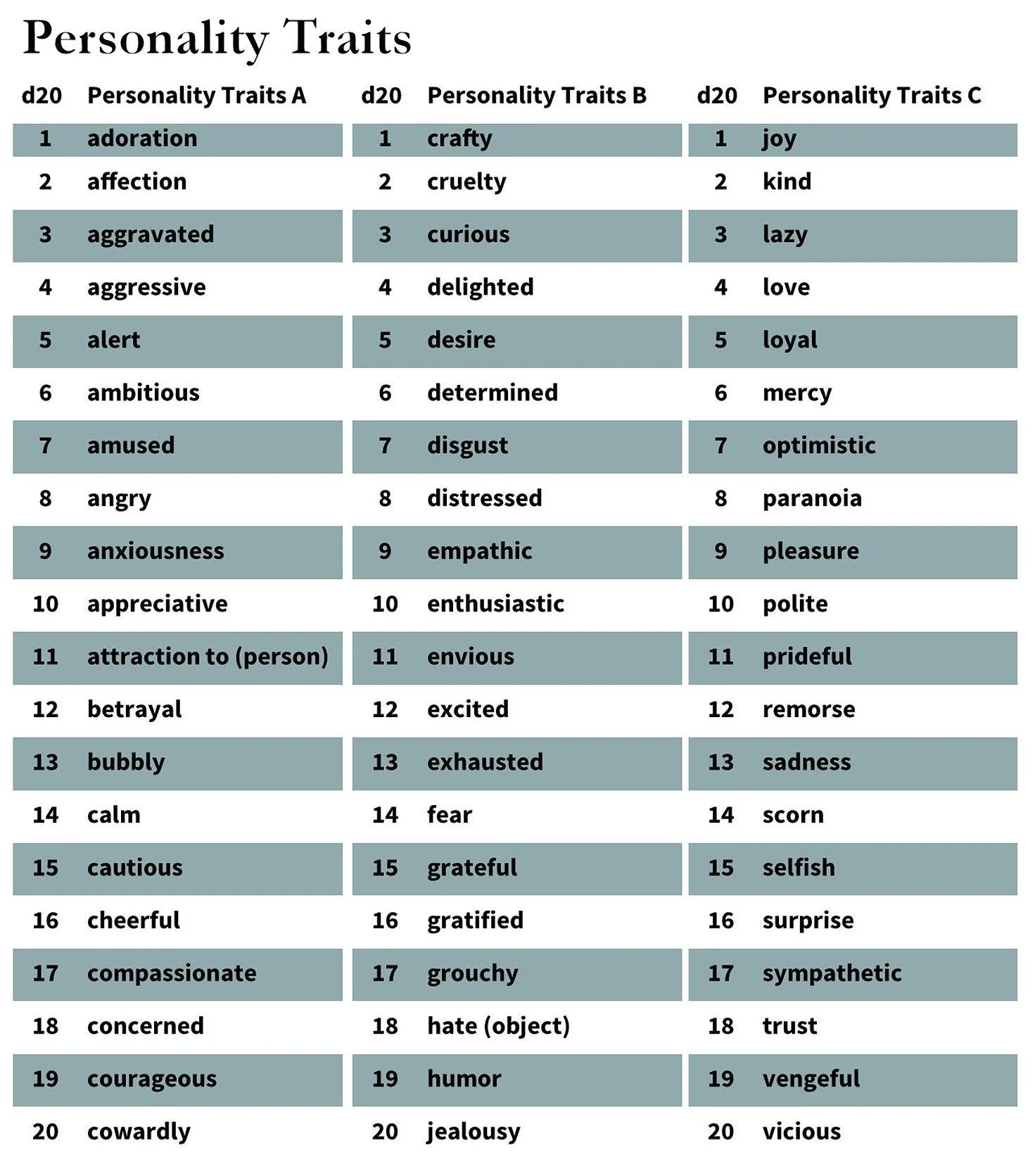
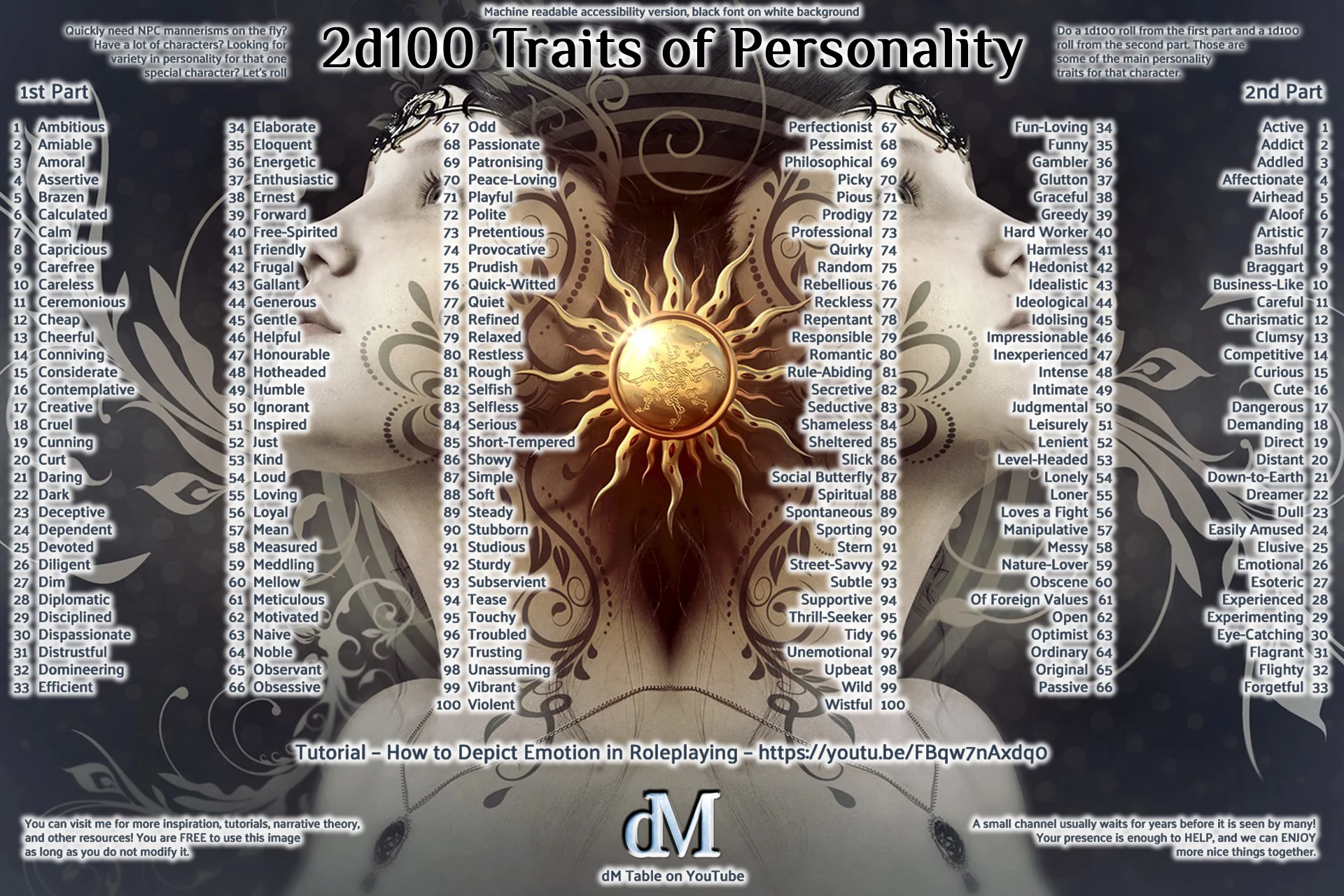
A d20 or 2d100 chart is useful for a spark. "Curious" plus "loyal" plus "vengeful" can be a fun prompt. It does not tell you how that person orders a drink, who they protect, or what they do when loyalty and revenge collide.
Writers already know the next trap. Archetypes feel stale when a character never breaks the mold. On the table, first player characters often become a fantasy version of the player because there is no second layer to grab when the scene turns. Game-master advice has long treated personality as racial, archetypal, cultural, and individual layers that have to be interpreted together — not as a single rolled word.
Lists cannot hold contradictions. Dice cannot remember that your priest is generous with children and vicious with creditors. That is the job of a character personality generator that writes the connections, not just the labels.
This is exactly the gap a dedicated AI writing partner is built to close.
Why Writing Assistant Works as a Character Personality Generator
Writing Assistant treats personality as behavior under pressure. You give it a function in the story, a social world, and at least one friction point. It returns a profile you can drop into a chapter, a character bible, or a session.
It is a writing partner for this job — not a random-table replacement that only shuffles adjectives.
| Traditional Approach | Writing Assistant |
|---|---|
| One rolled word on a d20 or d100 | Interlocking traits, tells, motives, and taboos |
| Hours of questionnaires and wiki pages | A usable profile in a single conversation |
| Archetype photocopy | Contradictions that still cohere |
| Every NPC sounds like the author | Distinct diction, tempo, and verbal tics |
| Traits that never change the plot | Stress behavior you can play or write immediately |
From labels to a living system
Ask for more than "kind" or "greedy." Request how the trait shows up in money, manners, faith, and fear. Positive traits create investment; negative traits create stakes. The useful output is the collision: the generous smuggler who will not harm a child and will ruin a debtor without blinking.
Contradictions on purpose
People are not consistent in a straight line. They are consistent in a pattern. A strong generator should hold two truths at once — courtly manners and a filthy temper, piety and a gambling habit — and show which one wins when time is short. That is how you avoid both the saint and the cartoon villain.
Voice, not just adjectives
Personality that never reaches the line-by-line voice will vanish in draft two. Ask for diction, sentence length, oaths, what they will not say, and the joke they use when they are lying. Supporting casts need this even more than protagonists. Readers forgive a slightly generic hero. They will not forgive five side characters who all hedge in the same way.
Cast-scale memory
A novel, a season, or a campaign lives or dies on whether the innkeeper in chapter three still has the same tell in chapter twenty. Because this AI keeps conversation context, you can generate a lead, then a rival, then a parent, and demand that none of them share a verbal fingerprint.
Try prompts like these:
"Generate a personality profile for a 40-year-old harbor smuggler who is generous with children, ruthless with creditors, and terrified of open water. Include core traits, a private superstition, speech patterns, and how she behaves when a deal goes bad."
"This paladin is publicly devout and privately superstitious. Give me three contradictions, a virtue that becomes a flaw under stress, and a 12-line argument with a thief who stole temple silver to feed a sibling."
"Build four distinct personalities for a heist crew: planner, face, muscle, and insider. No two may share diction, moral line, or tell. Show each one reacting to the same failed lock."
Related Agents You'll Also Find Useful
If you are also naming the person you just built, Name Generator can produce culturally grounded names for characters, houses, crews, and pets that match the personality instead of fighting it.
- Linguistic and cultural fluency for fictional and real-world naming
- Options that fit tone: grimdark, courtly, comic, or contemporary
- Fast iteration when a name is close but not quite right
If the personality has to survive a ruleset, economy, or faction map, Game Designer Assistant turns that inner life into systems, documentation, and playable roles.
- Brainstorming that respects genre, platform, and audience
- Help converting motives into mechanics, factions, and adventure hooks
- Support for bibles, pitch docs, and encounter design
If you want to play the person rather than only describe them, Roleplay Game Master keeps character consistency across long, improvised scenes.
- Persistent memory so NPCs do not reset every session
- Room to test a personality in conversation before it hits the table
- Useful for solo rehearsal and group play
Try Writing Assistant free — no credit card required.
How to Use an AI Character Personality Generator
Step 1: Name the job in the story
State who they are to the plot, not just their class or job title. "Rogue" is a stat block. "The only lockpicker who still attends her sister's sentencing" is a person. Include age band, social position, and the story problem they create.
"Create a personality for the bailiff who must arrest the player's mentor. He respects the mentor, fears his own lord, and has a sick child at home."
Step 2: Add one contradiction and one fear
A character without a motive drifts. Give Writing Assistant a value that will cost them something, plus a fear that is specific. "Afraid of failure" is weak. "Afraid the guild will learn she cannot read" will generate behavior.
"She is the most reliable caravan guard on the coast and has hidden her illiteracy for eleven years. Show how that fear shapes humor, pride, and violence."
Step 3: Demand evidence, not a list
Ask for tells, taboos, a sample paragraph of dialogue, and what they do with money, apologies, and power. If the result is still a list of adjectives, push once: "Show this in a three-beat scene at a funeral."
"Rewrite this profile as: 5 core traits, 2 flaws, 1 bond, 1 taboo, typical oaths, and a 150-word tavern scene that proves all of them."
Step 4: Stress-test, then freeze the voice
Run the same person through praise, humiliation, and a bad deal. Keep the version whose choices surprise you without feeling random. Save that snapshot and reuse it as the source of truth when you add siblings, rivals, or a second adventure.
Step 5: Multiply the cast on purpose
Generate the next character against the first. Instruct the tool: "Do not reuse her diction, moral line, or coping style." That single constraint is how a character personality generator becomes a cast designer.
Results and Use Cases
📊 Novelist building a lead and a foil
Scenario: You have a premise — a cartographer who falsifies coastlines — and a blank second lead.
Traditional Approach: A weekend of trait lists, a Pinterest board, and two chapters where both women hedge in your own syntax.
Writing Assistant: One conversation produces opposing relationships to truth: the cartographer who lies to keep sailors alive, and the admiralty clerk who tells the truth to keep her pension. Their argument writes itself.
- Clear moral friction without cartoon evil
- Distinct sentence rhythm for each woman
- A reusable profile for later chapters
💼 Game master stocking a town before session
Scenario: The party will hit a port at 7 p.m. You need a harbormaster, a fence, and a priest who all want different things from the same crate.
Traditional Approach: Three hastily named NPCs who all say "I don't know anything about that."
This generator: Three motives, three tells, three ways to fold under a bribe. You walk in with playable people instead of hats.
- Faster prep without a full backstory novel
- Traits that create hooks the table can grab
- Easy to extend if the party adopts an NPC
📱 Mobile: a personality in the parking lot
Scenario: Your group is already at the store. You need the shopkeeper to matter in one scene.
Traditional Approach: You improvise "gruff but fair" for the fifth time this campaign.
On your phone: Open a session, dictate the prompt, and walk in with a man who undercharges veterans, overcharges wizards, and will not look at anyone's left hand. Full web, iOS, and Android parity means the profile is in your pocket.
- Voice-to-text for prompts while you walk in
- A single tell you can actually remember at the table
- Room to generate a second NPC if the party splits
🎯 Screenplay: five voices in one room
Scenario: A pilot scene traps five people in a negotiation. On the page they all sound like the writer.
Traditional Approach: A table read where every line could be swapped without damage.
The same workflow: Generate five personalities with banned words, different sentence lengths, and different ways of interrupting. Then write the scene against those constraints.
- Dialogue that survives a table read
- Status and class readable in the speech itself
- Fewer "who said that?" notes from collaborators
FAQ
What is a character personality generator used for?
A character personality generator is used to invent consistent inner lives for fictional people — traits, flaws, motives, speech, and stress behavior — so they can carry a scene in a novel, script, comic, or tabletop game. It is a drafting tool for characterization, not a medical or psychological assessment of real people.
How is an AI generator different from a d20 or d100 trait table?
A table gives you a spark: curious, loyal, paranoid. An AI generator connects those sparks into behavior, diction, and conflict. You still choose the interesting contradiction. The tool's job is to show how that contradiction plays when money, love, or danger enters the room.
Can I use this for D&D NPCs and player characters?
Yes. It is a strong fit for Ideals, Bonds, Flaws, and the extra layer those prompts do not cover — how the person talks, what they will not do, and what they do when two values collide. After you lock a profile, Roleplay Game Master is useful if you want to rehearse the NPC in conversation before the session.
Is this character personality generator free?
You can start on a free tier with no credit card. That is enough to test profiles, supporting casts, and a handful of NPCs. Long novels, weekly campaigns, and heavy revision may need a paid plan for more usage. There is no separate fee per character.
Does it work on mobile?
Yes. Sessions work across web, iOS, and Android with the same core writing features, so you can generate a personality on a laptop and check it on your phone at the table. Speech-to-text helps when you would rather dictate a prompt than type it.
How do I keep generated characters from feeling generic?
Give the tool a specific social world, a cost, and a ban list. "Make them not the brooding loner" is weak. "No orphan backstory, no dead wife, must care more about reputation than money" will force a shape. Then run the result through Name Generator so the name matches the culture and tone you actually built.
Conclusion
A character personality generator is only as good as the behavior it produces. Trait encyclopedias and dice tables still matter as sparks. They do not hold a contradiction, a voice, and a fear in the same place.
Writing Assistant does that job: it turns a role and a friction point into a person you can write, cast, or play, then keeps the next person from sounding like the last. Use it for leads, foils, and the shopkeeper who has to last more than one line.
Try it on the next character who would otherwise get a single adjective. Then keep going until the whole cast can argue without sharing a throat.
Explore more at Jenova.
For Developers: Writing Assistant is available programmatically via the Jenova API — integrate character personality generation into your application with a single API call. Full documentation →