Character Memory Template for AI Roleplay: Keep NPCs Consistent
2026-09-18
Roleplay Game Master helps you run long, immersive AI roleplay by holding unlimited memory and locking character consistency for every NPC you invent. While typical chatbots drop names, promises, and tone once the context window fills, this AI keeps campaigns coherent from the first scene to the fiftieth.
In September 2026, roleplayers still lose plot the moment a model’s context window fills — often around 8,000–9,000 tokens on popular roleplay frontends.
✅ Unlimited conversation memory — no manual memory dumps mid-scene ✅ Perfect character consistency across sessions, not just the last few replies ✅ Complete creative freedom for any genre, rating, or ensemble cast ✅ Full feature parity on web, iOS, and Android, so a commute scene can pick up a desktop campaign
To understand why a character memory template for AI roleplay became a community workaround in the first place, it helps to look at how language models actually forget.
Quick Answer: What Is a Character Memory Template for AI Roleplay?
A character memory template for AI roleplay is a structured note that stores identity, relationships, plot, and scene state so the model stays consistent when the chat gets long. Roleplay Game Master makes that continuity automatic instead of a copy-paste chore.
Key capabilities:
- Persistent character and campaign memory across sessions
- Stable NPC voice, inventory, secrets, and relationship status
- Scene-level continuity (location, time of day, unresolved hooks)
- Freedom to run romance, horror, slice-of-life, or tabletop-style campaigns without rebuilding the bible every few dozen messages
The Problem With AI Roleplay Memory
A survey of memory mechanisms in the LLM era defines memory as the process of acquiring, storing, retaining, and retrieving information. Chat models only do the first part well inside a sliding window. Everything else is your problem.
Roleplay makes that failure obvious. You are not asking for a one-shot answer. You are asking the model to be someone, in a world with history, across hundreds of turns. When the window fills, the bot invents a new eye color, forgets a betrayal, or greets a lover like a stranger. Community docs call this context rot: older beats get pushed out, and the character starts degrading.
But keeping a living story coherent is frustratingly difficult:
- The model has no durable “who is this person” store unless you pin one
- Summaries written as prose bury the facts the model actually needs
- Ensemble casts multiply names, debts, injuries, and secrets
- Manual memory fields punish you for playing instead of bookkeeping
Context Windows Are Not Character Memory
Short-term context is working memory, not a character sheet. Research on LLM memory distinguishes that temporary window from long-term stores that must live outside the prompt. If your “memory” is just the last few pages of chat, the NPC cannot remember a promise from last Tuesday.
8,000–9,000 tokens — Approximate JLLM context window before details start dropping
That is not a campaign. That is a short scene with amnesia waiting at the edges.
Episodic Facts Get Mixed With Semantic Facts
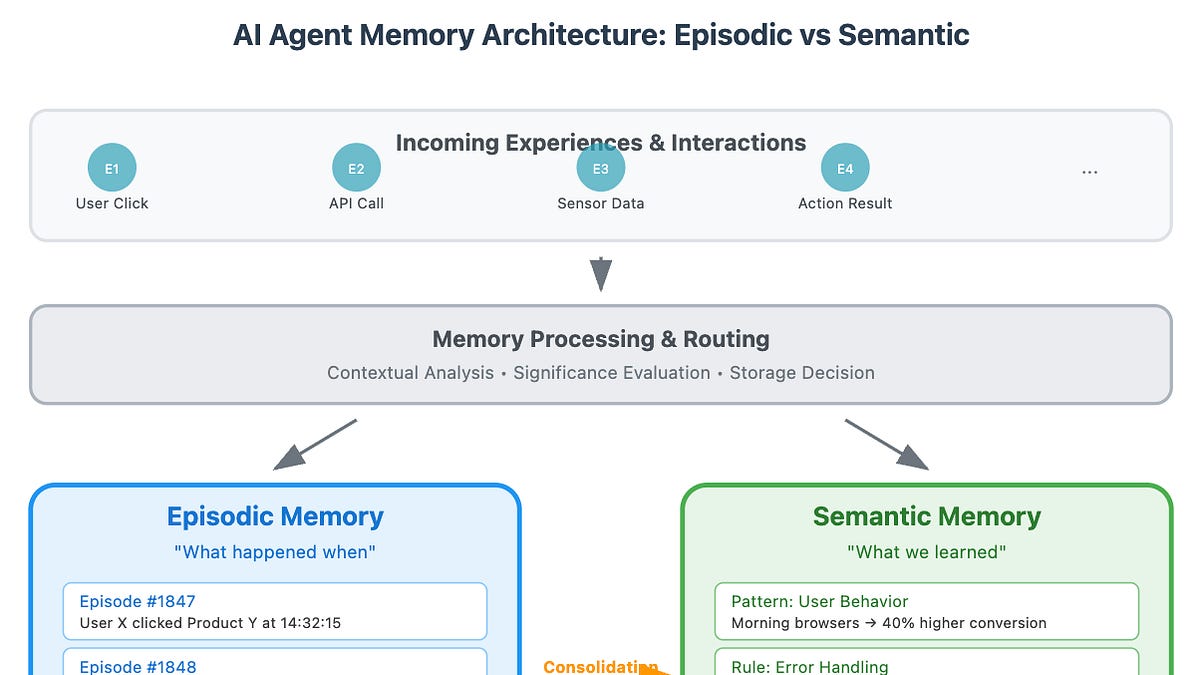
Cognitive-style agent memory splits episodic memory (“what happened when”) from semantic memory (durable facts, relationships, and preferences). Roleplay chats smash both into one recap paragraph. The model then treats a one-off tavern joke as a personality trait, or treats a core wound as optional flavor.
Manual Templates Decay Faster Than the Story
Serious players already keep a pinned memory field or a side document. Guides for consistent characters even warn you not to trust a memory toggle — lock the character in a file. That works until you forget to update it after a confession, a death, or a costume change. The template becomes fanfiction about a story the chat already left behind.
Backups and Exports Do Not Fix Continuity
You can export cards, JSONL logs, and reading copies and still watch the live character drift. A backup preserves text. It does not retrieve the right beat at the right moment, which is the actual job of memory.
This is exactly what Roleplay Game Master was built for.
Why Roleplay Game Master
Roleplay Game Master is an immersive roleplay partner with unlimited memory and perfect character consistency. You describe the world, the cast, and the tone. It runs the scene, tracks what happened, and stays in character without a pinned wiki you have to rewrite after every climax.
That is a different job from a generic chatbot with a notes box. A standard LLM is essentially parametric semantic memory — a pile of decontextualized knowledge. Roleplay needs the missing piece: a durable record of this campaign’s events, plus stable facts about this character.
| Traditional Approach | Roleplay Game Master |
|---|---|
| Pin a chat-memory field and update it by hand | Unlimited memory that persists across the campaign |
| Recap dumps that clog the context window | Continuity without turning play into clerical work |
| NPCs drift in name, tone, and inventory | Perfect character consistency for the cast you defined |
| Story dies when you switch devices | Pick up the same scene on phone or desktop |
| Character cards without living history | Creative freedom plus a memory of what already happened |
Use a Character Memory Template That Mirrors How Agents Remember
If you still want a written character memory template for AI roleplay — for a character bible, a collab doc, or another frontend — structure it the way agent architectures do. Incoming scenes should be routed, not pasted as a novel.
Semantic memory (what is always true)
- Identity: name, age band, species/role, pronouns, distinctive features
- Voice: diction, humor, taboos, languages, what they never say
- Relationships: status with {{user}} and key NPCs (ally, rival, secret, debt)
- World rules: magic cost, law, geography the character actually knows
- Invariants: scars, vows, phobias, inventory that should not vanish
Episodic memory (what happened when)
- Dated or ordered beats: “Session 4 — Kael sold the map at the docks”
- Causal effects: who knows, who is injured, which door is now locked
- Open hooks: the unread letter, the missed rendezvous, the lie still standing
- Current scene state: location, time, weather, who is in the room
Janitor-style memory guides already push a similar split: environment, relationship dynamic, current plot, character notes, user notes, important past events. Keep entries short, one tense, facts not scenes. The architecture diagram above is the reason that format works: episodes stay timestamped; lessons consolidate into rules.
Here is a compact template you can reuse:
Environment: rain, alley behind the opera, two exits Relationship dynamic: {{user}} and {{char}} are partners hiding a crime; trust is high, honesty is not Current plot points: looking for the stolen score; city watch two streets over {{char}} notes: left-hand scar; carries the torn letter; will not say Maren’s name {{user}} notes: wearing the borrowed coat; still has the key Important past events: {{char}} betrayed the guild last winter; {{user}} covered it
That is a good character memory template for AI roleplay. Playing inside Roleplay Game Master is better, because the living chat is the memory — you are not racing the window with post-it notes.
Reliable, Believable, Capable Characters
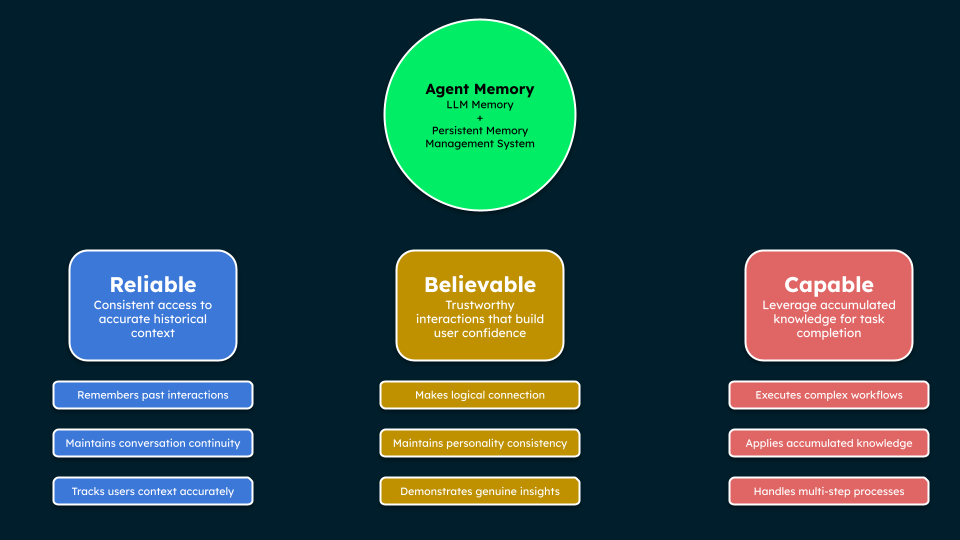
Quality roleplay fails in three distinct ways, and memory is the common fix.
- Reliable: the bot can retrieve last session’s injuries, names, and location instead of hallucinating a reset
- Believable: personality, speech, and ethics stay stable, so the character feels like the same person
- Capable: multi-step plots (heists, slow-burn romance, political campaigns) can actually complete because earlier moves still exist
Those pillars are not flavor. They are what players mean when they say “this one remembers me.”
Prompts That Feed Memory Instead of Fighting It
Talk to the game master in outcomes and invariants, not essays.
"Continue the campaign. Last beat: Elara learned Kael sold the map. She has the torn letter. Do not reset their history. Open in the rain outside the safehouse, cold not yelling."
"Lock character memory: barkeep is Ivo, gray streak, scar on the left hand, still owed 40 silver from the card game. He does not become a new NPC."
"Slow-burn tavern scene only. No timeskip. Keep every returning NPC consistent — names, debts, and who already knows about the letter."
The same discipline applies if you paste a template into another tool: list facts, not cinema. Community memory advice is blunt on this — more text is not more memory.
Related Agents You'll Also Find Useful
If you are building a cast rather than only running scenes, adjacent tools cover the rest of the table.
Name Generator — Before the first reply, you still need names that fit culture, era, and tone. Use it to name the PC, the rival house, the ship, and the cat, then drop those locked names into your opening message so memory has clean handles.
- Cultural and linguistic naming, not random syllable salad
- Works for people, places, factions, and titles
- Gives you stable proper nouns the roleplay can actually remember
College Life — If your taste is open-world social roleplay rather than a GM-led dungeon, this is an emergent campus story: friendships, heartbreak, and status all unfolding from your choices. Memory matters here because a rumor from week one should still hurt in week six.
- Choice-driven social dynamics instead of a railroaded quest
- Relationship continuity as the main mechanic
- Same “do not break character” need as any long campaign
Vesper Court — A darker lane: a woman wakes in a hidden vampire court with no memory of why. Blood intrigue only works if each night’s bargains survive until the next dusk. Use it when you want gothic romance with consequences.
- Night-by-night plot that depends on retained secrets
- Character consistency under high-emotion scenes
- Forbidden-desire tone without resetting the political board
Try Roleplay Game Master free — no credit card required.
How It Works
Step 1: State the Cast and the Invariants Open the game master and lead with who must never drift. Names, voice, wounds, and the relationship with you belong in the first message, not buried in chapter four.
"You are GM. I play Ren, quiet cartographer. Companion is Captain Sera: dry humor, never shouts, missing the last two fingers on her right hand. We are wanted in Virel. Do not soften that."
Step 2: Separate World Rules From Tonight’s Scene Give semantic rules (how magic costs, who can lie to whom) once. Then give the episodic opener (where you are, what just happened). Mixing them into one purple paragraph is how templates fail.
"World rule: glamours fail in church bells. Scene: midnight, warehouse loft, Sera is bandaging my arm and has not mentioned the wanted posters."
Step 3: Play, Then Pin Only What Changed Stay in scene. When something story-critical happens — a death, a confession, an item lost — state it once, clearly. You are writing an episodic log, not a novelization.
"Memory update, not a new scene: Sera now knows I forged the charts. The original map is ash. She kept the compass."
Step 4: Resume Across Sessions Without a Recap Novel Because memory is unlimited, you do not need a 500-word OOC summary every login. A short “continue from the loft, same injuries, same secret” is enough to re-enter the beat.
"Continue from the loft. Same night. Sera has the compass. I am still bleeding. No timeskip."
Step 5: Move to Your Phone Without Breaking Continuity The same campaign should be playable on mobile when you have ten minutes on a train. Open the thread, send the next line of dialogue, and keep NPCs stable. That is the test of real character memory, not a template sitting in a docs tab.
Results & Use Cases
🎲 Long-Form Campaign Without a Wiki Editor
Scenario: You and two friends are running a 30-session heist chronicle. The crew has a fence, a crooked priest, a named cat, and three unpaid debts.
Traditional Approach: After each session someone pastes a recap into chat memory, trims it when it overflows, and still watches the priest change names.
Roleplay Game Master: You play. The debts, aliases, and the cat stay put, so session 19 can cash a check written in session 3.
- Ensemble NPCs remain distinct
- Heist logistics survive timeskips
- Less OOC bookkeeping, more table time
💼 Slow-Burn Romance That Remembers the Wound
Scenario: A rivals-to-lovers arc where a betrayal in act one must still shape every polite conversation in act three.
Traditional Approach: The model “forgives” too early because the betrayal aged out of the window. You paste the wound into memory again. It still comes out as generic angst.
This AI roleplay partner: The betrayal is treated as semantic relationship fact plus episodic event. Later tenderness has to work around it, which is the entire point of the genre. If you want a prebuilt gothic frame with the same pressure, Vesper Court is the darker cousin.
- Emotional continuity without railroading
- Voice stays sharp under intimacy
- Secrets remain secrets until they are spent
📱 Mobile Scene on a Commute
Scenario: You drafted a tavern standoff at your desk. The next morning you have twelve minutes on the subway and want Ivo the barkeep, not a new extra.
Traditional Approach: Phone apps with thin history rewrite the room. You spend the commute re-explaining the scar and the 40 silver.
Unlimited-memory roleplay: You send one line of dialogue. Ivo still has the scar and the debt. The scene moves.
- True device switching, not a new bot
- Short sessions that still accumulate lore
- No laptop required to keep character
🖋️ Building the Cast Before You Play
Scenario: You need a full party bible — names from three cultures, a ship, a rival house — before the GM scene starts.
Traditional Approach: Random name sites plus a messy notes app. Inconsistent spelling becomes “new NPCs.”
Name Generator into the game master: Lock spelling once, then open the campaign with those exact strings so memory has clean keys. Pair with College Life if the story you actually want is social and campus-shaped rather than sword-and-heist.
- Stable proper nouns
- Faster character-card setup
- Less drift caused by typos the model treats as new people
FAQ
What is a character memory template for AI roleplay?
A character memory template for AI roleplay is a short, structured list of invariants and story beats: who the character is, how they speak, who they are to you, what already happened, and what is true in the current room. It exists because most chat models only “remember” what still fits in the context window. Keep it factual and compact. If you want the same outcome without maintaining the document, use an agent built for unlimited roleplay memory.
Why do AI roleplay characters forget previous scenes?
They are not storing your campaign as long-term memory. They are reading a limited slice of recent text. When that slice fills, older names and promises fall out — context rot. Episodic logs and semantic facts have to live in a real memory system, or in a template you update by hand.
Is Roleplay Game Master free?
Yes. You can try Roleplay Game Master on a free plan with core features and limited usage, no credit card required. Paid tiers increase usage if you run long daily campaigns. Start with a single chronicle and see whether NPCs still match their first appearance after a week of play — that is the test that matters.
How is this different from Janitor AI or Character.AI memory fields?
Those frontends typically give you a pinned memory box you must write, trim, and refresh. Their own memory guidance tells you to keep it short, structured, and updated, then to generate summaries as chats grow. The game master is built so immersive play and character consistency are the product, not a field you babysit. You can still keep a written bible if you enjoy worldbuilding; you should not need it to prevent amnesia.
Does character memory for AI roleplay work on mobile?
It should, or it is not campaign memory. This agent runs with the same continuity on web, iOS, and Android, including speech-to-text if you would rather dictate a reply than type on a train. If a “memory template” only lives in a desktop doc, it will not save a mobile session.
Can I import my own character memory template?
Yes, as opening instructions. Paste your semantic block (identity, voice, relationships, world rules) and a short episodic log (last three impactful events plus current scene). Then play. Do not paste a chapter of prose. If you are still naming the cast, generate locked names first with Name Generator, then freeze that spelling in the opener.
Conclusion
A character memory template for AI roleplay is a clever patch for a blunt limitation: chat models forget. Split durable character facts from timestamped events, keep lines short, and you will get better NPCs on any frontend. The better move is not to become your own memory server.
Roleplay Game Master keeps unlimited memory and character consistency so lore, relationships, and plot can actually accumulate. Build the party, set the scene, and stay in character — on the couch or on your phone.
Try it now, then explore more at Jenova.
For Developers: Roleplay Game Master is available programmatically via the Jenova API — integrate unlimited-memory AI roleplay and character consistency into your application with a single API call. Full documentation →