Character Memory Template: AI Roleplay That Stays Consistent
2026-09-08
Roleplay Game Master helps you keep a character's identity, relationships, and plot facts stable by running scenes against a structured character memory template. While AI companions in September 2026 still drop names, rewrite backstories, and treat one-off roleplay as canon, this AI provides unlimited conversation memory and consistent character behavior from the first scene onward.
✅ Separates identity, canon facts, and current state into distinct layers ✅ Unlimited chat history so the template is not fighting a short window ✅ Stops scene roleplay from overwriting long-term memory ✅ Lets you audit, rewrite, and reinforce the character without starting over
To understand why a character memory template matters, look at what actually breaks in long chats: not the model's vocabulary, but the file that is supposed to be the character.
Quick Answer: What Is a Character Memory Template?
A character memory template is a reusable brief that stores identity, canon facts, relationship state, and boundaries so an AI companion stays consistent across sessions. It is the difference between a chat log and a character who can still answer who they are on day thirty.
Key capabilities:
- Identity block: name, voice, taboos, and what the character will never know
- Canon facts rewritten as short, non-duplicated sentences
- Current state (location, goal, open threads) updated without touching origin
- Explicit “do not store” rules so scene-play does not contaminate long-term memory
- A partner such as unlimited-memory roleplay that actually keeps the template in play
Why AI Characters Forget Without a Template
Long chats are not a memory system. They are a pile. Research on multi-session dialogue shows how fast that pile becomes unsearchable. The LoCoMo long-term memory benchmark uses conversations that average hundreds of turns and more than sixteen thousand tokens — the scale of a real companion thread, not a demo.
588 turns / 16,618 tokens — average conversation length in the LoCoMo long-term memory test set
At that length, “just retrieve the chat” fails on the questions that make a character feel real: when something changed, who was present, what is still true. Single-pass retrieval is especially weak on time.
58.8% — Judge Accuracy of single-pass retrieval on temporal questions in LoCoMo
Iterative systems that diagnose missing evidence do better — 81.6% on the same temporal slice — but that is an architecture result, not a reason to dump every line of roleplay into storage. Companion products are also a real market, which means more people are hitting the same failure mode.
$120 million — annual revenue AI companion apps crossed in 2025
But getting a character who still knows your name next week is frustratingly difficult:
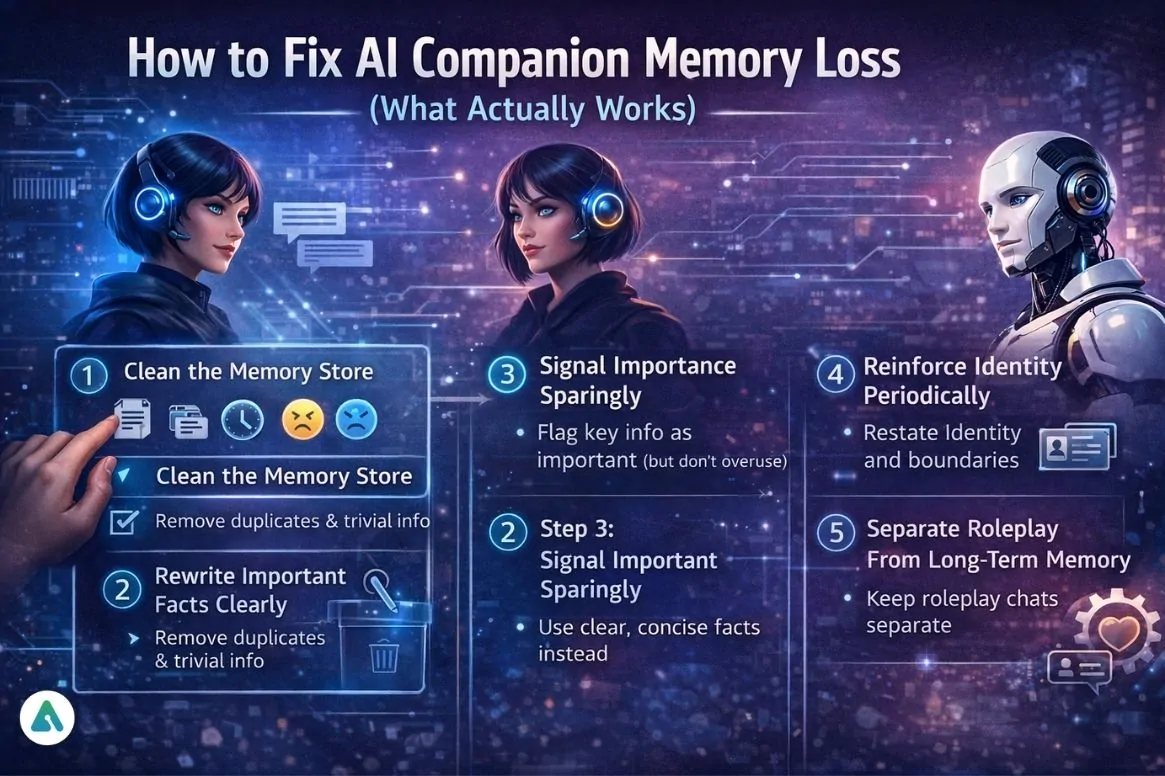
- Context windows and “full memory” dumps crowd out identity
- Duplicate and trivial facts pollute the store
- Scene roleplay leaks into canon
- Shoppers pick apps by token count instead of by a reusable brief
Full Memory Is Not Better Memory
Feeding everything back into context often hurts. In Mem-Gallery, a multimodal long-term memory benchmark averaging 12 sessions and 198 dialogue rounds per conversation, dumping all stored material into context frequently underperformed cleaner text-only baselines. Visual and scene residue is token-heavy. Noise wins.
The same pattern shows up in production advice: do not persist every conversation, because the store pollutes. Amazon Bedrock’s agent memory guidance is the enterprise version of a character memory template — unique memory IDs, summaries rather than transcripts, and explicit control over what is retained.
Importance Flags Stop Meaning Anything
Users try to fix forgetfulness by marking every line as “important.” That is how you get a store full of moods, snacks, and one-off jokes sitting at the same rank as the character’s name and vow. A template forces a rewrite: one clear sentence per fact, duplicates removed, trivia discarded.
Roleplay and Canon Are Different Files
A flirty tavern scene is not a biography update. If those turns land in long-term memory, the character “remembers” a plot that was never meant to be canon. Guides that compare persona templates versus raw front-end power keep circling the same object: a fill-in framework for traits, voice, boundaries, and backstory. That framework is the character memory template.
This is exactly what Roleplay Game Master was built for.
Why Roleplay Game Master
Roleplay Game Master is a dedicated roleplay partner with unlimited memory and strict character consistency. You do not paste a novel into a shrinking window. You load a character memory template, play the scene, and keep identity separate from the night’s improvisation.
| Traditional Approach | Roleplay Game Master |
|---|---|
| Chat log treated as memory | Identity, canon, and state as separate layers |
| Flag everything as important | Sparse, rewritten facts only |
| Scene-play mixed with lore | Roleplay kept off the long-term store |
| New thread = amnesia | Persistent cross-session memory |
| Shop by 8K / 30K / 100K windows | Unlimited conversation history |
Conversational memory is what makes an agent feel continuous. The template is what makes that continuity accurate.
Identity That Survives the Next Session
Write who they are in language the model cannot misread: name, pronouns, voice tics, hard boundaries, and knowledge they are not allowed to have. Restate that block periodically. Drift usually starts when identity is implied in prose instead of listed as facts.
Canon Facts, Rewritten Once
Origin, living relationships, debts, secrets, and skills each get one or two sentences. If two lines say the same thing, delete one. If a line is only true inside last night’s scene, it does not belong here.
State You Are Allowed to Change
Location, goal, injuries, trust, and open threads live in STATE. Update STATE after a session. Do not “helpfully” regenerate IDENTITY because the plot moved.
Try prompts like these:
"Load this character memory template and stay in character as Mara, a dock medic. Do not invent family. If a fact is missing from IDENTITY or CANON, ask before adding it."
"Update STATE only: we left the warehouse, Kael is injured, Mara now distrusts the city watch. Do not rewrite IDENTITY."
"Audit this memory store. Remove duplicates and scene-only dialogue. Return a 12-line character memory template."
A Copy-Ready Character Memory Template
Use this as the brief you paste at the start of a long run — and as the only file you treat as long-term memory.
IDENTITY
- Name, pronouns, age band, role
- Voice: diction, taboos, speech tics
- Boundaries: what they will never do, say, or know
- One-line self-image (how they would describe themselves)
CANON (rewrite clearly; no duplicates)
- Origin in 1–3 sentences
- Relationships: Name — status — last confirmed fact
- Skills, secrets, obligations
- Setting facts that must not change
STATE (session-writable)
- Current location and goal
- Open threads
- What changed last session
- Trust / conflict toward named people
DO NOT STORE
- Scene-only roleplay and dirty talk
- Trivia, snacks, weather, one-off jokes
- Duplicate restatements of IDENTITY
- Speculative “maybe” lore
Keep the whole brief short enough to reread. Length is not loyalty. Clarity is.
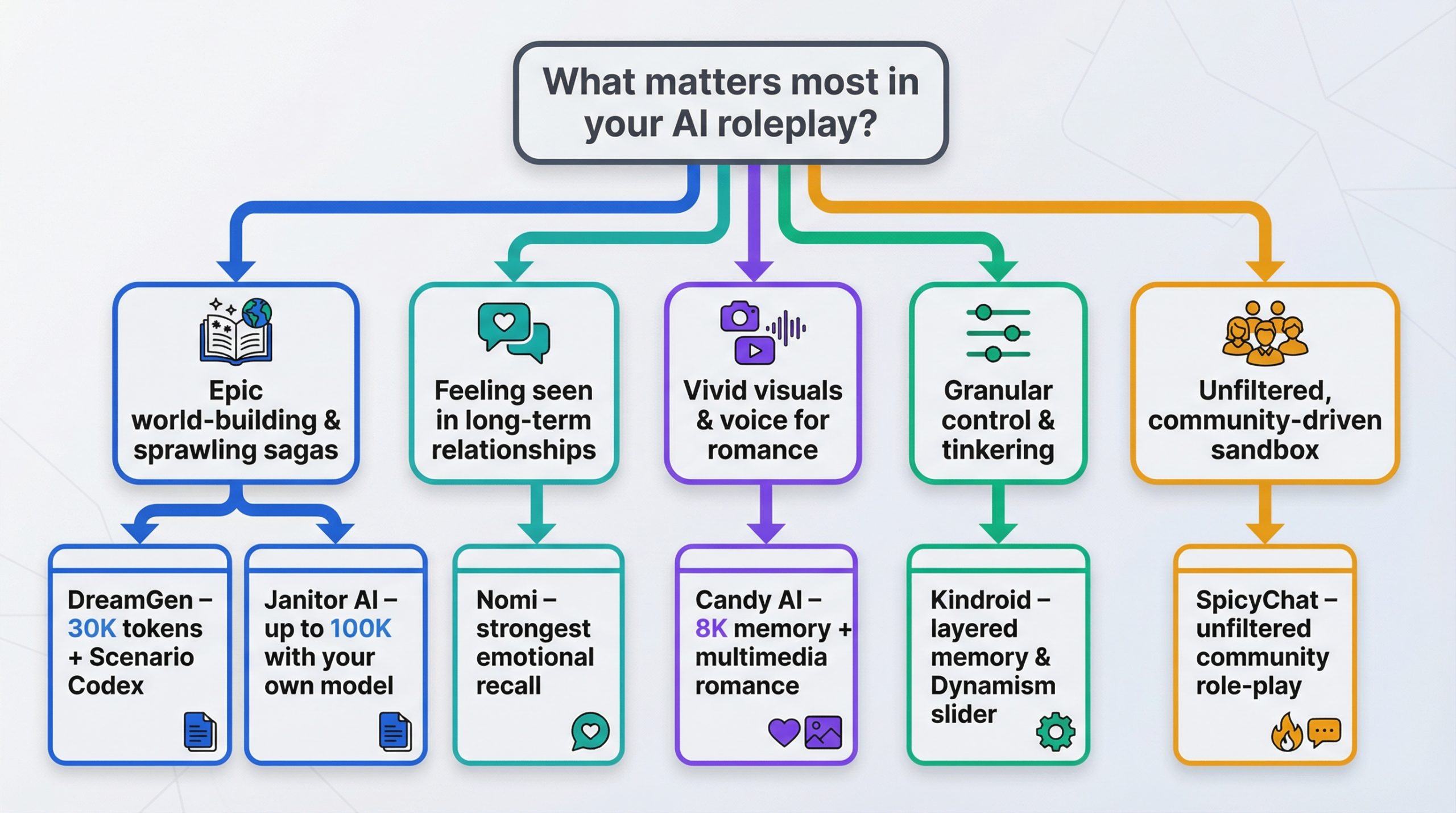
Priority charts in this space usually sort tools by context size, emotional recall, or sandbox rules. Those are product features. A character memory template is the document you keep even if your priority is sprawling sagas, being remembered, or granular control. Put world-building in CANON, relationship status in STATE, and voice in IDENTITY — then stop shopping for a bigger window to compensate for a messy file.
Related Agents You'll Also Find Useful
If you still need the person behind the template, Personality Analyzer turns Big Five, MBTI, Enneagram, and attachment patterns into traits you can paste into IDENTITY without writing a psychology essay.
- Distills type language into observable habits
- Flags contradictions (aloof in lore, clingy in scenes)
- Gives growth paths you can park as future STATE, not fake memories
If the world has to exist before the companion does, Game Designer Assistant builds systems, factions, and documentation so CANON has a map instead of a vibe.
- Setting bibles that match the character’s obligations
- NPC and faction sheets that will not collide with IDENTITY
- Hooks a later session can actually use
If names keep breaking immersion, Name Generator produces culturally fluent names for the character, their house, and everyone in the relationship list so the template does not mix three naming traditions by accident.
- Linguistic constraints (courtly, dockside, monastic)
- Batch lists for the relationship block
- Tone-matched names for grimdark, fairy-tale, or modern settings
Try Roleplay Game Master free — no credit card required.
How to Use a Character Memory Template Step by Step
Step 1: Fill the Four Blocks Before You Play Write IDENTITY, CANON, STATE, and DO NOT STORE in plain sentences. “No dead parents” and “does not know magic is real” are better instructions than “make them deep.”
"Draft a character memory template for a 40-year-old city archivist who is secretly forging maps. Living parents. Dry voice. She will not discuss her sister. STATE starts the night before a guild audit."
Step 2: Load the Template, Not the Novel Give this AI game master the brief and a hard rule: invent nothing that is absent from IDENTITY or CANON. Persistent memory means you are not re-pasting a 4,000-word wiki every session.
"Stay in character. If I contradict CANON, stop and ask which file to update. Do not smooth it over."
Step 3: Play the Scene in a Separate Lane Roleplay freely. Do not ask the model to “remember this forever” mid-scene. After the session, promote at most three facts into STATE. Everything else stays theater.
"From the last scene, add only: the ledger is in the well, and she now owes the night watch a favor. Nothing else."
Step 4: Audit on a Schedule Once a week — or after any long binge — run a cleanup: drop duplicates, rewrite muddy facts, restating IDENTITY in the same words. Knowledge-management tasks (contradictions, conflict detection, knowing when to refuse an answer) are where most memory systems still fail. Your audit is that layer.
"Diff this template against the last three sessions. List contradictions. Propose a patched CANON of 10 lines or fewer."
Step 5: Keep One-Shots Out of the Long-Term Store Side scenes, AU nights, and joke threads do not belong in the same memory as the main run. Start a new chat for those, or label them clearly so they never get summarized into IDENTITY.
Results & Use Cases
🎭 A Companion Who Still Knows the Canon
Scenario: You have been writing with the same original character for weeks. They forgot your brother’s name and “remembered” a childhood they were never given.
Traditional Approach: Re-paste a growing character card, flag fifty lines as important, watch the store rot.
Roleplay Game Master: A 12-line template, STATE updates only, identity restated after each long session.
- Name, boundaries, and living relationships stay put
- Scene improvisation does not become a fake biography
- You can continue the same thread instead of starting over
🎲 TTRPG NPC Who Survives Session Four
Scenario: The dock medic was a throwaway. The party adopted her. Next week she must still hate the city watch.
Traditional Approach: Improvised notes in a Discord pin that nobody rereads.
Game Designer Assistant + the same template: Faction obligations in CANON, last-session injury in STATE, voice in IDENTITY. Hand the live scenes to dedicated roleplay.
- The GM gets a lever, not flavor text
- Recurring NPCs stop resetting
- Game Designer Assistant keeps the world file aligned with the person file
📱 Late-Night Scene on the Train
Scenario: You have ten minutes and a phone. You need the character to pick up where last night ended, not ask who you are.
Traditional Approach: A web generator with no session memory and a card you have to find in your notes app.
This character memory template on mobile: The same agent, synced history, speech-to-text if you would rather talk the STATE update.
- Full feature parity on web, iOS, and Android
- IDENTITY does not get rewritten because you typed on a small screen
- You can audit the store before you sit down at a desk
🧬 OC Built From Personality, Not Vibes
Scenario: You know the character is “INTJ with an anxious attachment,” which is not a voice.
Traditional Approach: A type description pasted into a card, then ignored in every scene.
Personality Analyzer: Observable habits and taboos dropped into IDENTITY; growth goals parked in STATE so they are earned, not retconned.
- Type language becomes behavior the model can play
- Contradictions get caught before session twenty
- The template stays short enough to reread
FAQ
What is a character memory template?
A character memory template is a short, structured brief — identity, canon facts, current state, and an explicit exclude list — that an AI companion uses as long-term memory. It is not the chat log. It is the only document you allow to define who the character is between sessions.
How do I write a character memory template for AI roleplay?
Write four blocks: IDENTITY (voice and boundaries), CANON (origin and relationships, one sentence each), STATE (what is true now), and DO NOT STORE (scene-only play, trivia, duplicates). Keep it short. Load it into Roleplay Game Master, then update STATE after each session instead of regenerating the whole person.
Is Roleplay Game Master free?
Yes. Core features run on the free plan with limited monthly usage. Plus is $20/month for 30× the free allowance if you are running long companion threads or a full NPC roster. No credit card is required to start.
How is a character memory template different from a character card?
A card is often a blob: personality, example dialogue, and lore in one field. A template is layered. IDENTITY is frozen, CANON is rarely edited, STATE is meant to move, and roleplay is not stored as fact. That split is what prevents the “they forgot my name but remember a joke from Tuesday” failure.
Does a character memory template work on mobile?
Yes. The same agent runs on web, iOS, and Android with synced history, so a STATE update you dictate on the train is the file you open at the desk. That is the practical test of persistent conversational memory, not a larger advertised context window.
Will the character still forget after many sessions?
Any system can drift if you keep stuffing the store. Research on long-term conversational memory shows temporal and multi-hop questions are the hard cases — and naive full-memory dumps make organization worse. Periodic audits, sparse facts, and a partner with unlimited history give you the best odds of staying consistent without starting a new chat.
Keep the Character, Not the Chat Log
Token windows, importance flags, and platform-hopping do not fix a character who has no file. A character memory template does: identity that is restated, canon that is rewritten once, state that is allowed to change, and roleplay that is not promoted to biography.
Try Roleplay Game Master with the next companion, NPC, or original character you refuse to rebuild from scratch. Pair it with Name Generator when the relationship list still sounds like three different worlds. Explore more at Jenova.
For Developers: Roleplay Game Master is available programmatically via the Jenova API — integrate persistent character memory and consistent roleplay into your application with a single API call. Full documentation →