Character Lore Generator: AI Backstories for TTRPG & Fiction
2026-09-08
Game Designer Assistant helps you build playable character lore by turning a race, class, and one-line concept into family history, formative events, and campaign hooks. While writers still stall on blank backstories in September 2026, this AI character lore generator produces origin stories a dungeon master can drop into session zero.
✅ Turns race, class, and setting notes into a full origin ✅ Writes family conflict, accusations, and unfinished business ✅ Produces hooks a DM can use, not disconnected flavor text ✅ Stays consistent across NPCs, party members, and sequels
To understand why that matters, look at how most characters still get made: a stat block, a name, and a vague tragedy. The gap between “elf ranger” and someone the table remembers is lore.
Quick Answer: What Is a Character Lore Generator?
An AI character lore generator is a writing tool that turns race, class, and setting details into complete backstories with family history, formative events, and table-ready hooks. It is built for TTRPG players, GMs, and fiction writers who need origin stories that survive contact with a campaign.
Key capabilities:
- Family, upbringing, and lifestyle that explain the class you actually play
- Formative events (exile, false accusation, monastery sanctuary, rival cults)
- Campaign hooks: enemies, debts, unfinished vows, and places that still matter
- Iteration in chat so you can kill the orphan trope and keep the parts that fit your table
Why Character Lore Is Still Hard to Write
A memorable character is more than a race/class combo. Guides on creating a D&D backstory treat origin, culture, and class as one design problem, not three separate menus. That is the right instinct. Execution is where most people stall.
On D&D Beyond, new players still ask how long a backstory needs to be. Experienced tables often go much further:
2–3 pages — length many D&D players write just to establish character and DM hooks
That workload collides with a real creative bottleneck.
after they have a cool concept, a personality, and still no history that feels true. Tabletop gaming has kept expanding, which means more session zeros, more one-shots, and more NPCs that need a past before Friday night.But getting lore that a table will actually use is frustratingly difficult:
- Random tables give locations without meaning
- Generic AI drafts recycle orphans, amnesia, and “the village burned”
- Class and backstory refuse to talk to each other
- The DM receives flavor text with no lever to pull
Random Tables Create Place, Not Motive
Classic “This Is Your Life” tools are excellent at surprise. A d100 birthplace can drop you in the Shadowfell, a lich’s domain, or an enchanted spring. A sibling table can give you rivals or ghosts. What they rarely do is explain why a Sun Soul monk was raised by an uncle after a druid feud, then accused of a theft they did not commit.
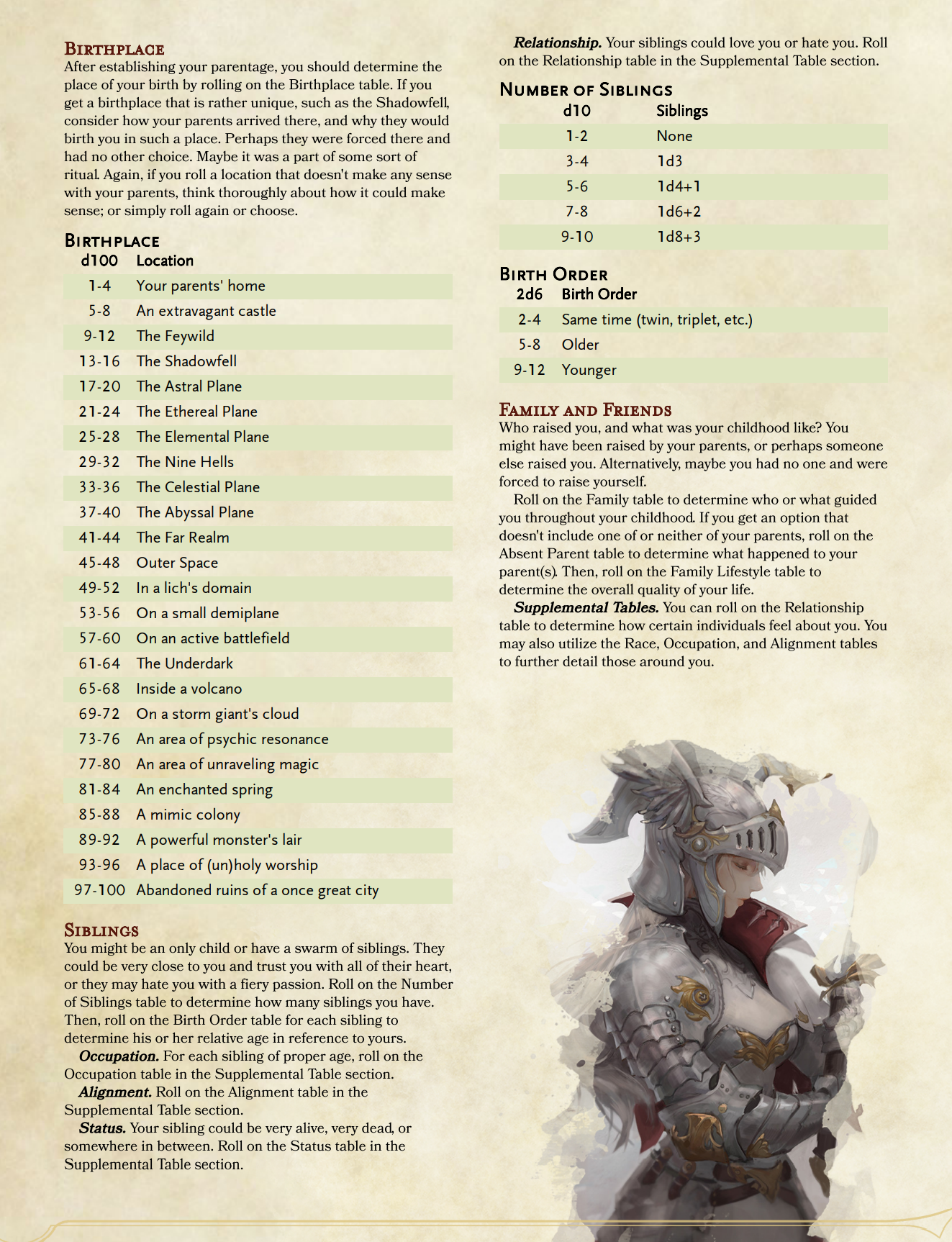
A roll of “monastery” plus “urchin” plus “wrongly accused” can be gold. Left as three disconnected results, it is noise. Lore only works when cause and effect stay intact.
Class Fantasy Gets Detached From Childhood
If you chose Way of the Sun Soul, the backstory should make that path feel inevitable or hard-won. Too many origins could belong to any class. The monastery, the enemies who want to exploit your abilities, and the vow to prove yourself should all point at the same person who will sit down with 8 ki points and a quarterstaff.
Volume Is Not the Same as Craft
Generative tools made long-form text cheap. That is not automatically good lore. An analysis of 14,419 self-published genre books found that titles with substantial AI text were about 20% of the sample but earned a smaller share of sales than books with no detected AI text. Flooding a campaign bible with interchangeable paragraphs has the same failure mode: more words, less character.
Human judgment still decides what belongs in play. As one industry discussion of generative tools put it, AI is an idea generator — the solution comes from the human. A character lore generator should draft the connective tissue. You still choose what the table sees.
This is exactly what Game Designer Assistant was built for.
Why Game Designer Assistant
Game Designer Assistant is a dedicated partner for game narrative, systems, and documentation. For character work, that means it does not stop at a pretty paragraph. It treats lore as design: background that explains skills, enemies that can walk into a scene, and a life that still has unfinished business.
| Traditional Approach | Game Designer Assistant |
|---|---|
| d100 birthplace with no causal link | Origin tied to class, culture, and the campaign’s map |
| Orphan / amnesia / burned village | Specific family rifts, false accusations, and vows |
| Hours of blank-page writing before session zero | Playable lore from a short, constrained prompt |
| Flavor text the DM never uses | Hooks, rival NPCs, and places that still matter |
| One-shot NPCs that all sound the same | Persistent memory so later characters stay in-world |
Creative teams already lean on generative tools for production work. Digiday research found 82% of surveyed marketers use generative AI most for creative production. Character lore is the tabletop version of that job: you need a draft fast, then you need a human to keep it honest.
Family That Explains the Person You Play
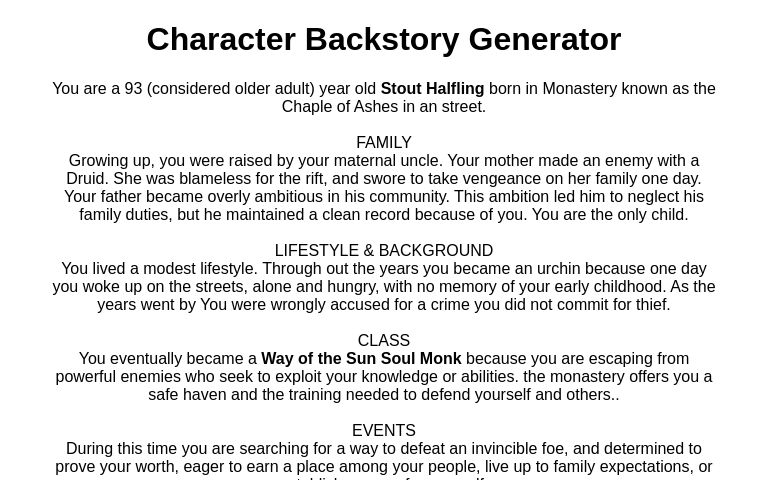
Ask for family, not a single tragic sentence. A strong result names who raised the character, who neglected them, and which feud still has a living enemy. The stout halfling monk example works because the mother’s conflict with a druid, the father’s ambition, and the uncle who did the raising all point at the same wound: proving worth after being left.
Lifestyle, Class Path, and the Event That Changed Course
The generator should connect street years, a false charge of theft, and the monastery that offered both safety and a fighting style. Class is not a hat you put on at level 1. It is the institution, mentor, or desperate bargain that answered a problem the character could not solve alone.
Events the DM Can Schedule
“Searching for a way to defeat an invincible foe” is a campaign spine. “Eager to earn a place among your people” is a social hook. Good lore leaves the GM a list of scenes, not a novel they have to abridge. Incorporating those details into play is a known craft problem; even classic GM advice starts from the idea that backstory only matters if it can show up in the world.
Try a prompt like this:
"Generate character lore for a 93-year-old stout halfling Way of the Sun Soul monk, born in a monastery called the Chapel of Ashes. Include family, the street years, a false accusation, and two campaign hooks a DM can use in the first three sessions."
Or keep it system-agnostic:
"Write a one-page origin for a disgraced court cartographer who now adventures as a lore bard. No dead parents. Give me a living rival, a map that should not exist, and a reason the party should not fully trust them yet."
Related Agents You'll Also Find Useful
If you are also naming the character, Name Generator builds culturally fluent names for people, houses, taverns, and artifacts so the lore and the name come from the same world.
- Linguistic and cultural constraints (Elvish court, dockside cant, monastic orders)
- Names that fit tone: grimdark, fairy-tale, pulpy, or historically grounded
- Batch lists for NPCs you invented in the same backstory
If the character is headed for a script or actual-play series, Film Screenwriter develops arc, dialogue, and visual character work beyond the TTRPG sheet.
- Scene-level wants and wounds
- Dialogue that sounds like this person, not a lore dump
- Structure from concept through revision
If you need a visual bible after the prose is locked, Manga Creator turns that origin into sequential pages with consistent design — useful for character sheets, session-zero handouts, or a short origin comic.
- Panel flow for the “how I got here” montage
- Costume and motif consistency across pages
- One-shots or longer origin chapters
Try Game Designer Assistant free — no credit card required.
How to Generate Character Lore Step by Step
Step 1: Give the Constraints That Matter Share system (or “system-agnostic”), race or ancestry, class or role, age band, tone, and anything you refuse. “No orphans” is a better instruction than “make them interesting.”
"Pathfinder 2e dwarf animator inventor, late 40s, hopeful tone, living parents, one sibling who joined a rival guild. I need lore a GM can hook in chapter 1."
Step 2: Demand Cause and Effect Ask the Game Designer Assistant to connect childhood → lifestyle → class. If the output could fit any class, send it back.
"Rewrite so the class choice is the only sane response to the family conflict. Keep the false accusation. Cut the amnesia."
Step 3: Extract Table-Ready Hooks Do not leave the best ideas buried in paragraph four. Ask for a short list the DM can lift: one ally, one enemy, one location, one secret the character would lie about.
"Turn this origin into four session hooks, each one sentence, tagged ally / enemy / location / secret."
Step 4: Stress-Test Against the Campaign Paste the GM’s premise (heist, west marches, political intrigue) and ask what would break. A monastery-in-hiding backstory may fight a campaign that starts in a royal court — unless you add a reason the monk is there.
"This campaign is a city-politics game with no dungeons for the first six sessions. Adjust the lore so the monk has a civic reason to stay, without deleting the Chapel of Ashes."
Step 5: Lock a Short Version for the Table Keep a long private bible if you want one. Give the table a half page. Ask for a “what the party knows” cut and a “what only I know” cut so you do not spoil your own mystery.
Results & Use Cases
🎲 Session-Zero PC Who Is Not Another Orphan
Scenario: You have a concept — stout halfling, Sun Soul monk, older than the rest of the party — and game night is tomorrow.
Traditional Approach: An hour of random tables, then a generic “raised in a monastery” blurb the DM cannot use.
Game Designer Assistant: A full origin with uncle-as-guardian, a druid feud, a false theft charge, and a monastery that is both school and safehouse.
- Class fantasy and childhood finally match
- The DM gets a living enemy and a place to set a scene
- You arrive at session zero with a character, not a stat block
🎬 Supporting Cast for a Novel or Actual-Play Arc
Scenario: You need three NPCs who feel like they had lives before the protagonists arrived.
Traditional Approach: Recycled mentors and innkeepers with no private motives.
Game Designer Assistant: Each NPC gets a compressed lore file — want, wound, public story, private story. Hand the dialogue pass to Film Screenwriter when you need scenes, not sheets.
- Recurring NPCs stop resetting every episode
- Secrets are scheduled, not improvised into contradiction
- Voice and history stay aligned
📱 NPC Generator on the Train to Game Night
Scenario: Your paladin just asked the name of the dock clerk, and you are on your phone between stops.
Traditional Approach: “Uh, Garrick. He’s… tired.”
This character lore generator: A two-paragraph dock clerk with a smuggling cousin, a debt to the harbormaster, and a reason to help or hinder the party — written on mobile with the same session memory as your desktop notes.
- Full feature parity on web, iOS, and Android
- Speech-to-text if you would rather talk the prompt
- Lore you can paste into a VTT journal before you sit down
📚 Origin Comic or Visual Character Bible
Scenario: You want the party to see the Chapel of Ashes, not only hear about it.
Traditional Approach: A moodboard of unrelated monks and temples.
Manga Creator: Six pages that follow the lore you already approved — street years, accusation, monastery gate, first sun-bolt kata — so the visual identity matches the written one.
- Faster than briefing a separate artist from a messy wiki
- Consistent costume language for later commissions
- A handout that new players will actually read
FAQ
What is a character lore generator?
A character lore generator is a tool that produces origin stories for fictional people — typically ancestry, family, class path, and the events that pushed them onto the road. An AI version, such as Game Designer Assistant, writes those pieces as one causal chain so the result can be used in a TTRPG, novel, or visual story without another round of stitching.
Is Game Designer Assistant free?
Yes. You can use it on the free plan with core features and limited monthly usage. Paid tiers raise usage (Plus is $20/month for 30× the free allowance) if you are generating full party bibles, NPC decks, or setting guides. No credit card is required to start.
How is an AI character lore generator different from random backstory tables?
Tables are outstanding at surprise: planar births, odd sibling counts, a lich’s domain. They do not automatically create motive. The AI approach takes those same ingredients — monastery, urchin years, false accusation — and writes the cause-and-effect so class, family, and hooks point at one person. You can still seed it with table results; you should not stop at the raw rolls.
Can this generate D&D, Pathfinder, and original-world lore?
Yes. Specify the system, or say you want system-agnostic fiction. Name the class (or the role, if you are off-book), the tone, and any lore bible you already have. The more constraints you give — living parents, no isekai amnesia, a city-politics campaign — the less generic the origin.
Does a character lore generator work on mobile?
Yes. The same agent runs on web, iOS, and Android with synced history, so a backstory you started at the desk can be revised on the train. That is the difference between a one-off webpage generator and a partner that remembers the Chapel of Ashes next week.
Will the lore be usable at the table, or just long?
Ask for two cuts: a half-page public version and a bullet list of DM hooks. Long lore that never appears in play is a known problem; even community threads about how elaborate a backstory should be keep circling the same test: can the GM use it? If a paragraph cannot become a scene, send it back.
Generate Character Lore Your Table Will Remember
Blank pages and disconnected d100 results still produce the same three tragedies. A dedicated character lore generator does the harder job: family that explains the class, events that explain the vow, and hooks a dungeon master can schedule.
Try Game Designer Assistant with the next PC, NPC, or rival you would otherwise improvise. Pair it with Name Generator when the origin is solid but the name is not. Explore more at Jenova.
For Developers: Game Designer Assistant is available programmatically via the Jenova API — integrate character lore generation into your application with a single API call. Full documentation →